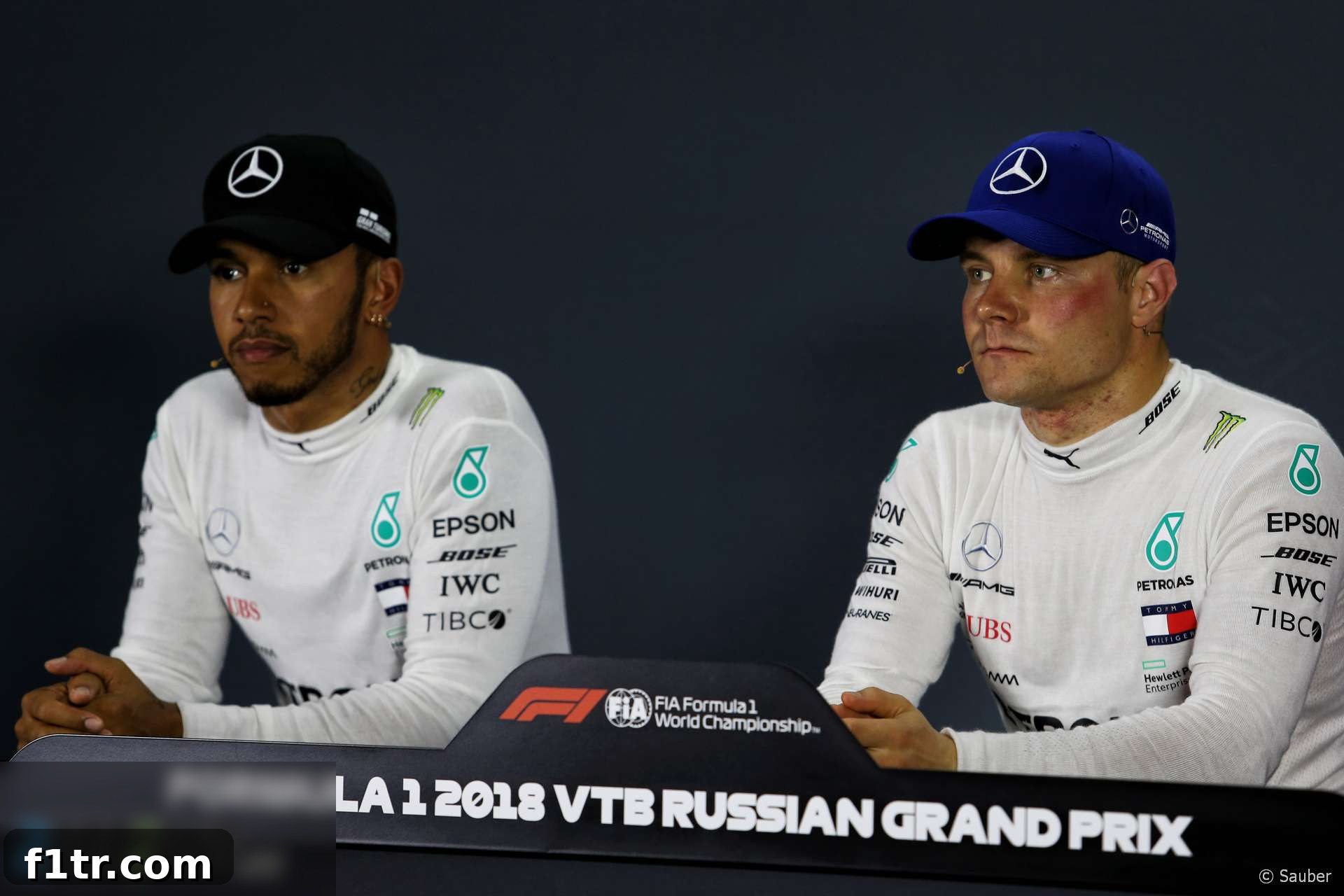
Mercedes Faces Difficult Team Order Decision for Russian Grand Prix Amidst Championship Battle
As the Formula 1 season intensified, the Mercedes-AMG Petronas F1 Team found itself at a critical juncture ahead of the Russian Grand Prix. The team leadership, spearheaded by Toto Wolff, was poised for crucial discussions regarding the potential implementation of team orders for its drivers, Lewis Hamilton and Valtteri Bottas. These sensitive talks were not just about race strategy, but also about managing the delicate balance of championship aspirations and individual driver ambitions, especially concerning the approach to the treacherous first corner of the Sochi Autodrom.
The Sochi Showdown: A Strategic Imperative
The stage was set for a thrilling Sunday race in Sochi, with Valtteri Bottas having secured a strong qualifying position, starting ahead of his championship-leading teammate, Lewis Hamilton. Directly behind Hamilton on the grid was his closest title rival, Sebastian Vettel of Ferrari, intensifying the pressure on the silver arrows. The particular challenge of the Sochi Autodrom lies in its exceptionally long run from the starting grid to the first braking zone. This extensive stretch offers ample opportunity for slipstreaming and rapid acceleration, potentially leaving the Mercedes duo vulnerable to the aggressive Ferrari challenge lurking behind them. The dynamics of this initial phase of the race made the discussions about team orders not just a possibility, but a strategic imperative.
The decision to even consider team orders, a contentious topic in Formula 1, underscored the high stakes of the Russian Grand Prix. With championship points at a premium, Mercedes had to weigh the benefits of individual driver freedom against the overarching goal of securing constructors’ and drivers’ titles. The qualifying results placed Bottas in a prime position, but also in a potentially sacrificial role, depending on the outcome of the team’s strategic summit. This internal dilemma within Mercedes highlighted the brutal reality of elite motorsport, where personal glory often clashes with collective success.
Toto Wolff’s Candid Assessment: Balancing Sportsmanship and Strategy
Following a tense qualifying session, Mercedes Team Principal Toto Wolff addressed the media, including RaceFans, confirming that an extensive meeting was scheduled for Sunday morning. This meeting would involve both Mercedes drivers, senior management, and key engineering personnel, all gathered to forge a unified approach to the race. Wolff’s statements revealed the inherent conflict within his philosophy: a deep-seated appreciation for pure racing but a clear understanding of the need for strategic calculation at this critical juncture of the season.
“We are not in a part of the season where I would particularly enjoy the Mercedes racing each other at the front,” Wolff admitted with a hint of reluctance. His words encapsulated the dilemma faced by any team principal leading a dominant outfit. While the ideal scenario involves fair and uninhibited competition between teammates, the harsh realities of a championship battle often dictate a more pragmatic approach. “As much as I hate to say it as a race fan, you need to calculate a little bit more at that stage,” he added, highlighting the professional responsibility that often overrides personal desires for sporting spectacle. This sentiment from Wolff was not just a passing comment; it reflected a deliberate and painful shift in mindset, acknowledging that the pursuit of ultimate victory sometimes requires making unpopular decisions that prioritize the team’s championship ambitions above all else.
The championship landscape further complicated matters. Lewis Hamilton entered the Russian Grand Prix with a substantial 110-point lead over his teammate, Valtteri Bottas. With a maximum of 150 points still available in the remaining races, the Russian Grand Prix held the potential for Bottas to mathematically drop out of championship contention. This specific scenario added immense pressure to the team’s strategic discussions. If Bottas were to secure a win and Hamilton struggle, it could keep the slender hope alive for the Finn, but if the positions were reversed or if Bottas was asked to concede, it would likely cement Hamilton’s path to the title. Wolff openly conceded that Hamilton, a fierce competitor, would naturally prefer to avoid resorting to team orders, valuing victories earned purely on merit.
Driver Perspectives: Ambition Versus Team Mandate
The prospect of team orders, as Wolff acknowledged, is never a popular one, particularly for the drivers involved. “None of us actually likes it because we have seen it in the past from other teams and we have had that discussion between Nico [Rosberg] and Lewis,” Wolff explained. This reference to the intense Hamilton-Rosberg rivalry, often characterized by its lack of team interventions, highlighted Mercedes’ historical preference for allowing their drivers to race freely. However, the current championship situation clearly necessitated a re-evaluation of this philosophy.
Lewis Hamilton, a multiple world champion, epitomizes the spirit of racing on his own terms. His desire to win without external assistance is well-documented and deeply ingrained in his competitive DNA. For Hamilton, a victory achieved through team orders might feel less satisfying than one earned by purely outperforming his rivals. On the other side of the garage, Valtteri Bottas was in desperate need of a win. Despite consistent performances, the Finn had not yet secured a victory that season, a fact that surely weighed heavily on him. For Bottas, relinquishing a potential race win due to team orders would be a particularly bitter pill to swallow, potentially impacting his morale and future standing within the team. Wolff perfectly captured this delicate balance: “Lewis wouldn’t want it because he wants to go on his own and Valtteri doesn’t want it because he needs that win that he didn’t have this year.”
The tension within the team was palpable, a microcosm of the larger debate surrounding team orders in Formula 1. On one hand, the integrity of the sport demands fair competition; on the other, a team’s primary objective is to maximize its championship points. This internal conflict placed an enormous burden on the leadership to navigate the situation with sensitivity and strategic acumen. The forthcoming meeting was therefore not just about issuing directives but about fostering understanding and achieving “buy-in” from both drivers, a crucial element for maintaining team cohesion and morale.
The Crucial First Corner: A Detailed Strategic Discussion
When pressed specifically on whether the discussions would delve into detailed tactics for the critical first corner of the race, Wolff’s response was affirmative: “Yes, probably. We’ll discuss it in the morning how we kind of see that.” This confirmed the granular level of strategic planning that Mercedes was undertaking. The long run to Turn 1 at Sochi is notoriously challenging, and past races have seen numerous incidents and overtakes during this phase. The specific vulnerabilities of the Mercedes cars to the Ferraris, particularly if they could utilize a slipstream effectively, made this opening sequence a paramount concern.
A poorly managed first corner could undo all the team’s qualifying efforts, potentially leading to contact, loss of positions, or even race retirement. Therefore, the discussions would likely cover various scenarios: how each driver should position their car, braking points, defending lines, and crucially, how they should react if a Ferrari attempts an aggressive move. The goal would be to minimize risk while maximizing the team’s collective advantage. This could involve a pre-arranged agreement on who takes the lead, or perhaps a clear directive for one driver to defend aggressively against the Ferraris, allowing the other to pull away. Such detailed planning demonstrates the level of precision required at the pinnacle of motorsport, where split-second decisions on track are often the culmination of hours of strategic foresight.
Historical Context: The Shadow of Past Team Order Controversies
The reluctance expressed by Toto Wolff regarding team orders is deeply rooted in the contentious history of such directives in Formula 1. Throughout the sport’s rich past, instances of team orders have often sparked intense debate among fans, media, and even within the racing fraternity. Iconic examples, such as Ferrari’s “let Michael pass for the championship” instruction to Rubens Barrichello at the 2002 Austrian Grand Prix, or the infamous “Fernando is faster than you” radio message to Felipe Massa in Hockenheim in 2010, have left an indelible mark on F1 lore. These moments, while often strategically sound for the team, frequently draw criticism for undermining the sporting integrity and the spectacle of head-to-head racing.
Mercedes, having experienced the fierce but fair rivalry between Lewis Hamilton and Nico Rosberg for multiple seasons, had largely prided itself on allowing its drivers to compete freely. This philosophy earned them respect but also presented significant challenges, as evidenced by the occasional on-track clashes between their drivers. The current contemplation of team orders, therefore, marked a departure from their usual approach, underscoring the extraordinary pressure of the championship battle. Wolff’s reference to the “hate” he feels as a race fan when considering such actions highlights the internal struggle to balance the raw passion for racing with the cold, hard logic of championship mathematics. The memory of past controversies serves as a cautionary tale, compelling Mercedes to approach this decision with utmost care, aiming to achieve their goals while minimizing the negative repercussions on their public image and internal harmony.
Beyond Turn 1: Broader Race Strategy Implications
While the first corner naturally dominated the initial discussions, the strategic meeting would undoubtedly extend to broader race implications. A Formula 1 Grand Prix is a complex tapestry of strategy, where decisions regarding tire management, pit stop timing, and defensive or offensive maneuvers against rivals are crucial. Team orders might not be limited to simply switching positions at the start; they could manifest in more subtle ways throughout the race. For instance, one driver might be instructed to push hard early to create a gap, while the other manages tires more conservatively. Alternatively, in the event of an unexpected safety car or VSC, strategy calls could be made that overtly favor one driver over the other based on championship standing.
The threat from Ferrari, with Sebastian Vettel in close proximity to Hamilton, meant that Mercedes also had to consider a collective defense strategy. This could involve one Mercedes car actively “covering” Vettel, even if it compromised its own race pace, to protect Hamilton’s position. Such tactical decisions, while less overt than a direct position swap, are still forms of team orders designed to optimize the team’s overall championship outcome. The discussions would therefore be multifaceted, encompassing various race scenarios and contingency plans to ensure Mercedes leaves Sochi with the maximum possible points, regardless of how the individual race plays out for Hamilton and Bottas.
The Verdict and Its Aftermath: A Defining Moment for Mercedes
The morning meeting before the Russian Grand Prix was set to be a defining moment for Mercedes, one that could significantly influence the trajectory of the championship. The outcome of these discussions, whether they resulted in explicit team orders or a more nuanced strategic alignment, would send a clear message about the team’s priorities. Achieving “buy-in” from both drivers was paramount, as dissent or resentment could destabilize the harmonious working environment that Mercedes had carefully cultivated. A unified front, even under controversial circumstances, was essential for the team’s continued success.
Ultimately, the decision would reflect the balance Mercedes chose to strike between pure sporting competition and strategic championship management. While the concept of team orders often elicits a mixed reaction from fans – some viewing it as a necessary evil for team success, others as an affront to fair play – for Mercedes, the calculation was clear. With the championship nearing its climax, the team had to make a choice that maximized their chances of securing both titles. The Russian Grand Prix was not just another race; it was a strategic battleground where the future of the championship could be decisively shaped by the directives issued from the Mercedes pit wall.
The immense pressure on Toto Wolff and his team was undeniable. The decision, whatever its form, would carry significant weight, impacting driver morale, public perception, and most importantly, the ultimate outcome of the Formula 1 season. As the engines roared to life in Sochi, the world would be watching not just the battle on track, but also the strategic chess match unfolding within the Mercedes garage.