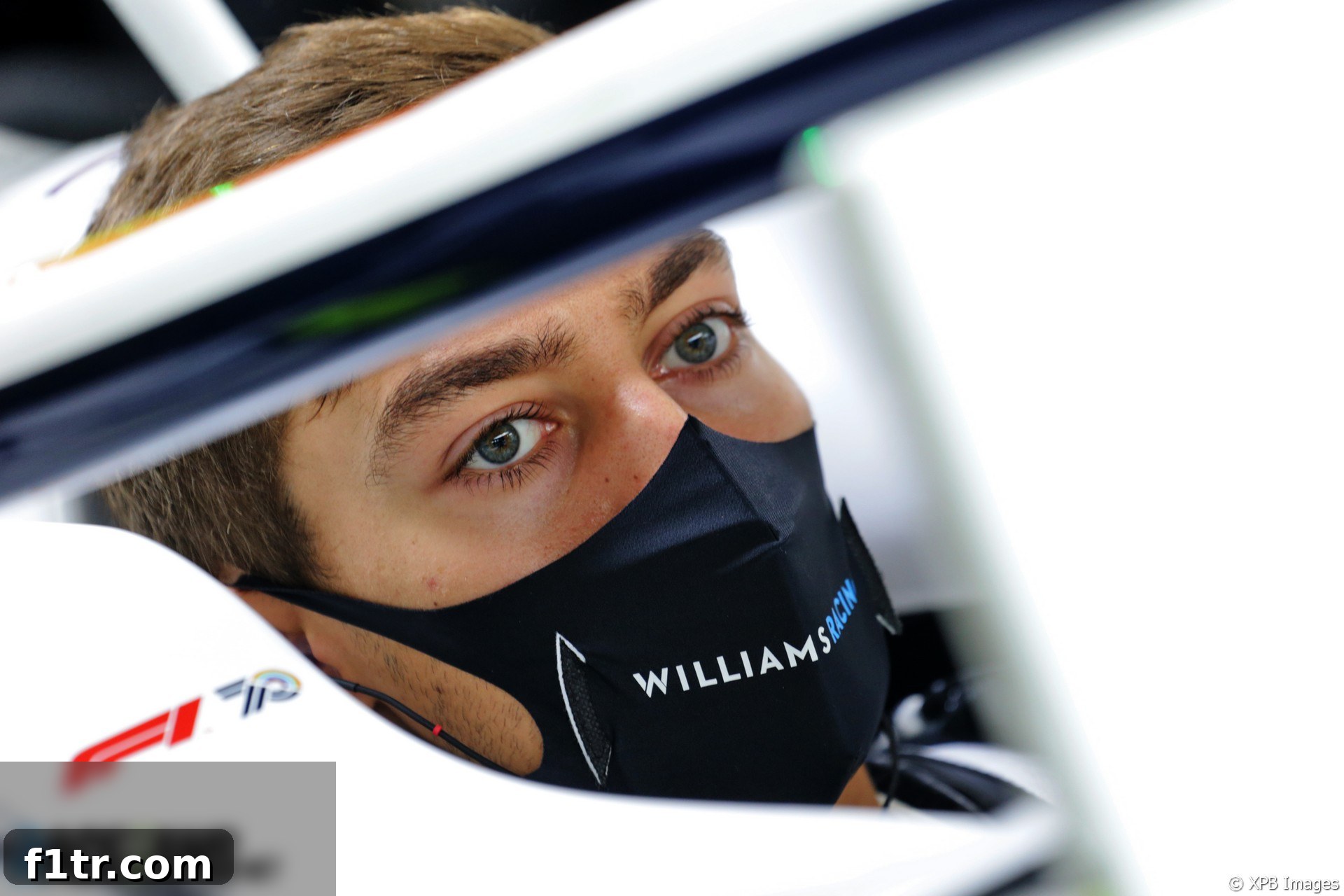
George Russell’s Quest for a Level Playing Field in Formula 1
George Russell, a name synonymous with prodigious talent in the junior racing categories, has openly shared his profound frustration at being unable to truly demonstrate his exceptional abilities alongside the sport’s most heralded young stars, such as Charles Leclerc and Max Verstappen. His journey to Formula 1 was paved with back-to-back championship triumphs in GP3 (now Formula 3) and Formula 2, a testament to his raw speed and strategic acumen. Yet, since making his grand prix debut at the start of last year, Russell has found himself trapped in a paradoxical situation: he has never been out-qualified by a teammate, a remarkable achievement in itself, but the uncompetitive nature of his Williams car has simultaneously prevented him from scoring a single championship point. This dichotomy highlights a critical challenge many talented drivers face in a sport where equipment can often overshadow raw skill.
Unlocking Untapped Potential: George Russell’s F1 Dilemma
The core of Russell’s sentiment revolves around the desire for a fair and even playing field, a fundamental aspiration for any elite competitor. “Obviously as a driver you want to prove what you can do on an even and fair ground,” Russell articulated in response to inquiries. He vividly illustrates this point with an analogy: “In any sport – if you are racing in the Tour de France and one guy has got a superior bike or a bike that has got an electric motor or something like that, you might be the best cyclist in the world but you won’t be able to compete with them.” This powerful metaphor succinctly captures the essence of his predicament. Despite his undeniable prowess, the inherent performance disparity in Formula 1 machinery means that the ultimate demonstration of a driver’s capability is often curtailed by the tools at their disposal. There is, as he admits, “definitely an element of frustration,” yet he acknowledges this as an intrinsic part of Formula 1’s historical fabric: “Ultimately I think that is part of what Formula 1 is. There’s always been fast cars, there’s always been slower cars.” This acceptance, however, does not diminish his longing for a chance to fight for positions reflective of his true talent.
A Champion’s Frustration: Junior Dominance vs. F1 Reality
Russell’s path to Formula 1 was nothing short of spectacular, marked by a consistent display of dominance. His championship wins in GP3 in 2017 and Formula 2 in 2018 against strong opposition underlined his readiness for the pinnacle of motorsport. These junior categories are often considered purer tests of driver skill, with more standardized equipment ensuring closer competition. Transitioning to F1, however, exposed him to the stark reality of the sport’s pecking order. The Williams Racing team, a historic constructor with a rich legacy, has, in recent years, fallen to the back of the grid due to various financial and technical challenges. For a driver of Russell’s caliber, consistently outperforming his teammates but finishing far outside the points-paying positions can be a mentally taxing experience. His immaculate qualifying record against experienced F1 campaigners underscores his speed and consistency, suggesting that if provided with a more competitive car, he could easily be challenging the established midfield, or even higher, mirroring the early career trajectories of talents like Leclerc and Verstappen who quickly found themselves in top-tier machinery.
Navigating the Straits of Struggle: Williams’ Recent History
The struggles of Williams Racing are well-documented. Once a dominant force in Formula 1, the team experienced a significant decline in competitiveness and financial stability over the past decade. This downturn culminated in challenging seasons where scoring points became an increasingly rare occurrence. Operating on a significantly smaller budget than many of their rivals, Williams faced an uphill battle in the fiercely competitive world of F1 development. The ripple effect of these financial constraints was evident in the car’s performance, which consistently lagged behind the rest of the grid. This environment, while providing invaluable experience in battling against the odds and extracting maximum performance from limited machinery, is inherently limiting for a driver aiming to showcase their full potential. Russell’s tenure at Williams has, therefore, been a masterclass in driving an uncompetitive car with dignity and consistent effort, earning him widespread admiration but few tangible results in terms of championship points.
The Dawning of a New Era: F1’s Transformative Regulations
A beacon of hope for Russell and many in the F1 paddock lies in the upcoming regulatory changes. Formula 1 is on the cusp of a significant overhaul, with new financial and technical regulations set to reshape the competitive landscape. While Russell temper his expectations for immediate change, stating, “Unfortunately I think 2021 will be more of the same,” his gaze is firmly fixed on the horizon beyond. He expresses a collective hope: “I hope, and I think everybody hopes, come 2022 with the new financial regulations, the new technical regulations, it’ll bring the whole field closer together.” The 2022 technical regulations are designed to promote closer racing by simplifying aerodynamics and making cars less sensitive to turbulent air, thereby allowing drivers to follow each other more closely. Crucially, the introduction of a stringent budget cap aims to level the financial playing field, preventing the wealthiest teams from outspending their rivals indefinitely. This combination of rule changes is anticipated to significantly reduce the performance gap between the top teams and the rest of the grid, fostering a more meritocratic environment where driver skill can shine brighter. “Hopefully it puts the driver literally in the driving seat to be able to make or break the weekend and I think everybody’s looking forward to that,” Russell added, encapsulating the sentiment that many share for a future where driver talent dictates more of the outcome.
A Fresh Start: Dorilton Capital’s Vision for Williams Racing
A pivotal development in Williams’ recent history was the acquisition of the team by new owners, Dorilton Capital, earlier this year. This change in ownership brought much-needed financial injection and a renewed sense of optimism to the historic British outfit. Russell anticipates that the benefits of this significant investment will begin to materialize as early as next year, with a more substantial impact expected in the long term. “We’ve not lost sight of 2020 yet and we haven’t lost sight of 2021 either,” he affirmed, highlighting the team’s ongoing commitment to immediate improvements while simultaneously laying foundations for the future. He expressed genuine excitement about the new era: “I think now with the new owners it’s really exciting with more finance behind us to be able to focus into the future for 2022 and beyond but also keep a good eye on 2021 to continue to progress the car.” This strategic balancing act involves continuing to develop the current and immediate future cars while dedicating significant resources to the radical new regulations of 2022. The increased financial backing from Dorilton Capital is crucial for Williams to not only survive but to thrive, allowing them to invest in infrastructure, talent, and car development necessary to claw their way back up the grid.
The Road Ahead: Balancing Immediate Progress with Long-Term Ambitions
The challenge for Williams under its new ownership and with George Russell at the helm is to navigate the delicate balance between short-term improvements and long-term strategic goals. While the immediate focus remains on maximizing performance from the current machinery and preparing for the transitional 2021 season, the ultimate objective is to capitalize on the 2022 regulation changes. Russell’s comments reflect this duality: “That’s exciting for us and hopefully we can make a step to cement our place ahead of Haas and Alfa Romeo and try and catch onto the back of the midfield.” This statement reveals a clear roadmap: first, to establish themselves firmly ahead of their closest competitors, and then to bridge the gap to the lower end of the highly competitive midfield. This ambition requires sustained investment, intelligent development, and a steadfast belief in their engineering capabilities. For Russell, these incremental gains are vital, not just for the team’s morale but also for his own career progression, demonstrating that he can lead a team forward and contribute to tangible performance improvements.
Ascending the Ranks: Williams’ Battle for Midfield Prominence
The prospect of joining the midfield battle is a significant step for Williams. The midfield in Formula 1 is often the most intense and unpredictable part of the grid, with multiple teams and drivers vying for every point. Successfully cementing their place ahead of rivals like Haas and Alfa Romeo would represent a substantial achievement and provide a crucial platform for further growth. For George Russell, competing consistently in the midfield would finally offer him the opportunity to showcase his racecraft, strategy execution, and consistent pace against a broader spectrum of drivers and machinery. It would allow him to engage in meaningful on-track battles, hone his skills in competitive scenarios, and demonstrate his ability to score points regularly. This renewed competitiveness would not only elevate Williams’ standing in the constructors’ championship but also significantly boost Russell’s stock as one of F1’s most promising talents, positioning him for future opportunities at the sport’s front-running teams. The broader impact on Formula 1 would be a more exciting and unpredictable championship, aligning perfectly with the sport’s vision for a more level playing field.
A Driver’s Dream and a Team’s Revival: Hope for Williams and George Russell
In conclusion, George Russell’s journey in Formula 1 is a compelling narrative of immense talent grappling with challenging circumstances. His frustration at not being able to fully express his capabilities alongside peers like Max Verstappen and Charles Leclerc is entirely understandable, given his stellar junior career record and consistent out-performance of his F1 teammates. However, the horizon is bright with the promise of transformative regulations in 2022 and the renewed financial backing of Dorilton Capital. These changes offer a genuine chance for Williams Racing to climb back up the grid, to once again compete for points and, eventually, for podiums. For Russell, this represents not just a career opportunity but the fulfillment of a driving dream: to compete on an even footing, where his skill and dedication can truly make the difference. The collective anticipation for a more competitive, driver-centric Formula 1 signals an exciting new chapter for the sport, with George Russell poised to be a central figure in Williams’ potential resurgence.