F1’s Bouncing Battle: Mercedes’ Porpoising Ordeal and the Quest for Stability
The 2022 Formula 1 season ushered in a new era of technical regulations, bringing with it a radical redesign of the cars centered around ground effect aerodynamics. While intended to promote closer racing and provide a more level playing field, these changes inadvertently reintroduced a phenomenon largely unseen in F1 for decades: porpoising. This severe aerodynamic bouncing, which causes cars to oscillate violently at high speeds, has plagued several teams, none more prominently than Mercedes, whose star drivers Lewis Hamilton and George Russell have endured significant physical discomfort and notable performance setbacks.
Understanding Porpoising: The Ground Effect Phenomenon Explained
Porpoising is an aerodynamic instability directly linked to the ground effect concept. It occurs when the intense downforce generated by a car’s underbody, designed to suck it closer to the track surface, becomes unstable. As the car gets closer to the ground, the downforce increases exponentially, pulling it even further down. However, at a critical point, the airflow underneath the car can ‘stall’ or separate, leading to a sudden and drastic loss of downforce. This causes the car to rise slightly, re-engaging the airflow, and the downforce returns, pulling it back down with force. This rapid, cyclical process repeats itself, creating a severe and often violent bouncing motion that strikingly resembles a porpoise leaping in and out of the water – hence the descriptive name.
The 2022 regulations mandated larger underbody tunnels and simplified top-body aerodynamics, making ground effect the primary source of downforce. While highly efficient in theory, this design is also inherently more sensitive to ride height and airflow stability. This sensitivity, combined with the extreme stiffness required for optimal aerodynamic performance, has brought porpoising back into the F1 lexicon as a critical engineering and driver welfare challenge.
Mercedes’ Torment: Hamilton and Russell Endure Unprecedented Discomfort
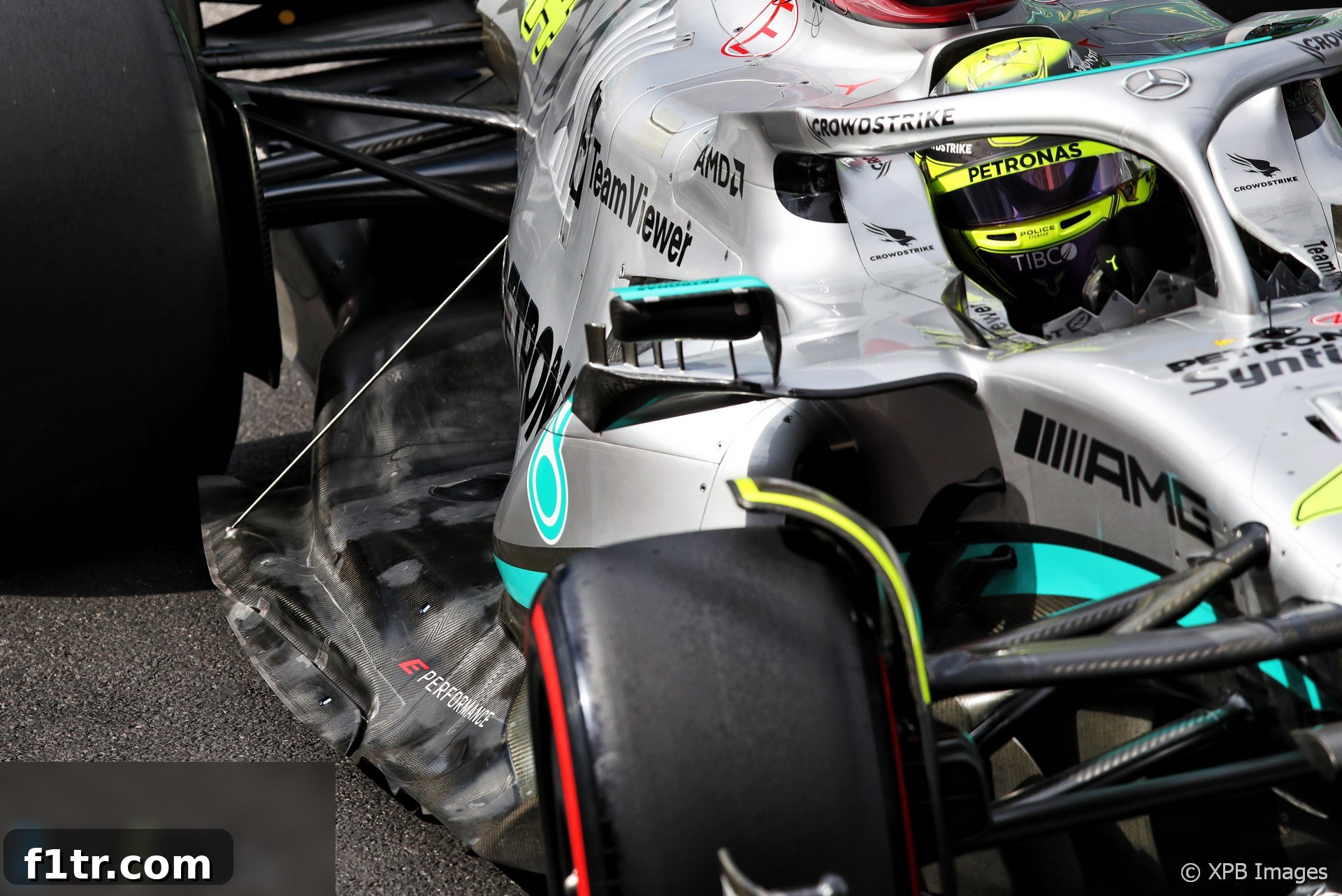
The Mercedes-AMG F1 W13 E Performance has arguably been the car most visibly and severely affected by porpoising throughout the season. Both seven-time world champion Lewis Hamilton and his highly-rated young teammate George Russell have openly spoken about the excruciating physical toll of driving their bouncing machine at speeds exceeding 300 km/h. The intensity of the W13’s porpoising has reached a point where, as Mercedes Team Principal Toto Wolff revealed, even the team’s highly skilled physiotherapists are often unable to alleviate the deep-seated pain and soreness their drivers experience after race weekends.
Russell, in particular, has been a vocal advocate for driver safety, repeatedly warning that the levels of porpoising he has experienced are simply unsustainable in the long term. He reported experiencing chest pains after the Emilia Romagna Grand Prix and emphasized that the chronic health implications for drivers needed to be seriously addressed. Hamilton, too, has frequently expressed his agony, notably after the Azerbaijan Grand Prix, where he described himself as being “a bit sore” and in considerable pain following 46 punishing laps around the high-speed Baku street circuit.
Baku’s Bumps Exacerbate the Problem for Many
The Baku City Circuit, known for its exceptionally long straights, high speeds, and undulating surface, proved to be a particularly brutal test for cars prone to porpoising. The unique combination of extreme velocities and inherent track imperfections amplified the bouncing, forcing teams like Mercedes to make difficult setup compromises. They often had to run their cars even stiffer and lower to try and control the aerodynamics, a strategy that frequently led to the car “bottoming out” – hitting the track surface with its floor. This bottoming out further destabilizes the delicate aerodynamic balance, significantly affecting straight-line speed, braking stability, and overall cornering performance.
Mercedes Team Principal Toto Wolff starkly highlighted the significant performance deficit witnessed in Baku: “We are facing the same issues when the car is not quick, and that is that we have porpoising. Others like Ferrari have it too, here even a bit worse at different places of the track. We are bottoming out badly, which affects our aerodynamics and affects our straight-line speed greatly. As a consequence, the ride is not very good, and this can cost several tenths. Yesterday we were losing a second on all straights to Ferrari and Red Bull.” Such a substantial loss on the most critical parts of the circuit makes competing at the front virtually an impossible task.
Ferrari’s Approach: Learning to Live with the Bounce
While Mercedes grapples openly with its porpoising crisis, other front-running teams like Ferrari have shown signs of better management and adaptation. Ferrari Team Principal Mattia Binotto acknowledged that his cars also experience bouncing, particularly noticeable in practice sessions. However, he maintained that the Scuderia had made significant strides in mitigating the issue since introducing updates to their F1-75 challenger at the Spanish Grand Prix.
“Yesterday we were certainly bouncing and bottoming,” Binotto stated, referring to the Baku practice sessions. “I think that is the consequence of the fact that we are going softer and softer, lower and lower. It’s great to see that the car maybe can afford it without losing too much performance both on the straight and on the corners. It’s always a compromise.”
Binotto’s comments suggest that Ferrari has found a more effective balance, allowing them to run their cars aggressively low for maximum ground effect without the debilitating performance losses and severe physical side effects experienced by their rivals at Mercedes. He expressed a pragmatic optimism about future improvements, indicating that while porpoising might be present in their car, it is not currently a limiting factor to their overall performance, unlike for some of their competitors.
The Broader Debate: F1 Regulations and Driver Safety
The resurgence of porpoising has ignited a broader and increasingly urgent discussion within Formula 1 regarding the very nature of the technical regulations and their direct impact on driver health and long-term safety. The fundamental question posed by many stakeholders, from drivers to team principals, is whether the new rules have inadvertently created a generation of cars that are simply too uncomfortable, and potentially dangerous, to drive over a full, demanding season.
Mattia Binotto, however, offers a contrasting perspective, suggesting that the situation is manageable. “Overall, if we judge Formula 1, I don’t think they are less comfortable cars to drive in terms of formula motorsport,” he argued. “I think that it’s a challenge for the drivers, no doubt, but still I think those cars are quite comfortable to drive.” He views porpoising primarily as a complex technical challenge that teams are fully capable of solving through innovative engineering, much like many other hurdles in F1’s rich history.
This perspective, however, stands in stark contrast to the growing concerns raised by drivers like Russell and team principals like Wolff, who have hinted at the potential need for intervention from the FIA (Fédération Internationale de l’Automobile), F1’s governing body, if the issue persists and driver well-being remains demonstrably at risk. The FIA has a paramount responsibility for safety, and if accumulating medical evidence suggests long-term damage or chronic injury from sustained high-frequency vibrations and impacts, adjustments to the regulations or mandatory technical directives could become necessary to safeguard the athletes.
The Path Forward: Engineering Solutions and Compromises
For teams like Mercedes, the immediate future involves intensive research and development to fully understand and effectively eliminate porpoising without sacrificing performance. This includes exploring a wide array of setup changes, significant aerodynamic modifications, and sophisticated suspension adjustments. The core challenge lies in finding a comprehensive solution that eradicates the bouncing phenomenon while preserving and even enhancing the inherent speed-generating capabilities of their ground effect concept.
The fact that some teams appear to have found engineering solutions, or developed a more optimal aerodynamic package that makes their cars significantly less susceptible to the phenomenon, highlights the complex nature of the problem. This disparity has naturally led to questions about whether fundamental design philosophies, specific technological advancements, or simply a better understanding of the new regulations are giving certain teams a crucial advantage in managing this unique challenge.
Binotto’s confidence in finding solutions in the mid-to-long term reflects the resilient and innovative engineering spirit embedded within Formula 1. The sport has always thrived on evolution, constantly adapting to new technical challenges and pushing the boundaries of automotive engineering. However, the unique physiological impact of porpoising adds an entirely new dimension to this process, placing driver welfare and health at the absolute forefront of the solution-finding process. The ultimate goal remains to create cars that are not only incredibly fast, technologically advanced, and exciting to watch, but also fundamentally safe and sustainable for the elite athletes who push them to their absolute limits week after week.
Related Articles: 2022 Azerbaijan Grand Prix
- FIA should black-flag cars if their porpoising endangers drivers’ safety – Horner
- Transcript: Why Norris reluctantly complied with McLaren’s Baku team orders
- Montreal is “going to hurt” in stiff 2022 cars say drivers hoping for bouncing fix
- Leclerc was heading to a ‘comfortable win’ before retirement – Ferrari
- F1 should penalise those who ‘obviously’ slow on purpose in qualifying – Norris
Browse all 2022 Azerbaijan Grand Prix articles