Advert | Become a Supporter & go ad-free
Sebastian Vettel’s Troubled Return: An Australian Grand Prix to Forget
The 2022 Formula 1 season opener in Australia marked a highly anticipated return for four-time world champion Sebastian Vettel. After missing the first two races due to contracting Covid-19, expectations were mixed regarding his immediate performance. While he had participated in a shakedown and two pre-season tests with Aston Martin’s AMR22, the lack of actual race mileage was a significant question mark. Despite his confidence that his experience would quickly bring him back up to speed, what unfolded at Albert Park was a weekend riddled with misfortune, ultimately leading to a premature exit and leaving little room for celebration for the German driver.
Before practice commenced on Friday, Vettel expressed optimism about his readiness. “We had a decent test, we had more tests than last year in a way,” he stated, reflecting on his pre-season preparations. “It’s not too long ago, but for sure I missed the race rhythm. It’s obviously a disadvantage not to have had those two races and race with these cars but I think it will be okay. I’ve done this before, so should be okay.” His words conveyed a seasoned professional’s belief in his ability to adapt, a sentiment shared by many who watched his illustrious career unfold. However, the unique challenges of the new technical regulations and a car that proved tricky would soon test this confidence.
Friday’s Frustrations: A Practice Plagued by Technical Woes and Peculiar Incidents
Vettel’s return quickly descended into a series of unfortunate events, beginning almost immediately on Friday. His first practice session was cut short due to a power unit failure, which severely limited his track time. He completed a mere 18 laps before his AMR22 ground to a halt, forcing him to miss the entire second practice session. This critical loss of mileage meant he couldn’t gather essential data or fully acclimatize to the newly reconfigured Albert Park circuit, a significant handicap for any driver, let alone one returning after a forced absence.
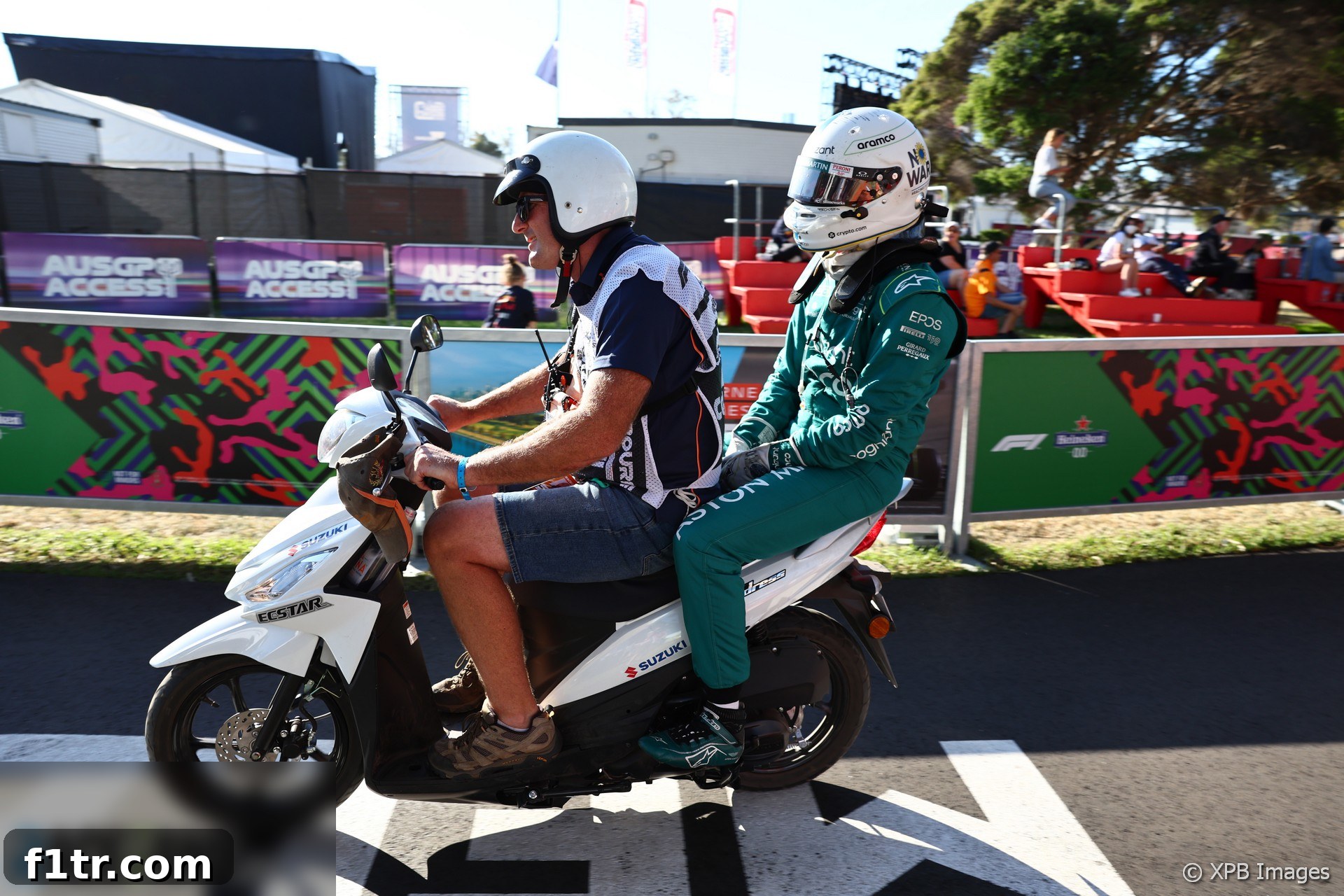
Adding to the bizarre turn of events, Vettel found himself in hot water with the stewards. Following his power unit failure, he was seen riding a moped onto the track to return to the pits. While seemingly an innocuous attempt to navigate the circuit efficiently, this action violated safety regulations, resulting in a fine from the FIA stewards. This unusual incident only served to underscore the chaos that had already begun to define his Australian Grand Prix weekend, painting a picture of a driver and team already under immense pressure.
Saturday’s Setbacks: Qualifying Chaos and Controversial DRS Changes
The difficulties escalated significantly on Saturday. The Aston Martin team was already grappling with the inherent balance issues of their AMR22. However, an eleventh-hour decision by the FIA to remove one of the four DRS zones, confirmed just before final practice, added another layer of complexity. This unexpected change had profound implications for aerodynamic setup, forcing teams to hastily re-evaluate their configurations. The removal of a DRS zone, typically used to aid overtaking, was a critical factor in how cars behaved on track, particularly affecting stability and potential for “porpoising” – the aerodynamic bouncing seen in the new generation of F1 cars.
Aston Martin team principal Mike Krack voiced the team’s frustration. “The frustrating bit was that we were notified quite late about the whole difference,” he explained. “There is a big implication of this because as soon as you remove the DRS zone there we were concerned that we would run into more oscillation issues.” This late notification undoubtedly threw a spanner into their weekend plans, compounding the existing challenges with the car. Krack noted that Aston Martin wasn’t alone in this predicament, observing a similar impact on other teams. “You could see it also with other cars. I think the interesting bit was there was nobody running in the first 15 minutes of free practice three. So there was a lot of people who had a bit of work to do.” This collective hesitancy demonstrated the widespread confusion and necessary last-minute adjustments across the paddock.
Vettel’s Saturday took an even more dramatic turn when he managed only a handful of out-laps before crashing heavily during FP3. This incident put his participation in qualifying in serious doubt. Adding to Aston Martin’s woes, his teammate Lance Stroll also hit the wall, further stretching the resources of the beleaguered mechanics. In a strange twist of fate, Vettel was only able to join qualifying after Stroll’s repaired car was involved in a subsequent crash during Q1, triggering a lengthy red flag period. This stoppage provided Vettel’s mechanics with just enough time to complete their frantic rebuild, allowing him to squeeze in a qualifying run. Despite their best efforts, he could only manage 17th on the grid, a testament to the turbulent preparation and the car’s inherent struggles.
Advert | Become a RaceFans supporter andgo ad-free
Race Day Debacle: An Early Exit and Mounting Disappointment
Race day offered Vettel a glimmer of hope: an opportunity to log significant laps in the AMR22 and potentially salvage some pride from the disastrous weekend. Starting from near the back, he opted for hard tyres, a strategic choice that Alexander Albon later demonstrated could yield positive results, but one that Carlos Sainz Jnr also showed was tricky to manage, particularly in getting them up to optimal temperature.
The race offered little reprieve. On lap nine, shortly after the first restart, Vettel fell victim to the cold hard tyres and the challenging conditions, ploughing into the gravel at Turn 11 and dropping to last place. “Sorry for that,” he relayed to his team over the radio, the disappointment evident in his tone. His race engineer, Chris Cronin, provided crucial context: “That was a big tailwind there Sebastian, bigger than the previous lap, 30kph tailwind.” This explanation hinted at the delicate balance and sensitivity of the new generation cars, where even subtle environmental factors could profoundly impact handling.
As he pushed to recover and close the gap to his teammate and the rest of the tail-enders, Vettel continued to struggle with the car’s characteristics. He reported that the AMR22 felt “a bit on the nose through the high-speed, understeer medium-speed,” indicating a challenging and inconsistent balance that made it difficult to push with confidence. By lap 22, drivers ahead were beginning their pit stops and emerging directly into Vettel’s mirrors. Alexander Albon, who would impressively go on to score a point, was just two seconds ahead. However, Vettel’s afternoon was destined for an early conclusion.
On lap 23, his race came to an abrupt end. Running fractionally wide at Turn 4, he lost control of his car on the exit kerb, sending him careening into the barrier on the inside of the track. The utter dejection in his voice as he prepared to climb out of his wrecked car spoke volumes, encapsulating the entire weekend’s frustration and futility. It was a disheartening end to a comeback that had promised much but delivered only adversity.
A Career Under Scrutiny: Contextualizing Vettel’s Melbourne Misfortune
Sebastian Vettel has navigated some genuinely tricky periods in recent years. His final season at Ferrari was marred by a growing number of unforced errors and a noticeable dip in confidence, leading to his eventual departure. His inaugural season with Aston Martin in 2021 began unpromisingly but saw a significant improvement, culminating in a second-place finish in Baku and another on-the-road podium in Hungary, which he controversially lost due to a technical infringement. These glimmers of past brilliance offered hope for 2022.
Advert | Become a RaceFans supporter andgo ad-free
However, the combination of an enforced absence due to Covid-19, coupled with a fundamentally problematic car made even trickier by the late DRS changes in Melbourne, converged to create a truly challenging first weekend back. This array of circumstances made it difficult to attribute his struggles solely to his time away from the cockpit, shifting focus towards the machinery beneath him and the volatile conditions.
Team’s Unwavering Confidence: Krack’s Defense of His Driver
Crucially, despite the dismal results, Aston Martin team principal Mike Krack publicly reaffirmed his unwavering faith in Vettel. Krack, who was Vettel’s race engineer when the German arrived in F1 16 years prior, possesses a deep understanding of his driver’s capabilities. He stressed that the team needed to meticulously examine the equipment they were providing to the four-time world champion.
“We really take something away from it,” Krack stated thoughtfully after the race. “I’m happy that Seb is fine, first of all, after all these incidents.” He then delved into the heart of the matter: “But I think if someone like him, a four-time world champion, has these issues that he was having this weekend, and this is not down to not driving, because he has driven the car. This is something that we need to really look at what car we provide him, what feedback he gets from the car.”
Krack’s defense was emphatic and insightful. “Because, you will agree with me, that him being off so much as he has been this weekend is not normal and I do not think that this is related to having missed races. He has been a multiple winner in Melbourne, he knows where he is here. He has had some tests with the car, so I think it would be really easy to say he was not there for two weekends.” This strong statement from the team principal deflected blame from Vettel, placing the onus squarely on Aston Martin to deliver a more compliant and competitive car. “A driver of that class, we really need to check what tool we are giving him,” Krack concluded, underscoring the team’s commitment to resolving the underlying car performance issues.
Looking Ahead: The Road to Recovery for Vettel and Aston Martin
Sebastian Vettel’s Australian Grand Prix return was undeniably a weekend to forget, a harsh reintroduction to the competitive pressures of Formula 1. However, the unequivocal support from Mike Krack and the team’s acknowledgment of the car’s shortcomings provide a crucial foundation for moving forward. For Aston Martin, the focus must shift rapidly to understanding the nuances of the AMR22 under the new regulations, addressing its balance issues, and improving its reliability. For Vettel, despite the string of unfortunate events, his determination and experience remain invaluable. The task ahead for both driver and team is immense, but the commitment to overcome these early season challenges is clear. The journey to recovery will be closely watched, with fans hoping to see the four-time world champion return to form and Aston Martin climb the constructor standings.
Become a RaceFans Supporter
RaceFans is run thanks in part to the generous support of its readers. By contributing £1 per month or £12 per year (or the same in whichever currency you use) you can help cover the costs of creating, hosting and developing RaceFans today and in the future.
Become an RaceFans Supporter today and browse the site ad-free. Sign up or find out more via the links below:
- Become a RaceFans Supporter
- RaceFans Supporter FAQ
2022 Australian Grand Prix Related Articles
- Aston Martin’s porpoising “does not allow us to exploit the progress the guys have made”
- Wolff puts Mercedes’ odds of championship victory at “two to eight”
- FIA responds to Verstappen’s criticism of Safety Car performance
- “So this is the end of our race, I guess?” How Alonso’s luckless Australian GP unfolded
- Two-degree temperature rise led to Hamilton’s “difficult position” radio message
Browse all 2022 Australian Grand Prix articles