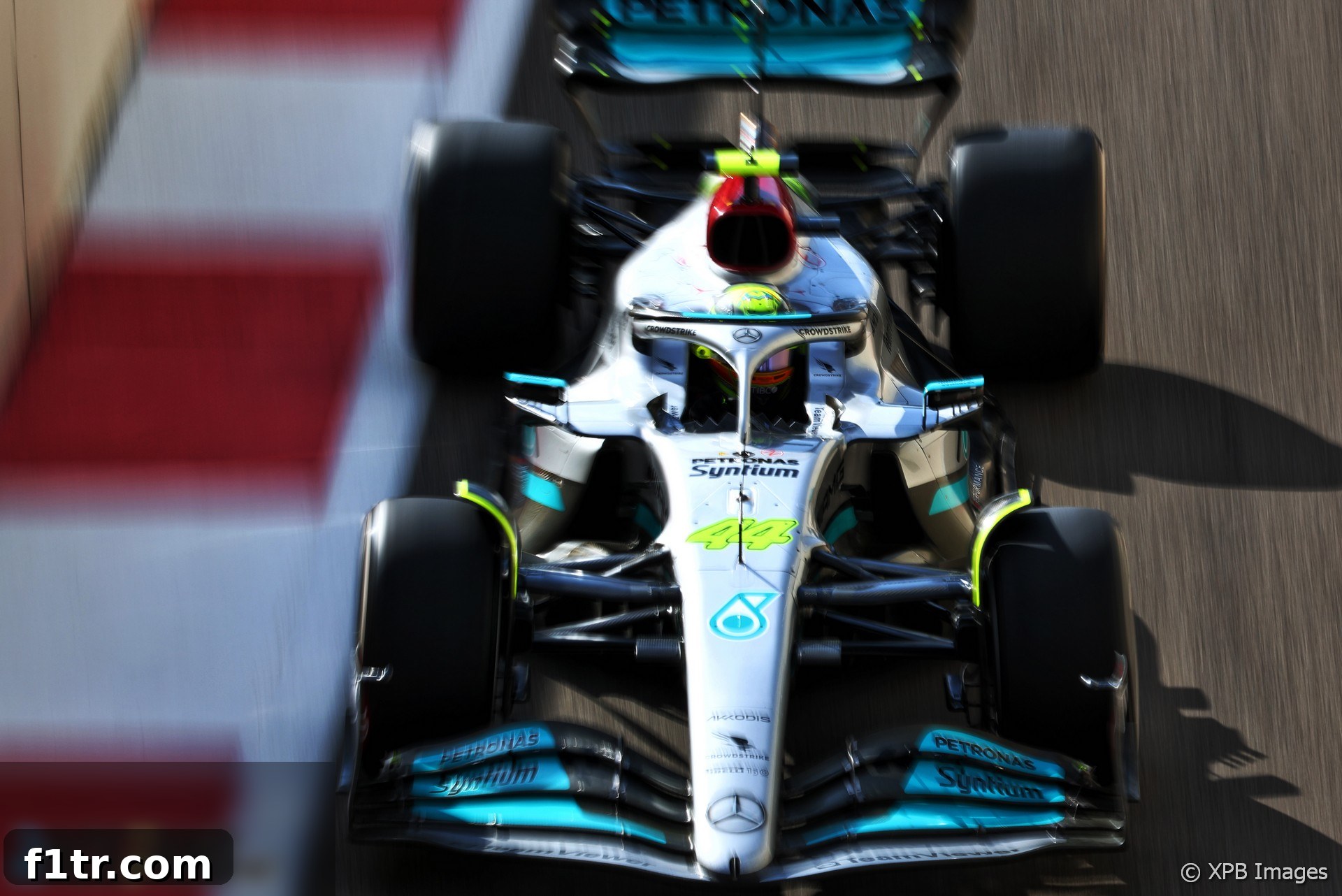
The high-stakes atmosphere of the Abu Dhabi Grand Prix practice session was momentarily overshadowed by a significant investigation involving one of Formula 1’s most decorated drivers, Lewis Hamilton. Ahead of the crucial qualifying session, Hamilton found himself under the scrutiny of race stewards, accused of failing to sufficiently reduce his speed and committing an overtake under a red flag during the final practice. This incident sparked immediate debate and highlighted the rigorous enforcement of safety protocols in top-tier motorsport.
The Incident Unfolds: A Red Flag Violation Claim
The events leading to the investigation began during a critical phase of the final practice session. Hamilton, pushing hard on a set of soft tyres, was on what he intended to be a flying lap. As he rounded turn four, a red flag signal was displayed, indicating an immediate halt to on-track activity due to safety concerns. Simultaneously, Lando Norris, who was on a cool-down lap, quickly alerted his McLaren team over the radio to Hamilton’s actions, stating, “Hamilton overtook, the Haas as well, under the red flag.”
The critical moments unfolded rapidly. Hamilton had encountered Norris and subsequently passed Kevin Magnussen’s Haas as he approached turn five. Almost concurrently with the red flag display, Hamilton’s race engineer, Peter Bonnington, transmitted an urgent message: “Red flag, red flag, no overtaking.” Bonnington immediately followed up, instructing Hamilton to “get yourself back behind Magnussen” and reminding him of the vital “delta positive” requirement. This directive ensures drivers maintain a minimum lap time during red flag periods, preventing them from driving too quickly and jeopardizing marshals or other drivers. “So just stay on that delta,” Bonnington reiterated, emphasizing the importance of adherence to these safety protocols.
Why the Red Flag? Debris on Track
The reason for the session’s temporary suspension was a safety concern arising from a piece of debris on the track at turn nine. The front-right wheel shroud had detached from Pierre Gasly’s AlphaTauri, posing a significant hazard to any car running over it at racing speeds. Such debris can cause punctures, suspension damage, or even send uncontrolled fragments flying, underscoring why red flag procedures are paramount for the safety of drivers, marshals, and spectators alike.
The Stewards’ Summons: A Deep Dive into the Rules
Following Norris’s radio call and race control’s observation, the stewards promptly summoned Lewis Hamilton to meet them at 4pm local time. The investigation centered on whether Hamilton had breached Article 2.5.4.1 (b) of Appendix H of the FIA International Sporting Code. This specific regulation outlines the mandatory conduct of drivers when a red flag is displayed, particularly during practice sessions.
Understanding the gravity of such an infraction requires a closer look at the International Sporting Code. These rules are the backbone of safety in Formula 1 and other FIA-sanctioned events, meticulously crafted to minimize risks in high-speed, unpredictable environments. A red flag is one of the most serious signals in motorsport, demanding immediate and precise responses from all participants. Any deviation from these protocols can have severe consequences, ranging from penalties to potential accidents.
International Sporting Code Appendix H Article 2.4.5.1 (b): The Mandate of the Red Flag
The section of the rule Hamilton was investigated for provides an exhaustive framework for driver behavior under red flag conditions. It is crucial for maintaining order and safety when a session or race must be halted. Let’s break down the core components:
b) Red flag
This flag should be waved at the start line when it has been decided to stop a practice session or the race. Simultaneously, each marshal post around the circuit should also wave a red flag.
When the signal to stop is given:1) during practice, all cars shall immediately reduce speed and proceed slowly back to their respective pits;
2) during a race, all cars shall immediately reduce speed and proceed slowly to the red flag line ((*) see the note at the end of point b));
3) overtaking is forbidden and drivers should remember that race and service vehicles may be on the track, the circuit may be totally blocked because of an accident and weather conditions may have made the circuit undriveable at racing speed;
4) if the race is stopped, drivers should remember that speeding is pointless because:
– the classification of the race or the order of the re-starting grid will be established from a point prior to the red flag being shown and according to the regulations of the competition;
– the pit lane exit will be closed.
All cars shall stop in order before the red flag line(*) until informed whether the race is to be resumed or ended and given the appropriate directions by marshals according to the regulations of the competition.
The red flag may also be used by the Clerk of the Course or his nominee to close the circuit (see Article 2.1.4).
(*): Red flag line: a continuous, 20 cm wide line should be marked with non-skid paint, crossing the track from side to side, at right angles to the track centreline, at the point behind which all cars must stop if a race is stopped or suspended, where they can be conveniently attended to and formed into a starting grid from which the safety car will lead them off if the race is resumed.
The key phrases in this extensive regulation for Hamilton’s case are “immediately reduce speed” and the explicit declaration that “overtaking is forbidden.” The rule emphasizes the critical need for drivers to be acutely aware of their surroundings and to respond without hesitation. The mention of “race and service vehicles” and the potential for a “totally blocked circuit” underlines the severe risks involved if drivers fail to comply. Even a momentary lapse in judgment can have catastrophic consequences.
The Verdict: Hamilton Avoids Penalty
Despite the initial alarm and the thorough investigation, the outcome for Lewis Hamilton was a reprieve. The stewards ultimately decided against imposing a penalty. This decision, while welcomed by Hamilton and his team, suggests that mitigating factors or the specific interpretation of “immediately reduce speed” played a role. It’s plausible that while Hamilton did pass Magnussen, the stewards might have considered his immediate reaction to Bonnington’s call, his subsequent slowing down, and adherence to the delta time as sufficient mitigation, indicating an attempt to comply, even if not perfectly instantaneous.
The incident serves as a stark reminder of the razor-thin margins and the intense scrutiny under which Formula 1 drivers operate. Every decision, every fraction of a second, and every adherence to the rules are meticulously observed. While Hamilton avoided a penalty on this occasion, the investigation itself underscores the FIA’s unwavering commitment to driver and marshal safety, reinforcing that even multiple world champions are not exempt from the stringent regulations designed to protect everyone involved in the sport.
This episode also highlights the crucial role of communication between driver and engineer, as well as the vigilance of fellow competitors like Lando Norris, who contribute to the overall safety ecosystem on the track. The rapid deployment of the red flag for even a small piece of debris showcases the proactive approach to preventing larger incidents, ensuring that Formula 1 remains at the pinnacle of motorsport safety.
2022 Abu Dhabi Grand Prix Insights
- Norris dissatisfied with solitary podium finish: “One isn’t enough”
- Verstappen achieves most dominant title win since Vettel in 2013
- Magnussen’s experience makes him ‘positive’ ousted Schumacher can return to F1
- Overtaking still difficult at Yas Marina despite 2021 track changes, say drivers
- Depressing to consider points lost says Gasly after AlphaTauri slump to ninth
Browse all 2022 Abu Dhabi Grand Prix articles