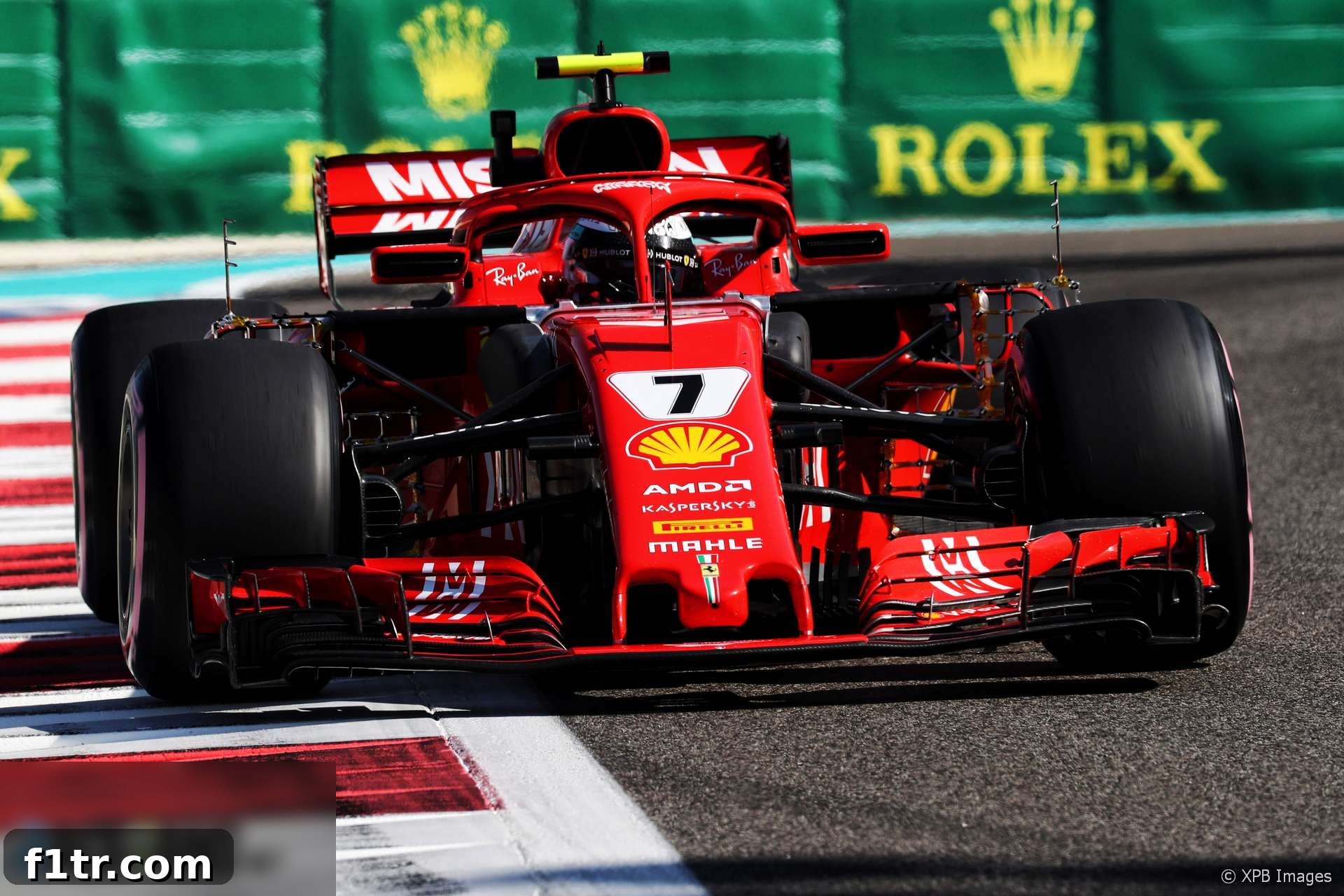
Kimi Raikkonen, the seasoned Ferrari driver, found himself under the scrutiny of Formula 1 stewards during a critical final practice session, ultimately receiving a reprimand. The incident involved the Finn’s car crossing multiple white lines, including the crucial pit entry line, an infraction that contravened clear instructions issued to all drivers ahead of the race weekend. This subtle but significant violation highlighted the meticulous adherence required to F1 regulations, even in non-competitive sessions.
The incident occurred as Raikkonen navigated the circuit during the final practice session, a period dedicated to fine-tuning car setups and pushing performance limits. Stewards meticulously reviewed the telemetry and video evidence, concluding that the “Iceman” had failed to maintain his position to the right of the solid white line that delineates the path to the Safety Car line. Furthermore, his car was observed crossing the distinct white line that separates the main track from the pit entry lane. While Raikkonen did not proceed to fully enter the pits, the act of crossing these designated boundaries was deemed a breach of protocol.
Understanding the F1 Regulations: Why White Lines Matter
Formula 1 racing operates under a stringent set of regulations designed to ensure fairness, safety, and consistent conduct across all teams and drivers. The specific rules governing pit entry and exit procedures are among the most critical, given the high speeds and confined spaces involved in the pit lane. The stewards’ findings in Raikkonen’s case referenced two key regulatory documents:
- **Race Director’s Instruction in Event Notes 8.2:** This instruction explicitly states, “when entering the pits drivers must stay to the right of the solid white line.” This directive is issued before each race weekend to clarify specific track details and operational procedures, ensuring all participants are fully aware of local rules.
- **Appendix L Chapter IV Article 4 (d):** This broader regulation governs conduct within the pit lane, including phrases such as “…the crossing… of the line… by a car entering the pit lane…” This foundational rule underscores the sanctity of the pit lane boundaries and the precise manner in which drivers must approach or depart from them.
The primary reason for such strict enforcement of these lines is safety. The pit lane is a high-risk area where mechanics work in close proximity to cars moving at considerable speeds. Any ambiguity in a driver’s intention or deviation from the prescribed entry path can create dangerous situations, potentially leading to collisions or harm to personnel. By requiring drivers to stay to the right of the solid white line, the FIA aims to create a predictable and orderly flow into the pit lane, minimizing risks.
The Stewards’ Deliberation and Rationale
Despite the fact that Raikkonen’s Ferrari did not complete a full pit entry after crossing the lines, the stewards were unequivocal in their judgment that a violation had occurred. Their reasoning was based on the interpretation that his car was “in the process of entering the pit lane and the pits.” This distinction is crucial; it implies that the mere act of positioning the car in a manner consistent with entering the pit lane, regardless of whether the entry was completed, constitutes a breach. The intention or the perceived intention, as evidenced by the car’s trajectory, was sufficient for a penalty.
This ruling highlights the meticulous nature of F1 stewarding. Modern Formula 1 employs sophisticated telemetry, GPS tracking, and an array of high-definition cameras that provide stewards with comprehensive data from every angle. This technological advantage allows for incredibly precise analysis of driver actions, leaving little room for subjective interpretation regarding track limits or line crossings. The stewards are tasked with enforcing the letter of the law, ensuring that every driver adheres to the same stringent standards, irrespective of their stature or the session’s competitive significance.
The decision to consider both infractions – crossing the line to the Safety Car path and the pit entry line – as part of a single incident led to the imposition of a single reprimand. This pragmatic approach acknowledges that while two distinct lines were crossed, they were contiguous and formed part of a continuous movement, preventing a double penalty for what was essentially one sequence of events.
The Significance of a Reprimand in Formula 1
A reprimand is the mildest form of penalty that Formula 1 stewards can issue. It serves as an official warning to a driver for an infringement, without immediately impacting their race result or grid position. However, reprimands are not without consequence. Accumulating three reprimands over the course of a season, provided at least two of them were for driving infringements, results in an automatic ten-place grid penalty for the next race. This cumulative effect means that even seemingly minor infractions like Raikkonen’s can contribute to a more significant penalty down the line, urging drivers to maintain impeccable conduct throughout the season.
In Raikkonen’s case, this was his first reprimand of the 2018 season. The stewards likely opted for this less severe punishment because the infringement occurred during a practice session, where competitive advantage was not a direct factor, and it did not immediately endanger other competitors or marshals. Had a similar incident occurred during qualifying or the race, or if it had created a hazardous situation, a harsher penalty such as a time penalty, grid drop, or even a drive-through might have been considered.
Kimi Raikkonen’s Performance and Context in the 2018 Season
The reprimand came amidst a strong showing from Kimi Raikkonen in the final practice session, where he demonstrated impressive pace by setting the second-quickest time. This performance underscored his ability to extract significant speed from his Ferrari SF71H, a car that was proving to be a formidable challenger for the championship in 2018. Raikkonen, known for his stoic demeanor and raw talent, was consistently performing at a high level, often serving as a crucial wingman for his teammate Sebastian Vettel in their championship battle against Mercedes’ Lewis Hamilton.
The 2018 season was a competitive one for Ferrari, and every detail, from driver performance to adherence to regulations, was under immense scrutiny. Raikkonen’s reprimand, while minor, served as a reminder that even the most experienced drivers must remain vigilant and precise in all aspects of their driving. For a driver of Raikkonen’s caliber and experience, such an error might be seen as an uncharacteristic lapse in concentration, or perhaps a consequence of pushing the limits to find every millisecond of performance.
Broader Implications for F1 Driving Standards
Incidents like Raikkonen’s minor infringement highlight the incredibly high standards expected of Formula 1 drivers. The margin for error is virtually non-existent, and every movement on track, no matter how trivial it might seem to an outside observer, is governed by a strict rulebook. This rigorous enforcement ensures the integrity of the sport and maintains a level playing field where consistency and precision are paramount.
The constant evolution of F1 tracks, with their complex pit entry and exit configurations, coupled with the ever-increasing speeds of the cars, necessitates unwavering attention to detail from drivers. The FIA and Race Director continually adapt and refine regulations to match the demands of the sport, ensuring that safety remains paramount without stifling the competitive spirit. This particular reprimand serves as a subtle, yet firm, reminder to all drivers about the importance of respecting track limits and pit lane protocols at all times, reinforcing the disciplined environment that defines elite motorsport.
Ultimately, while Kimi Raikkonen’s reprimand was a small blip in his weekend, it perfectly encapsulates the intricate world of Formula 1, where even a slight deviation from a white line can lead to official sanction. It reinforces the message that in F1, precision isn’t just about lap times; it’s about every single action on the circuit.
Don’t miss anything new from RaceFans
Follow RaceFans on social media:
- Join RaceFans on Facebook
- Follow RaceFans on Twitter
- Get daily email updates from RaceFans
2018 F1 Season – Related Articles
- F1 feared “death knell” for Drive to Survive after Ferrari and Mercedes snub
- McLaren staff told us we were “totally crazy” to take Honda engines in 2018 – Tost
- ‘It doesn’t matter if we start last’: How Red Bull’s junior team aided Honda’s leap forward
- Honda’s jet division helped F1 engineers solve power unit problem
- McLaren Racing losses rise after Honda split
Browse all 2018 F1 season articles