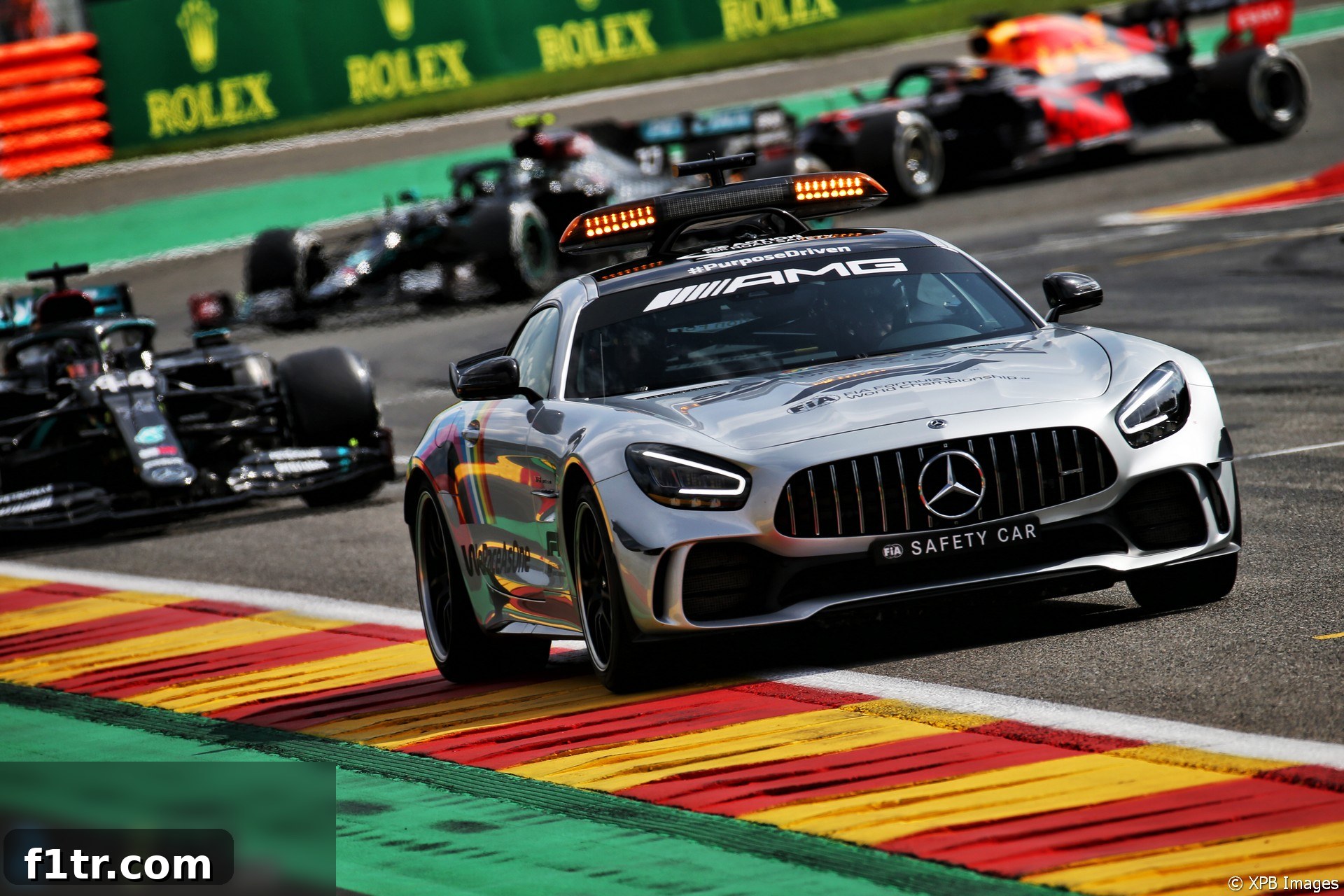
Formula 1 has moved to significantly bolster its safety protocols, particularly concerning Safety Car periods and trackside marshal operations. The proactive measures come in response to alarming near-miss incidents witnessed during the Emilia-Romagna Grand Prix at Imola and the subsequent Turkish Grand Prix. Former Race Director Michael Masi confirmed that crucial procedural adjustments have been communicated to teams and drivers, underscoring a renewed commitment to safeguarding personnel on track.
The catalyst for these changes at Imola was a harrowing moment during a Safety Car deployment. A group of six drivers, who had been granted permission to un-lap themselves, passed perilously close to marshals who were actively working at the side of the circuit. One of the drivers involved, Sebastian Vettel, vehemently voiced his concerns, describing their proximity to the marshals as “very, very dangerous.” This incident highlighted a critical flaw in existing procedures, where the imperative for drivers to regain their lap positions inadvertently created a high-risk environment for trackside personnel.
In exclusive discussions, Michael Masi elaborated on the swift actions taken following the Imola race. He confirmed that teams and drivers received immediate advisories regarding new procedures for Safety Car periods, specifically addressing the challenges encountered at Imola. “We have already changed the processes in how we would deal with an un-lapping procedure, which we’ve discussed with the team managers and drivers,” Masi stated. The core of this revised protocol involves extending Safety Car periods to allow ample time for the un-lapping process to occur safely. “I’ve advised them in these circumstances that it may take an extra lap or two if we’re going through an un-lapping scenario,” he added.
This adjustment signifies a deliberate shift towards prioritizing safety over the expediency of resuming racing. Masi highlighted the collective buy-in from all stakeholders, emphasizing that this procedural modification was met with widespread acceptance. “That’s just one of the parts that everyone’s accepting of. We had a good discussion both with the team managers on Thursday in Turkey and then with the drivers on Friday night,” he explained. Crucially, these changes were implemented not through complex regulatory amendments, but as practical, operational refinements. “At the moment with the way the regulations are, it’s more a process and a procedural side of how that’s enacted than a regulatory side,” Masi affirmed, suggesting a flexible and responsive approach to evolving safety needs.
The concerns over marshal safety were further amplified by a separate incident during the Turkish Grand Prix. During the second stage of qualifying, conducted in treacherous wet conditions, drivers were critical of race control’s decision to begin the session while marshals and a recovery crane were still present on the circuit at Turn 8. They were in the process of recovering a car that had crashed in the preceding session. The sight of heavy machinery and vulnerable personnel on track during live qualifying, especially in poor visibility, understandably sparked an outcry from the paddock.
While Masi had previously maintained confidence in the assurances he received regarding the crane’s removal, he later conceded that the outcome of the situation in Turkey was far from ideal. Speaking candidly, he admitted, “I’d be lying to say that it was an ideal situation.” He stressed the inherent challenges of real-time race management: “But you need to deal with it in the best way in the circumstances when it arises.” Masi offered a rationale for the decision, noting that it was an out-lap for the drivers, where the intention is typically not to push to the absolute limit. He also highlighted that “we extended the double yellow zone, so not just from turn eight but all the way through to the start of turn seven to give everyone ample warning.” However, this justification did little to quell the underlying concerns about the potential risks posed.
These successive incidents inevitably led to accusations that race control was prioritizing the spectacle of ‘the show’ over fundamental safety considerations. Such claims are deeply unsettling in a sport that has historically made tremendous strides in safety. Masi, however, unequivocally rejected this notion. “It’s not [the case], point blank,” he asserted, leaving no room for ambiguity. His forceful denial underscores the FIA’s official stance that safety remains, and always will be, the paramount concern in Formula 1.
Masi reiterated his steadfast directive that marshals must be afforded sufficient time to ensure incident scenes are entirely safe before racing activities resume or intensify. This directive is a cornerstone of his operational philosophy. “We have a meeting with the clerk of the course at each of these events on Wednesday,” he explained. “I have always said from last year and throughout this year that if it means that we have an extra lap under Safety Car or that we have an extra five laps under Safety Car or whatever, I much prefer the trackside marshals to take a deep breath before reacting, as we may have seen 10 years ago.”
This approach signifies a departure from an era where rapid decision-making might have inadvertently pressured marshals. Masi emphasized that with modern communication and information access, there is no longer any valid reason to rush critical safety procedures. “Because times have changed overall, access to information has changed. There’s no reason to rush that. I much prefer it to be done,” he stated. His philosophy is rooted in continuous learning and adaptation, a principle vital for maintaining the highest safety standards in a dynamic sport like Formula 1. “And as I said, we live and learn every day,” he concluded.
The role of trackside marshals in Formula 1 cannot be overstated. These dedicated volunteers, often unpaid, are the unsung heroes of motorsport, risking their safety to ensure that races can proceed and incidents can be managed. Their presence, training, and the conditions under which they operate are critical to the sport’s integrity and safety record. Any situation that compromises their safety is a direct threat to the foundation of motorsport itself. The procedural adjustments, particularly the extension of Safety Car periods for un-lapping, directly address this vulnerability, providing a necessary buffer zone for marshals to perform their duties without the added pressure of fast-approaching race cars.
Furthermore, the Turkish Grand Prix incident served as a potent reminder of the inherent dangers when heavy recovery vehicles operate in proximity to a live track, especially under challenging weather conditions. While race control continually balances the desire to maintain the event’s flow with safety, such incidents necessitate rigorous self-reflection and re-evaluation. The commitment to extending double yellow zones and ensuring clear communication aims to mitigate these risks, but the ultimate goal remains zero contact between operational personnel/equipment and active racing cars.
These recent events and the subsequent procedural enhancements underscore Formula 1’s ongoing, iterative journey towards unparalleled safety. The FIA, in collaboration with race directors, teams, and drivers, is constantly reviewing and refining protocols to prevent future incidents. While the spectacle of Formula 1 is undeniably thrilling, the well-being of every participant – from the drivers in their cockpits to the marshals on the ground – must always take precedence. The lessons learned from Imola and Turkey reinforce a vital message: in the high-stakes world of Formula 1, safety is not merely a regulation to be met, but a culture to be upheld and continuously improved, ensuring the sport remains exhilarating yet secure for all involved.
Interviews
- What’s changed in F1 25 – and why? In-depth Q&A with Codemasters’ Gavin Cooper
- F1 24 director Mather on anti-cheat measures and the last-gen tech debate
- F1 24 director Lee Mather on physics, in-race goals and revamped career mode
- Exclusive: Horner on Red Bull’s success, believing in Perez and why 2024 will be closer
- ‘Some days I think ‘why the hell do I do this?’: Steiner on Haas’ future – and Andretti
Browse all Interviews