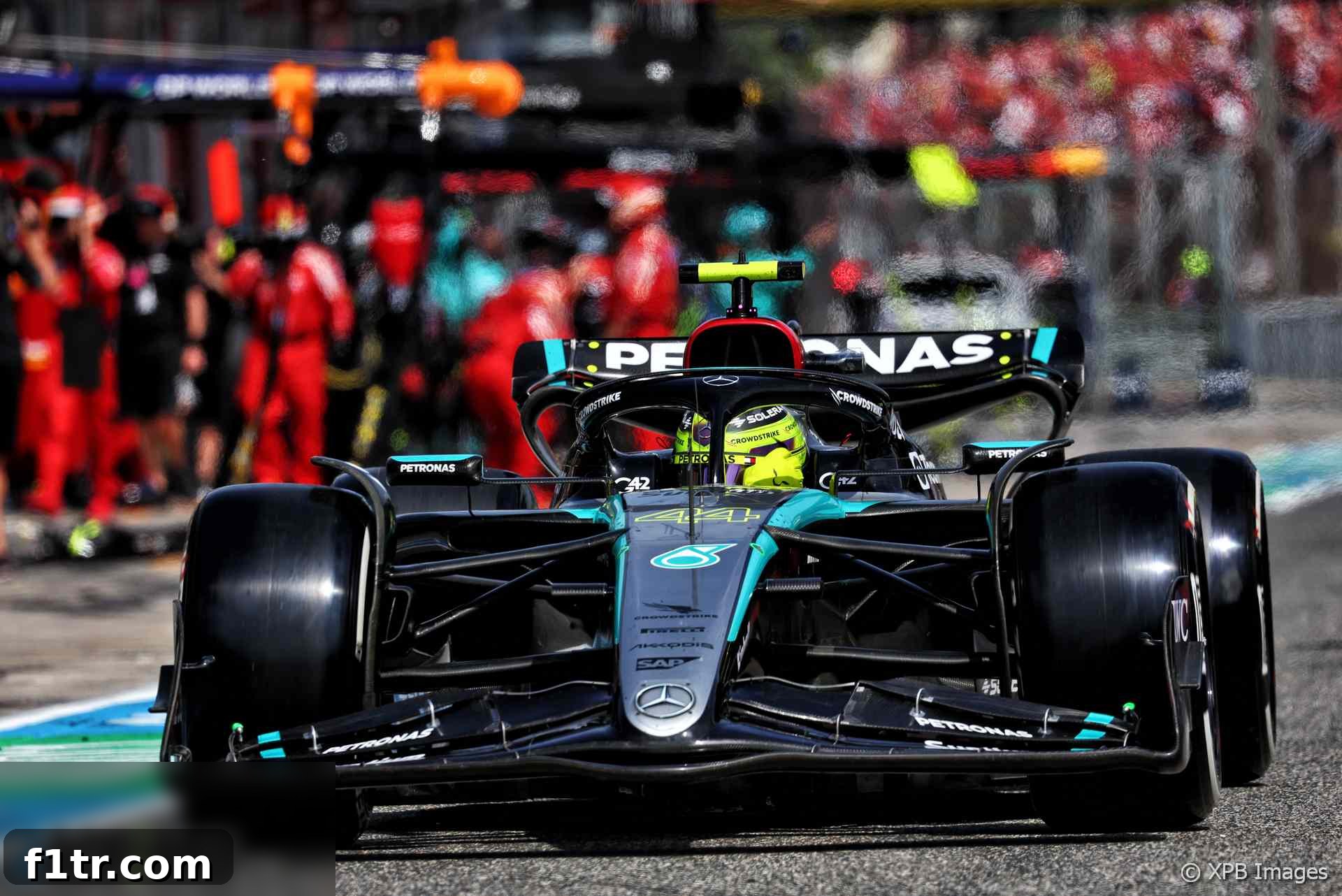
Mercedes-AMG Petronas Formula 1 Team is demonstrating an unwavering commitment to performance recovery, steadily rolling out a comprehensive upgrade package designed to propel their W15 challenger up the grid. Following initial deployments in Miami and Imola, the team has confirmed that this relentless development push will continue with further enhancements slated for the upcoming Monaco Grand Prix and the Canadian Grand Prix, and beyond. This aggressive strategy underscores Mercedes’ determination to close the gap to their rivals and reclaim their position at the pinnacle of Formula 1 racing.
The impact of these upgrades is already manifesting on track, with technical director James Allison reporting tangible gains. At the Emilia Romagna Grand Prix in Imola, the team observed a crucial improvement of “a tenth or two” of a second per lap relative to their competitors. While seemingly small, such marginal gains are incredibly significant in the hyper-competitive world of Formula 1, often making the difference between several grid positions or even race outcomes. This recent step forward adds to an overall progress curve, which Allison proudly notes has brought Mercedes “several tenths of a second now nearer the front than we were at the start of the year.” This progressive improvement signals a promising trajectory for the Silver Arrows as they navigate the demanding 2024 season.
The phased rollout of these critical upgrades highlights Mercedes’ methodical approach to development. The first part of the latest package made its debut at the Miami Grand Prix, allowing the team to gather initial data and validate its impact in real-world conditions. The subsequent components were then introduced at Imola, completing a significant phase of the development cycle. This iterative process is crucial for F1 teams, enabling them to understand the correlation between simulation data and track performance, fine-tune new parts, and ensure optimal integration with the existing car architecture. The commitment to delivering further aerodynamic and mechanical components for Monaco and Canada demonstrates a sustained, aggressive development curve, essential for challenging the front-runners.
At the heart of this renewed drive is a fundamental shift in the design philosophy behind the W15. Mercedes consciously moved away from the concepts that underpinned their challenging W13 and W14 cars, which struggled with unpredictable handling and a narrow operating window. The 2024 challenger was conceived with a new, more conventional, yet innovative approach, focusing on creating a stable, predictable, and ultimately faster platform. This foundational change was a monumental undertaking, requiring extensive research, development, and a complete re-evaluation of previous design choices. The team’s current priority is to rigorously build upon this new, promising platform, unlocking its full potential through continuous upgrades and optimization. Each new component is designed to enhance the W15’s inherent strengths and address any lingering weaknesses, pushing the car further towards its maximum performance ceiling.
The intensity of this development push is palpable within the team’s facilities. James Allison describes the factory at Brackley as being on a “war footing,” a testament to the extraordinary effort and dedication of hundreds of engineers, designers, manufacturers, and support staff. This analogy perfectly encapsulates the high-stakes, time-sensitive nature of Formula 1 development, where every fraction of a second gained requires immense intellectual capital and tireless work. The decision to split the latest upgrade package into two parts, rather than delivering it as a single “slab,” was a strategic move to accelerate its introduction. By bringing forward components as soon as they were ready, Mercedes aimed to get them onto the track quicker, enabling earlier data collection and faster validation. This rapid deployment strategy underscores the urgent desire to improve performance and gain a competitive edge in a fiercely contested championship.
The upgrades encompass a range of technical areas, extending beyond purely aerodynamic components. While revisions to the floor, front wing, rear wing, and bodywork are always critical for generating downforce and managing airflow, Mercedes is also likely exploring enhancements in areas such as suspension kinematics, brake cooling, and possibly minor chassis refinements. Each of these elements plays a vital role in the overall performance of an F1 car, influencing everything from cornering speeds and tyre degradation to straight-line efficiency. The sophisticated interplay between these various components means that every upgrade requires meticulous design, rigorous testing through computational fluid dynamics (CFD) and wind tunnel analysis, and precision manufacturing. The goal is clear: to integrate these pieces seamlessly to extract every possible millisecond of lap time. Allison’s team remains focused on “slogging the assets back in the factory that find the lap time to design them, build them, get them out on the car,” emphasizing the continuous cycle of innovation required to compete at the highest level.
As Mercedes continues this aggressive development program, the competitive landscape of Formula 1 remains incredibly tight. While Red Bull still holds a formidable advantage, teams like Ferrari and McLaren have shown impressive form, often challenging for podiums and even victories. Mercedes’ goal is not just to close the gap to the front but also to solidify its position as a clear contender for regular podium finishes and, eventually, race wins. The “tenth or two” gained at Imola is not merely an isolated improvement; it’s a building block, a testament to the team’s capacity for progress. The cumulative effect of these incremental gains over multiple races could be transformative, potentially shifting the team from fighting in the midfield to consistently challenging the established front-runners. The psychological boost this provides to drivers Lewis Hamilton and George Russell, knowing their feedback is directly translating into performance improvements, cannot be underestimated.
The upcoming races present diverse challenges and opportunities for the W15. The Monaco Grand Prix, a unique street circuit requiring maximum downforce and exceptional car balance, will test the car’s slow-speed performance and mechanical grip. Any improvements in these areas from the recent upgrades will be immediately evident. Following this, the Canadian Grand Prix offers a different set of demands with its high-speed straights and chicanes, where power unit efficiency and aero drag become paramount. The staggered introduction of new parts for these specific races suggests a tailored approach, optimizing the car for the unique characteristics of each circuit. Mercedes’ ambition extends throughout the entire season, with Allison confirming that further enhancements are planned “in the races to follow.” This long-term commitment underscores their strategic vision, aiming to be a strong championship contender not just in the short term, but consistently throughout 2024 and beyond.
Stay informed with the latest updates and in-depth analysis from the world of Formula 1. Discover comprehensive race reports, exclusive team insights, and expert commentary as Mercedes navigates their journey back to the top.
2024 Monaco Grand Prix: Key Analysis and Insights
- Unpacking the Strategic Nuances of the 2024 Monaco Grand Prix
- Driver Perspectives: Navigating the Unique Challenges of Monaco
- Mercedes’ Hopes and Expectations for Performance in Monaco
- Monaco Grand Prix: Analyzing Key Incidents and Lessons Learned
- Technical Insights: The Extreme Aerodynamic Demands of Monaco
Explore all articles related to the 2024 Monaco Grand Prix