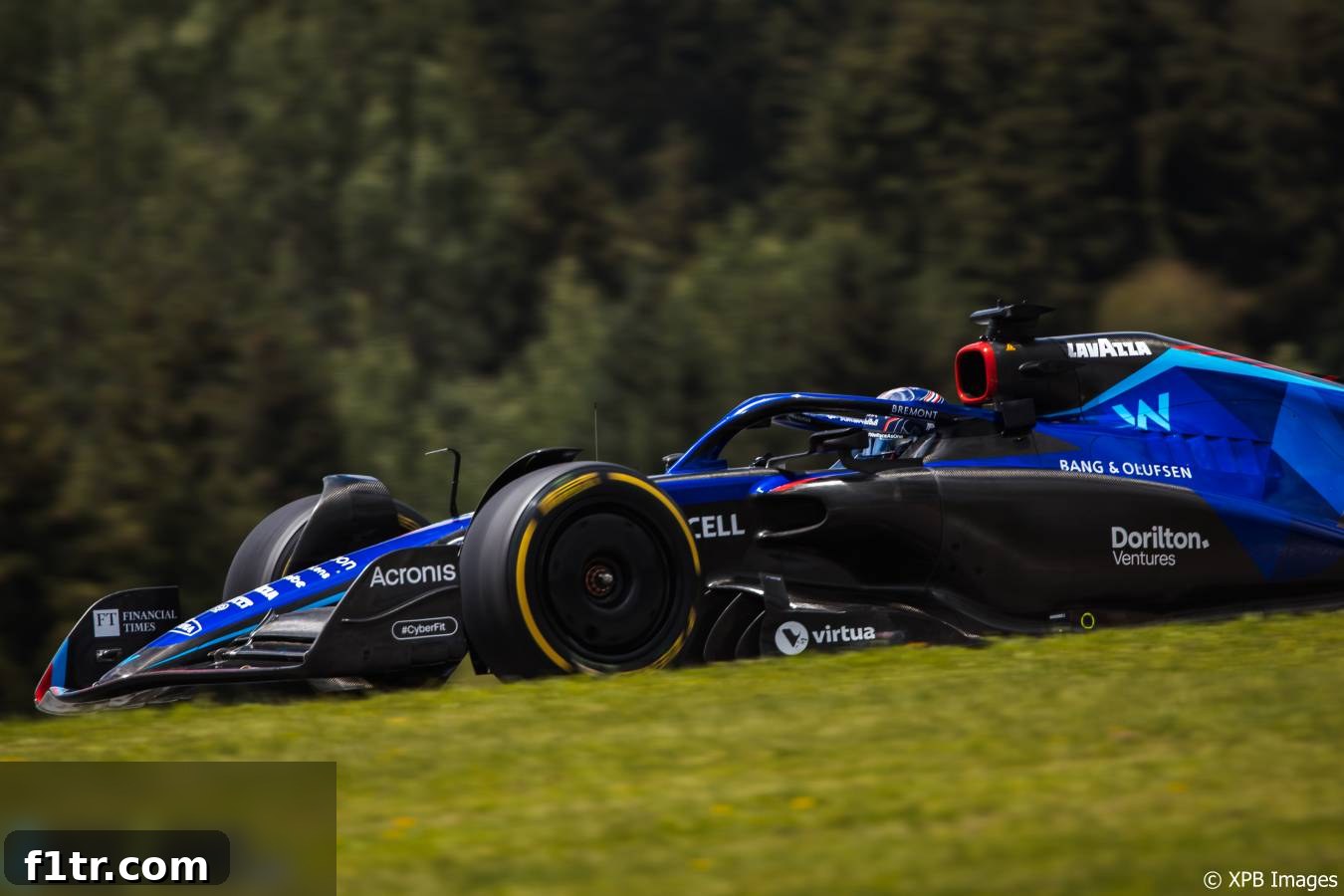
Alexander Albon Slams ‘Unfair’ Austrian GP Penalty, Reigniting F1 Stewarding Controversy
Williams driver Alexander Albon has vehemently contested the five-second time penalty and two superlicence penalty points issued to him following a contentious incident with Lando Norris during the Austrian Grand Prix sprint race. Albon’s strong assertion that the penalty was “unfair” has significantly amplified the ongoing discourse within the Formula 1 community regarding the consistency of stewarding decisions and the inherent challenges of navigating wheel-to-wheel combat at the pinnacle of motorsport.
This controversial verdict against Albon has not only impacted his immediate race result but also placed him under increased scrutiny with a growing tally of superlicence points, bringing him perilously closer to a potential race ban. His outspoken criticism highlights a broader, underlying frustration among drivers who grapple with what they perceive as unpredictable and inconsistent application of racing rules by the FIA, raising fundamental questions about the fairness and clarity of competition in a sport where split-second decisions define success and failure.
The Austrian GP Sprint: A Critical Clash at Turn 3
The incident that ignited Albon’s ire unfolded on lap four of the high-octane sprint event at the iconic Red Bull Ring. Battling fiercely for 11th position, McLaren’s Lando Norris attempted to leverage his DRS (Drag Reduction System) advantage to overtake Albon’s Williams on the approach to the challenging Turn 3. As both drivers braked deep into the corner, Norris positioned his car on the outside, a bold and aggressive move in such close proximity.
Navigating the apex side-by-side, the critical moment arrived as Norris found himself forced wide. He bounced conspicuously over the notorious yellow ‘sausage kerb’ on the corner’s exit, subsequently running onto the asphalt run-off area. This forced excursion momentarily allowed Albon to retain his track position, though the manoeuvre immediately drew the vigilant attention of race control, prompting an investigation.
Visibly agitated and frustrated by the contact, Norris promptly relayed his dismay over team radio. “He pushed me completely off,” Norris claimed with exasperation. “I was ahead of him and he pushed me off.” His race engineer, Will Joseph, acknowledged the protest, responding succinctly, “Yeah, we saw it. It’s just like we discussed earlier,” a remark that suggested similar scenarios or specific car behaviours might have been anticipated or discussed between the team and driver pre-race.
Stewards’ Verdict and Albon’s Staunch Aerodynamic Defence
Despite the initial skirmish and Norris being forced off track, the McLaren driver eventually managed to execute a clean overtake on Albon two laps later, on lap six, securing an 11th-place finish. Albon, who initially crossed the finish line in 13th, saw his provisional result revised downwards to 16th after the stewards concluded that he was indeed responsible for forcing Norris off the circuit. Consequently, the five-second time penalty was applied to his race time.
More critically and with potentially far-reaching implications for Albon, the incident resulted in two additional penalty points being added to his superlicence. This accumulation brought his total to six points within a 12-month period, placing him precariously halfway towards the ominous threshold of a potential one-race ban. The threat of such a ban casts a long shadow over his driving, compelling him to exercise extreme caution in future races and significantly intensifying his dissatisfaction with the ruling, which he believes was unwarranted.
Albon offered a comprehensive and technically grounded defence, centering on the inherent limitations and aerodynamic characteristics of his Williams FW44. He adamantly asserted that the incident was entirely unintentional, rather an unavoidable outcome dictated by his car’s specific behaviour in highly dynamic, close-combat scenarios. “I’ll let you make what you saw of it but, for me, I was pretty much in front going on the brakes,” Albon explained post-race, detailing his perspective on the critical braking phase of the manoeuvre and his track position.
He continued to elaborate on the challenges: “So I braked where I can brake and unfortunately we are quite sensitive on the aero, especially on the front, and when a car goes late on you around the outside, that’s it.” Albon further explained the detrimental effects of “dirty air” – the turbulent air created by a leading car – which, when combined with the Williams’ front-end sensitivity, drastically impacts grip and steering precision, particularly when another car attempts an aggressive outside pass. This aerodynamic vulnerability, he suggested, made it almost impossible to hold a tight line and maintain optimal control while battling side-by-side with another competitor.
“I would have easily made the corner if I was in front, but just the way how much later he braked, I caught the dirty air almost in the middle of the overtake,” Albon stated, providing further insight into the exact moment the incident unfolded. “You saw we were struggling out there today. We didn’t have much grip, so understeered wide, but there was no attempt to push him wide, it was just the limitation of what we have. It is hard for us to battle around other cars and that’s the simple fact of it, I think.” His explanation paints a vivid picture of a driver constrained by the performance envelope of his machinery, battling complex physics as much as his rival, making the fine line between aggressive, hard racing and rule-breaking incredibly blurred.
Albon was unequivocal in his disagreement with the stewards’ decision, making his position abundantly clear. “Obviously, I’m going to say it’s an unfair penalty because I’m not that kind of driver,” he asserted, keen to reinforce his reputation for clean and fair racing, a reputation he believes was unfairly tarnished by the ruling. “I’m not trying to force anyone off the circuit.” This strong denial underscores his belief that the stewards may have misconstrued the incident as a deliberate act of aggression rather than an unfortunate, perhaps unavoidable, consequence of the dynamic racing environment and his car’s inherent technical characteristics.
The Shadow of Silverstone: Questions of Stewarding Consistency
The timing of Albon’s penalty has inevitably led to broader discussions about the consistency, or palpable lack thereof, in Formula 1 stewarding. Just one weekend prior, at the British Grand Prix, numerous drivers were either noted or investigated for remarkably comparable incidents involving forcing rivals off the track. Crucially, in many of those instances, no penalties were applied, leading to a perception of leniency. Albon posits that his current penalty might be a direct repercussion – a “legacy” – of the perceived leniency at Silverstone, suggesting a reactive rather than a consistently applied approach to officiating.
“I’m not surprised because we complain about it and then they go extra hard the next race, it’s the same with most things,” Albon observed with a discernible tone of resignation, implying a familiar pattern. This highlights a perceived cyclical approach where driver grievances or public outcry about perceived laxity in one race often lead to an overly stringent crackdown in the subsequent event. Such an oscillating cycle creates a confusing and inherently unpredictable regulatory landscape for competitors, making it difficult for them to adapt their driving styles with confidence and clarity.
Albon also pointed out the practical outcome of the incident for Norris, arguing that the penalty meted out was disproportionate to any actual disadvantage suffered. “I think Lando didn’t lose much, he overtook me after so I think there needs to be a little bit of forgiveness and understanding as well. We’re not all driving the same cars out there. I feel like we got done by, we lost three or four positions there for the main race and I don’t think it was deserved.” His heartfelt plea for “forgiveness and understanding” speaks to the nuanced nature of racing incidents, where the intent behind the action, the performance disparities between competing cars, and the ultimate consequence for the affected driver should ideally be weighed, rather than a rigid, isolated application of rules without considering the full, complex context of the evolving race situation. The tangible loss of crucial grid positions for the main race, stemming directly from the sprint penalty, was a particularly galling point for Albon and the Williams team, impacting their strategy and potential for points.
Broader Driver Frustrations with FIA Race Control and Inconsistency
Albon’s penalty and his subsequent comments are far from isolated incidents; rather, they are symptomatic of a growing undercurrent of tension and dissatisfaction between Formula 1 drivers and the FIA’s race control structure. This simmering discontent notably boiled over during a heated drivers’ meeting on Friday evening before the Austrian Grand Prix weekend, culminating in four-time world champion Sebastian Vettel reportedly walking out in frustration. Vettel’s dramatic exit served as a powerful, symbolic gesture of the collective dissatisfaction permeating the paddock, where drivers increasingly feel a profound lack of clarity, accountability, and consistency in officiating decisions.
Other highly influential figures on the grid have also voiced their explicit criticisms. Fernando Alonso, renowned for his frank and often biting observations, has been a particularly vocal critic of what he perceives as a highly inconsistent application of racing rules across different Grands Prix and varied incidents throughout the season. George Russell, a director of the prestigious Grand Prix Drivers’ Association (GPDA) and a respected voice among his peers, echoed these sentiments, publicly stating that there was “no accountability” from the FIA race director and stewards within the current regulatory system. This widespread and high-profile criticism underscores a fundamental erosion of trust and mutual understanding between the rule enforcers and the elite athletes who must perform within those rules at breakneck speeds and under immense pressure.
When questioned by RaceFans about whether he felt his penalty served as yet another illustration of the season’s perceived stewarding inconsistencies, Albon responded with a decisive and unequivocal, “Yeah, it does.” This straightforward affirmation powerfully conveys the pervasive sense of unpredictability and ambiguity that drivers currently face regarding the acceptable limits of on-track conduct. The core problem, as articulated by many in the sport, is the “moving goalpost” of regulations, which makes it exceedingly difficult for drivers to confidently assess what actions are permissible and which will, retrospectively, invite punishment and negatively impact their championship hopes.
“We had a long chat in the driver’s briefing about this kind of stuff and you’ve seen it,” Albon elaborated, directly referring to the intense Friday meeting. “There tends to be, when people complain about a decision, the next race it becomes extra tough on that decision, whatever it may be. So it’s the rules.” This observation describes a worrying trend: a reactive approach to stewarding where public or driver outcry against perceived leniency often triggers an overly severe response in the subsequent event, rather than a steadfast, principled, and consistent application of the sporting regulations, leading to an environment of uncertainty for competitors.
The stark contrast between the “let them race” ethos, which was widely discussed and advocated after the British Grand Prix, and the perceived strictness in Austria, was not lost on Albon. “We’ve talked about ‘let them race’ after Silverstone and then we can’t race in Austria. So it’s tricky and it’s a moving goalpost for us – we don’t really know what we can and cannot do. Anyway, it is what it is.” This succinctly captures the profound dilemma confronting drivers: they are encouraged to engage in thrilling, close-quarters combat for the sake of entertainment and the spectacle of the sport, yet simultaneously risk incurring penalties that feel arbitrary and inconsistent. This constant oscillation in regulatory interpretation leaves drivers in a perpetual state of ambiguity, making it incredibly challenging to push the boundaries of performance and aggression without the ever-present fear of retrospective punishment and its severe consequences.
The Future of F1 Officiating and Driver Confidence
The ongoing saga surrounding Albon’s penalty and the broader driver discontent highlights a critical and pressing challenge for Formula 1’s governing body. The imperative is to establish and consistently uphold clear, transparent, and universally understood officiating standards that drivers can trust implicitly. Without such foundational clarity, the delicate and vital balance between aggressive, exhilarating racing – the very essence of F1 – and the principles of fair play risks being irrevocably disrupted. Such disruption could detrimentally impact not only the safety of the sport but also the purity of competition and the spectacle eagerly anticipated by millions of fans worldwide, potentially leading to a diluted product.
Alexander Albon’s penalty, while seemingly a minor incident within the grand narrative of a championship season, serves as a powerful microcosm of this larger, systemic struggle within Formula 1. It underscores the urgent need for open dialogue, consistent interpretation, and perhaps a comprehensive review of the stewarding process itself, to ensure that the sport remains both thrilling for spectators and equitably judged for all its competitors, fostering a sense of confidence and fairness in its high-stakes environment.
Advert | Become a RaceFans supporter and go ad-free
2022 Austrian Grand Prix: Related Content
- FIA affirms three sprint races on 2023 Formula 1 calendar
- “Oh, so unlucky!” How Alonso’s cursed Austrian Grand Prix unfolded on his radio
- Ferrari believe their performance deficit to Red Bull is now “negligible”
- Another fan’s experience of harassment last weekend – and why F1 must act
- AlphaTauri “desperately” need upgrades after “disaster” weekend, urges Gasly
Browse all 2022 Austrian Grand Prix articles