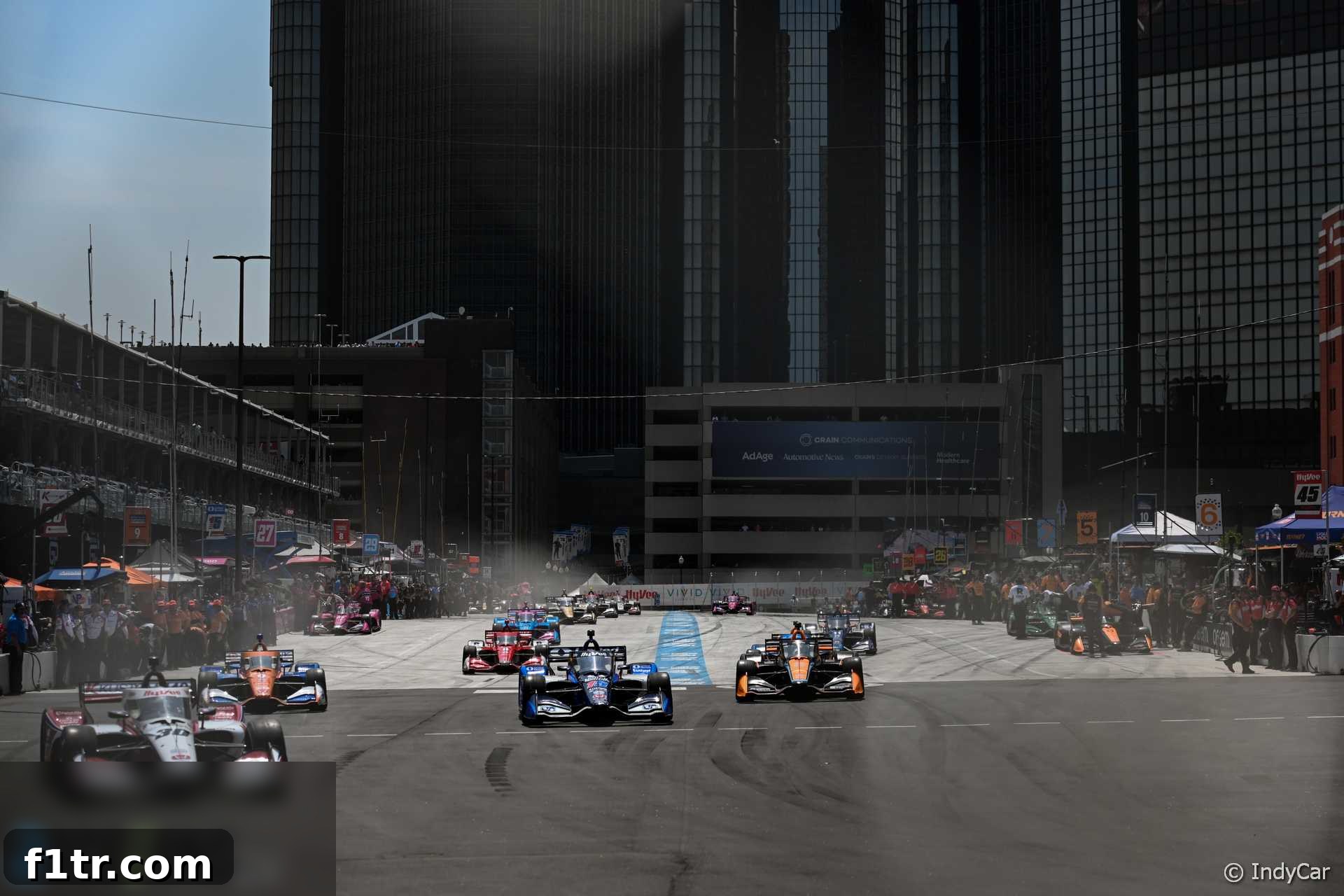
IndyCar has once again pushed the boundaries of conventional motorsport design, introducing a groundbreaking double-sided pit lane for its much-anticipated return to the streets of Detroit. This innovative, yet potentially contentious, configuration has been implemented out of necessity, driven by the unique and confined urban landscape of the new street circuit. While lauded for its ingenuity in maximizing limited space, this unconventional pit lane has already sparked considerable debate among drivers, teams, and fans regarding its safety and operational complexities, particularly where the two lanes converge and funnel back onto the high-speed racing line.
Advert | Become a Supporter & go ad-free
The decision to opt for a double-sided layout represents a significant departure from the traditional single-lane pit systems commonly found across global motorsports. Unlike purpose-built racetracks that offer ample room for extensive pit facilities, urban circuits like Detroit inherently present spatial challenges. The new 1.7-mile, 10-turn circuit, winding through the heart of downtown Detroit and around the General Motors Renaissance Center, simply could not accommodate a conventional, full-length pit lane without compromising the track layout or spectator areas. This engineering solution, therefore, became a pragmatic necessity, showcasing IndyCar’s commitment to bringing thrilling racing to accessible urban environments, even if it introduces unforeseen operational hurdles.
The Anatomy of an Unconventional Pit Lane: Merging and Exiting Challenges
The primary concern voiced by many drivers revolves around the critical junction where the two parallel pit lanes converge into a single exit path. This “funneling section” mandates that cars, often arriving at the pit entry simultaneously after a hectic stint, must merge from four lines of traffic (two on each side of the pit lane) into just two, and then into one, before seamlessly rejoining the race. McLaren’s Felix Rosenqvist articulated these anxieties after the track’s inaugural practice session, highlighting the intensity of this merge zone.
“When the session started there was quite a lot of cars coming in four-wide into the funnelling section,” Rosenqvist explained. “It’s kind of unique in that way because the pit-speed-limit-off section is way further, like after the funnel.” This specific design choice means that drivers are released from the pit speed limit only *after* navigating the tight merge, potentially leading to aggressive maneuvers and a reluctance to lift off the throttle, as drivers vie for track position even before they’ve fully cleared the pit lane. The inherent competitive spirit of IndyCar drivers, where every inch of track is contested, could elevate the risk of incidents in this high-stakes section, transforming a routine pit stop into a high-stakes maneuvering challenge.
The Pit Exit Conundrum: Racing Line Intrusion and Qualifying Impact
Beyond the merging dilemma, the pit lane exit presents its own set of challenges, particularly its proximity to the racing line at the track’s first left-handed turn. Pato O’Ward, Rosenqvist’s McLaren teammate, voiced significant concerns about this crucial point. “I think that’s going to be interesting in the race with the blend line where it is,” O’Ward stated, underscoring the potential for conflict between cars rejoining the circuit and those already at full racing speed. This intersection of high-speed racing and slower, exiting traffic introduces a critical safety concern that requires meticulous management from both drivers and race control.
Advert | Become a RaceFans supporter andgo ad-free
The blend line, a painted demarcation designed to guide exiting cars safely onto the track, appears to be positioned in a manner that could force returning drivers directly into the path of oncoming traffic, especially at Turn 1 – a corner where drivers typically carry considerable speed. This scenario is problematic not only for safety during the race but also critically for qualifying sessions. O’Ward highlighted the risk of “impeding” – an infraction where a slower car obstructs a faster car on a hot lap – suggesting that the pit exit could become a flashpoint for penalties and frustrating compromises. “I think the pit exit is going to be something to look out for in qualifying, like impeding and stuff like that,” O’Ward elaborated. “I don’t know if they’re going to mark it as impeding, but it definitely gets you out of place if someone gets sent there while you’re on a flier.” The nuances of race control judgment in such situations become paramount. A driver on a crucial qualifying lap, pushing the limits for pole position, could have their effort nullified by an exiting car, even if the latter is merely following the blend line. This delicate balance between safety, fair play, and competitive advantage puts immense pressure on both drivers and race officials to navigate the unique challenges of the Detroit pit lane with utmost precision.
Driver Confidence vs. Caution: A Divided Paddock
Despite the anxieties expressed by some, not all drivers share the same level of apprehension regarding the Detroit pit lane’s novel design. Kyle Kirkwood offered a more optimistic assessment, suggesting that initial concerns might be overblown and that the system, in practice, functioned effectively during Friday’s practice sessions. “In my mindset, it’s very safe,” Kirkwood asserted, providing a counterpoint to the prevailing caution. “That’s the most important part.” His perspective emphasizes the importance of direct experience over pre-conceived notions, highlighting how drivers quickly adapt to new circuit configurations.
Kirkwood’s confidence stems from his experience during the early runs, where he observed that the pit exit, initially perceived as a major hazard, proved to be manageable. “It seems like pit exit was a concern for everyone yesterday, but it doesn’t seem like it’s going to be that big of an issue. I think everyone’s pretty calm now on exit.” He emphasized the reliance on active communication and driver awareness: “It’s pretty easy to see a car coming out, to be honest you can’t really see the car that’s on-track, so you’re very reliant on the car that’s on-track to give way and for you to just kind of stay out of the way.” This highlights the unwritten rules of engagement and the professional courtesy often exchanged between drivers, which becomes even more critical in such confined and challenging environments. Kirkwood concluded his assessment with a clear endorsement of the core innovation: “But that was more the concern than the double pit lane. I think the double pit lane has been absolutely fine.” His views suggest that while the pit exit demands respect, the double-sided nature of the pit lane itself, once understood, is a practical and safe solution.
Navigating Risk and Innovation in Urban Motorsport
The Detroit Grand Prix pit lane serves as a potent microcosm of the larger challenges and triumphs of modern urban motorsport. Street circuits, by their very nature, require extraordinary compromises and ingenious solutions to adapt racing infrastructure to existing city layouts. While they bring the thrill of high-speed competition directly to urban populations, they also force engineers and organizers to confront spatial limitations that purpose-built tracks do not. The double-sided pit lane is a prime example of this innovative spirit, pushing the boundaries of what is considered conventional in the pursuit of spectacle and accessibility.
IndyCar’s embrace of such a unique design also underscores the series’ commitment to adapting and evolving. However, the initial feedback from drivers like Rosenqvist and O’Ward serves as a crucial reminder that innovation must always be balanced with rigorous safety considerations and practical race day implications. Race control and the stewards will undoubtedly be under immense scrutiny to manage incidents, enforce rules, and ensure the integrity of competition, especially during crucial moments like qualifying and pit stop cycles. The effective communication between race officials and drivers, coupled with clear guidelines, will be paramount to ensuring a smooth and safe event.
The blend of concern and cautious optimism within the paddock reflects the inherent duality of pushing boundaries in motorsport. While the double-sided pit lane introduces potential complexities, it also adds another layer of intrigue to the Detroit Grand Prix, making pit strategy and driver awareness even more critical determinants of success. As the racing weekend unfolds, all eyes will be on this unique feature, observing how drivers adapt to its demands and whether IndyCar’s bold design proves to be a stroke of genius or a source of contention. Ultimately, it’s a testament to the dynamic nature of IndyCar racing, where ingenuity and bravery go hand-in-hand, even on pit road, promising a compelling spectacle for fans and a challenging test for competitors.
Become a RaceFans Supporter and Go Ad-Free
RaceFans thrives thanks to the invaluable support of its dedicated readers. By contributing a modest £1 per month or £12 per year (or its equivalent in your local currency), you play a crucial role in covering the ongoing costs of content creation, website hosting, and continuous development of RaceFans, ensuring its future growth and quality.
Join the community of RaceFans Supporters today and enjoy an uninterrupted, ad-free browsing experience across the entire site. Discover more about becoming a supporter or sign up through the links provided below:
- Become a RaceFans Supporter
- RaceFans Supporter FAQ
Advert | Become a RaceFans supporter andgo ad-free
IndyCar: Further Insights and Updates
- IndyCar driver McLaughlin cleared of injury after crashing through barrier at Barber
- Schumacher says his IndyCar feels like ‘an F2 car, just with better tyres’
- IndyCar “way faster than Formula 1” in some corners, says Grosjean
- FIA to award more F1 superlicence points to IndyCar drivers from 2026
- Schumacher to race full-time in IndyCar with RLL in 2026
Browse all IndyCar articles