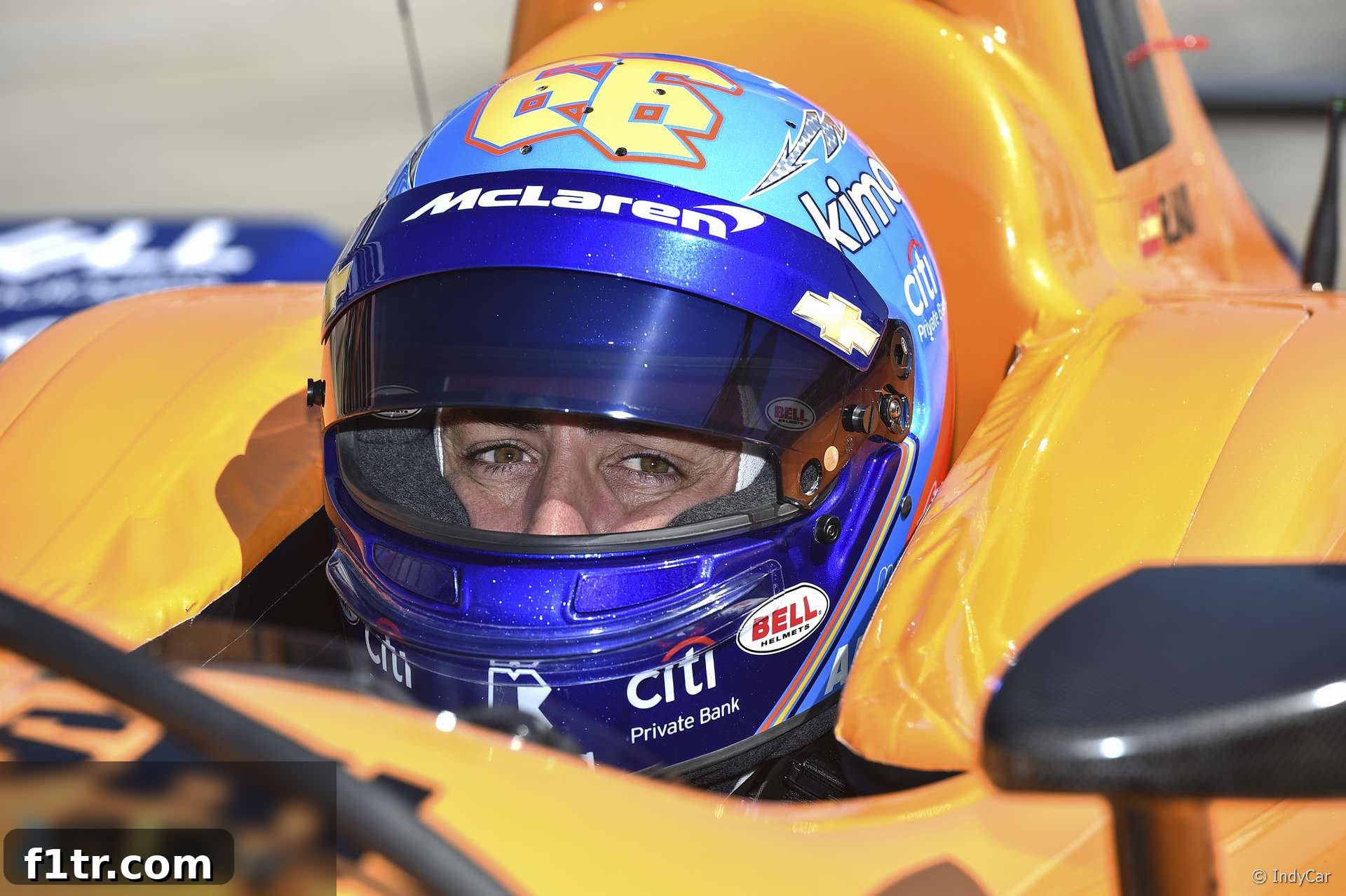
The pursuit of motorsport’s elusive “Triple Crown” remains one of the ultimate tests of a driver’s versatility and skill. For two-time Formula 1 World Champion Fernando Alonso, conquering the legendary Indianapolis 500 is the final jewel in this prestigious crown. However, achieving victory at the iconic Brickyard demands more than just raw talent; it requires profound commitment and intimate understanding of the unique challenges presented by oval racing, a sentiment strongly echoed by this year’s Indy 500 winner, Simon Pagenaud.
Advert | Become a Supporter & go ad-free
Pagenaud, who celebrated his Indy 500 triumph in his eighth attempt this year, firmly believes that Alonso must dedicate himself to a full season of IndyCar racing to truly maximize his prospects of claiming the coveted Borg-Warner Trophy. Having competed full-time in the series since 2012, Pagenaud’s seasoned perspective offers invaluable insight into the intricate nature of the “Greatest Spectacle in Racing” and why a one-off appearance might no longer suffice for a driver aiming for victory.
“Winning the Indy 500 is far from easy; it’s an extraordinary feat,” Pagenaud asserted, reflecting on his arduous journey to victory lane. “It took me several years of dedicated effort and learning. You just have to look at motorsport legends like Tony Kanaan, who needed 13 attempts to finally achieve his dream. Dario Franchitti, another multiple winner, would undoubtedly tell you the same – it’s a race that demands immense patience, perseverance, and a deep understanding of its nuances.”
The Indianapolis 500 stands apart not only for its historical significance but also for its unparalleled competitive intensity. Held just once a year, this 500-mile endurance race presents a unique set of strategic and technical hurdles. “It’s one of the most difficult races to win globally because of its annual occurrence,” Pagenaud explained. “There are typically eight critical pit stops throughout the race, and for victory, you absolutely need a perfect team executing flawlessly in every single one. Precision, speed, and synchronization are paramount. Simultaneously, your strategy must be impeccable, adapting to changing race conditions, managing tire wear, and optimizing fuel consumption. Every decision, every move, can be the difference between glory and disappointment.”
Beyond the operational excellence of the pit crew and the shrewdness of the strategists, the performance of the car itself is non-negotiable. “You need the right engine package for that specific year, one that delivers both raw power and reliability under extreme conditions,” Pagenaud elaborated. “Crucially, you also need strong teammates who can contribute to developing and fine-tuning the car setup during practice sessions and qualifying. Their data, feedback, and ability to push the car to its limits are vital for creating a winning package.”
The delicate art of car setup at Indy is perhaps the most challenging aspect. “You simply cannot afford to make mistakes with the setup,” Pagenaud stressed. “Even a minor error can leave you buried deep in the field for the entire race, making it a truly nightmarish day. When you’re hitting speeds of 400 kilometers an hour (approximately 250 mph) at the end of the straights, following another car means dealing with turbulent air – essentially, you’re navigating the wake of a fighter jet. This significantly destabilizes your car and demands incredible skill and confidence to manage.”
Environmental factors further compound the complexity of the race. “Temperature variations are another significant problem at Indy,” Pagenaud highlighted. “As the track temperature rises, the car’s handling characteristics change dramatically. It tends to become very ‘loose,’ meaning the rear end slides excessively. This makes controlling the car incredibly complicated and physically demanding, pushing drivers to their absolute limits for hours on end.”
Alonso’s ambitious goal of becoming only the second driver in history, after Graham Hill, to achieve motorsport’s ‘Triple Crown’ – a feat that encompasses victories in the Monaco Grand Prix, the Le Mans 24 Hours, and the Indianapolis 500 – underscores his extraordinary talent and drive. Having already secured victories at Monaco and Le Mans, the Indy 500 represents the final, most elusive piece of his personal puzzle. Pagenaud, himself a veteran of Le Mans, offers a compelling comparison between the two prestigious endurance events, emphasizing the distinct nature of the Indy 500.
“While winning Le Mans is undeniably complicated and requires immense effort, imagine having 33 competitors on the grid, each one as talented and as determined as you are, all vying for that single victory,” Pagenaud articulated, painting a vivid picture of the Indy 500’s competitive landscape. “To me, it’s probably the toughest race in the world to win, primarily because of the sheer depth of competition and the multitude of unpredictable factors that can come into play throughout the 500 miles. Every driver, every team, is meticulously prepared, and the margins for error are infinitesimally small.”
Pagenaud’s advice to Alonso is rooted in his own experience and the lessons learned over years of racing in IndyCar. “Ultimately, it’s Fernando’s decision, his career path, and what he truly feels is right for him,” Pagenaud acknowledged. “However, from my perspective, to have a realistic chance of winning Indy, and to have a shot at winning it consistently, you need to be fully immersed in the series. This means doing the full season with your team, building strong relationships, and fostering mutual understanding. It’s about knowing them inside and out, and critically, them knowing you – your driving style, your preferences, your strengths, and your areas for development.”
Alonso’s previous attempts at the Indianapolis 500 have offered a mixed bag of results and invaluable lessons. His highly anticipated debut in 2017 with McLaren and Andretti Autosport showcased his undeniable talent on ovals, as he led a significant number of laps before being forced to retire due to an engine failure. That performance electrified the motorsport world and fuelled his Triple Crown aspirations. However, his return in 2019 proved to be a stark reminder of the race’s unforgiving nature, as he agonizingly failed to qualify for the event in McLaren’s single-car entry, a moment that sent shockwaves through the paddock and highlighted the immense challenge of even making it onto the grid.
A full season in IndyCar would allow Alonso to experience the diverse range of tracks, from high-speed ovals to challenging road courses and unforgiving street circuits. This exposure would be crucial for understanding tire degradation across different surfaces, mastering fuel saving techniques unique to IndyCar, and adapting to the distinct dynamics of the Dallara chassis with its various aero configurations. Such a commitment would not only sharpen his skills but also allow him to develop a deeper connection with his engineering team, fostering the seamless communication and trust essential for success.
Furthermore, dedicating a full season to IndyCar would help Alonso develop the specific muscle memory and instinct required for oval racing. The close-quarters action, the reliance on aerodynamic wash, and the precision needed for consistent lap times in traffic are skills best honed through continuous practice and race experience. It would also enable him to become more familiar with the competitive rhythms of the series, understanding the strengths and weaknesses of his rivals, and adapting to the dynamic flow of races that often feature multiple lead changes and intense battles.
As Pagenaud himself gears up for the IndyCar season finale at Laguna Seca this weekend, where he sits third in the championship, aiming to reclaim the title he previously won in 2016, his words carry the weight of experience. His journey exemplifies the dedication required to conquer the pinnacle of American open-wheel racing. For Fernando Alonso, the path to the Triple Crown may indeed lie in embracing the full challenge of IndyCar, not just the single, glorious race at Indianapolis, but the entire, demanding season that forges true champions.
Advert | Become a RaceFans supporter andgo ad-free
IndyCar
- IndyCar driver McLaughlin cleared of injury after crashing through barrier at Barber
- Schumacher says his IndyCar feels like ‘an F2 car, just with better tyres’
- IndyCar “way faster than Formula 1” in some corners, says Grosjean
- FIA to award more F1 superlicence points to IndyCar drivers from 2026
- Schumacher to race full-time in IndyCar with RLL in 2026
Browse all IndyCar articles