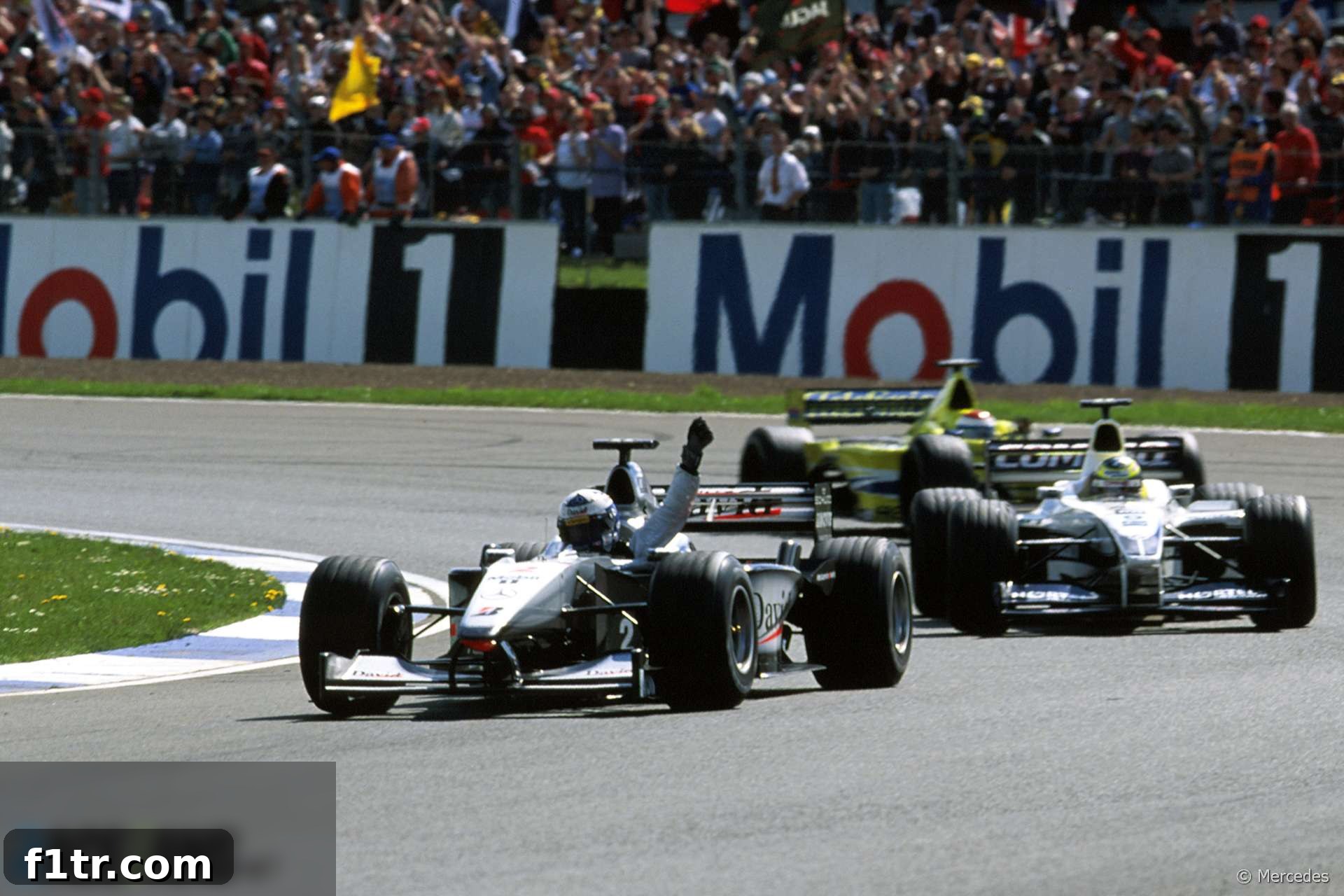
Silverstone, a circuit steeped in Formula 1 history, is renowned for its capricious weather. Locals and seasoned racegoers will often quip about its two default settings: relentlessly wet, biting cold, and blustery, or a scorching sun-trap that leaves spectators resembling ripe beetroot. Indeed, it’s not uncommon to experience both extremes within a single weekend, returning home with the distinct memory of both a shiver down your spine and a fission-grade sunburn.
This notoriously unpredictable nature made Bernie Ecclestone’s decision to schedule the 2000 British Grand Prix for mid-April particularly baffling. The consequences were almost inevitable: a weekend defined by persistent rain, highly changeable conditions, and an overwhelming amount of mud. Even decades later, circuit staff preparing the outer car parks would occasionally unearth fossilized remnants of Ford Mondeos, their tattered Coulthard flags a poignant, almost archaeological, reminder of a weekend that offered F1 fans a truly unique, albeit challenging, experience – conditions eerily reminiscent of the Great War trenches. Yet, against all odds and the prevailing forecasts, the main event itself unfolded on a miraculously dry track.
The F1 circus arrived at Silverstone with Michael Schumacher, the formidable Ferrari driver, in a commanding position. He had dominated the early stages of the 2000 season, clinching victory in the first three races and establishing a significant lead in the Drivers’ Championship standings. In stark contrast, reigning champion Mika Hakkinen of McLaren was experiencing a challenging start, with just six points to his name from a single second-place finish. This alarming deficit was clearly taking its toll on McLaren team principal Ron Dennis, a man whose usual ebullience could make even the most cheerful individual seem subdued, now visibly stripped of his customary optimism.
Qualifying: A Twist in the Tale
The build-up to the qualifying session was a chaotic affair, with free practice sessions held under virtually every conceivable weather condition, save for snow. The damp Saturday morning session saw Schumacher momentarily lose control, spinning off the track. What followed raised eyebrows and ignited a fresh wave of controversy: the fuel filler flap on his F1-2000 visibly popped open, then promptly closed again.
This incident occurred amidst a period of intense scrutiny over technical regulations. At the previous round, FIA president Max Mosley had dropped a bombshell, revealing that three unnamed teams had been suspected of using banned traction control systems during the preceding season. A subsequent rule change had been implemented specifically to prevent teams from using pit-lane speed limiters as a disguised form of traction control. Ferrari’s technical director, Ross Brawn, confirmed that the same button which activated the pit lane speed limiter also triggered the fuel filler flap on the F1-2000. However, Brawn vehemently denied any suggestion that Ferrari was illicitly using the system for traction control, maintaining that the activation was purely coincidental to the pit lane speed limiter function.
As the crucial qualifying session commenced, the capricious Silverstone weather began to show mercy. Conditions remained chilly but the track was progressively drying, setting the stage for a tense battle for pole position. In a significant upset to the established order of the 2000 season, Mika Hakkinen’s impressive run of pole positions was broken, not by championship rival Michael Schumacher, but by his own McLaren teammate, Rubens Barrichello. This marked the Brazilian’s third career pole position, achieved with as many different teams, having previously started from the front for Jordan and Stewart, showcasing his raw speed and adaptability.
The front row of the grid presented an unexpected sight for the top two teams, McLaren and Ferrari. Heinz-Harald Frentzen, driving for Jordan, delivered a stellar performance, seizing second place by an incredibly narrow margin – just three-thousandths of a second slower than Barrichello’s pole time. Both Hakkinen and Coulthard encountered issues during their fastest laps, relegating them to the second row of the grid, sharing positions three and four respectively.
Championship leader Michael Schumacher was making his return to Silverstone for the first time since his leg-breaking crash at the circuit the previous year. He even paid a visit to the medical team who had treated him, acknowledging their critical role in his recovery. However, he struggled to find optimal pace in qualifying, ultimately having to settle for fifth on the grid after mistiming his final flying lap by a mere tenth of a second. Despite his disappointment, the distraught crowd responded to the announcement of his grid position with a heartwarming and uplifting cheer, a testament to his enduring popularity and their relief at seeing him back on track after his accident.
Following a challenging weekend at Imola, young Jenson Button, driving for Williams, delivered an exceptional performance in his very first home Grand Prix. He qualified an impressive sixth, a strong rebound after a troubled free practice, and notably out-qualified the younger Schumacher brother, Ralf, by a narrow margin of five-hundredths of a second, much to the delight of the British fans.
Grid Positions: The Starting Line-up for Silverstone 2000
| Position | Driver | Car | Time |
|---|---|---|---|
| 1 | Rubens Barrichello | Ferrari | 1’25.703 |
| 2 | Heinz-Harald Frentzen | Jordan | 1’25.706 |
| 3 | Mika Hakkinen | McLaren | 1’25.741 |
| 4 | David Coulthard | McLaren | 1’26.088 |
| 5 | Michael Schumacher | Ferrari | 1’26.161 |
| 6 | Jenson Button | Williams | 1’26.733 |
| 7 | Ralf Schumacher | Williams | 1’26.786 |
| 8 | Jos Verstappen | Arrows | 1’26.793 |
| 9 | Eddie Irvine | Jaguar | 1’26.818 |
| 10 | Jacques Villeneuve | BAR | 1’27.025 |
| 11 | Jarno Trulli | Jordan | 1’27.164 |
| 12 | Giancarlo Fisichella | Benetton | 1’27.253 |
| 13 | Pedro Diniz | Sauber | 1’27.301 |
| 14 | Johnny Herbert | Jaguar | 1’27.461 |
| 15 | Jean Alesi | Prost | 1’27.559 |
| 16 | Ricardo Zonta | BAR | 1’27.772 |
| 17 | Nick Heidfeld | Prost | 1’27.806 |
| 18 | Mika Salo | Sauber | 1’28.110 |
| 19 | Pedro de la Rosa | Arrows | 1’28.135 |
| 20 | Alexander Wurz | Benetton | 1’28.205 |
| 21 | Marc Gene | Minardi | 1’28.253 |
| 22 | Gaston Mazzacane | Minardi | 1’29.174 |
Race Day: Drama, Strategy, and a Home Victory
Race day dawned under a thick blanket of fog, casting an ethereal, almost eerie, atmosphere over Silverstone. The density of the mist was such that the crucial pre-race warm-up session had to be delayed, as the essential medical helicopter was unable to land at the circuit. This logistical challenge extended to attendees; celebrities and VIPs, ordinarily whisked to the track with ease, were forced to navigate the muddy approaches via shuttle bus. The traditional drivers’ parade, a highlight for many fans, was also regretfully cancelled, adding to the melancholic start of the day.
However, as if by some divine intervention for the racing gods, the weather miraculously cleared by race time. The clouds dispersed, revealing a surprisingly sunny sky and a dry track – a stark contrast to the preceding days. Pole-sitter Rubens Barrichello capitalised perfectly on his advantage, leading the field into Copse, Silverstone’s iconic and challenging first corner. He was closely followed by Heinz-Harald Frentzen and the two McLarens. Jacques Villeneuve, known for his aggressive starts, once again surged forward, leaping up to sixth place. To the collective dismay of the partisan crowd, Michael Schumacher, starting fifth, had a less fortunate getaway, slipping down to eighth position. His younger brother, Ralf Schumacher, was among those who gained places, subsequently passing Villeneuve to claim sixth.
With most of the front-running teams opting for a single pit stop strategy for fuel and tyres, a significant portion of the race was decided on track. Drivers had to skillfully manage their pace, execute daring overtakes, and strategically seek out clear air to perform over-cuts or under-cuts on their rivals. This placed a premium on consistent lap times and precise car handling.
The turning point in the race came on lap 24, when Heinz-Harald Frentzen made his crucial pit stop. This strategically released David Coulthard into clear air, providing him with the perfect opportunity to unleash his McLaren and hunt down the race-leading Ferrari of Barrichello. Coulthard, demonstrating exceptional pace and determination, steadily closed the gap over several nail-biting laps. On lap 30, the Scottish McLaren driver executed a bold and decisive move on Barrichello into Stowe corner, wrestling the lead away. After the race, Coulthard candidly admitted that this audacious pass was directly inspired by the legendary move Nigel Mansell had made on Nelson Piquet at the very same corner to claim the 1987 British Grand Prix – a true nod to Silverstone folklore. Once in the lead, Coulthard immediately began to build a significant advantage, showcasing the true potential of his McLaren.
Among the top contenders, Mika Hakkinen was the first to make his planned pit stop on lap 31, followed a couple of laps later by his teammate Coulthard. Both McLarens experienced flawlessly executed stops, returning to the track without any significant delay. For Ferrari, however, the pit stop sequence proved far more dramatic and ultimately disastrous. A hydraulic issue began plaguing Barrichello’s car, leading to a dramatic spin on his in-lap, followed by his unfortunate retirement from the race just a lap later. This devastating setback prematurely ended his hopes of converting pole position into victory. Meanwhile, Michael Schumacher, still running on low fuel, was absolutely flying, pushing his Ferrari to its limits in a desperate attempt to compensate for his slow start and close the gap to the leaders.
Once all the planned pit stops were completed, the order at the front saw David Coulthard firmly in the lead, followed by Mika Hakkinen, securing a dominant McLaren 1-2. Michael Schumacher held third place, ahead of Heinz-Harald Frentzen, who was running highest among the two-stop strategies, followed by Ralf Schumacher and Jenson Button, who was holding onto the last of the points positions. Unfortunately for Frentzen and Jordan, his strong run would not last much longer. His car became stuck in gear, forcing the German driver into a frustrating retirement after dropping down the order.
In the latter stages of the race, the tension began to build between the two leading McLaren drivers. Mika Hakkinen steadily chipped away at Coulthard’s advantage, as the race leader reportedly began suffering from gearbox glitches. Despite these mechanical concerns, Coulthard had built enough of a lead to hold off his teammate, taking the chequered flag by a margin of 1.4 seconds – a popular home victory. The Schumachers followed them across the line, Michael securing third ahead of Ralf, with Jenson Button earning valuable points for Williams in fifth. Jarno Trulli claimed the final point for Jordan, a modest result for a team that had harboured hopes of a much better showing at their home circuit, located directly opposite their factory.
Coulthard’s crucial victory at Silverstone brought the championship battle to life, firmly establishing him as the closest threat to Michael Schumacher. The pair were now separated by 20 points, with a substantial 130 points still available in the remainder of the season. This largely trouble-free home race for McLaren had injected vital momentum into their title challenge.
Having commenced its European season unusually early in Britain, Formula 1’s next destination would be the Spanish Grand Prix at the Circuit de Catalunya, scheduled just two weeks later. This brief hiatus provided just about enough time for the beleaguered Silverstone crowd to finally escape the infamous car park quagmires and make their way back home, undoubtedly with vivid memories of a weekend that defied expectations.
Race Result: 2000 British Grand Prix
| Position | Driver | Car | Laps | Time / gap / reason |
|---|---|---|---|---|
| 1 | David Coulthard | McLaren | 60 | 1:28’50.108 |
| 2 | Mika Hakkinen | McLaren | 60 | +1.477 |
| 3 | Michael Schumacher | Ferrari | 60 | +19.917 |
| 4 | Ralf Schumacher | Williams | 60 | +41.312 |
| 5 | Jenson Button | Williams | 60 | +57.759 |
| 6 | Jarno Trulli | Jordan | 60 | +19.273 |
| 7 | Giancarlo Fisichella | Benetton | 59 | +1 lap |
| 8 | Mika Salo | Sauber | 59 | +1 lap |
| 9 | Alexander Wurz | Benetton | 59 | +1 lap |
| 10 | Jean Alesi | Prost | 59 | +1 lap |
| 11 | Pedro Diniz | Sauber | 59 | +1 lap |
| 12 | Johnny Herbert | Jaguar | 59 | +1 lap |
| 13 | Eddie Irvine | Jaguar | 59 | +1 lap |
| 14 | Marc Gene | Minardi | 59 | +1 lap |
| 15 | Gaston Mazzacane | Minardi | 59 | +1 lap |
| 16 | Jacques Villeneuve | BAR | 56 | Gearbox |
| 17 | Heinz-Harald Frentzen | Jordan | 54 | Gearbox |
| 18 | Nick Heidfeld | Prost | 51 | Engine |
| 19 | Ricardo Zonta | BAR | 36 | Spun off |
| 20 | Rubens Barrichello | Ferrari | 35 | Hydraulics |
| 21 | Pedro de la Rosa | Arrows | 26 | Electrical |
| 22 | Jos Verstappen | Arrows | 20 | Electrical |
A Personal Recollection: Behind the Scenes at Silverstone 2000
I was incredibly fortunate to witness this memorable race from the exclusive confines of the Paddock and Paddock Club. At that time, my father worked for Orange, a prominent sponsor of the Arrows F1 team, which granted us unparalleled full access for the entire weekend. This privileged access meant we were mercifully spared the grim experience endured by countless other fans, who bravely trudged through the treacherous, muddy car parks. Our only minor disappointment was the unavoidable cancellation of our scheduled helicopter transfer on Sunday morning, a truly first-world problem! (Perhaps a JustGiving page for the emotional trauma of this cancellation might be appropriate for those who wish to contribute).
The entire experience was, quite simply, awesome. In those pre-selfie days, the focus was on genuine interaction. I eagerly collected autographs and, to my sheer delight, managed to meet almost the entire grid of drivers. Michael Schumacher, in particular, left a lasting impression; he was remarkably polite, approachable, and obliging, a characteristic shared by the overwhelming majority of drivers that weekend. Having spent much of the past decade working in professional paddocks in a more formal capacity, I vividly remember and occasionally miss the pure, unadulterated rush of being in that environment as a truly geeky, wide-eyed fan.
The Formula 1 paddock has, without a doubt, transformed massively since then. But back in 2000, once you gained entry, the drivers were surprisingly accessible. They certainly weren’t encircled by large entourages of public relations managers, personal trainers, or even garage feng shui consultants, as is often the case today. The team motorhomes, by current standards, were relatively understated, functional rather than extravagant. The core business and atmosphere of the paddock then was very much about the raw essence of motor racing, a palpable sense of focus and passion.
I am confident that the Paddock Club experience has also evolved considerably, yet even then, it largely met expectations. It offered impeccable wining and dining, served at mixed tables often shared by business executives and the celebrities they had invited to promote their brands. The conversational common ground, however, was often sparse and superficial. Intriguingly, few in the Paddock Club seemed particularly invested in the actual race; many would drift away from the grandstand a few laps in. I personally found it a somewhat peculiar environment to fully immerse oneself in the thrill of F1. To such an extent, in fact, that my craving for ‘proper racing’ led us to Castle Combe the very next day, to experience the unvarnished excitement of a club-level race.
Explore More Grand Prix Flashbacks
- 40 years ago today: How a tyre war prompted Senna’s unfinished Monaco masterpiece
- Schumacher seals record-breaking 10th constructors championship for Ferrari
- Strategic superiority clinches Schumacher’s first Ferrari title
- Disaster for Hakkinen brings title within Schumacher’s grasp
- Schumacher turns the tide against McLaren on tragic day at Monza
Dive into more captivating moments from Formula 1 history by exploring our full collection of Grand Prix flashbacks.