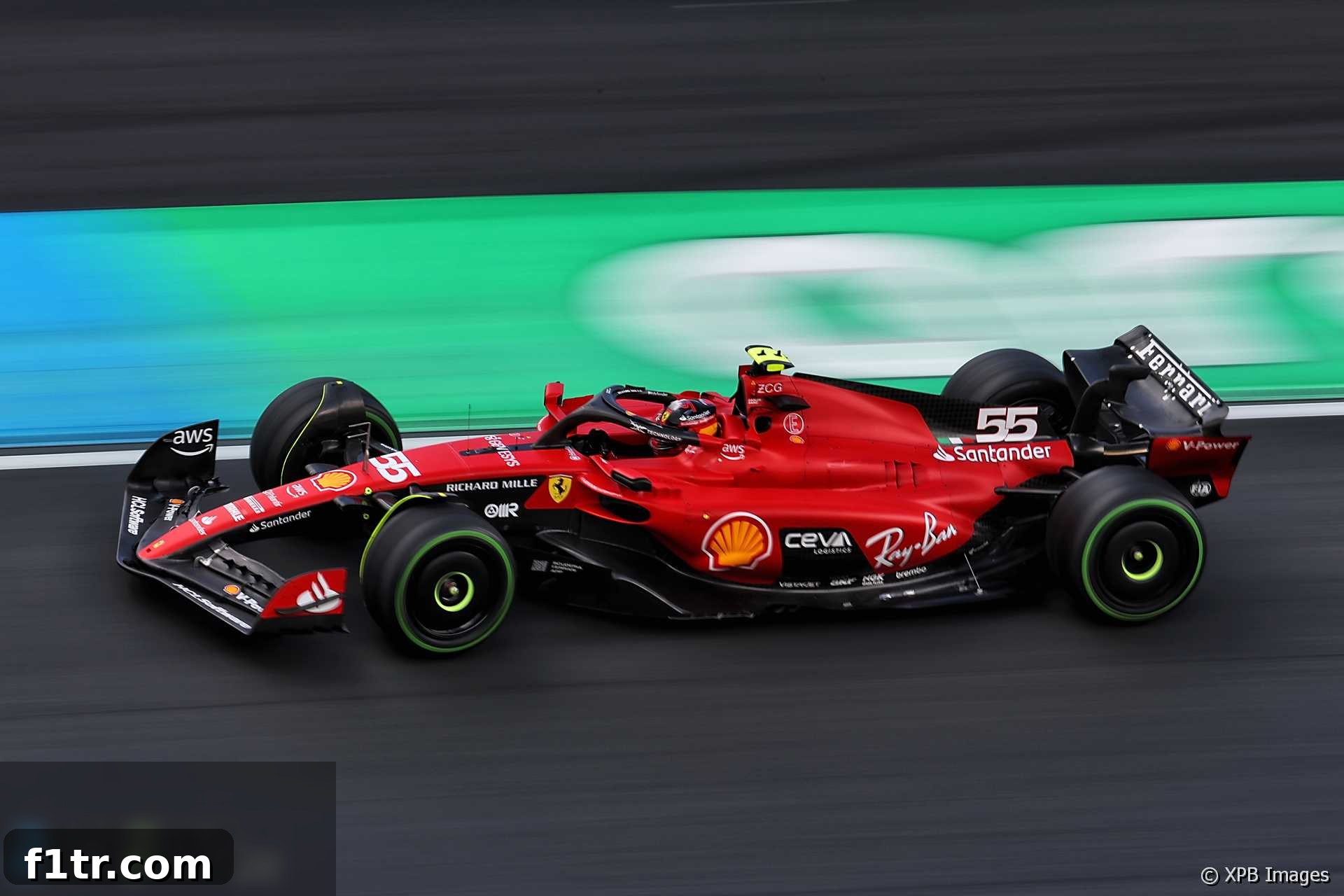
Charles Leclerc’s Ferrari Frustration: Unpredictable SF-23 and Hopes for a 2024 Overhaul
Charles Leclerc expressed profound frustration following his qualifying crash at the Dutch Grand Prix, admitting to having “zero idea” how his Ferrari SF-23 would behave from one corner to the next. The incident, which saw him hit the barriers during Q3, underscored a challenging weekend for the Monegasque driver and highlighted persistent handling issues with the current Ferrari challenger.
A Driver’s Nightmare: Unpredictable Handling at Zandvoort
Leclerc, a driver known for his exceptional talent and ability to extract maximum performance from his machinery, found himself battling not just the clock but also a car that offered little in the way of confidence. “It’s just a very difficult weekend,” Leclerc confessed after the session. “Every time you get into the car not knowing what you are going to get is not a situation I like.” This candid admission paints a vivid picture of the psychological toll such unpredictability takes on a Formula 1 driver, where split-second decisions and absolute confidence in the car’s limits are paramount.
The incident occurred at Turn 9, a critical point on the undulating Zandvoort circuit. According to Leclerc, this corner, along with Turns 1 and 10, had been a significant headache for him and the team throughout the practice sessions. “It’s one of those weekends where the car is extremely difficult to drive,” he reiterated, emphasizing the deep-seated nature of the problem. Modern Formula 1 cars are finely tuned instruments, and any inconsistency in their behavior can profoundly impact a driver’s ability to push to the absolute limit, especially on a demanding track like Zandvoort, known for its high-speed, banked corners and unforgiving run-off areas.
The SF-23’s Achilles’ Heel: Specific Corners and Lack of Confidence
Leclerc delved deeper into the technical specifics of his struggles, identifying key areas where the Ferrari SF-23 was particularly challenging. “Since FP1, we’ve been struggling in turns one, nine, and 10. We changed the car completely and honestly there’s not much that helps us in these three corners,” he explained. This indicates that despite significant setup changes and adjustments, the underlying characteristics of the car prevented a resolution to these handling anomalies. The unique aerodynamic demands of Zandvoort, with its rapid changes in direction and elevation, seem to have exposed a fundamental weakness in the SF-23’s design or its setup window.
He described the sensation in Turn 9 and 10 as particularly unnerving: “Turn nine and 10 is one of those corners where you go into the corner, you are releasing the brakes, there’s absolutely no grip in mid-corner for whatever reason. And then you are just trusting the car gripping again in the exit, which it didn’t on that lap and I obviously ended up in the wall.” This description highlights a critical issue: a lack of mid-corner grip, which is essential for carrying speed and maintaining stability. When a driver cannot trust the car to maintain its purchase on the track, it becomes impossible to drive at the cutting edge, leading to either cautious driving or, as in this case, a costly error.
Decoding Understeer and Oversteer: The F1 Driver’s Constant Battle
In Formula 1, the terms “understeer” and “oversteer” are central to a car’s handling characteristics, and Leclerc’s comments perfectly illustrate their impact. Understeer occurs when the front tires lose grip, causing the car to turn less sharply than intended. Conversely, oversteer is when the rear tires lose grip, leading the car to turn more sharply, often resulting in a slide. For Leclerc, the problem was the unpredictable oscillation between these two states: “In Formula 1 it’s all about anticipating and knowing what balance you are going to get once you get into the corner. But at the moment I’m getting into the corner and I have zero idea whether I’m going to have huge understeer, huge oversteer, and that makes it very, very difficult for us.”
This lack of a consistent balance makes it impossible for a driver to commit fully, especially when pushing the limits in qualifying. A driver relies on a predictable car to modulate throttle, braking, and steering inputs with precision. When that predictability is absent, it erodes confidence, slows lap times, and increases the risk of mistakes. The SF-23, on this particular weekend, proved to be an exceptionally challenging machine to tame, leaving Leclerc feeling isolated and uncertain behind the wheel.
Ferrari’s 2024 Vision: A Complete Overhaul
Amidst the immediate frustrations, there’s a beacon of hope for Leclerc and the Ferrari team. Just a day before qualifying, Ferrari’s head of chassis development, Enrico Cardile, revealed the team’s ambitious plans to significantly change its car for 2024. Leclerc’s reaction was one of clear relief: it was “great to hear that.” This statement, coming from a driver so acutely aware of the current car’s shortcomings, underscores the severity of the SF-23’s issues and the team’s commitment to radical change.
The phrase “completely different” implies more than just evolutionary upgrades; it suggests a fundamental rethinking of Ferrari’s car concept. This could involve significant alterations to the aerodynamic philosophy, suspension design, or even the weight distribution and overall architecture of the car. For a top team like Ferrari, admitting the need for such a drastic overhaul speaks volumes about the challenges they’ve faced in 2023, particularly in understanding and extracting consistent performance from their package. The team has often struggled with a narrow operating window for their cars, making them highly sensitive to track conditions, tire temperatures, and setup choices – a trait that seems to have been particularly amplified at Zandvoort.
The Psychological Toll on a Top Driver
For a driver of Charles Leclerc’s caliber, whose career has been marked by raw speed and fearless driving, grappling with an unpredictable car is profoundly challenging. Top F1 drivers thrive on pushing the absolute boundaries, finding the last hundredth of a second by dancing on the edge of grip. When that edge is constantly shifting and unknown, it undermines the very essence of their craft. “Obviously I can’t wait but first I’ve got a season to finish in ’23. But we can only go another direction because at the moment honestly the car is really difficult to drive,” Leclerc remarked, articulating the dual focus required: completing the current season while eagerly anticipating a fresh start.
The struggle at Zandvoort wasn’t just about lap times; it was about the fundamental trust between driver and machine. “It’s just very difficult to be on the limit,” Leclerc explained. “I think we are particularly struggling this weekend and even more so than what the balance would slow us down, just because we need to be so far off the limit because as soon as you get close to the limit, you just really don’t know what’s going to happen. That’s exactly what happened in my Q3 lap so it’s a difficult situation.” This candid insight reveals the conservative approach drivers must adopt when faced with such an unreliable package, ultimately compromising performance. It’s a stark reminder that even the most talented drivers are constrained by the capabilities – and temperament – of their cars.
The Bigger Picture: Ferrari’s Season and the Quest for Consistency
Ferrari’s 2023 season has been a rollercoaster of expectations and reality. After a strong finish to 2022, hopes were high for a championship challenge, but the Red Bull juggernaut and the SF-23’s inconsistent performance have dashed those dreams. While there have been flashes of brilliance, particularly from Leclerc and Carlos Sainz, the team has struggled to maintain form across different circuits and conditions. The Zandvoort weekend, therefore, is not an isolated incident but rather another chapter in a season defined by a persistent search for stability and predictability. Teams like Mercedes and Aston Martin have also faced their own challenges, but Ferrari’s struggles often come under intense scrutiny due to its storied history and passionate fanbase.
The team’s commitment to a significant redesign for 2024 is a clear acknowledgement that incremental changes are no longer sufficient. It signifies a strategic shift, likely influenced by comprehensive data analysis and driver feedback throughout the current season. The goal will be to create a car with a much wider operating window, one that is less sensitive to setup changes and can perform consistently across various tracks and environmental conditions, thereby unlocking the full potential of its immensely talented driver pairing.
Looking Beyond Zandvoort: Hopes for a Strong Finish and a Brighter Future
Despite the current difficulties, Leclerc remains focused on salvaging what he can from the remainder of the 2023 season. “So it’s been a very difficult weekend and hopefully we can have a clean race,” he concluded, highlighting the immediate priority of navigating the Dutch Grand Prix safely and effectively from his ninth-place starting position. The unpredictability of the Zandvoort circuit and the variable weather conditions common in the Netherlands could present opportunities for strategic gains, even with a challenging car. While the championship is out of reach, securing strong points finishes is crucial for Ferrari in the Constructors’ Championship battle.
The Path Forward: Development and Driver Feedback
The journey from a challenging current car to a successful future one is arduous, relying heavily on the synergy between drivers, engineers, and designers. Leclerc’s detailed feedback, though perhaps painful to deliver and hear, is invaluable for Ferrari’s technical team. His insights into specific corner behaviors, grip levels, and the car’s general temperament will be crucial in guiding the development of the 2024 challenger. The transition will require meticulous planning, rigorous simulation, and extensive testing to ensure that the “completely different” car lives up to its promise of predictability and raw pace. The team will undoubtedly be focused on understanding the root causes of the SF-23’s issues, whether they stem from fundamental aerodynamic concepts, mechanical setup limitations, or a combination of factors, to avoid repeating similar mistakes.
Support Independent F1 Journalism
Bringing the F1 News Directly from the Source
RaceFans strives to bring its readers news directly from the key players in Formula 1. We are able to do this thanks in part to the generous backing of our RaceFans Supporters.
By contributing £1 per month or £12 per year (or the equivalent in other currencies) you can help cover the costs involved in producing original journalism: Travelling, writing, creating, hosting, contacting and developing.
We have been proudly supported by our readers for over 10 years. If you enjoy our independent coverage, please consider becoming a RaceFans Supporter today. As a bonus, all our Supporters can also browse the site ad-free. Sign up or find out more via the links below:
- Become a RaceFans Supporter
- RaceFans Supporter FAQ
2023 Dutch Grand Prix Related Articles
- Azerbaijan GP defeat was key to record-equalling run of wins – Verstappen
- “Too early to say” if podium signals return to form for Aston Martin – Alonso
- Verstappen makes history with unbeaten hat-track in first home races
- Perez is ‘doing his job and will be our driver in 2024’, Horner insists
- Ferrari had the “sixth or seventh fastest car” at Zandvoort – Sainz
Browse all 2023 Dutch Grand Prix articles