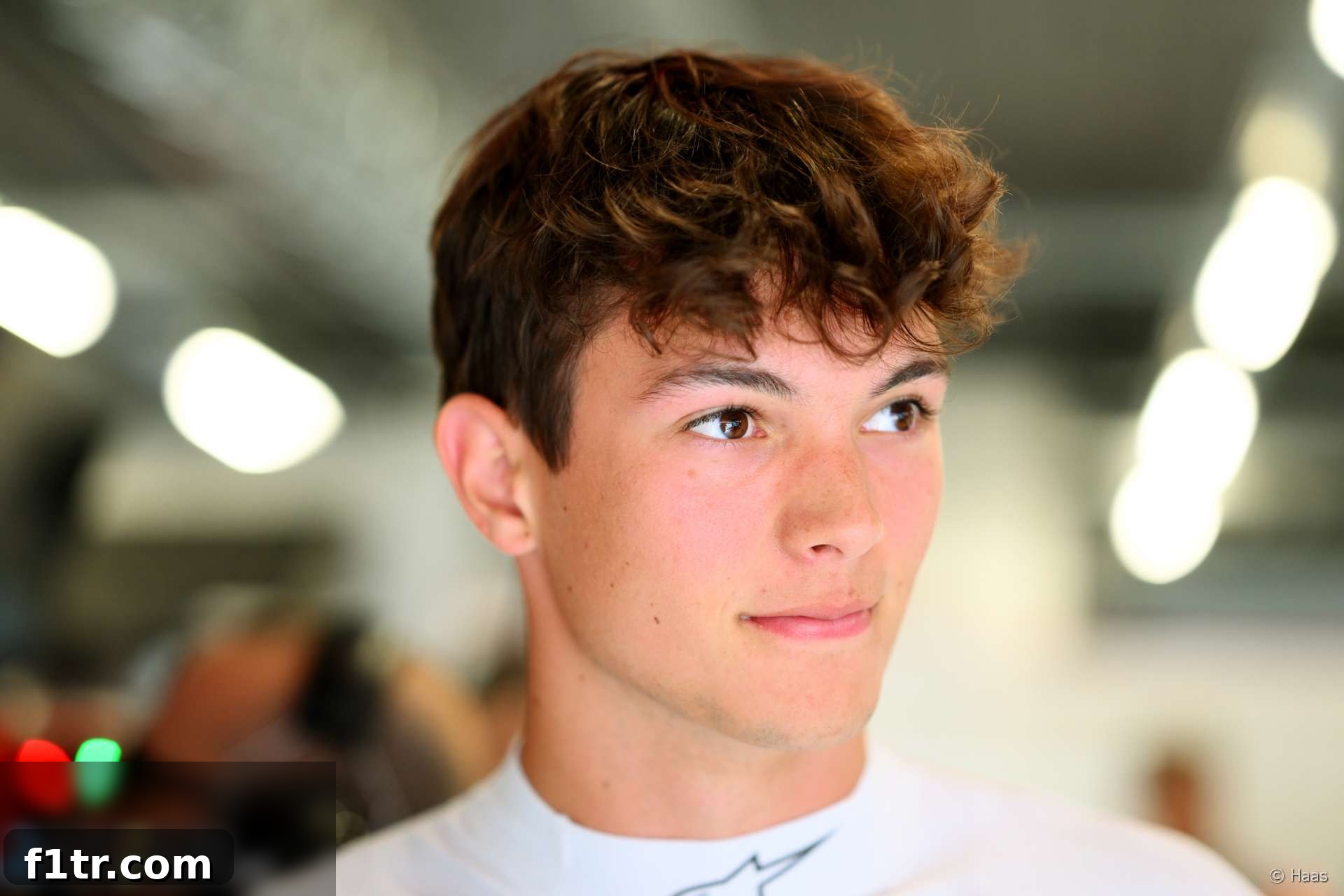
In the high-stakes arena of Formula 1, few young talents have captured attention quite like Oliver Bearman. Last year, he emerged as the grid’s quintessential ‘super-sub,’ delivering a series of largely impressive one-off performances for both Ferrari and Haas, hinting at a prodigious future. However, his eagerly anticipated transition into a full-time F1 driver role has proven to be a complex journey, marked by flashes of brilliance intertwined with the inevitable challenges and learning curves typical of a rookie season. This season has seen Bearman navigating the demanding pressures of Grand Prix racing, striving to convert raw potential into consistent, championship-worthy results.
Bearman’s debut as a full-time competitor in Australia provided an immediate glimpse into the unpredictable nature of top-tier motorsport. His weekend began with an alarming start, plagued by a significant crash and a subsequent spin during practice sessions. These incidents severely limited his valuable track time, forcing him to adapt quickly under immense pressure. Despite these early setbacks and facing the daunting conditions of a rain-hit race, Bearman showcased commendable resilience and maturity, skillfully guiding his car across the finish line. This ability to recover and complete a challenging race, rather than succumbing to the pressure of a difficult start, underscored his inherent determination. Following this baptism by fire, he quickly found his stride, reeling off a promising trio of points finishes that ignited optimism about his potential.
The subsequent races saw Bearman build on this initial momentum. In Shanghai, he demonstrated astute racecraft and strategic awareness, executing a long opening stint that paid dividends. His tenacious drive initially secured a commendable 10th place, a result that was further elevated by post-race penalties imposed on other drivers, ultimately promoting him two more spots up the order. This strategic foresight and the ability to capitalize on opportunities are hallmarks of a seasoned driver, making his performance all the more impressive for a rookie. The Japanese Grand Prix at Suzuka, a notoriously demanding circuit, presented another significant test. On his very first appearance at this iconic track, Bearman not only reached the highly competitive Q3 qualifying session but also converted his grid position into another valuable championship point. This achievement highlighted his raw speed and courage in tackling one of F1’s most revered layouts. His ability to perform under pressure was further evidenced in Bahrain, where he started from the back of the grid yet skillfully navigated the field to pick up another crucial point, notably holding off the highly-rated Andrea Kimi Antonelli in a direct battle. These early results painted a picture of a driver with significant promise, capable of both pace and strategic execution.
As the season progressed, however, the intense competition in Formula 1’s midfield began to exert its toll, and Haas found themselves increasingly under pressure. This challenging environment coincided with a prolonged point-less run for Bearman, testing his mettle and patience. A particularly agonizing moment occurred in Miami, where he looked set to break his drought. A well-judged pit stop by his team on a rapidly drying track had strategically placed him squarely within the points-scoring positions. Unfortunately, fate intervened in the form of a penalty incurred due to a pit lane error by his team, an outcome beyond his control, which cruelly snatched away his hard-earned points. This incident, a testament to the fine margins in F1, underscored the frustration inherent in a rookie’s journey. Imola presented another stroke of ill-fortune. During qualifying, a red flag was called at a critical moment, costing him a potential place in Q2 and severely compromising his starting position. This left him condemned to an afternoon stuck in traffic, making overtakes incredibly difficult on the narrow Italian circuit and preventing him from showcasing his true race pace.
Oliver Bearman: Key Performance Metrics
| Metric | Best | Worst |
|---|---|---|
| Grand Prix Start Position | 10 | 20 (x3) |
| Grand Prix Finish Position | 8 | 17 (x2) |
| Total Points Scored | 8 | |
Oliver Bearman’s performance snapshot for the current Formula 1 season.
While some of Bearman’s setbacks could be attributed to external factors or team errors, he also faced moments where self-inflicted errors proved costly, highlighting areas for development in his race management and discipline. Two specific incidents involving red flags stood out as significant blots on his early record. The first occurred in Monaco, where he was penalized for passing a rival under red flag conditions. This is a serious breach of safety regulations in Formula 1, reflecting a lapse in judgment and costing him valuable track position and potentially points. As if that wasn’t enough, a more severe incident unfolded at Silverstone. Under the same red flag conditions, Bearman suffered a crash, an error that was both avoidable and highly impactful. This particular incident led to a historically significant penalty: he became the first F1 driver ever to accumulate four penalty points for a single occurrence. The accumulation of penalty points is a critical aspect of driver discipline in Formula 1, with twelve points within a 12-month period leading to an automatic race ban. Bearman’s rapid accumulation of eight penalty points in a relatively short period immediately put him on a precarious footing, emphasizing the urgent need for greater caution and adherence to rules on track.
This period of misfortune and self-inflicted errors coincided with a palpable sense of frustration beginning to creep into Bearman’s performances. He finished 11th in three consecutive races, a position that, while close to the points, offered no championship reward. Compounding this, he found himself finishing behind his more experienced team mate, Esteban Ocon, in two of these races. The dynamic between team mates is always a fiercely competitive one, and consistently being outperformed, even by a seasoned driver like Ocon, can be demoralizing for a rookie. In the third of these races, a collision occurred between Bearman and Ocon. While the incident was complex, in Bearman’s defence, he had been running ahead until he was hit by Yuki Tsunoda, an external factor that undeniably contributed to the subsequent contact with his team mate. Such incidents, even when not entirely his fault, add to the pressure and scrutiny faced by a developing driver.
The prolonged points drought finally came to an end in the Spa sprint race, a moment of significant relief and a clear demonstration of his enduring potential. He secured a strong seventh-place finish, just two spots behind Ocon, proving his capability to challenge and run with his team mate. This result was crucial, not just for the points but for the psychological boost it provided. Throughout the season, Bearman has repeatedly shown flashes of the talent that propelled him to F1, particularly evident in some truly impressive qualifying performances where he has often extracted the maximum from his Haas machinery. His raw speed over a single lap is undeniable, suggesting a promising future. However, it’s also clear that, as a rookie, he still looks a bit “rough around the edges.” This phrase encapsulates the typical challenges faced by young drivers: occasional inconsistency, lapses in judgment, and the ongoing process of refining racecraft and discipline at the pinnacle of motorsport. The accumulated eight penalty points serve as a stark reminder of the tightrope he walks; he will have to tread very carefully to avoid triggering a race ban, a setback that could severely derail his burgeoning F1 career.
Oliver Bearman’s rookie season has thus far been a microcosm of the Formula 1 journey itself: a thrilling blend of exhilarating highs, frustrating lows, and invaluable learning experiences. His initial ‘super-sub’ reputation set a high bar, and while his full-time transition has been more nuanced, his underlying talent and determination are undeniable. The early points finishes showcased his strategic acumen and raw pace, hinting at a future star. Yet, the struggles in the midfield, combined with the costly errors and the looming threat of a race ban due to penalty points, illustrate the steep learning curve required to succeed in F1. For Bearman, the remainder of the season, and indeed his immediate future, hinges on his ability to temper his aggressive driving style with disciplined race management, to minimize self-inflicted errors, and to consistently deliver performances that justify the faith placed in him by his team and, ultimately, by Ferrari. His journey is a compelling narrative of potential versus pressure, a testament to the relentless demands of Grand Prix racing, and a watchful eye will be kept on his development as he continues to carve out his place in the elite world of Formula 1.
More from Formula 1
- Controversies, Norris, Newey and more: Five new motorsport books reviewed
- One of F1’s greatest races happened 15 years ago today. Or did it?
- “Overtaking is overtaking”: Domenicali denies F1’s yo-yo racing is “artificial”
- The crashes F1 is trying to prevent may be rare – but the danger is obvious
- F1 returning to India soon after 2027 sounds like wishful thinking
Browse all Formula 1 articles