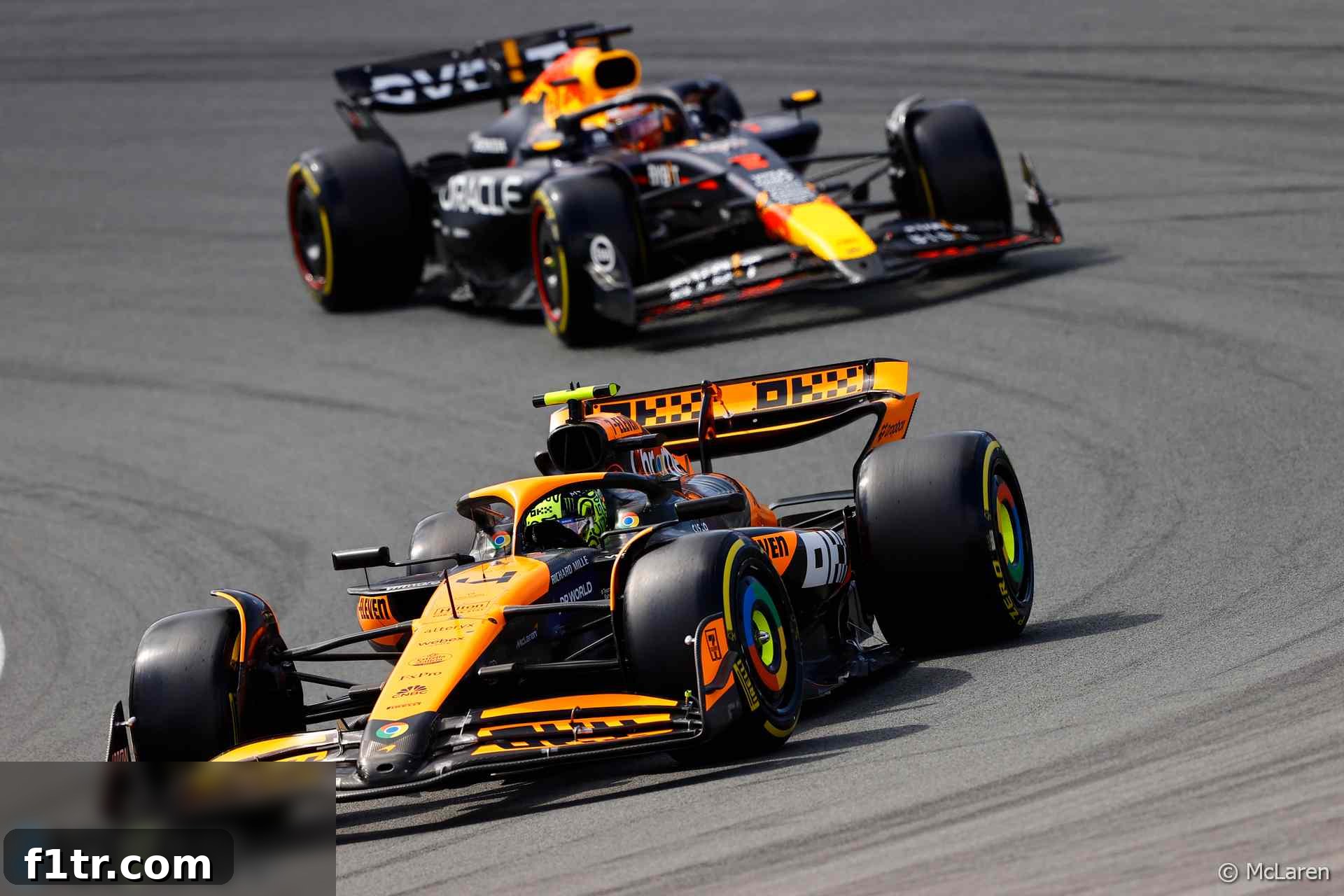
Lando Norris’s Dutch Grand Prix Triumph: Decoding McLaren’s Championship Hopes Against Max Verstappen
Lando Norris’s commanding victory at the Dutch Grand Prix ignited a flurry of excitement and speculation regarding his potential to challenge for the prestigious Formula 1 Drivers’ Championship. While his performance was undeniably stellar, it’s crucial to contextualize this result within the broader F1 landscape. Realistically, this triumph, achieved on a circuit inherently suited to the McLaren MCL38, offers limited insight into his immediate prospects of reeling in the formidable points leader, Max Verstappen.
Norris meticulously capitalized on every available opportunity on Sunday. His masterclass included not only securing the race win but also, with considerable flair, snatching the bonus point for the fastest lap from Lewis Hamilton on the very final tour of Zandvoort. The Mercedes driver had seemingly cemented the point with a 1’13.878 lap on 14-lap-old soft tyres. His team was confident enough in that benchmark to advise Hamilton against another attempt to improve it. However, as the checkered flag loomed, Norris, on a set of hard tyres that had endured an impressive 44 laps, meticulously shaved six-hundredths off Hamilton’s time, securing that crucial extra point for McLaren.
This remarkable feat ensured Norris collected the maximum 26 points at Zandvoort. Yet, with Verstappen skillfully minimizing damage by finishing a strong second, the McLaren driver’s gain on his rival was a mere eight points, reducing the daunting gap between them from 78 to 70 points. While every point matters, this incremental gain highlights the monumental task ahead for Norris in the 2024 F1 Championship.
The Championship Conundrum: A Steep Uphill Battle for Norris
Despite his recent heroics, Lando Norris is not yet the architect of his own destiny in this year’s championship battle. Even in a hypothetical scenario where he were to win all the remaining 12 races – encompassing nine traditional Grands Prix and a trio of sprint events – Verstappen could still clinch the championship by consistently finishing second behind him. To tip the scales in his favor under such a scenario, Norris would need to accumulate an additional five fastest lap bonus points. Furthermore, one can confidently expect Red Bull Racing to strategically deploy Sergio Perez to act as a spoiler, ensuring the title remains with their lead driver. This complex mathematical reality underscores the sheer dominance Verstappen has exerted and the formidable challenge Norris faces.
Given the intensely competitive standard of Formula 1 racing witnessed throughout 2024, such a scenario of consistent wins for one driver is highly improbable. However, it vividly illustrates the magnitude of the task confronting Norris. Moreover, despite delivering one of Red Bull’s heaviest straight-fight defeats under the current F1 regulations, the Dutch Grand Prix result, when viewed critically, provides limited indicators regarding Norris’s true prospects for making the kind of significant championship inroads he desperately needs against Verstappen.
McLaren’s Performance Profile: High Downforce Dominance vs. All-Round Pace
The emphatic nature of Norris’s victory at Zandvoort, with a 22-second buffer over Verstappen, was certainly heralded by some as definitive proof of a new performance peak for McLaren. However, upon closer examination, this performance profile isn’t entirely unprecedented for the Woking-based outfit. Only two rounds prior, Oscar Piastri had secured a dominant win at the Hungarian Grand Prix, finishing 14 seconds ahead of the nearest non-McLaren challenger and an impressive 21 seconds clear of Verstappen. Norris, it should be remembered, was leading his teammate by six seconds with four laps remaining in Hungary before he eased off, adhering to team instructions. These parallel performances highlight a specific strength rather than a universal leap.
Both the Hungaroring and Zandvoort are circuits that place a premium on a high-downforce aerodynamic setup. The MCL38 car demonstrably excels in this configuration. The subtle updates McLaren introduced for the Dutch Grand Prix weekend further reinforced this trend, yet Norris himself downplayed their transformative impact. “I still feel like we probably would have won without the upgrades this weekend,” Norris candidly admitted, adding, “The upgrades didn’t make us certainly a lot quicker here.” This suggests that while the updates were beneficial, McLaren’s inherent car characteristics, especially its high-downforce efficiency, were the primary contributors to their stellar performance on such tracks.
Navigating Future Circuits: The Challenge of Diverse Track Characteristics
However, McLaren’s potent high-downforce advantage will be of significantly less utility at the upcoming races. The next stop on the calendar, Monza, is famously the fastest circuit in F1, demanding a low-downforce setup where aerodynamic drag is minimized for outright speed. Following that, Baku also presents unique challenges with its long straights and tight corners, requiring a balanced setup. Several other venues still to come this season will similarly test different facets of car performance, moving away from the high-downforce sweet spot of the MCL38.
Mercedes’ known strength on faster, more traditional circuits like Spa-Francorchamps and Silverstone poses a direct threat to Norris’s pursuit of the maximum 25-point victories he critically needs to erode Verstappen’s championship lead. Ferrari, too, has shown flashes of formidable pace, particularly in qualifying and on specific track layouts. The varied nature of the remaining F1 calendar means that McLaren cannot simply expect to replicate their Zandvoort dominance at every race. Consistent performance across all track types is paramount for a genuine title challenge.
Indeed, despite the impressive margin of his victory on Sunday, Norris candidly admitted that he has “no idea” whether McLaren will be able to maintain such a competitive edge in the forthcoming races. “Anyone could be on top. Ferrari, Mercedes, Red Bull, us,” he stated, acknowledging the tightly packed competitive field. “Ferrari were quite quick today, we probably didn’t expect them to be as good as they were.” This highlights the unpredictable nature of the current F1 season and the fine margins separating the top teams.
Red Bull’s Set-Up “Gamble” and McLaren’s Own Hurdles
Post-race revelations further tempered the narrative of McLaren’s unassailable dominance. It emerged that Max Verstappen’s performance at Zandvoort had been compromised by a calculated set-up “gamble” on Red Bull’s part. This involved reverting to an older specification floor on the RB20, which evidently did not perform as optimally as anticipated. “Red Bull struggled a bit more,” Norris acknowledged, adding, “I think that was probably more the factor that the Red Bull struggled a bit more today than we were expecting.” This insight suggests that McLaren’s significant advantage wasn’t solely due to their own performance surge, but also partly a consequence of Red Bull’s own experimental misstep.
Moreover, the Dutch Grand Prix also served to highlight McLaren’s own persistent weaknesses that still require addressing. Norris, unfortunately, maintained his unenviable record of never successfully converting a pole position into a lead at the start of a race. This vulnerability at race starts remains a critical area for improvement. McLaren also suffered a strategic misstep, allowing Charles Leclerc to undercut Oscar Piastri in the first stint during pit stops, costing Piastri a crucial track position that he was unable to recover throughout the remainder of the race. Such operational inefficiencies can prove costly in a tight championship fight, underscoring the need for absolute perfection from the entire team.
Constructors’ Championship vs. Drivers’ Title: A Divergent Narrative
The championship narrative takes on a different hue when examining the Constructors’ Championship standings. Here, McLaren has demonstrated impressive consistency, outscoring Red Bull in eight of the last nine races, and are now a much closer 30 points adrift. This distinction between the drivers’ and constructors’ battle is crucial; while McLaren as a team has shown incredible strength, Norris has only out-scored Verstappen on three occasions all year, one of which was due to the Red Bull driver’s retirement in Australia. This indicates that while McLaren’s overall car package and team performance are rapidly improving, the individual brilliance and relentless consistency of Max Verstappen continue to set him apart in the drivers’ standings.
Lando Norris is acutely aware of the extensive work that lies ahead. He understands that a confluence of factors needs to align perfectly over the next nine races for him to even have a realistic shot at the title in the final race of the season. Consequently, his immediate focus remains firmly on driving the necessary improvements within the team. “We’ll just keep our heads down,” Norris asserted on Sunday evening. “There’s no point thinking how we’re going to do next weekend. We’ll just get there and work hard and wait ’til we get there. There’s no point thinking ahead.” This pragmatic and grounded approach reflects the challenging reality of competing at the pinnacle of Formula 1 and underscores the intense dedication required to contend for a world championship.
As the Formula 1 season progresses, the battle for supremacy promises to be riveting. While the Dutch Grand Prix showcased McLaren’s immense potential and Norris’s undeniable talent, the path to challenging for the championship remains incredibly complex, demanding relentless consistency, strategic perfection, and perhaps a touch of good fortune. Fans eagerly await to see how McLaren and Norris will tackle the diverse challenges of the upcoming circuits against the formidable force of Max Verstappen and Red Bull Racing.