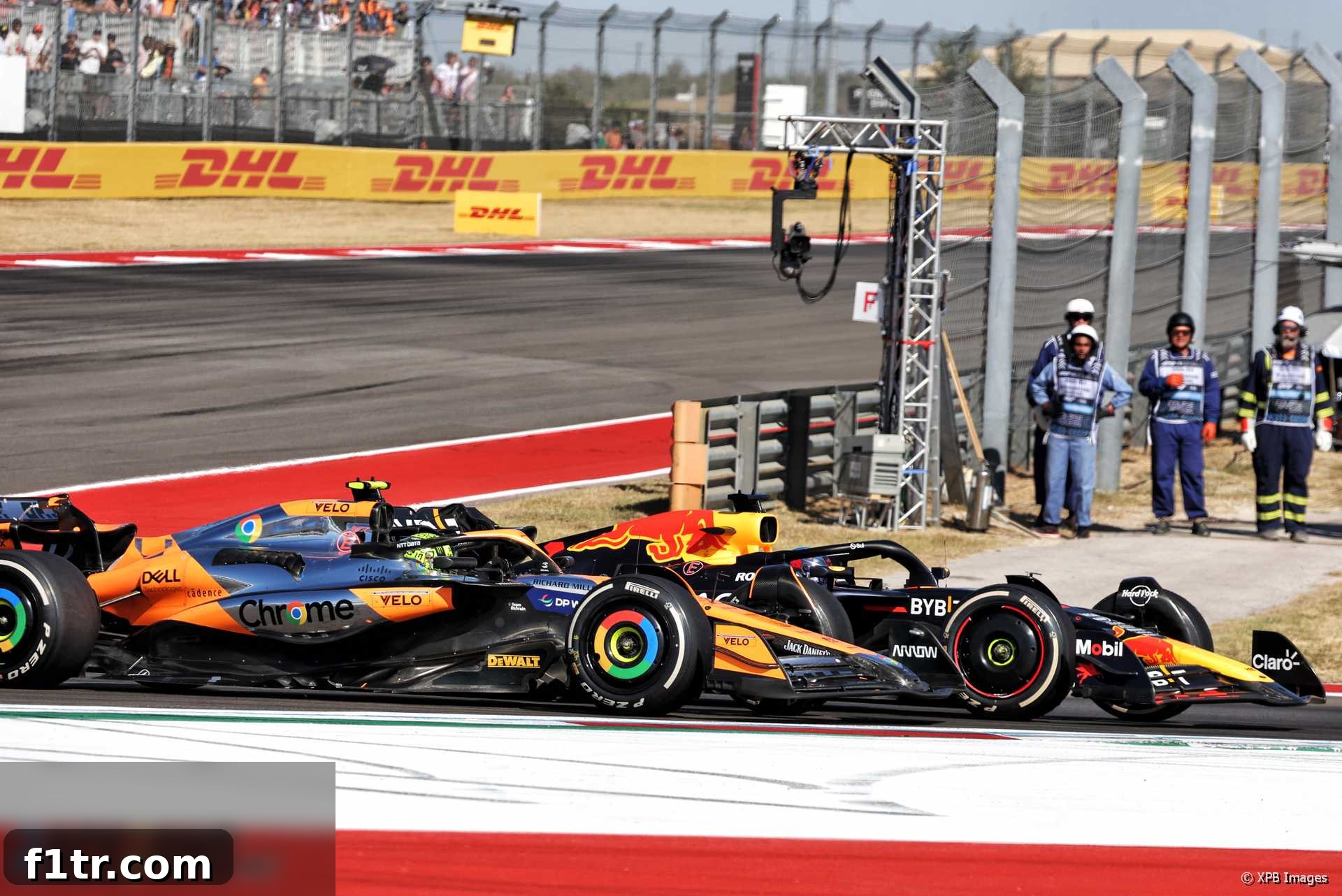
The highly anticipated appeal by McLaren concerning the controversial penalty issued to Lando Norris at the United States Grand Prix has been formally rejected by the race stewards. This definitive ruling means the five-second time penalty, which notoriously stripped Norris of a well-deserved podium finish, will stand, cementing the outcome of one of the season’s most debated incidents.
McLaren’s request for a review was ultimately denied on the grounds that they failed to present a “significant, new, and relevant piece of information,” a stringent requirement stipulated by the FIA’s International Sporting Code, specifically Article 14. This decision followed a comprehensive hearing conducted via videoconference, involving representatives from both the McLaren team and their rivals, Red Bull Racing, highlighting the gravity and widespread interest in the matter.
The Controversial Incident: Norris vs. Verstappen at COTA
The heart of the dispute centered on an incident during the 52nd lap of the United States Grand Prix. Lando Norris was handed a five-second time penalty for allegedly gaining an unfair advantage by overtaking Max Verstappen off the track at the challenging exit of Turn 12. Norris and the McLaren team vehemently contested this decision, arguing that Norris was in fact forced off the racing line by Verstappen, who had momentarily fallen behind as they approached the corner. Despite Norris completing the pass, his subsequent excursion beyond track limits led to the contentious penalty.
The impact of this ruling was immediate and substantial. The five-second addition to his race time demoted Norris from a provisional third place to fourth, costing him a valuable podium finish and, crucially, a six-point swing in the championship standings against his competitor. This outcome not only affected Norris’s individual performance but also carried significant implications for McLaren in the fiercely competitive Constructors’ Championship.
McLaren’s Appeal: A Bold Legal Strategy
In a somewhat unconventional move, McLaren sought to persuade the stewards to reconsider Norris’s penalty by presenting the stewards’ original decision document – Document Number 69 from the United States Grand Prix – as their “new piece of evidence.” The team’s core argument was that this decision document contained a critical factual error, an error which they claimed they had not been aware of or had the opportunity to address at the exact moment the decision was made.
Specifically, McLaren contended that the stewards had incorrectly identified Norris as the “overtaking driver” in their original ruling. The team argued that Norris had already completed his pass on Verstappen *before* they reached the critical corner. Therefore, by the time the incident at Turn 12 occurred, Norris was no longer the driver in the act of overtaking, but rather the driver who had been overtaken attempting to regain position. This subtle yet profound distinction, McLaren argued, should fundamentally alter the interpretation of the incident and, consequently, the legitimacy of the penalty.
Red Bull’s Counter-Argument and the Stewards’ Ruling
Red Bull Racing, represented by their seasoned Sporting Director Jonathan Wheatley, swiftly countered McLaren’s submission. Wheatley asserted that McLaren had failed to provide any evidence that met the stringent standards required by the FIA for a review. The stewards ultimately sided with Red Bull, concluding that McLaren’s argument, while detailed, was not “relevant” to the precise legal issue at stake under Article 14 of the International Sporting Code.
The stewards’ formal ruling on McLaren’s unique interpretation of “new evidence” was unequivocally dismissive. They stated: “McLaren appears to submit that the stewards finding that ‘car four [Norris] was not level with car one [Verstappen] at the apex’ was an error and that car four had overtaken car one before the apex (and therefore that car one was the overtaking car) and that this asserted error is itself, a new element. This is unsustainable.”
Their ruling further elaborated on the legal principle: “A petition for review is made in order to correct an error (of fact or law) in a decision. Any new element must demonstrate that error. The error that must be shown to exist, cannot itself be the element referred to in article 14.” In essence, the stewards rejected the notion that the alleged error *within* the original decision document could itself constitute the “new element” required for a review. They concluded, “In this case, the concept that the written decision (document number 69) was the significant and relevant new element, or that an error in the decision was a new element, is not sustainable and is, therefore rejected.”
The “High Bar” for Review: A Call for FIA Consideration
While rejecting McLaren’s specific request, the stewards did acknowledge a broader systemic challenge within the current right-of-review process. They explicitly noted that Article 14 of the International Sporting Code sets an exceptionally “high bar” for teams attempting to challenge decisions. This high threshold, they observed, appears to be designed primarily for decisions made after formal hearings where all parties have ample opportunity to present their case thoroughly.
Significantly, the stewards highlighted that the original decision against Norris was made in the intense, fast-paced environment of a live race session, often without the affected team having a full opportunity to present their detailed case in real-time. They drew the FIA’s attention to “the current ‘high bar’ that exists in Article 14… and the fact that it appears to have been designed more for decisions that are taken as a result of a hearing where all parties are present, rather than in the pressurised environment of a race session, when decisions are taken (as is allowed under the International Sporting Code) without all parties being present.” This statement suggests an implicit recognition that the current regulations might not be perfectly suited for the dynamic nature of in-race stewarding, potentially paving the way for future discussions and revisions within the FIA.
Industry Perspectives: Zak Brown and Christian Horner Weigh In
The McLaren CEO, Zak Brown, had voiced his team’s strong convictions even before the review hearing commenced. Speaking to Sky, Brown articulated McLaren’s belief that the original decision was flawed. “These things are difficult but we have a different view,” he explained. “I think a lot of people agree with our view that Lando [was] in front, and if you look at it from that perspective, you maybe have a different outcome on that corner.” Brown’s remarks underscore the subjective nature of racing incidents and the differing interpretations that can arise even among experts.
Brown went further, suggesting that Formula 1’s regulatory framework might benefit from a broader philosophical shift. He advocated for a relaxation of the sport’s rules, granting the experienced race stewards more discretion in determining which infractions warrant penalties. “We maybe have too many rules,” Brown posited. “There’s a reason why we have former F1 drivers and racing drivers as stewards. They know best what’s going on.” He emphasized the need to move beyond strict technicalities and allow stewards to apply their profound understanding of racing dynamics. “I think we’ve got to free up the rules a little bit and let the FIA stewards have a little bit more discretion, because they know what’s really happening, versus the very technicality of who got to the apex first – well, if you put your foot down, you’re going to get to the apex first, but maybe won’t make the corner. So I think we need to open up and just leave it a little bit more to the F1 stewards to use their discretion.” His comments resonated with many in the F1 paddock who champion a “let them race” ethos.
Conversely, Christian Horner, the Red Bull Team Principal, expressed skepticism regarding McLaren’s chances of presenting genuinely new evidence even before the hearing. “I don’t think there is any new evidence,” Horner stated confidently. He stressed the importance of trusting the established process and lauded the stewards for their original decisions. “I think the stewards are in difficult positions. I felt that the calls they made were absolutely fair and right at the weekend. You can’t overtake a car off the circuit.”
Horner also offered a pragmatic, somewhat tactical observation on the incident itself. He suggested that McLaren might have been better off instructing Norris to concede the position to Max Verstappen and then re-pass him legally. He reasoned, “They’re probably ruing the fact that they didn’t let Max back past because they had such a pace advantage at that part of the race with the overlap of the fresher tyre that they would have probably quite easily passed Max in those last four laps anyway.” This viewpoint highlights the strategic dilemmas teams face in the heat of battle, where immediate adherence to rules might sometimes yield a better long-term race outcome than pushing the limits.
The Ongoing Debate: Racing Etiquette and Future of F1 Stewarding
The Lando Norris penalty at the United States Grand Prix has undeniably reignited a fresh and fervent debate within the Formula 1 community regarding what constitutes a legitimate racing move, especially concerning track limits and overtakes. Several other drivers on the grid publicly sided with Norris, expressing their concern over the interpretation of the rules and advocating for the FIA to revise regulations to explicitly address and potentially outlaw drivers defending their position by forcing competitors off-track or by gaining an advantage themselves by running wide.
This incident serves as another reminder of the delicate balance between promoting aggressive, exciting racing and ensuring fair play and consistent application of the rules. The FIA and Formula 1 leadership are consistently challenged to refine regulations that can adapt to ever-evolving car performance, track designs, and racing strategies. While the McLaren review request was ultimately unsuccessful, the stewards’ own commentary regarding the “high bar” of Article 14, coupled with the widespread industry debate, strongly suggests that the discussion around stewarding processes, rule clarity, and the role of driver discretion will continue to be a prominent feature of Formula 1’s future trajectory.
Related Articles: 2024 United States Grand Prix
- McLaren Insist Stewards Made ‘Provable Error’ After Losing Bid For Review Of Norris’ Penalty
- Why McLaren’s Focus On Verstappen’s Driving Failed To Overturn Norris’ Penalty
- Stewards Reject McLaren’s Request To Review Norris’ United States GP Penalty
- McLaren Know Norris’ Penalty Is Likely To Stand – So What Do They Hope To Gain?
- McLaren Request Review Of Norris’ Penalty For Off-Track Pass On Verstappen
Browse All 2024 United States Grand Prix Articles