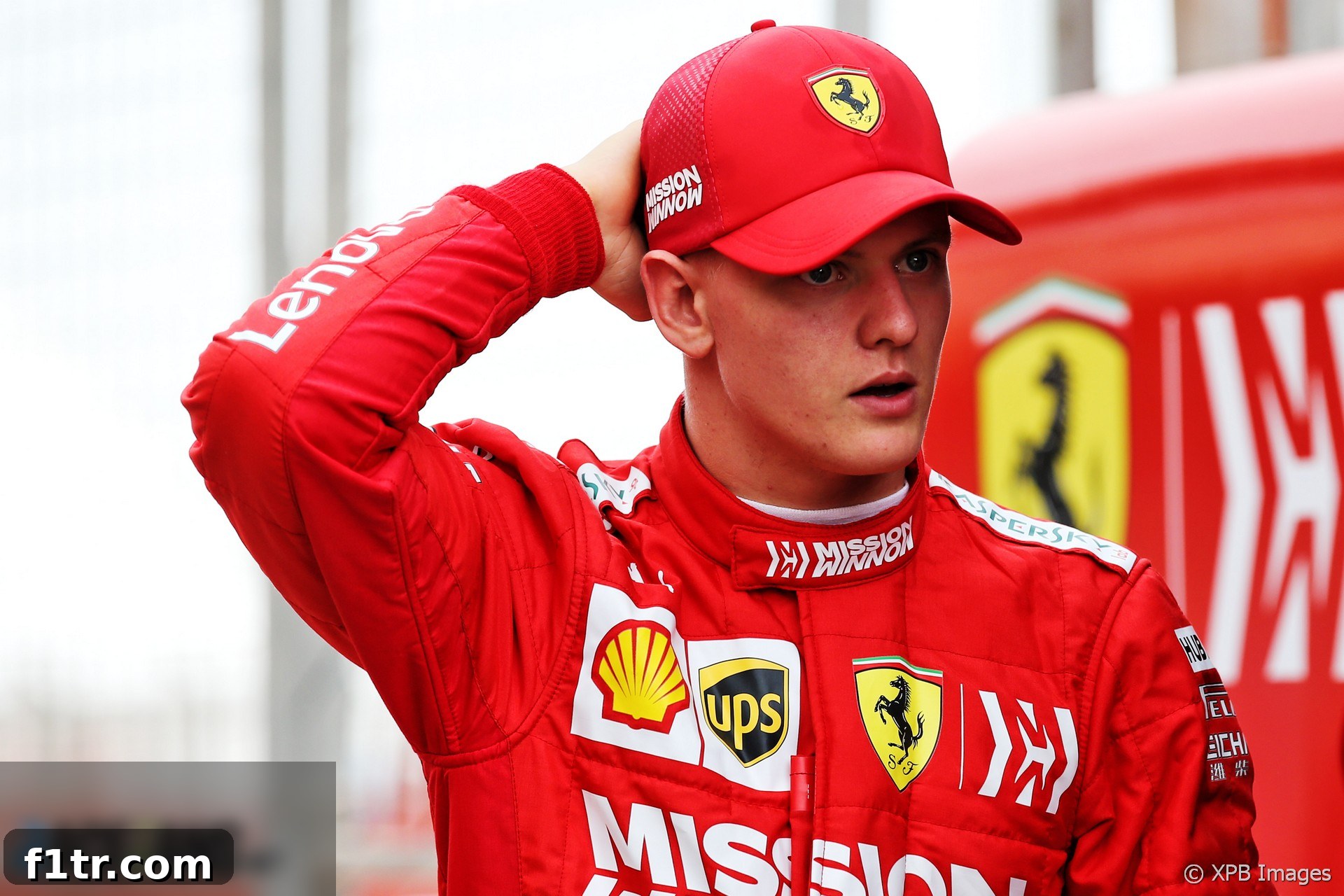
In a compelling observation that has resonated across the Formula 1 paddock, Scuderia Ferrari team principal Mattia Binotto remarked that Mick Schumacher’s handling of his inaugural Formula 1 test bore striking similarities to his legendary father, Michael Schumacher’s approach during his illustrious tenure with the team. This statement from Binotto, who worked intimately with the seven-time world champion throughout his decorated career at Maranello, immediately drew parallels, igniting hopes and discussions about the younger Schumacher’s potential trajectory in the sport.
Advert | Support Independent F1 Journalism – Go Ad-Free
However, Binotto’s initial impression of Mick, as he candidly admitted, differed in one key aspect. While the physical resemblance might not be immediately apparent, it is the underlying demeanor and methodological approach that truly evokes the spirit of the iconic F1 legend. Binotto’s deep understanding of the Schumacher ethos, stemming from years of collaboration, lends significant weight to his assessment, making this comparison more than just a fleeting observation; it’s a profound insight into the making of a potential future star.
“The very first time I saw him after many years in Maranello, when he came back, if you looked at him, I don’t think he’s looking very similar to Michael,” Binotto stated, highlighting the superficial differences. Yet, it was the intangible qualities that truly stood out. “But the way he’s behaving is very similar. And the way he approaches the exercise and the way he’s interested in the car, discussing it with the technicians – these are the characteristics that really catch your eye.” This nuanced distinction underscores that true greatness in racing often transcends mere genetics, manifesting instead in dedication, intellectual curiosity, and an unwavering commitment to improvement.
Binotto further elaborated on these profound similarities, painting a vivid picture of Mick’s immersion within the team’s operations. “Even in Maranello, you are looking after him, but he’s always in the workshop looking at the car, speaking with the mechanics,” he added. This hands-on, inquisitive nature, a hallmark of Michael Schumacher’s approach, suggests a deep-seated passion for the intricate mechanics and engineering behind the sport. “And I think that’s very similar to his father.” Such dedication, moving beyond the driver’s seat to understand the very heart of the machinery, is often cited as a distinguishing trait of the sport’s most successful figures.
Mick Schumacher’s journey into the hallowed halls of Ferrari began after a stellar performance in the European Formula Three championship, which he clinched the previous year. His triumph earned him a coveted spot in the prestigious Ferrari Driver Academy, a clear signal of Maranello’s long-term investment in his talent. His first opportunity to drive a current-specification F1 car came during the two-day test immediately following the Bahrain Grand Prix. This high-profile test was not merely a ceremonial drive; it was a crucial learning experience designed to acclimate him to the demands of elite-level motorsport. However, Binotto cautioned against drawing definitive conclusions from this initial outing, acknowledging the unusual circumstances that made a direct performance assessment challenging for the 20-year-old.
The conditions surrounding Mick’s debut F1 test run were far from ideal for a comprehensive performance evaluation. “To assess the performance, I think it is very difficult, because first, the weather conditions were very bad on that day,” Binotto explained, referring to the inclement weather that often complicates track running and makes direct comparisons unreliable. He also emphasized that the primary objective of the test was not to push for lap times but to facilitate a crucial learning process. “Because at the end, I think that the objective was not really to assess the performance. It was his very first day on an F1 car, more important for him still in the learning phase, day-by-day, facing a completely new challenge in his F2 season.” This approach allowed Mick to absorb the complexities of the car and the team environment without the immediate pressure of performance metrics, fostering a foundational understanding essential for his development.
What truly impressed Binotto, however, was Mick’s methodical and mature approach to the demanding two-day session. “I think what was certainly positive was the way he approached the exercise, the approach to the day of testing, never pushing to the limit, trying to improve run-by-run, learning the car, learning the team,” he recounted. This measured and analytical strategy is precisely what a top team looks for in a developing driver – not reckless speed, but intelligent progression and a deep desire to comprehend every aspect of the racing ecosystem. “And I think in that respect he did a very good job: very well focussed, concentrated and tried to do the proper job and learn. I think that’s the most you may expect on such a day.” This testament speaks volumes about Mick’s professionalism and potential, indicating he possesses the mental fortitude and analytical skills required to excel at the pinnacle of motorsport.
The legacy of the Schumacher name carries immense weight within the sport, and Mick’s association with Ferrari only amplifies the expectations. His progress through the junior categories, culminating in his F3 championship and subsequent entry into F2, has been keenly watched by fans and experts alike. The Ferrari Driver Academy is renowned for nurturing future champions, and Mick’s inclusion signifies a belief in his long-term prospects. His ability to adapt, learn, and demonstrate characteristics reminiscent of his legendary father provides a compelling narrative for his burgeoning career. The comparisons by Binotto are not just nostalgic; they are a strategic endorsement from one of F1’s most influential figures, potentially paving the way for Mick’s eventual ascent to the F1 grid.
As Mick navigates the challenges of his F2 season, these initial positive impressions from the Ferrari hierarchy will undoubtedly bolster his confidence and reinforce the team’s commitment to his development. The ultimate goal for any driver in the Ferrari Driver Academy is to one day race for the iconic Maranello squad, or at least secure a seat in Formula 1. Binotto’s remarks suggest that Mick Schumacher possesses not only the raw talent but also the crucial intangible qualities – the dedication, the meticulousness, and the profound interest in the machine – that set champions apart. These are the same attributes that propelled Michael Schumacher to unparalleled success and cemented his status as one of the greatest drivers in F1 history. For now, the focus remains on his continued learning and growth, but the seeds of a promising F1 career have undoubtedly been sown, nurtured by the very team that forged his father’s legend.
Advert | Become a RaceFans supporter andexperience an ad-free site
2019 F1 Season Insights
Dive deeper into the memorable moments and critical developments from the 2019 Formula 1 season with our comprehensive coverage:
- Crying in the Melbourne car park at 2019 grand prix was my career low – Ocon
- McLaren Racing reports reduced £71 million loss in 2019
- Kvyat: Hockenheim podium last year was “my biggest achievement” so far
- How the FIA’s new encrypted fuel flow meter targets Ferrari’s suspected ‘aliasing’ trick
- “He smashed my office door”: 23 must-see moments from ‘Drive to Survive’ season two
Browse all 2019 F1 season articles for more