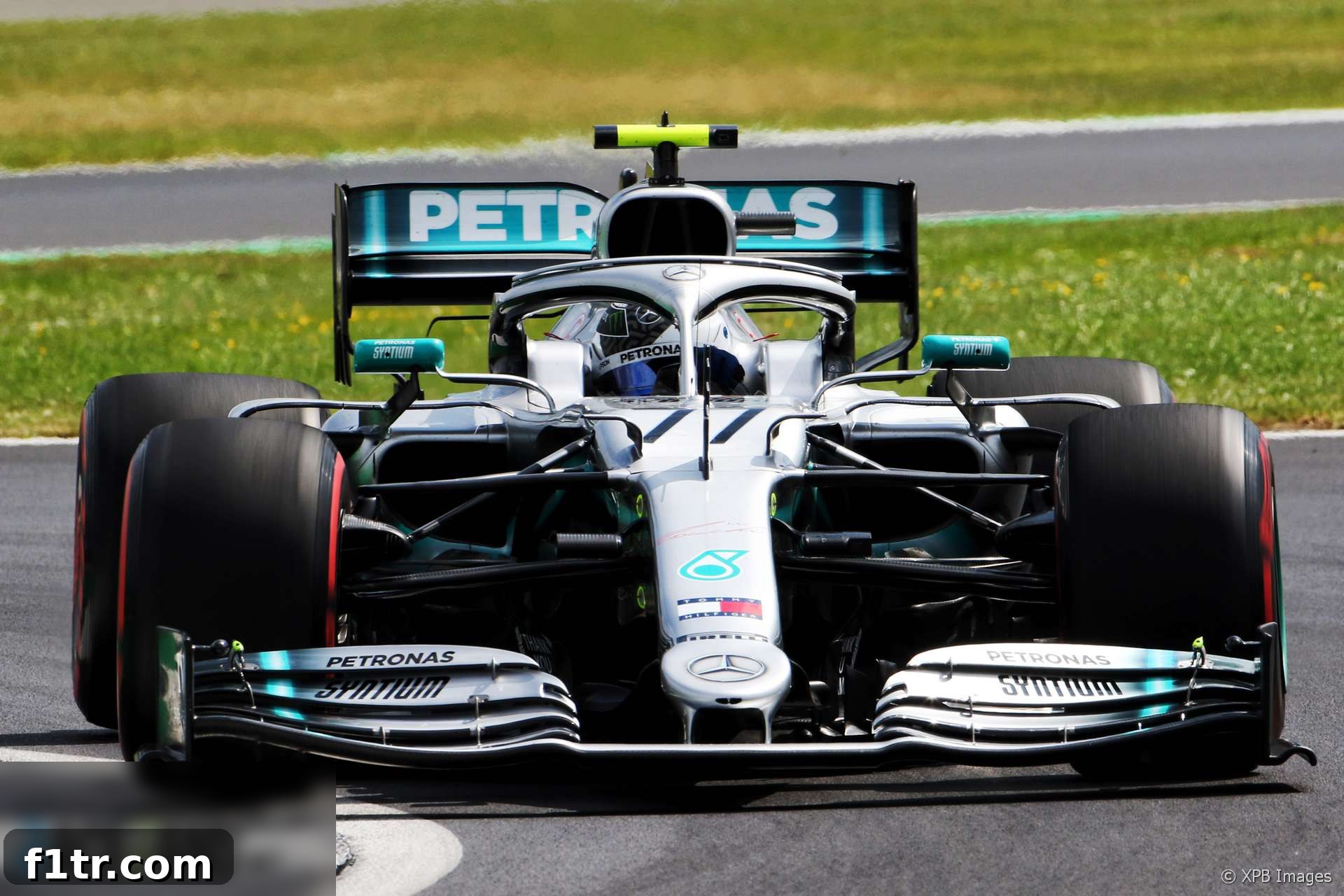
The hallowed grounds of Silverstone, a circuit steeped in motorsport history, set the stage for a dramatic qualifying session for the British Grand Prix. In a spectacle of speed, precision, and strategic acumen, it was Valtteri Bottas who emerged victorious, snatching pole position in a truly thrilling battle. The Mercedes driver showcased exceptional skill, beating his illustrious teammate and Ferrari’s rising star, Charles Leclerc, by an almost imperceptible margin of less than a tenth of a second. This incredibly close contest not only heightened anticipation for Sunday’s race but also underlined the intense rivalry at the very pinnacle of Formula 1, promising a captivating showdown on race day.
The qualifying hour at Silverstone is often a tense affair, but this session, in particular, delivered edge-of-the-seat drama from start to finish. Drivers pushed their machines to the absolute limit around the iconic British track, grappling with high-speed corners and technical sections. With strategic tyre choices playing a critical role, and millisecond differences separating the contenders, the narrative of the British Grand Prix qualifying unfolded as a testament to the relentless pursuit of perfection in Formula 1.
Q1: The Initial Gauntlet and Midfield Scramble
Advert | Become a Supporter & go ad-free
As the green light signaled the start of Q1, the air at Silverstone crackled with anticipation. Drivers immediately ventured onto the track, eager to lay down a marker and secure their progression. Lewis Hamilton, the home hero, wasted no time in asserting his dominance, setting a blistering pace that initially placed him at the top of the timesheets. However, his advantage was marginal, with Charles Leclerc hot on his heels, showcasing Ferrari’s potential. The battle between these two titans was immediately “nip-and-tuck,” with Hamilton shading the Ferrari by a mere two-hundredths of a second. Crucially, Hamilton achieved this on a set of soft tyres, while Leclerc demonstrated his car’s inherent pace by using the harder medium compound, hinting at a strong strategic hand for Ferrari. This early strategic divergence set a fascinating tone for the rest of qualifying.
Another driver demonstrating clever tyre management was Sebastian Vettel. The four-time world champion strategically opted for the harder rubber to comfortably secure his passage into Q2. Towards the end of the session, as the track evolved and other drivers looked for improvements, Vettel briefly ventured out on softs, seemingly prepared to respond. However, confident in his initial time and wishing to preserve his fresh tyres, he aborted the lap and pitted, a testament to his experience and the strength of his earlier run.
The usual narrative continued for the Williams pair, who found themselves rooted at the bottom of the timesheets. George Russell, despite being almost half a second quicker than his teammate Robert Kubica, was over a second slower than the next closest competitor, highlighting the significant performance gap the team faced. However, the battle for survival in the midfield was intense. Other Mercedes-powered cars, particularly those of Racing Point, were flirting with the Q2 cut-off. Lance Stroll, unfortunately, once again failed to advance his Racing Point into the top 15. In contrast, a superb last-gasp effort from his teammate Sergio Perez saw him snatch a spot in Q2, underscoring the cut-throat nature of the session and the importance of every thousandth of a second.
The margins were painfully tight, as evidenced by Kevin Magnussen’s heartbreaking elimination. The Haas driver missed out on Q2 by an agonizing 13 thousandths of a second, a testament to the fiercely competitive midfield. Toro Rosso’s Daniil Kvyat also fell at the first hurdle, along with Lance Stroll, George Russell, and Robert Kubica, concluding a highly competitive opening segment.
Drivers eliminated in Q1
| 16 | Kevin Magnussen | Haas-Ferrari | 1’26.662 |
| 17 | Daniil Kvyat | Toro Rosso-Honda | 1’26.721 |
| 18 | Lance Stroll | Racing Point-Mercedes | 1’26.762 |
| 19 | George Russell | Williams-Mercedes | 1’27.789 |
| 20 | Robert Kubica | Williams-Mercedes | 1’28.257 |
Advert | Become a RaceFans supporter andgo ad-free
Q2: Strategic Gambles and the Fight for the Top Ten
Q2 kicked off with a clear strategic theme: tyre choice for the start of the race. The medium tyre emerged as the preferred compound for most of the front-runners, an indication of their intent to begin Sunday’s Grand Prix on a more durable compound. Charles Leclerc, demonstrating superb pace, led the initial charge on the yellow-marked mediums, edging out Valtteri Bottas by a mere two-hundredths of a second. Lewis Hamilton, in the other Mercedes, also on mediums, slotted into third, illustrating the extraordinary parity at the front and the high stakes of every lap.
A notable turnaround in form was seen from Pierre Gasly. After a period of struggles, the Red Bull driver appeared to be in significantly better shape throughout practice and carried that momentum into qualifying. For the first time in a while, he joined his teammate Max Verstappen in running the harder medium tyre, and impressively, he was within two tenths of Verstappen’s pace, a crucial sign of progress and confidence within the Red Bull camp.
Sebastian Vettel, however, initially deviated from the conventional front-runner strategy. He started Q2 on a set of worn soft tyres carried over from the end of Q1, posting the eighth-fastest time. This move suggested Ferrari might be considering a split strategy. However, upon his return to the track for a second run, Vettel switched to a fresh set of soft tyres. This decision clarified Ferrari’s intent: both their cars would start the race on the soft compound. Though he briefly slipped out of the top ten, a strong final effort saw him comfortably secure fifth position, setting up a fascinating strategic battle for Sunday.
By the conclusion of Q2, Charles Leclerc had also improved his lap time on the soft tyre, confirming Ferrari’s united front with both their drivers opting for the soft compound to start the race. In contrast, both Mercedes and Red Bull cars would begin on the medium compound, promising a dynamic and strategically diverse opening stint to the Grand Prix.
The fight for the remaining spots in Q3 was fiercely contested. The Renault pair demonstrated strong performances, securing their places among the top ten. They were joined by the highly impressive home racers Lando Norris of McLaren and Alexander Albon of Toro Rosso, both of whom capitalized on the softer tyres to propel themselves into the final qualifying segment, much to the delight of the British crowd and their respective teams. The intensity of Q2 saw several promising drivers fall short, including the Alfa Romeo duo of Antonio Giovinazzi and Kimi Raikkonen, McLaren’s Carlos Sainz Jnr, Haas’s Romain Grosjean, and Racing Point’s Sergio Perez, all of whom delivered solid performances but ultimately missed out on the ultimate showdown.
Drivers eliminated in Q2
| 11 | Antonio Giovinazzi | Alfa Romeo-Ferrari | 1’26.519 |
| 12 | Kimi Raikkonen | Alfa Romeo-Ferrari | 1’26.546 |
| 13 | Carlos Sainz Jnr | McLaren-Renault | 1’26.578 |
| 14 | Romain Grosjean | Haas-Ferrari | 1’26.757 |
| 15 | Sergio Perez | Racing Point-Mercedes | 1’26.928 |
Advert | Become a RaceFans supporter andgo ad-free
Q3: The Pole Position Decider – A Battle of Milliseconds
The stage was set for the ultimate showdown: Q3. The battle for pole position at the British Grand Prix promised fireworks, and it delivered in spectacular fashion. In the initial runs, Lewis Hamilton, often imperious at Silverstone, suffered a moment of oversteer mid-corner at Brooklands, a slight twitch that spoiled his lap and immediately handed the initiative to his teammate. Valtteri Bottas seized the opportunity with both hands, delivering a phenomenal lap to momentarily snatch the top spot with a time of 1’25.093. The pressure was now firmly on Hamilton to respond.
The tension escalated dramatically during the final runs. Memories of Austria, where Bottas had lost pole in the dying moments of Q3, loomed large. His final attempt at Silverstone wasn’t perfectly clean, showing some signs of struggle. Behind him, Lewis Hamilton was on a charge, pushing his Mercedes to the absolute limit, visibly gaining time through the sectors. The crowd held its breath, expecting the local hero to snatch pole back.
Yet, it was not to be. In an unbelievably close finish, Hamilton fell agonizingly short of beating his teammate by a mere six thousandths of a second – an almost imperceptible margin that spoke volumes about the intensity of their internal battle and Bottas’s exceptional performance under pressure. The crowd let out a collective gasp, realizing just how fine the line between pole and P2 had been.
The drama, however, wasn’t confined to the Mercedes garage. Charles Leclerc then unleashed a superb first sector, displaying incredible pace and momentarily looking set to challenge both Mercedes cars for pole. The Ferrari was flying, raising hopes of an upset. But a recurring issue from practice seemed to resurface: Ferrari’s tyres had a tendency to fade towards the end of the lap. Despite his phenomenal start, Leclerc’s pace dropped slightly in the final sectors, causing him to fall short by less than a tenth of a second, ultimately securing an impressive third place on the grid. This performance, nonetheless, solidified his reputation as a formidable force, comfortably ahead of his teammate, Sebastian Vettel, who would line up behind the Red Bull pair.
Max Verstappen continued his strong form, securing fourth position, while his teammate Pierre Gasly delivered a commendable performance to take fifth, further underlining his resurgence. Sebastian Vettel, after his strategic tyre gambit, secured sixth place. Daniel Ricciardo put in a strong showing for Renault, grabbing seventh, ahead of the impressive Lando Norris, who delighted the home crowd with his eighth-place finish. Alexander Albon secured ninth for Toro Rosso, demonstrating his growing confidence, while Nico Hulkenberg rounded out the top ten for Renault, capping off a thrilling and strategically charged qualifying session at Silverstone.
Top ten in Q3
| 1 | Valtteri Bottas | Mercedes | 1’25.093 |
| 2 | Lewis Hamilton | Mercedes | 1’25.099 |
| 3 | Charles Leclerc | Ferrari | 1’25.172 |
| 4 | Max Verstappen | Red Bull-Honda | 1’25.276 |
| 5 | Pierre Gasly | Red Bull-Honda | 1’25.590 |
| 6 | Sebastian Vettel | Ferrari | 1’25.787 |
| 7 | Daniel Ricciardo | Renault | 1’26.182 |
| 8 | Lando Norris | McLaren-Renault | 1’26.224 |
| 9 | Alexander Albon | Toro Rosso-Honda | 1’26.345 |
| 10 | Nico Hulkenberg | Renault | 1’26.386 |
The qualifying session for the British Grand Prix was a showcase of Formula 1 at its finest: raw speed, unwavering determination, and cunning strategy. Valtteri Bottas’s hard-fought pole position, achieved by the narrowest of margins over Lewis Hamilton and Charles Leclerc, sets the stage for a truly captivating race. With Mercedes and Red Bull starting on mediums, and Ferrari on softs, the opening laps of the Grand Prix are destined to be a tactical masterclass. The diverse tyre strategies and the sheer competitiveness across the field promise an unpredictable and exhilarating race at Silverstone, where every decision and every tenth of a second will count.
Go ad-free for just £1 per month>> Find out more and sign up
2019 British Grand Prix
- 2019 British Grand Prix Star Performers
- Top ten pictures from the 2019 British Grand Prix
- Hamilton and Formula 1 at their best in Silverstone spectacular
- Hamilton passes Mansell and Clark as top Briton at home
- Paddock Diary: British Grand Prix day four
Browse all 2019 British Grand Prix articles