Welcome to our comprehensive motorsport round-up, where we bring you the most compelling stories and discussions from the world of single-seater racing. From nail-biting finishes and challenging conditions to exciting career moves and deep-seated technical debates, there’s always something to keep enthusiasts on the edge of their seats. This week, we delve into a young talent’s harrowing race, a rising star’s ambitious leap into a new series, and the ever-present controversies shaping the sport.
Race Weekend Reflections and Driver Insights
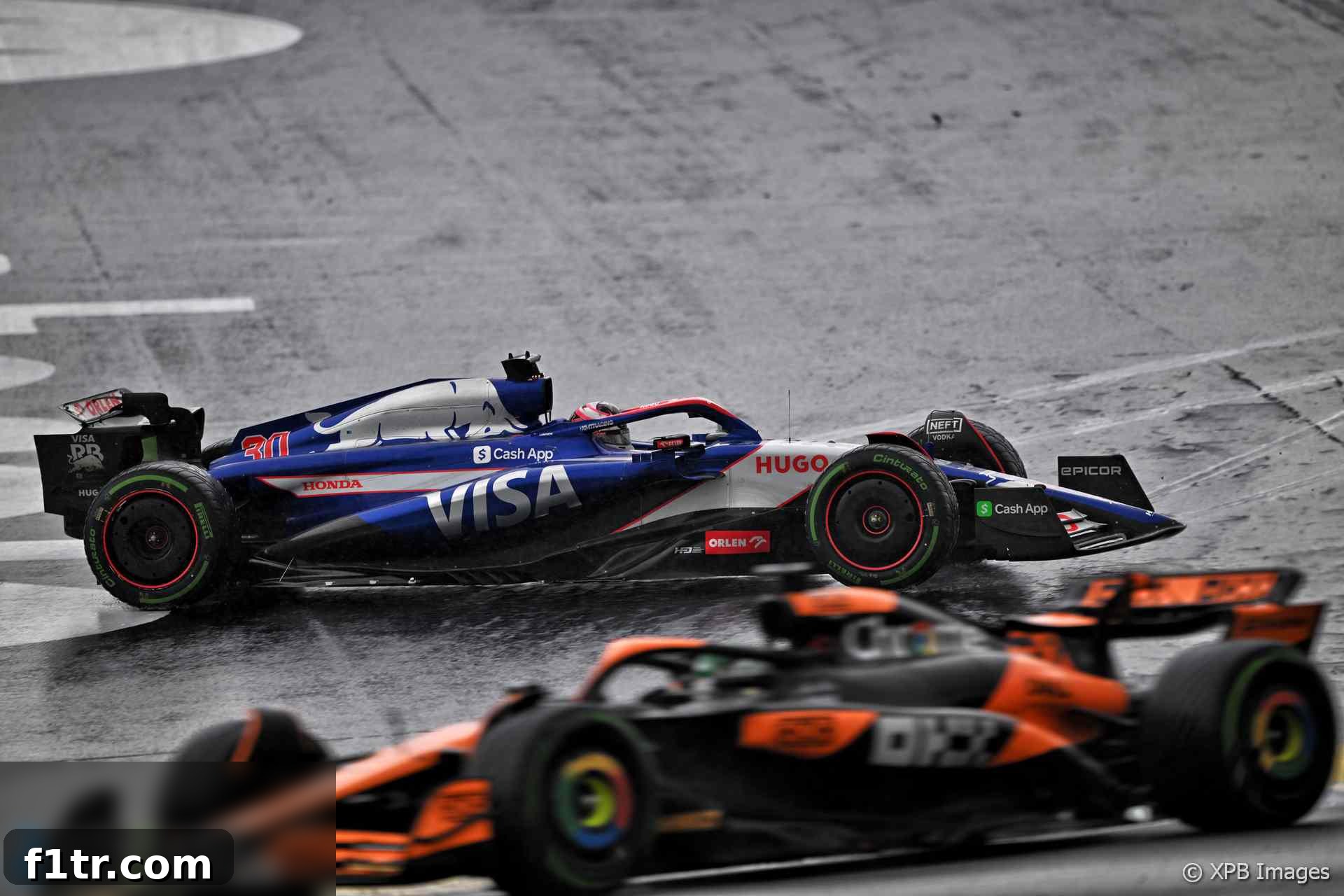
Lawson Navigates Chaos at Rain-Soaked Brazilian Grand Prix
RB driver Liam Lawson recently recounted a truly perilous experience during the rain-hit Brazilian Grand Prix, revealing he “nearly crashed probably 10 times” en route to securing his second ninth-place finish in just three starts. The young New Zealander’s performance highlighted not only his raw talent but also the treacherous conditions faced by drivers at Interlagos. Describing the race as “very sketchy,” Lawson’s candid remarks to the official F1 channel painted a vivid picture of the relentless challenge.
One of the most heart-stopping moments occurred even before he reached his pit box. “Even coming into the pit lane, we made the call to stop and I came into the pit lane and I wasn’t stopping and I was aiming straight for the tyre wall, the barrier at the pit entrance. And it just gripped before then.” This close call underscores the fine margins and inherent dangers of racing in extreme wet conditions, where visibility is minimal and grip can vanish in an instant. His ability to recover and continue fighting speaks volumes about his composure under pressure.
The race itself was a constant battle, with Lawson finding himself under incessant pressure. At one stage, he was knocked into a spin by Oscar Piastri, an incident that further complicated his already challenging afternoon. Despite this setback, Lawson demonstrated remarkable resilience. He elaborated on the ebb and flow of his race: “We were strong at the start of the stint, after the red flag, but everyone was in a train and we couldn’t really use it, and then it sort of faded away for us.” This meant a significant portion of his race was spent on the defensive. “So partly because of the pressure from behind we spent a lot of time defending, but it was a lot of concentration,” he added, emphasizing the mental toll of such a demanding grand prix. His ninth-place finish, therefore, was not merely a point-scoring achievement but a testament to his sheer determination and car control amidst the chaos.
Lawson’s impressive outings, including this latest points finish, continue to fuel discussions about his long-term future in Formula 1. Having stepped in for Daniel Ricciardo earlier in the season, he has consistently proven his capability to perform at the sport’s highest level. His calm demeanour and ability to extract performance even in the most challenging scenarios make him a valuable asset and a driver to watch closely as the grid shapes up for future seasons.
Shwartzman Set for Exciting IndyCar Debut with Prema
Former Formula 2 frontrunner Robert Shwartzman is embarking on a thrilling new chapter in his career, making the move to IndyCar racing next year with the newly formed Prema Racing team. This highly anticipated transition marks a significant moment for both Shwartzman and Prema, as the illustrious Italian squad expands its formidable presence from junior categories into the North American open-wheel series. Shwartzman will be joined by another familiar face from their Formula 2 days, Callum Ilott, forming a dynamic and experienced partnership for Prema’s inaugural IndyCar season.
Shwartzman, a long-time Ferrari Driver Academy member, has been a prominent figure in the motorsport ladder for several years. His talent was recently on display last month when he made his latest appearance in a Formula 1 car, driving for Sauber in the first practice session at the Mexican Grand Prix. During this session, he unfortunately incurred a five-place grid penalty for a yellow flag infringement, a minor blot on an otherwise commendable record of F1 development work.
Expressing his enthusiasm for the move, Shwartzman stated, “I’m definitely very, very excited to be back at Prema to start a new adventure in IndyCar. Everything will be new to us and there will be many challenges, but it will also be a lot of fun and a lot of work at the same time.” His remarks perfectly encapsulate the blend of excitement and formidable tasks ahead. Prema’s entry into IndyCar is a bold step, and with their proven track record of nurturing champions across F3 and F2, there’s a strong belief in their potential to succeed.
The competitive landscape of IndyCar presents a unique set of challenges, particularly the inclusion of oval racing, which is a stark contrast to the road and street circuits Shwartzman is accustomed to. “I think a very successful future lies ahead for us. IndyCar is a very competitive series, with so many strong drivers, and I’m looking forward to the racing, as it looks really cool. I have never driven on ovals and to master them, it will be a completely new challenge,” he acknowledged. This openness to learning and embracing new disciplines will be crucial for his adaptation and success in a series renowned for its diverse tracks and intense wheel-to-wheel action. His move represents a strategic career decision, offering him a fresh opportunity to compete at the highest level of motorsport.
Bilinski Completes Rodin’s 2025 Driver Line-up
Rodin Motorsport has finalized its driver line-up for the eagerly anticipated 2025 season with the announcement of Roman Bilinski as the third member of their team. Bilinski will partner with Louis Sharp and Callum Voisin, forming a promising trio for the upcoming campaign. This completion of the roster signals Rodin’s clear intent and strategic planning for their future in junior formulae.
Roman Bilinski brings a strong pedigree to Rodin, having clinched the prestigious Formula Regional Oceania championship earlier this year. This title is a significant achievement, showcasing his potential and ability to perform consistently in a competitive regional series often used by rising stars. In addition to his success in Oceania, Bilinski also secured a commendable 14th-place finish in the highly competitive European series, further demonstrating his capabilities against a strong field of international talent. Rodin Motorsport, known for its commitment to nurturing young drivers and providing a robust platform for their development, will undoubtedly look to harness Bilinski’s recent championship-winning momentum. His integration into the team alongside Sharp and Voisin creates an exciting prospect, as they aim to challenge for top honours in their respective championships and further solidify Rodin’s reputation as a top-tier junior motorsport outfit.
Further Insights and Motorsport Analysis
Alonso’s Unparalleled Genius: A Bold Comparison
‘Better than Schumacher and Senna’ – Marques on what makes Alonso so special (Aston Martin)
Former Formula 1 driver Tarso Marques recently ignited a fervent debate with his assertive claim that Fernando Alonso surpasses even legends like Michael Schumacher and Ayrton Senna. Marques, speaking to Aston Martin, stated, “I think he was better than Schumacher when they raced against each other and, Brazilians will get upset, I would say he’s better than Senna too. Senna was amazing, a natural talent, but the truth is that he used to make more mistakes than Fernando.”
This provocative comparison delves into the nuances of driver performance, highlighting Alonso’s renowned consistency and minimal error rate throughout his illustrious career. While Schumacher is celebrated for his relentless drive and tactical brilliance, and Senna for his raw, almost mystical speed and aggressive prowess, Marques points to Alonso’s remarkable ability to deliver peak performance with very few missteps. This perspective invites fans and pundits to re-evaluate what defines true greatness in Formula 1. Alonso’s career, marked by two world championships and an unparalleled longevity at the sharp end of the grid, showcases an adaptability and mental fortitude that few drivers have matched. His capacity to extract maximum performance from any machinery, often outperforming the car’s theoretical limits, further solidifies Marques’s argument about his exceptional skill set and unwavering dedication.
Ericsson Finds Strength in Challenging Andretti Season
Ericsson finds positives in tough first season with Andretti (IndyCar)
Marcus Ericsson, reflecting on his inaugural season with Andretti Global in IndyCar, has identified crucial positives despite a challenging start. The Swede, a former Indy 500 winner, acknowledged the difficulties but expressed optimism for the future. “We’ve built a really good foundation for next year. Especially the second half, I feel like we’ve been in the mix every track we’ve been to,” he shared with IndyCar. “We can build on that and have the off-season to analyse and work on things. Then, we should be really, really strong next year.”
Ericsson’s move to Andretti was met with high expectations, given his previous successes. However, adapting to a new team and a highly competitive series often comes with its own set of hurdles. His comments reflect a mature understanding of the development process within a top-tier motorsport team. The ability to identify progress and build momentum in the latter half of the season is a strong indicator of the team’s growing synergy and Ericsson’s persistent efforts. This positive outlook, coupled with a dedicated off-season for analysis and refinement, bodes well for their prospects in the upcoming IndyCar season, where consistency and continuous improvement are key to challenging for victories and the championship title.
We always endeavour to credit original sources. Got a tip for a link relating to single-seater motorsport? Please send it to us via the contact form.
Social Media Spotlight: Engaging with the Motorsport Community
The world of motorsport thrives on interaction, and social media provides a vibrant platform for drivers, journalists, and fans alike to share their thoughts and reactions. Here’s a look at some notable posts that sparked discussion and offered unique perspectives from the recent race weekend and beyond:
Jamey Price, a well-known motorsport photographer, highlighted a curious observation regarding media attendance at the post-race press conference in Brazil. He noted, “…There was no Dutch media in the post race press conference either… By my count there was one French journalist. Four Brazilian journalists, Tom Clarkson (host) , the tv camera operator……..and me 😂” This tweet sparked conversations about the geographical representation of media at F1 events and the logistics of covering races, particularly for print media.
Further to this, F1 commentator David Croft addressed the perceptions of bias in media coverage. He elaborated, “Sometimes there’s more to a story than just a sound bite or a chance to attack people for perception of British bias. For my part, as it’s a press conference for written media only, I never attend the post race conference, no matter who’s won. Thursday press conferences are…”. Croft’s insight provided valuable context on the division of media duties and how journalists choose which sessions to attend, often based on their specific roles (TV vs. written press), challenging superficial assumptions about media presence and perceived biases.
Meanwhile, RaceFans shared an interesting statistical note about Lance Stroll’s unfortunate Brazilian Grand Prix. “@lance_stroll should have become Canada’s most experienced #F1 driver in yesterday’s #BrazilianGP. However he spun off on the formation lap, then drove into a gravel trap and got stuck, and failed to start. He therefore remains tied on 163 starts with @27villeneuve. #RaceFans #BrazilianGP”. This post encapsulated the often-unpredictable nature of motorsport, where a driver’s milestone can be thwarted by an unexpected incident before the race even officially begins. It also sparked a nod to Canadian F1 history, tying Stroll’s current career to that of legendary Jacques Villeneuve.
- Find more official F1 accounts to follow in the F1 Twitter Directory
Comment of the Day: The Pirelli Wet Tyre Conundrum
The debate surrounding Pirelli’s wet weather tyres in Formula 1 continues to be a hot topic, especially after recent rain-affected races. Are the tyres truly the problem when it comes to racing in heavily wet conditions, or is the issue more complex?
The full wets are actually good wet weather tyres as seen a few years ago in Japan. The problem is that there is a big gap between them and the intermediates, which have even fewer grooves than a track day tyre for road legal sportscars would have. They’re beefed-up slicks more than anything.
The teams generally don’t want to use full wet tyres even when they should, even apparently when their own drivers are scared to drive, because the intermediates will generally be faster – until the car spins out or the race is (inevitably) neutralised. That’s not a Pirelli or a race control issue, that’s a team issue.
MichaelN
MichaelN’s insightful comment cuts to the core of the issue, suggesting that while the full wet tyres are effective, the crucial gap lies in the performance window of the intermediate tyres. These intermediates, described as “beefed-up slicks,” often lack the necessary grooves to effectively clear standing water, creating a perilous transition zone between slightly damp and fully drenched tracks. This disparity forces teams into a difficult strategic dilemma. Even when conditions clearly warrant full wets for safety, the intermediates often offer a pace advantage on circuits where standing water isn’t uniform or for drying lines. This pursuit of marginal speed can lead to scenarios where drivers are struggling significantly, increasing the risk of accidents and often leading to safety car periods or red flags.
MichaelN argues that this decision-making ultimately rests with the teams, prioritizing speed over optimal safety in marginal conditions. This perspective shifts the blame from Pirelli’s tyre design to the strategic choices made by teams within the highly competitive F1 environment. The ongoing discussion highlights a fundamental tension between performance optimization and driver safety in extreme weather, urging a re-evaluation of how F1 approaches wet weather racing from a regulatory, design, and strategic standpoint to ensure both thrilling racing and paramount driver well-being.
Happy Birthday!
We’d like to extend our warmest birthday wishes to A.S. Mahesh, Claudio Sampaio, Flowerdew, and Hawksfan! We hope you all have a fantastic day celebrating.
On This Day in Motorsport History
- 30 years ago today, Damon Hill won a tense, soaking Japanese Grand Prix, cutting Michael Schumacher’s lead to one point, while Martin Brundle survived a frightening crash.
On this day three decades ago, the 1994 Formula 1 season witnessed one of its most dramatic and pivotal races at Suzuka. Damon Hill delivered a masterful performance in utterly treacherous, rain-soaked conditions to win the Japanese Grand Prix. This victory was crucial, as it allowed him to significantly narrow the championship gap to his rival, Michael Schumacher, bringing it down to a mere one point heading into the season finale. The race was a true test of skill and nerve, with visibility severely hampered and grip levels fluctuating wildly. Adding to the drama, Hill’s teammate Martin Brundle endured a terrifying crash, from which he thankfully emerged unscathed, underscoring the extreme dangers faced by drivers in such conditions. This iconic race remains etched in F1 history as a testament to Hill’s resilience and a pivotal moment in one of the sport’s most memorable championship battles.
That concludes our latest motorsport review. Stay tuned for more updates, analyses, and breaking news as the racing world continues to deliver thrilling action and compelling narratives.