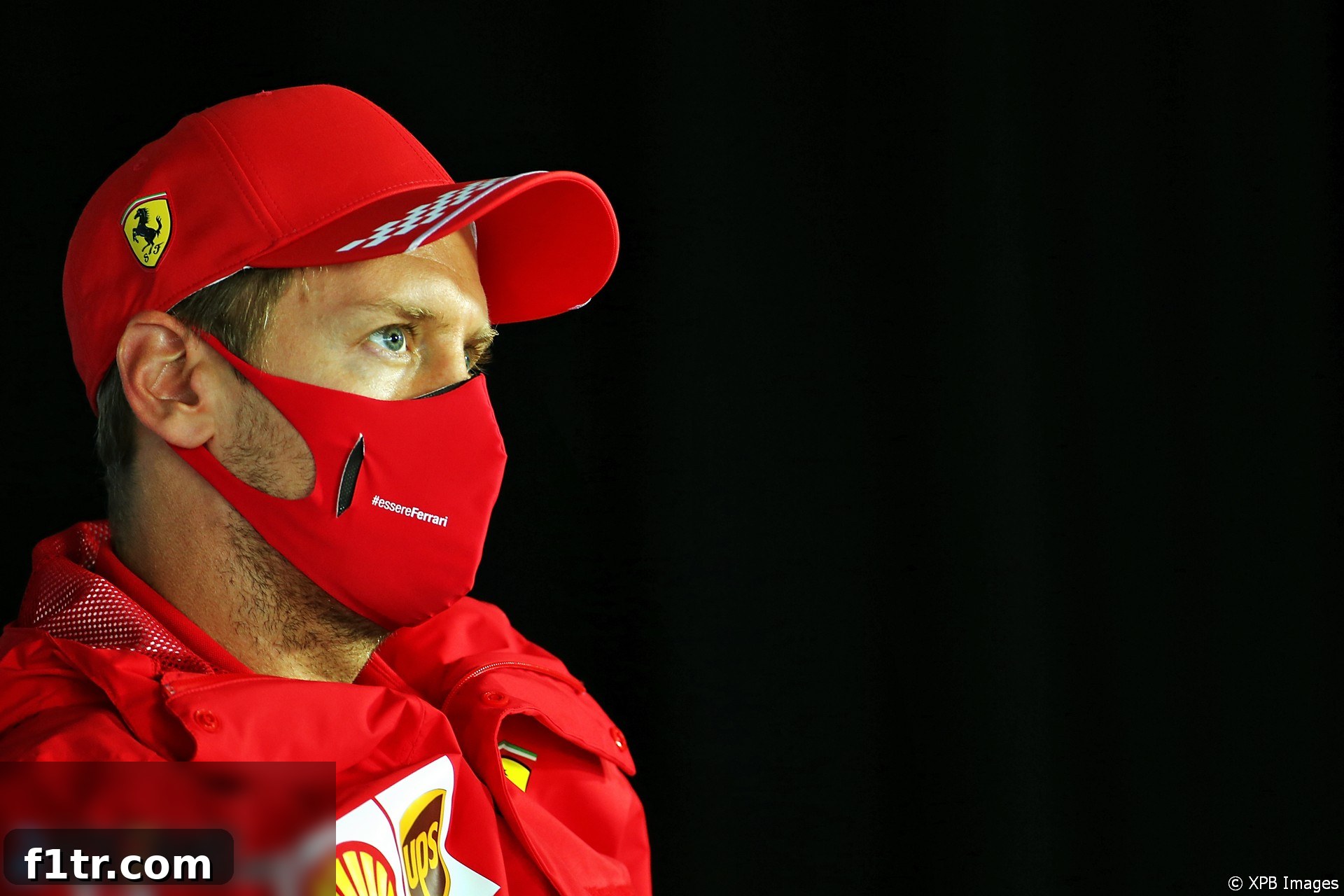
Sebastian Vettel’s Future: Unraveling the F1 Driver Market’s Biggest Mystery
The Formula 1 driver market is in full swing, and at the heart of the swirling rumors is four-time world champion Sebastian Vettel. Following the announcement of his departure from Ferrari at the end of the current season, speculation about his next destination has reached a fever pitch. With limited top-tier seats available, every interaction and comment is meticulously analyzed, turning the sport’s annual ‘silly season’ into a high-stakes chess match involving team principals, billionaires, and the drivers themselves.
The Red Bull Conundrum: A Return to Roots?
In the past week, the intensity surrounding Vettel’s future took a dramatic turn when he was photographed engaged in conversation with Red Bull co-owner Dietrich Mateschitz. This sighting immediately ignited whispers of a potential reunion with his former team, where he clinched all four of his world titles. Mateschitz, the multi-billionaire visionary behind Red Bull Racing, holds the ultimate key to any such move. However, team principal Christian Horner has consistently maintained that the team’s current driver lineup for next season remains unchanged, consisting of Max Verstappen and Alexander Albon.
While a return to Red Bull might appeal to Vettel for its familiarity and past successes, the path is fraught with challenges. Verstappen is firmly entrenched as the team’s leader, and integrating another highly decorated, competitive driver could risk destabilizing a carefully constructed hierarchy. Furthermore, Red Bull has historically nurtured talent through its junior program, making it less likely to bring back a veteran unless a truly exceptional circumstance arises. Despite Horner’s denials, the image of Vettel and Mateschitz sharing a moment continues to fuel the imaginations of fans and pundits alike, reminding everyone that in Formula 1, the unexpected can always happen.
Aston Martin Beckons: A New Chapter with Racing Point?
Another heavily rumored destination for Vettel is the team currently known as Racing Point, which is set to transform into the Aston Martin factory team next year. Recent reports from German media outlets have suggested that if Vettel joins, it would be as a replacement for Sergio Perez, who has consistently been the team’s top points-scorer over the last five seasons. This narrative positions Vettel alongside Lance Stroll, whose father, Lawrence Stroll, is not only the team owner but also a significant investor in the Aston Martin brand.
This potential pairing aligns perfectly with Lawrence Stroll’s established strategy for his son’s Formula 1 career. Young Lance has frequently been teamed with experienced and highly regarded racers from whom he can learn and develop. Should Vettel join, he would follow in the footsteps of drivers like Perez and Felipe Massa in F1, and even earlier mentors like Felix Rosenqvist in F3 and Brandon Maisano in F4. Vettel’s unparalleled experience, technical feedback, and championship-winning mentality would undoubtedly be invaluable to Lance and the ambitious Aston Martin project. The allure of being part of a revitalized factory team, backed by a prestigious automotive brand and significant investment, would certainly be a compelling prospect for a driver of Vettel’s caliber seeking a fresh challenge.
Mercedes’ Strategic Chess Game: The Hamilton Contract Leverage
The potential link between Vettel and Aston Martin becomes even more intriguing when considering the broader implications within the Mercedes-Benz family. Mercedes is widely expected to secure extensions for both Lewis Hamilton and Valtteri Bottas for the upcoming season. Comments from Daimler board chairman Ola Kallenius have reinforced this expectation. Interestingly, reports have already surfaced indicating that Bottas’s deal is nearing completion. If confirmed, this would be a departure from convention, as Mercedes typically finalizes its six-time champion’s contract before Bottas’s.
Hamilton himself has been quick to address any speculation regarding his next salary, famously shooting down “made up” reports on social media. He has also insisted that his salary is less critical to him than the personal freedoms his contract affords him away from race weekends. Nonetheless, it’s undeniable that his price for the next season will be a subject of intense negotiation and keen debate. At 35 years old, Hamilton has a finite number of competitive seasons remaining, and with them, the opportunity for large-money deals that define the twilight of a superstar’s career. This reality gives Toto Wolff, Mercedes team principal and CEO, a strategic imperative: to secure the best possible terms for the team while retaining his star driver.
With Hamilton’s contract negotiations looming, Wolff requires a crucial lever to potentially influence Hamilton’s salary demands and contractual terms. That lever is having a truly credible, world-class candidate for Hamilton’s seat. Wolff has previously spoken warmly about Vettel following the announcement of his split from Ferrari, though he initially made it clear Vettel would only be considered for a Mercedes seat if one of the current drivers departed. Hamilton’s precise plans beyond this season remain somewhat opaque – perhaps he desires a one-year deal, or maybe something longer. However, Wolff remembers the valuable lesson learned from Nico Rosberg’s abrupt retirement at the end of 2016: the undeniable importance of having a robust backup plan in place.
With Mercedes proteges like Esteban Ocon now firmly established at Renault and George Russell recently confirming his commitment to Williams for the foreseeable future, Wolff might indeed be eyeing Vettel as a formidable contingent option if Hamilton were to unexpectedly decide to step away from the sport sooner rather than later. In this intricate scenario, strategically placing Vettel at Aston Martin – a team deeply connected to Mercedes as a customer and a project steered by Wolff’s close friend Lawrence Stroll – would represent an incredibly shrewd and sensible move. It would keep Vettel within the Mercedes sphere of influence, potentially available if needed, while simultaneously bolstering Aston Martin’s ambitions and providing a formidable challenge to Hamilton’s negotiating position.
Vettel’s Perspective: Navigating the Paddock’s Interconnections
RaceFans directly questioned Vettel about this potential connection, specifically asking if Toto Wolff had facilitated an introduction to Racing Point. This would have been an easy suggestion to dismiss outright if it were untrue. However, Vettel’s response, neither confirming nor denying Wolff’s involvement, was arguably significant in itself.
“I think in some way you can say that everyone is close to each other in the paddock,” Vettel answered, reflecting on the tight-knit nature of the Formula 1 community. “So I think given the fact that I’ve been around for such a long time, I came across most people, not all probably, but most people.” His long tenure in the sport certainly means he has established relationships with key figures across various teams and management structures. “So I think it doesn’t need anybody’s initiative to get to know somebody or to get in touch. So in that regard it’s probably helpful that I’ve been around for a while and know most of the faces and people.” This nuanced reply suggests that while direct mediation might not have been strictly necessary, the interconnectedness of the paddock, potentially including an understanding nod from Wolff, could play a subtle yet crucial role.
Regarding a potential vacancy at Racing Point, on paper, Sergio Perez’s long-term contract and Lance Stroll’s deeply entrenched ties to the team, given his father’s ownership, appear to rule out such a move. Yet, Vettel, with his vast experience in the F1 paddock, is keenly aware that contractual agreements are not always set in stone.
“I think there’s two ways to look at it,” he explained, offering insight into the often-fluid nature of driver contracts. “One is on paper, obviously, which seats there are and which they’re not. I think for that I probably have too little information in terms of contracts and what are people’s contracts and so on. But the other one is I think I’ve been around for a long time and you never know. Obviously things can always change. And I think irrespective of that I need to make the decision myself and then obviously see whether there’s something suitable in in that direction.” This mature perspective underscores his understanding that despite public appearances, unforeseen circumstances, buyouts, or strategic shifts can always create unexpected opportunities, and a driver must always be prepared to assess all viable options.
The ‘Pink Mercedes’ Factor: Performance and Controversy
Adding another layer of complexity to the Racing Point scenario is the ongoing question of the legality and performance of their RP20 car. Dubbed the “Pink Mercedes” due to its striking resemblance and technical similarities to last year’s championship-winning Mercedes W10, the car has been the subject of formal protests from rival teams. While Racing Point maintains its compliance, the controversy highlights the car’s undeniable performance advantage, derived from its close relationship with Mercedes’ intellectual property.
For a driver like Vettel, who has openly expressed his desire for a competitive car, the RP20’s speed is a major draw. If a direct Mercedes seat remains unattainable, then Racing Point, with what is effectively the closest thing to a current-spec Mercedes on the grid, offers an incredibly attractive alternative. The opportunity to drive a front-running car, even one embroiled in debate, would be a significant incentive for Vettel as he looks to reignite his career and challenge at the sharp end of the grid. This unique performance aspect further strengthens the argument for Racing Point as a viable and highly desirable destination for the four-time world champion.
The Unpredictable Future
The intricate dance of driver contracts, team strategies, and personal ambitions paints a fascinating picture of the Formula 1 driver market. Sebastian Vettel’s future remains a central enigma, intertwined with the fates of Lewis Hamilton, Valtteri Bottas, and the ambitious projects at Red Bull and Aston Martin. While denials and official statements provide a public front, the subtle cues, private conversations, and strategic maneuvers behind the scenes are what truly shape the grid for the upcoming season. As the ‘silly season’ progresses, every development will be scrutinized as the F1 world eagerly awaits the resolution of one of its biggest mysteries.
For the latest updates on the F1 driver lineup, keep an eye on developments. View the current list of 2021 F1 drivers and teams as it evolves.