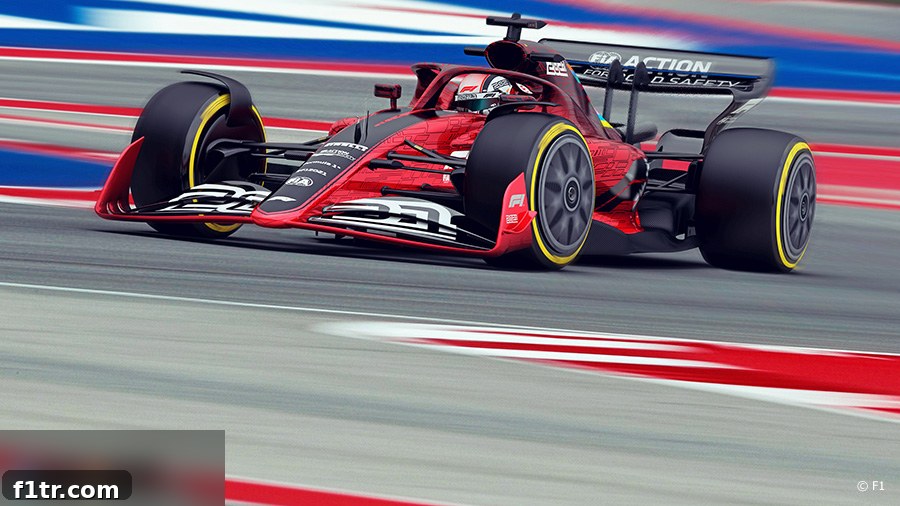
Ross Brawn Rejects “Nasty to Drive” Claims for F1’s 2021 Aerodynamic Overhaul
Formula 1’s managing director of motorsports, Ross Brawn, has unequivocally dismissed concerns that the significant aerodynamic modifications planned for the 2021 F1 season will render the new generation of cars “nasty to drive.” This assertion comes amidst a pivotal period for the sport, which aims to usher in a new era of closer racing and improved on-track spectacle through a comprehensive overhaul of its technical regulations.
The controversy was initially ignited by Racing Point technical director Andrew Green, who raised alarm bells about what he perceived as “fundamental issues” with the proposed changes. Green’s primary apprehension centers on the innovative ground effect-generating ‘tunnels’ integrated into the cars’ floors. He suggested that these crucial aerodynamic elements would be detrimentally affected by the ‘dirty air’ churned out by the car in front, potentially destabilizing the cars and making them unpredictable for drivers.
The Core of the Debate: Ground Effect, Dirty Air, and Driving Dynamics
Understanding Green’s concerns requires a brief dive into the physics of Formula 1 aerodynamics. Ground effect, a principle largely banned from F1 since the early 1980s, uses the shape of the car’s underbody to create a low-pressure area, effectively sucking the car to the track and generating immense downforce. The 2021 regulations sought to reintroduce this concept, aiming to reduce reliance on complex front and rear wings, which are highly sensitive to turbulent air.
Dirty air, conversely, is the disturbed airflow left in the wake of a leading car. This turbulent air significantly reduces the aerodynamic efficiency of a following car, making it harder for drivers to stay close and attempt overtakes. One of the main goals of the 2021 regulations was precisely to mitigate the impact of dirty air, allowing cars to follow each other more closely and thus enhance the racing spectacle. Green’s argument implies that the very solution – ground effect tunnels – might become a vulnerability when exposed to the problem they are designed to solve, leading to a challenging and potentially unpleasant driving experience.
Ross Brawn’s Rebuttal: Questioning Simulation Accuracy and Team Contributions
However, Ross Brawn confidently countered Green’s claims, suggesting that Racing Point’s ability to accurately simulate the new regulations might be insufficient, particularly given the unprecedented shift to 18-inch wheels. Brawn, a veteran of F1 engineering and strategy, emphasized the sophisticated nature of modern F1 car development and the intricate level of detail required for accurate simulations.
The Critical Role of Advanced Tyre Modelling
Brawn elaborated on the complexities involved, particularly highlighting the evolution and importance of tyre modelling. “The knowledge and complexity of the cars we have today is incredibly refined in terms of what the teams are doing,” he stated. He pointed out that it wasn’t long ago that a truly decent tyre model, capable of capturing the aerodynamic impact of the tyre, simply didn’t exist. The front tyre, in particular, exerts an enormous influence on how the overall aerodynamics of an F1 car function, making its accurate representation in simulations absolutely vital.
The transition from 13-inch to 18-inch wheels is a game-changer. Brawn explained that one of the reasons for this switch was to mitigate the extreme movement of the sidewalls seen on the smaller, high-profile 13-inch tyres. “You can imagine in cornering, you’ve got this very dynamic tyre that’s distorting like mad at the contact patch and not distorting halfway up,” he described. This dynamic distortion creates complex aerodynamic effects that are incredibly difficult to model accurately. Brawn expressed skepticism that Andrew Green’s team would have a sufficiently advanced tyre model for the 18-inch tyres yet, unlike the official F1 technical working groups who have dedicated extensive resources to this challenge. “I’d be amazed if Andrew Green has got a tyre model yet of an 18-inch tyre that tells him what the tyres are doing in cornering. We have. I don’t think he was,” Brawn asserted, underscoring the gap in accessible data and simulation capabilities.
A Historical Perspective on Driving Dynamics
Brawn also offered a historical perspective to temper the “nasty to drive” narrative. He reflected on the state of F1 technology a decade prior, noting, “this refinement has only existed in the last few years. I can remember 10 years ago we didn’t have the knowledge or simulations. We didn’t know what was going on.” Yet, he stressed that cars from that era were not universally deemed “nasty to drive,” even if they were less aerodynamically refined than their modern counterparts. This comparison suggests that perceived driving difficulty might be relative to current levels of precision and control, rather than an absolute measure of an undriveable car. Brawn concluded that it was “a bit premature to say that,” given the ongoing development and testing.
Racing Point’s Limited Contribution to 2021 Regulation Development
Adding weight to his critique, Brawn pointed out that Racing Point (formerly Force India) had minimal involvement in the foundational aerodynamic development programme for the 2021 regulations. “When we started work on the aero programme, Force India/Racing Point declared they would not be able to support the 2021 programme and have not been able to contribute anything to this program because of the resources they have,” Brawn revealed. This lack of direct contribution means Racing Point has likely conducted the least amount of independent work on the new regulations compared to other teams that actively participated in the research and development phases.
This resource disparity, Brawn implied, could significantly impact the depth and accuracy of Racing Point’s analysis. “So it’s a bit of an unfortunate statement to be critical at this stage as I think it’s premature and not based on any facts they have, maybe opinion,” he contended. Brawn expressed confidence that once Andrew Green’s team begins the rigorous process of properly designing their own car within the new framework, any imagined anomalies or perceived difficulties will likely be smoothed out. The iterative process of design, simulation, and real-world testing in F1 often reveals solutions to initial theoretical challenges.
The Broader Vision: Enhancing Competition and Overtaking
The overarching goal of the 2021 F1 technical regulations was not merely to change the cars for the sake of it, but to fundamentally improve the quality of racing. By redesigning the aerodynamics to reduce the detrimental effects of dirty air, Formula 1 aimed to enable cars to follow each other more closely and increase overtaking opportunities. The reintroduction of ground effect, coupled with simplified front wings and innovative floor designs, was central to this vision.
Brawn’s confidence stems from the extensive research and collaboration undertaken by Formula 1’s technical working groups, involving computational fluid dynamics (CFD) and wind tunnel testing, to ensure the new cars would achieve their objectives without compromising safety or driveability. The dialogue between Brawn and Green highlights the natural tension between ambitious regulatory change and the pragmatic challenges faced by individual teams in adapting to such shifts.
Anticipating the Future of F1 Car Design and Performance
As Formula 1 continues to evolve, debates like this are commonplace when significant regulatory overhauls are introduced. The sport constantly balances innovation with the imperative to maintain competitive balance and driver appeal. While initial concerns about radical changes are understandable, the history of F1 demonstrates an incredible capacity for engineers to adapt, innovate, and overcome technical hurdles. The transition to 18-inch wheels and the new aerodynamic philosophy represents a fresh chapter, demanding new approaches to vehicle dynamics and tyre management.
Ross Brawn’s steadfast belief suggests that the sport is on the right track, and any initial “nasty” characteristics predicted by early simulations will undoubtedly be ironed out through rigorous development and testing by all teams. The true test of the 2021 regulations will ultimately lie on the track, where drivers and their finely tuned machines will reveal the real impact of these bold changes on the spectacle of Formula 1.
Related F1 Season Articles
- Crying in the Melbourne car park at 2019 grand prix was my career low – Ocon
- McLaren Racing reports reduced £71 million loss in 2019
- Kvyat: Hockenheim podium last year was “my biggest achievement” so far
- How the FIA’s new encrypted fuel flow meter targets Ferrari’s suspected ‘aliasing’ trick
- “He smashed my office door”: 23 must-see moments from ‘Drive to Survive’ season two
Browse all 2019 F1 season articles