The High Cost of Crashes: F1’s Budget Cap and the Compensation Debate
For decades, spectacular crashes and unavoidable incidents have been an integral, albeit often devastating, part of motorsport. Historically, the financial fallout from these events was simply considered “part of the game,” an inherent risk that teams bore regardless of fault. This unwritten rule meant that even innocent parties, suffering catastrophic damage through no action of their own, were expected to absorb the costs. Such incidents frequently dealt crippling blows to teams, sometimes proving to be the final, insurmountable hurdle in their struggle for survival. These tales of woe are not mere anecdotes but significant chapters in Formula 1 history, illustrating the brutal economic realities of competitive racing.
A stark example of this bygone era is the demise of the original Lotus F1 operation. In 1994, with the team desperately fighting for its future, Johnny Herbert qualified an impressive fourth at the Italian Grand Prix. A strong points finish, perhaps even a podium, could have provided a crucial lifeline. However, his race, and effectively the team’s last hope, ended prematurely when he was innocently punted out at the first corner. While Lotus had been on a downward spiral for some time, Herbert firmly believed that crash was the definitive “final nail in the coffin,” preventing a potential team-saving result. The financial strain of repairing such damage, without any means of recovery, became unbearable.
Similarly, the Surtees team, helmed by the formidable ‘Big John,’ never fully recovered from a devastating incident at the 1973 British Grand Prix. In a calamitous multiple collision, Jody Scheckter inadvertently wiped out all three of Surtees’ cars. John Surtees himself, until his final days, attributed the eventual collapse of his eponymous team to that particular race. While other factors certainly contributed to the team’s ultimate fate, the immediate, profound financial impact of losing three cars in a single crash was a burden too heavy to overcome. Had that multi-car pile-up been avoided, Surtees might have enjoyed many more seasons of competition.
For decades, the direct and peripheral financial costs associated with accidents in motorsport were unequivocally accepted as an unavoidable aspect of racing. Competitors, regardless of their culpability, if any, in these incidents, bore the full brunt of the expenses. Crucially, there was no established mechanism for redress, nor any consideration for the devastating impact these costs could have on team owners and their operations. The prevailing philosophy was simple: if you couldn’t stand the heat, you had to exit the kitchen. Any civil court actions for damages were largely viewed as futile, as accidents – and the damage they caused – were considered an inherent risk of participating in the sport.
The Paradigm Shift: Formula 1’s Budget Cap Era
This deeply ingrained perspective began to shift dramatically with the introduction of Formula 1’s budget cap. This groundbreaking regulation, designed to level the playing field and promote financial sustainability, fundamentally limits the amount teams can spend on actual racing activities throughout a season. Suddenly, the financial implications of crash damage became far more acute. It no longer mattered if a multi-billion dollar conglomerate owned a team and had seemingly endless funds; those funds could not be deployed outside the strict confines of the budget cap to cover unforeseen repair costs.
Mercedes team principal Toto Wolff was among the first to publicly highlight this new financial reality. Following the collision between George Russell and Valtteri Bottas at Imola, Wolff articulated the severity of the situation. “Our car is a write-off in a cost-cap environment,” he stated. “That is certainly not what we needed. It’s probably going to limit upgrades that we’re able to do.” This candid assessment underscored the direct correlation between crash damage and compromised performance development, a scenario previously unfathomable for top teams with virtually unlimited resources.
The sentiment was echoed by Red Bull Racing team boss Christian Horner after the infamous British Grand Prix crash involving Lewis Hamilton and Max Verstappen at Silverstone. Horner referenced the substantial financial implications, stating: “The other significant factor is the cost-cap element of this. That crash cost us approximately $1.8 million (£1.3m) and an accident like that has massive ramifications in the budget cap era.” This specific figure put a tangible price tag on the incident, demonstrating how a single crash could consume a significant chunk of a team’s tightly controlled annual budget, forcing difficult compromises on development plans and overall competitiveness.
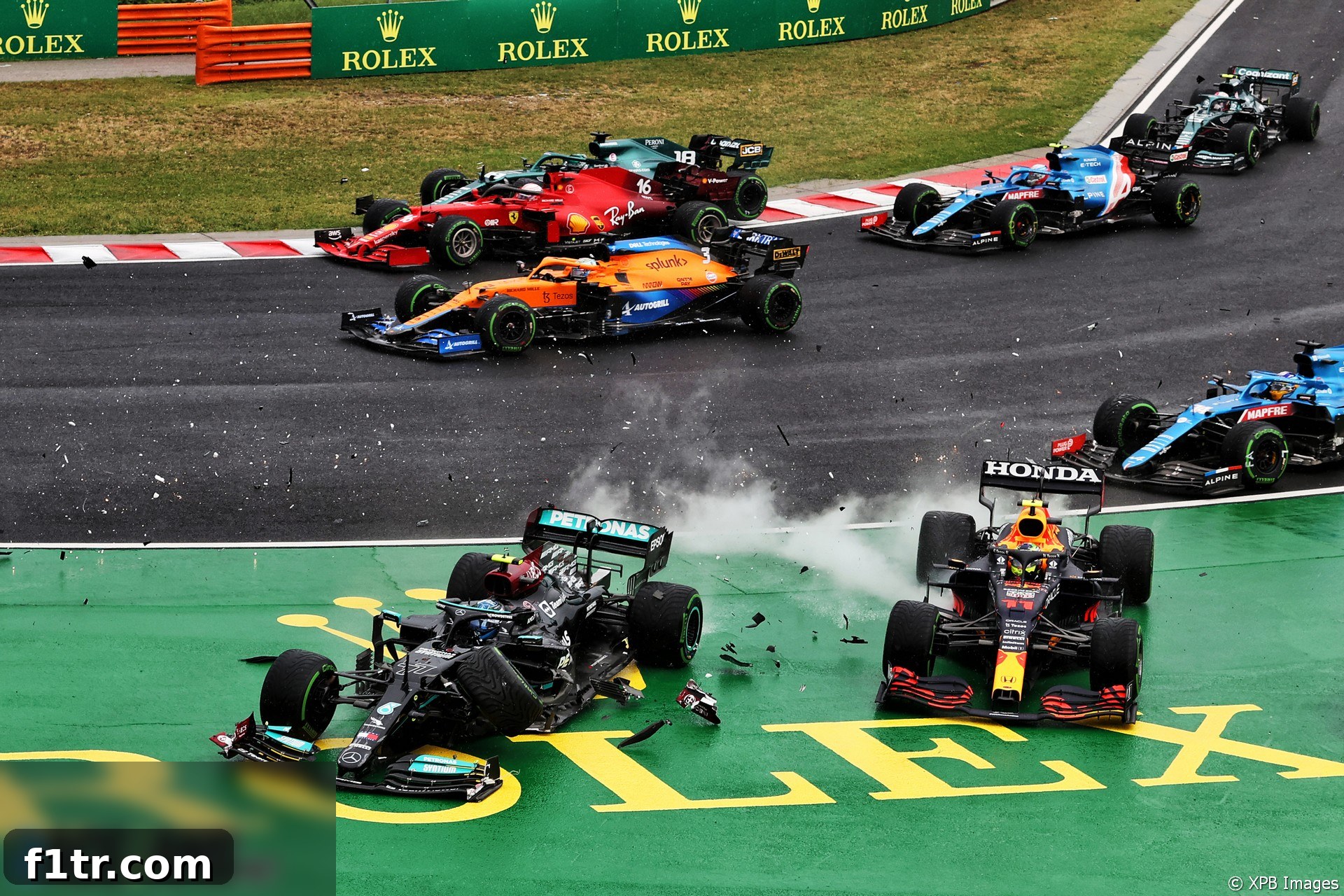
Red Bull’s woes compounded at the Hungarian Grand Prix, where Valtteri Bottas triggered a multi-car pile-up at the start. This incident effectively took out Sergio Perez’s car and caused significant damage to Verstappen’s, though he managed to salvage a points finish. The accumulation of these high-cost incidents in quick succession prompted Horner to call for a re-evaluation of the budget cap’s included items with the FIA. He emphasized that this was not merely a Red Bull specific problem, but “something that can affect all teams, not just Red Bull,” highlighting the systemic nature of the issue across the grid.
The “Guilty Party Pays” Proposal: A Radical Shift
While Wolff and Horner articulated the financial strain, it was Ferrari team principal Mattia Binotto who took the next logical, and revolutionary, step. Following the Hungarian Grand Prix, where Charles Leclerc’s engine was damaged after Lance Stroll clumsily collided with him, Binotto openly proposed a system of compensation. He suggested that if a driver is found at fault for an accident, their team should be liable to pay for the damages and repairs incurred by the aggrieved teams. This proposition represents a significant departure from long-standing F1 convention.
Binotto’s rationale centered squarely on the impact of the budget cap. “I think there is value for discussions in the near future with the other team principals, FIA and F1,” Binotto stated. “Obviously if you’re not guilty, having such damage in the budget cap is something which is even more of a consequence now.” He acknowledged the difficulty of simply adding “exemptions” to the budget cap, suggesting such a system would be “very difficult to be policed.” Instead, his focus was on fostering greater accountability: “But I think that what we may consider is that if a driver is faulty, the team of the driver should pay at least to the other teams for the damages and repairs. That will make the drivers more responsible.”
Navigating the Complexities of Compensation in F1
Binotto’s “guilty party pays” concept, while seemingly fair from an aggrieved team’s perspective, flies directly in the face of Formula 1’s deeply entrenched conventions. Implementing such a system would inevitably open a “can of worms,” creating massive knock-on effects throughout the sport and potentially cascading into lower categories, where any precedent set in F1 is often adopted. The implications extend far beyond mere financial transactions, touching upon the very sporting integrity and judicial process of racing.
One of the primary challenges lies in the precise apportionment of blame. For a claim to be granted, stewards – the judicial body in any incident – would need to assign fault on a percentage basis. This could lead to a significant increase in appeals and requests for review, further complicating an already convoluted and time-consuming process. Such disputes could ultimately spill over into civil courts, especially when the sums involved run into many millions, adding layers of legal complexity and expense. This raises a crucial question: if damages were awarded by stewards, should they be included within either team’s cost cap, or be considered an expense outside of it?
Despite the inherent complexities, a structured system for compensation could conceivably be formulated. One approach might involve categorizing all incidents on a scale of one to four, with drivers or teams found guilty on a sliding scale – for instance, 25/75 (partially to blame, the other predominantly so), 50/50 (no claim), or 100/0 (wholly at fault). Further splits could be established for multi-car accidents, allowing for granular assessment. An independent, FIA-appointed assessor would be granted access to a team’s cost accounts to accurately determine and award damages accordingly. This would ensure transparency and consistency in the evaluation process.
However, the real difficulty lies not in the conceptual formulation of such a process, but in its practical implementation. Such a system immediately raises philosophical questions that challenge F1’s core identity. Is a “guilty pays” system compatible with the sport’s cherished “let them race” philosophy, which encourages aggressive competition without undue fear of financial reprisal? What mechanisms would be in place for intra-team incidents, where teammates collide? Would stewards demand that the ‘guiltiest’ driver’s team compensates their own operation? Furthermore, establishing clear and fair appeal processes would be critical to ensure justice and prevent endless disputes.
The Future of F1 and Compensation
At this stage, the extensive chatter surrounding the costs of crashes and demands for compensation remains largely speculative, a direct consequence of the budget cap’s immediate impact. Any claims process, if introduced, is likely to have major ramifications on the overall structures and integrity of the sport, while simultaneously proving highly complex to implement without introducing unintended consequences. For these reasons, financial compensation for crash damage is widely considered unlikely to be introduced in Formula 1 anytime soon.
Yet, the history of Formula 1 teaches us that what seems impossible today can become reality tomorrow. Similar words of skepticism were uttered just 15 years ago when budget caps were first proposed; today, in 2021, they are a harsh but widely accepted reality. The same pattern unfolded with the introduction of safety innovations like HANS devices and the Halo, and even with sporting changes like sprint qualifying – all initially met with heavy opposition before becoming indispensable parts of the sport. On that historical basis, it is not inconceivable that some form of compensation for innocent teams, designed to mitigate the financial devastation of crashes within the budget cap era, could be introduced in F1 sooner rather than later. The evolving financial landscape of Formula 1 necessitates a continuous re-evaluation of its rules, and the question of crash compensation may yet find its place in the sport’s future.
News Focus
- No happy ending for Ricciardo’s made-for-Netflix redemption arc
- No ‘two alphas’ for Red Bull as team forms its longest-running driver line-up
- Will Mercedes come to the rescue of Ocon’s career a third time?
- How the midfield’s hottest team mate rivalry boiled over
- Petty officialdom or deserved decisions? Five drivers stripped of wins in 2024
Browse all News Focus articles