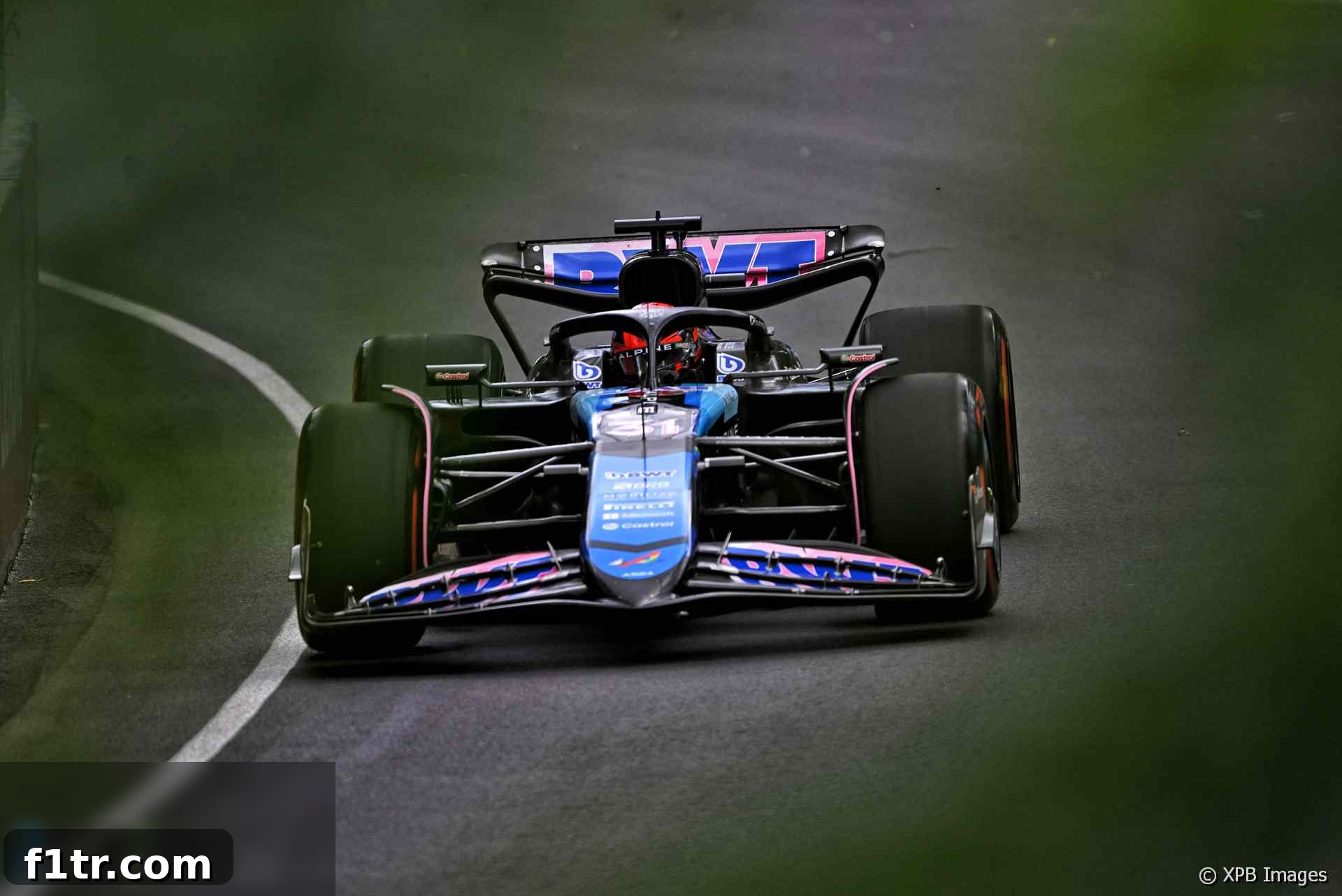
Esteban Ocon, the beleaguered Alpine driver, found himself facing an uphill battle even before the lights went out at the Canadian Grand Prix. After a disappointing Q1 exit at the challenging Circuit Gilles Villeneuve, Ocon revealed a crucial disadvantage: his car was “a couple of kilos” heavier than that of his team mate, Pierre Gasly. This revelation paints a clearer picture of the tight margins that define Formula 1, where even minor discrepancies can have significant consequences for a driver’s performance and qualifying prospects.
Advert | Become a Supporter & Go Ad-Free
The Weight of Disadvantage: A Hidden Handicap
In the hyper-competitive world of Formula 1, every gram counts. Teams meticulously shave weight from every component to meet the minimum car weight regulations, as running underweight brings penalties, while any excess weight acts as a direct performance impediment. Esteban Ocon’s disclosure that his Alpine was a “couple of kilos” heavier than Gasly’s highlights a substantial disadvantage. While “a couple of kilos” might seem negligible in everyday terms, in F1, it translates to tenths of a second per lap, especially over a challenging circuit like Montreal.
Ocon explained that this weight difference, which has reportedly been a factor for several races, is being rotated between the two Alpine cars. This practice, while aimed at ensuring fairness over the long term, means that one driver at a given Grand Prix is inevitably operating with a handicap. For the Canadian Grand Prix, this burden fell on Ocon. This rotational system, designed to balance development and component availability, paradoxically creates an immediate disparity that can profoundly impact individual race weekends, particularly in qualifying sessions where margins are razor-thin.
The impact of this additional weight is multifaceted. It affects the car’s balance, potentially making it less agile through chicanes and slower to respond to steering inputs. It also places greater strain on the tyres, leading to increased degradation over a stint. Crucially, it directly reduces acceleration and outright top speed, factors that are incredibly important on a power-sensitive circuit like Circuit Gilles Villeneuve, with its long straights and heavy braking zones. For a driver like Ocon, already pushing the limits, this inherent disadvantage becomes a significant hurdle to overcome.
Qualifying Chaos: Traffic, Tyres, and the Cruel Margins
Ocon’s Q1 exit wasn’t solely attributable to the car’s weight. He cited a confluence of issues during the session, painting a picture of a challenging and frustrating qualifying run. “There was a bit too many things basically that didn’t go right for us this weekend and this session,” he confessed to the official F1 channel. These issues included encountering traffic at the start of his crucial flying lap, which can disrupt a driver’s rhythm and compromise tyre preparation. Optimum tyre temperature and pressure are paramount for extracting maximum grip, and any interruption during the out-lap can lead to suboptimal performance.
Furthermore, Ocon reported additional traffic during the lap itself, an incident that he estimated cost him a vital tenth of a second. In a qualifying session where the difference between progressing to Q2 and being eliminated can be milliseconds, a tenth is an eternity. His best lap time was 0.146 seconds slower than Pierre Gasly’s, who secured the very last spot in Q2. This minuscule gap underscores the brutal nature of Formula 1 qualifying, where the smallest mistake, or the slightest misfortune like traffic, can dictate a driver’s entire weekend.
The accumulation of these factors – the inherent weight disadvantage, suboptimal tyre preparation, and traffic disruptions – created a perfect storm that conspired against Ocon. Each element individually might have been manageable, but their combined effect was too great to overcome. For a driver fighting for every hundredth of a second, such a combination of adverse circumstances makes progression almost impossible. It’s a stark reminder that F1 performance is a delicate balance of driver skill, car performance, strategic execution, and a touch of luck.
The Monaco Aftermath: A Grid Penalty’s Shadow
Adding to Ocon’s woes was a five-place grid penalty carried over from the Monaco Grand Prix, where he was deemed responsible for a collision with his team mate, Pierre Gasly, on the opening lap. This incident, which saw Ocon attempting an optimistic overtake into Portier, resulted in contact that damaged both Alpine cars and ultimately led to Ocon’s retirement from the race. Such incidents between team mates are always contentious and often lead to internal discussions and repercussions, beyond just the sporting penalty.
Arriving in Canada with this penalty meant that even a stellar qualifying performance would have been undermined. After qualifying 18th, the five-place penalty relegated him to the very back of the grid, starting Sunday’s race from 20th position. Starting from the last row on a circuit known for its tight confines and limited overtaking opportunities, especially in the early stages, presents an enormous challenge. It forces a driver and team to consider aggressive or unconventional strategies right from the outset, hoping to capitalize on unforeseen circumstances or superior race pace.
The psychological impact of such a penalty also cannot be understated. Knowing that even a perfect qualifying effort will result in a back-row start can be demoralizing. It shifts the focus from outright performance to damage limitation and strategic improvisation, which adds another layer of pressure to an already demanding weekend.
Alpine’s Shifting Sands: Ocon’s Future and Team Dynamics
Compounding the difficulties for Ocon is the recent confirmation from Alpine that he will not be driving for the team in 2025. This announcement, coming between the Monaco and Canadian Grands Prix, marks a significant turning point in his career and within the Alpine team structure. While the reasons for his departure are multifaceted, ranging from his perceived aggressive driving style (exacerbated by the Monaco incident) to team strategy and driver market dynamics, it inevitably casts a shadow over his remaining races with the Enstone-based squad.
For Ocon, the pressure is now on to prove his worth to other teams on the grid. Every race becomes an audition, and every performance is scrutinized. For Alpine, the focus shifts to finding a suitable replacement and navigating the remaining season with a driver whose future lies elsewhere. While professionalism dictates that Ocon will continue to give his utmost, the underlying dynamic within the garage changes. Such a situation can sometimes lead to increased tension or, conversely, a sense of liberation for the departing driver.
Despite these internal team developments, Ocon remains a crucial part of Alpine’s immediate technical efforts. Earlier this year, he was the first of the team’s drivers to utilize a significant floor upgrade, introduced ahead of schedule at the Chinese Grand Prix. This highlights the trust and reliance the team still places on him for car development, even as their paths diverge beyond 2024. The floor upgrade itself is a critical component in modern F1 aerodynamics, responsible for generating a substantial portion of a car’s downforce. Its early introduction with Ocon suggests he was instrumental in its initial feedback and integration, demonstrating his technical input despite the public separation.
Strategic Hopes for Race Day: The Degradation Gamble
Despite starting from the last position on the grid, Ocon remains pragmatic and hopeful about his prospects for the Canadian Grand Prix. His optimism is rooted in the observations of tyre degradation during the practice sessions. The Circuit Gilles Villeneuve is known for being hard on tyres due to its combination of heavy braking zones, high-speed straights, and traction demands out of slow corners. This can lead to significant tyre wear, especially on softer compounds, creating opportunities for drivers who can manage their tyres more effectively or are on alternative strategies.
“Obviously there is an opportunity with the strategy which, we’ve seen some degradation in practice three and hopefully some drivers will degrade more than us, fingers crossed,” Ocon stated. “If that’s the case then we can hopefully do a good race and optimise everything.” This indicates Alpine might be eyeing a one-stop strategy, or at least a strategy that capitalizes on rivals suffering higher degradation. If Ocon’s car proves to be gentler on its tyres, or if the team can execute a perfectly timed pit stop under a Safety Car period, he could potentially make significant inroads through the field.
Tyre management is often a game-changer in Montreal. A driver who can preserve their tyres longer can extend a stint, gaining track position as others pit earlier, or run faster lap times towards the end of a stint when rivals are struggling. The variability of tyre performance, especially in changing conditions often seen in Canada, adds another layer of unpredictability. For Ocon, starting from the back, a well-executed strategy focusing on tyre longevity and opportunistic overtaking will be his best route to salvaging points from a challenging weekend.
The Broader Context: Alpine’s 2024 Season Struggles
Esteban Ocon’s struggles in Canada are emblematic of a broader challenging season for Alpine. The team has openly admitted to having started the year with an underperforming car, lagging behind their rivals in terms of pace and development. While recent upgrades, including the floor introduced by Ocon, have shown signs of improvement, the team remains firmly in the midfield, often battling for the lower points-paying positions. This difficult season has been marked by a lack of consistent performance, technical issues, and internal management changes, all contributing to a turbulent atmosphere.
Both Ocon and Gasly have shown flashes of potential, demonstrating the inherent talent within the driver lineup. However, the car’s limitations have often meant that even strong individual performances yield only modest results. The focus for Alpine throughout 2024 has been on understanding the car’s weaknesses, implementing upgrades effectively, and laying the groundwork for a more competitive 2025 season. This context makes Ocon’s fight in Canada all the more poignant; he is not only battling personal disadvantages and penalties but also the inherent limitations of his machinery.
The Canadian Grand Prix, with its unique challenges and propensity for unpredictable races, offers a glimmer of hope for teams and drivers struggling for pace. The notorious “Wall of Champions” and the close proximity of the barriers mean that driver errors are easily punished, and Safety Car periods are common. These incidents can shuffle the pack and open up strategic windows for those further down the grid. For Esteban Ocon, navigating the complexities of the Circuit Gilles Villeneuve with a heavier car, a grid penalty, and an uncertain future, while simultaneously hoping for strategic opportunities, encapsulates the relentless and often unforgiving nature of Formula 1.
Advert | Become a RaceFans supporter andgo ad-free
2024 Canadian Grand Prix Coverage
- “He needs to be more careful”: Unheard radio messages from the Canadian Grand Prix
- Marko contradicts stewards’ reason for Red Bull and Perez penalties
- Only one F1 championship looks like a worthwhile fight in 2024
- Red Bull can fix kerb-riding without losing RB20’s major strengths – Verstappen
- Mercedes suspect Montreal track layout ‘made us look quicker’
Browse all 2024 Canadian Grand Prix articles