Lando Norris’ 2023 Belgian Grand Prix weekend at the iconic Spa-Francorchamps circuit began with promising pace, yet his race day appeared to be spiraling out of control as early as lap 17. What transpired next was a masterclass in strategic adaptability and opportunistic driving, turning a potential disaster into a points-scoring finish against all odds.
Advert | Become a Supporter & go ad-free
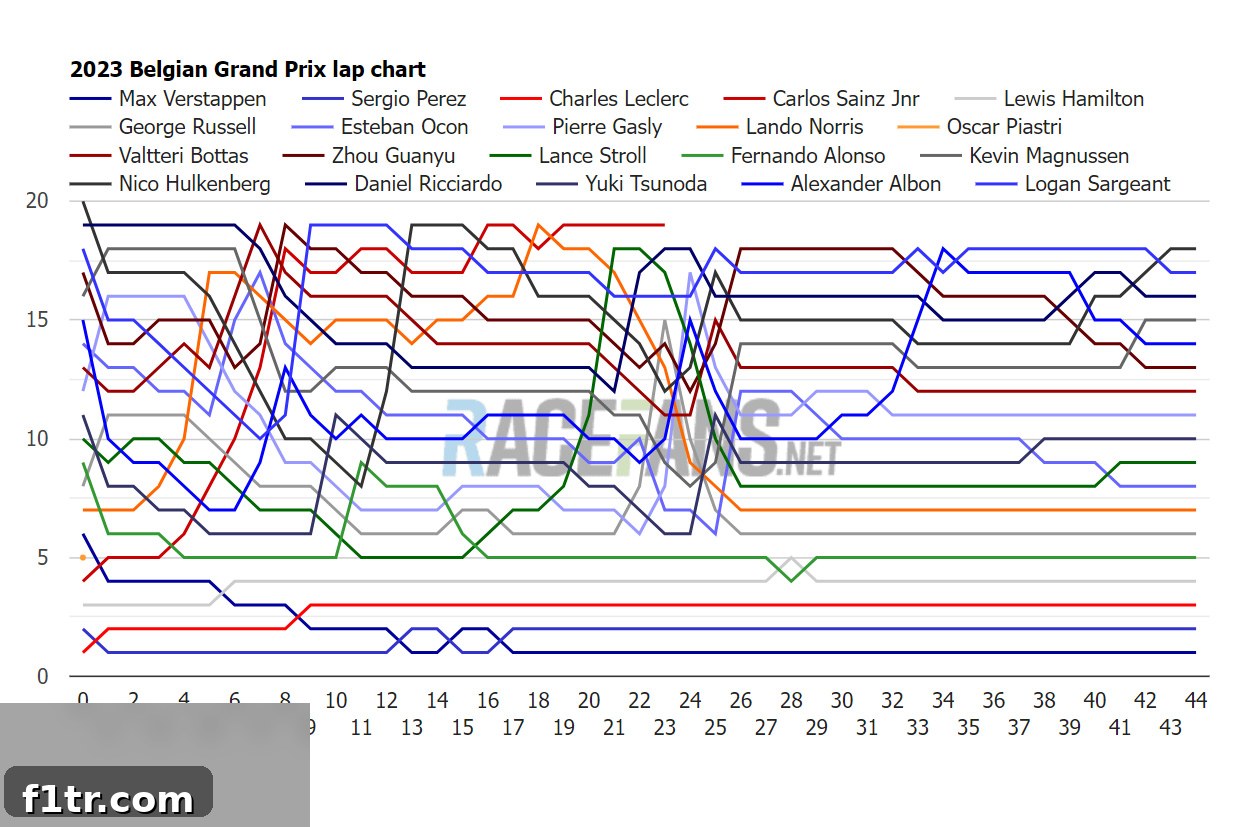
The McLaren driver’s initial stint on soft tyres proved challenging, with the car struggling for pace and grip, causing him to lose a disheartening four positions within the opening laps. This early struggle prompted the McLaren pit wall to make an aggressive, perhaps premature, strategic call: pit Norris as early as lap five for a set of hard compound tyres. This was a significant gamble, as the team – and indeed, most of the grid – had little to no data or experience with the hard tyres over a race distance that weekend. The gamble quickly backfired, as the hard tyres offered minimal grip, causing Norris to plummet further down the order, eventually being relegated to 16th place by the two Alfa Romeo drivers.
McLaren Team Principal Andrea Stella openly acknowledged the miscalculation. “The goal was to get Lando out of the cars around him, give him some free air and try to go long to then finish on a soft tyre,” Stella explained, detailing the original intent behind the risky hard tyre switch. “But I have to admit that our judgment on the grip of the hard tyres was incorrect. The tyres didn’t have much grip at all and Lando found himself again in the mix of the other cars.” The initial strategy seemed to have locked Norris into a spiral of underperformance, with little hope of recovery through conventional means.
However, salvation for Norris and McLaren arrived from an unexpected quarter: the heavens above Spa-Francorchamps. Shortly before the halfway point of the 44-lap race, a light drizzle began to fall across the circuit. While the rain never intensified enough to warrant a switch to full wet or even intermediate tyres, it was significant enough to transform track conditions and force every driver to exercise extreme caution. Even race leader Max Verstappen, who reported a massive scare navigating the treacherous Eau Rouge and Raidillon complex, was compelled to back off, losing as much as five seconds per lap during this period. The delicate balance between speed and control became the defining factor on the damp asphalt, leveling the playing field and creating a window of opportunity for those brave enough to seize it.
Recognizing this critical shift in conditions, McLaren saw their chance. They urgently needed to get Norris off the underperforming hard tyres. In a bold and unconventional move, they summoned him into the pits on lap 17 for a fresh set of soft tyres. This timing was remarkably early for a second pit stop, especially considering that some drivers, like George Russell, hadn’t even made their first stop by this point. It was a high-risk, high-reward strategy – an aggressive undercut that hinged entirely on Norris being able to extract maximum performance from the softs in marginal conditions and making them last an extraordinary distance.
The decision proved to be an inspired one. Emerging from the pits in last place, Norris immediately found his rhythm on the fresh, warm soft tyres. The combination of newfound grip and his inherent talent for driving in challenging conditions allowed him to lap seconds faster than the entire field. In a remarkable display of pace between laps 19 and 22, Norris was untouchable. No other driver could match his speed; the second-fastest drivers during these crucial laps – Verstappen on laps 19 and 22, and Nico Hulkenberg in between – collectively lost a staggering 5.3 seconds to the McLaren. This period of blistering pace was the bedrock of his improbable recovery.
Andrea Stella elaborated on the team’s strategic brilliance. “Luckily the race gave us the opportunity to rectify the situation by going on soft very early,” he said, highlighting the pivotal role of the rain. “We timed going on soft with the rain.” This wasn’t merely a stroke of luck; it was the culmination of meticulous preparation and real-time analysis. “I would like to praise the work done by our people that from the factory and from the track supporting the operations by observing the rain development because they gave us information that allowed us to think that we can go through the rain on dry tyres.” This synergy between trackside operations and remote analysis allowed McLaren to make an informed, audacious decision that fundamentally altered the course of Norris’s race.
Advert | Become a RaceFans supporter andgo ad-free
“Timing this on to the soft tyres allowed Lando to recover a massive amount of time on anybody else that was out there on the used tyres and they needed to be much more careful than Lando while driving under the rain,” Stella added. Other drivers, still nursing older, harder compound tyres, found themselves losing precious seconds lap after lap to Norris’s relentless charge. This cumulative gain formed the basis of what effectively became a “super-undercut,” a strategic maneuver where a driver gains a disproportionately large number of positions by pitting much earlier and capitalizing on significantly faster out-laps while competitors remain on track with worn tyres. The upshot was an astonishing recovery of 12 places when other drivers eventually made their own pit stops, catapulting Norris into an improbable seventh-place finish. Even Norris himself confessed to being surprised by the outcome, stating, “I wasn’t quite sure how I got there.”
A lesser-known factor contributing to Norris’s remarkable feat was McLaren’s car setup. For the Belgian Grand Prix, the team had opted for an ‘over-winged’ configuration, meaning his car had a higher level of downforce than many of his rivals. While this setup provided greater aerodynamic grip, particularly through the high-speed corners of Spa’s middle sector, it came at the cost of straight-line speed. Before the race, Norris had predicted that McLaren’s rivals would enjoy an advantage of up to 25kph in the DRS zones, a prediction that largely came to fruition in dry conditions. This compromise often puts a car at a disadvantage on a power-sensitive circuit like Spa.
However, what was initially a potential weakness transformed into a significant advantage when the rain began to fall. The extra downforce provided crucial stability and grip on the damp track, allowing Norris to push harder and maintain control where others were struggling. Furthermore, this high-downforce setup proved instrumental in helping him manage and preserve his soft tyres for a mammoth 27-lap stint – an extraordinary distance for a soft compound, especially in mixed conditions. Higher downforce can reduce tyre slip, thereby mitigating wear over a longer run, and in this case, it was a critical enabler for the success of the extended soft tyre strategy.
Stella confirmed the synergy between setup and strategy. “Because we had enough downforce in the middle sector, that’s the reason why we could extend the run on the soft so long and actually retain competitiveness even when the rubber was almost finished on the soft tyres,” he stated. This highlights that Norris’s P7 finish was not just about quick thinking and skillful driving, but also about the underlying engineering choices that, by chance or design, converged to create the perfect storm for a dramatic comeback. It was a testament to McLaren’s ability to adapt, showcasing how a challenging start can be overcome with strategic foresight, effective communication, and a touch of unexpected weather.
2023 Belgian Grand Prix lap chart
The positions of each driver on every lap. Click name to highlight, right-click to reset. Toggle drivers using controls below:
Advert | Become a RaceFans supporter andgo ad-free
2023 Belgian Grand Prix race chart
The gaps between each driver on every lap compared to the leader’s average lap time. Very large gaps omitted. Scroll to zoom, drag to pan and right-click to reset. Toggle drivers using controls below:
2023 Belgian Grand Prix lap times
All the lap times by the drivers (in seconds, very slow laps excluded). Scroll to zoom, drag to pan and toggle drivers using the control below:
Advert | Become a RaceFans supporter andgo ad-free
2023 Belgian Grand Prix fastest laps
Each driver’s fastest lap provides crucial insight into their peak performance potential and the moments where their car and tyre combination truly shined. While Lewis Hamilton ultimately secured the fastest lap of the race, the list below highlights the single quickest effort by each driver, illustrating individual bursts of speed across various stints and conditions, including how the evolving track conditions influenced overall pace.
| Rank | No. | Driver | Car | Lap time | Gap | Average speed (kph) | Lap no. |
|---|---|---|---|---|---|---|---|
| 1 | 44 | Lewis Hamilton | Mercedes | 1’47.305 | 234.98 | 44 | |
| 2 | 1 | Max Verstappen | Red Bull-Honda RBPT | 1’48.922 | 1.617 | 231.49 | 32 |
| 3 | 23 | Alexander Albon | Williams-Mercedes | 1’49.841 | 2.536 | 229.55 | 35 |
| 4 | 27 | Nico Hulkenberg | Haas-Ferrari | 1’49.907 | 2.602 | 229.42 | 26 |
| 5 | 24 | Zhou Guanyu | Alfa Romeo-Ferrari | 1’50.188 | 2.883 | 228.83 | 27 |
| 6 | 2 | Logan Sargeant | Williams-Mercedes | 1’50.236 | 2.931 | 228.73 | 36 |
| 7 | 11 | Sergio Perez | Red Bull-Honda RBPT | 1’50.308 | 3.003 | 228.58 | 31 |
| 8 | 16 | Charles Leclerc | Ferrari | 1’50.436 | 3.131 | 228.32 | 30 |
| 9 | 31 | Esteban Ocon | Alpine-Renault | 1’50.439 | 3.134 | 228.31 | 27 |
| 10 | 77 | Valtteri Bottas | Alfa Romeo-Ferrari | 1’50.515 | 3.210 | 228.15 | 26 |
| 11 | 63 | George Russell | Mercedes | 1’50.603 | 3.298 | 227.97 | 25 |
| 12 | 10 | Pierre Gasly | Alpine-Renault | 1’50.911 | 3.606 | 227.34 | 25 |
| 13 | 14 | Fernando Alonso | Aston Martin-Mercedes | 1’50.938 | 3.633 | 227.28 | 42 |
| 14 | 20 | Kevin Magnussen | Haas-Ferrari | 1’50.993 | 3.688 | 227.17 | 27 |
| 15 | 3 | Daniel Ricciardo | AlphaTauri-Honda RBPT | 1’50.994 | 3.689 | 227.17 | 25 |
| 16 | 18 | Lance Stroll | Aston Martin-Mercedes | 1’51.297 | 3.992 | 226.55 | 26 |
| 17 | 22 | Yuki Tsunoda | AlphaTauri-Honda RBPT | 1’51.394 | 4.089 | 226.35 | 26 |
| 18 | 4 | Lando Norris | McLaren-Mercedes | 1’51.682 | 4.377 | 225.77 | 26 |
| 19 | 55 | Carlos Sainz Jnr | Ferrari | 1’53.138 | 5.833 | 222.86 | 9 |
Advert | Become a RaceFans supporter andgo ad-free
2023 Belgian Grand Prix tyre strategies
Understanding the tyre strategies deployed by each team is fundamental to dissecting the ebb and flow of a Formula 1 race. This chart, typically visualizing the sequence and duration of tyre compounds used by each driver, would reveal the strategic choices made under race conditions, the impact of the early rain, and how teams reacted to changing circumstances at Spa.
Advert | Become a RaceFans supporter andgo ad-free
2023 Belgian Grand Prix pit stop times
Pit stop efficiency is a critical component of modern Formula 1, with mere tenths of a second often determining track position and strategic success. This table provides a detailed breakdown of how long each driver’s pit stops took, from entry to exit. It highlights the consistency and speed of the pit crews and can reveal any delays or exceptional performances that influenced the race outcome, such as the crucial stop for Lando Norris on lap 17 which set the stage for his remarkable comeback.
| Rank | No. | Driver | Team | Complete stop time (s) | Gap to best (s) | Stop no. | Lap no. |
|---|---|---|---|---|---|---|---|
| 1 | 22 | Yuki Tsunoda | AlphaTauri | 22.61 | 1 | 9 | |
| 2 | 11 | Sergio Perez | Red Bull | 22.71 | 0.1 | 2 | 29 |
| 3 | 22 | Yuki Tsunoda | AlphaTauri | 22.737 | 0.127 | 2 | 24 |
| 4 | 3 | Daniel Ricciardo | AlphaTauri | 22.843 | 0.233 | 1 | 5 |
| 5 | 1 | Max Verstappen | Red Bull | 22.887 | 0.277 | 1 | 14 |
| 6 | 1 | Max Verstappen | Red Bull | 23.012 | 0.402 | 2 | 30 |
| 7 | 44 | Lewis Hamilton | Mercedes | 23.023 | 0.413 | 2 | 27 |
| 8 | 31 | Esteban Ocon | Alpine | 23.085 | 0.475 | 1 | 6 |
| 9 | 14 | Fernando Alonso | Aston Martin | 23.085 | 0.475 | 1 | 10 |
| 10 | 44 | Lewis Hamilton | Mercedes | 23.09 | 0.48 | 1 | 12 |
| 11 | 2 | Logan Sargeant | Williams | 23.109 | 0.499 | 3 | 34 |
| 12 | 16 | Charles Leclerc | Ferrari | 23.148 | 0.538 | 2 | 28 |
| 13 | 44 | Lewis Hamilton | Mercedes | 23.156 | 0.546 | 3 | 42 |
| 14 | 16 | Charles Leclerc | Ferrari | 23.224 | 0.614 | 1 | 13 |
| 15 | 3 | Daniel Ricciardo | AlphaTauri | 23.29 | 0.68 | 2 | 22 |
| 16 | 55 | Carlos Sainz Jnr | Ferrari | 23.303 | 0.693 | 1 | 7 |
| 17 | 31 | Esteban Ocon | Alpine | 23.339 | 0.729 | 2 | 25 |
| 18 | 77 | Valtteri Bottas | Alfa Romeo | 23.362 | 0.752 | 1 | 6 |
| 19 | 23 | Alexander Albon | Williams | 23.529 | 0.919 | 3 | 33 |
| 20 | 2 | Logan Sargeant | Williams | 23.57 | 0.96 | 1 | 8 |
| 21 | 20 | Kevin Magnussen | Haas | 23.572 | 0.962 | 2 | 25 |
| 22 | 23 | Alexander Albon | Williams | 23.596 | 0.986 | 2 | 23 |
| 23 | 20 | Kevin Magnussen | Haas | 23.638 | 1.028 | 1 | 5 |
| 24 | 11 | Sergio Perez | Red Bull | 23.684 | 1.074 | 1 | 13 |
| 25 | 4 | Lando Norris | McLaren | 23.744 | 1.134 | 2 | 17 |
| 26 | 77 | Valtteri Bottas | Alfa Romeo | 23.786 | 1.176 | 2 | 24 |
| 27 | 14 | Fernando Alonso | Aston Martin | 23.798 | 1.188 | 2 | 29 |
| 28 | 63 | George Russell | Mercedes | 23.837 | 1.227 | 1 | 22 |
| 29 | 2 | Logan Sargeant | Williams | 23.938 | 1.328 | 2 | 24 |
| 30 | 24 | Zhou Guanyu | Alfa Romeo | 24.045 | 1.435 | 2 | 25 |
| 31 | 24 | Zhou Guanyu | Alfa Romeo | 24.449 | 1.839 | 1 | 7 |
| 32 | 27 | Nico Hulkenberg | Haas | 24.571 | 1.961 | 1 | 12 |
| 33 | 4 | Lando Norris | McLaren | 25.012 | 2.402 | 1 | 5 |
| 34 | 23 | Alexander Albon | Williams | 25.015 | 2.405 | 1 | 7 |
| 35 | 27 | Nico Hulkenberg | Haas | 25.238 | 2.628 | 2 | 24 |
| 36 | 18 | Lance Stroll | Aston Martin | 25.397 | 2.787 | 1 | 20 |
| 37 | 10 | Pierre Gasly | Alpine | 25.664 | 3.054 | 1 | 23 |
Become a RaceFans Supporter
RaceFans is run thanks in part to the generous support of its readers. By contributing £1 per month or £12 per year (or the same in whichever currency you use) you can help cover the costs of creating, hosting and developing RaceFans today and in the future.
Become a RaceFans Supporter today and browse the site ad-free. Sign up or find out more via the links below:
- Become a RaceFans Supporter
- RaceFans Supporter FAQ
2023 Belgian Grand Prix
- Haas drivers fear losing battle for seventh after “grim weekend” in Spa
- Mercedes optimistic they’re “in the right place for winter” with development plan
- Ferrari not convinced by call to equalise engines: ‘Renault is not so far away’
- Ferrari staying “calm” amid swings in performance from race to race
- Pirelli proposes new “super-intermediate” to address wet weather tyre problems
Browse all 2023 Belgian Grand Prix articles