Mark Blundell, a name synonymous with resilience and technical insight in the demanding world of Formula 1, carved out a remarkable career despite facing numerous challenges across various teams. After achieving impressive podium finishes with Ligier and Tyrrell, Blundell found himself poised for what seemed like his biggest F1 opportunity yet: a drive with the legendary McLaren team. This comprehensive look into his F1 journey, shared with RaceFans, delves into the iconic machinery he raced, the groundbreaking technologies he helped develop, and the stark realities of life at the pinnacle of motorsport.
1990 Williams-Renault FW13: Pioneering Active Suspension
The formidable Williams-Renault FW14B, which would spectacularly dominate the 1992 Formula 1 World Championship, wasn’t an overnight marvel. It was the culmination of relentless innovation and years of intricate development, particularly focused on its pioneering, computer-controlled active suspension system. Mark Blundell, who signed a crucial three-year testing contract with Williams in 1989, played an instrumental role in this groundbreaking project. He believes he accumulated more test mileage on this sophisticated system than any other driver, essentially becoming the human interface for its evolution.
Much of this intensive development work was conducted using a heavily modified test mule based on Williams’ 1990 chassis. As recounted by Karun Chandhok in a previous “My F1 Cars” feature, this experimental vehicle even famously featured a printer stowed within a sidepod, a testament to the era’s innovative, albeit sometimes rudimentary, data collection methods. The active suspension system heralded a new era of possibilities, offering a dizzying array of potential enhancements for on-track performance, many of which Blundell was the first driver to experience and provide feedback on.
Blundell vividly recalls a steering wheel switch that allowed him to hydraulically lift the front end of the car. This ingenious mechanism was designed to reduce aerodynamic drag on straights, thereby boosting terminal speed. “The big problem is when you switched it back off again to recover so that you had a nose down and some downforce been developed for when you went into turn one at 150 miles an hour if it hadn’t quite worked, you were in trouble,” he explained, highlighting the fine line between innovation and peril.
The essence of active suspension lay in its ability to liberate car setup from the traditional compromises required for an entire lap. Instead, the system could be individually tuned to the unique demands of each corner, optimizing grip, balance, and aerodynamic stability at every point on the track. This technical leap forward not only unlocked unprecedented levels of performance but also pushed the physical demands on Formula 1 drivers to extraordinary new extremes.
“It was getting to the stage where the human input was becoming beyond the physicality of a driver,” Blundell noted. He offered the last corner at Estoril as a prime example: “We got to a point there when you turned into the corner in fifth gear and there was zero roll in the car. The active ride had taken over and taken all the roll out, so you’d enhance your aerodynamics, your platform was more stable.” However, this stability came with a caveat. “The biggest issue as a driver was you couldn’t keep your right foot stuck into the throttle pedal. The G [force] was just basically pulling your head off and your foot away from the throttle.”
While Blundell was logging countless miles and gaining invaluable experience at Williams, the lack of racing opportunities began to weigh on him. When the struggling Brabham team extended an offer for Blundell to make his Formula 1 race debut, the allure of competitive driving proved too strong to resist, marking a pivotal, albeit retrospectively debated, turn in his career path.
1991 Brabham-Yamaha BT59Y: A Challenging Debut
Following a season utilizing Judd engines, Brabham secured a new engine supply deal with Yamaha for the 1991 season. However, development delays meant their all-new chassis wasn’t ready for the opening race. Consequently, Mark Blundell and his experienced teammate, Martin Brundle, were forced to begin the season with a heavily modified BT59 chassis, originally designed for the previous year, for the initial two Grands Prix. This stopgap solution meant Blundell’s first Formula 1 car was inherently compromised, heavy, and far from ideal for the competitive demands of the sport.
“It was not a great car,” Blundell candidly remembers of the BT59Y. The issues extended beyond just an outdated design; fundamental engineering flaws plagued the car. “We didn’t have a six-speed gearbox. I think we were down to even four gears because they couldn’t fit two gears in. There was some horrendous mess-up.” Adding to the team’s woes was the nascent Yamaha engine program. “We had Yamaha engines that were new to the paddock and a lot of development side being undertaken from there,” he explained, indicating the steep learning curve and unreliability associated with a brand-new engine supplier.
Despite these significant gearbox problems and the car’s inherent limitations, Blundell managed to narrowly qualify for his Grand Prix debut in Phoenix. However, his race was short-lived, as he spun off before reaching half-distance. The BT59Y’s brief and challenging tenure concluded after its final appearance in Brazil, where Blundell’s engine sadly failed, underscoring the team’s struggle with both chassis and power unit reliability.
1991 Brabham-Yamaha BT60Y: A Design Flaw and Financial Woes
The Sergio Rinland-designed BT60Y was intended to be a substantial leap forward for Brabham, rectifying the shortcomings of its predecessor. However, to Blundell’s utter dismay, the team committed a catastrophic error during its construction. After taking precise measurements of both Blundell and Brundle for the cockpit dimensions, a discrepancy emerged once the carbon monocoques were built. Neither driver could extract themselves from the cockpit quickly enough to meet the FIA’s stringent safety regulations for cockpit extraction time.
“The monocoque was made and, lo and behold, we went for our seat fit, there’d been a discrepancy in the dimensions laid out for the buck, and the carbon monocoque no longer gave us the capability of raising our knees to get our fire exit done cleanly in the duration allowed,” Blundell detailed, explaining the perilous situation. “So you couldn’t actually get your legs out and get your knees clear of the bulkhead because the bulkhead was made in a wrong position.”
The makeshift solution to this critical safety flaw had severe, detrimental consequences for the car’s structural integrity and handling characteristics. “The team ground away, with an angle grinder, the carbon bulkhead, so we could get our legs out. And of course that took away some rigidity and strength from the monocoque from day one,” Blundell revealed, highlighting how a desperate fix compromised the car’s fundamental safety cell.
Despite these profound design flaws, the new car at least offered the drivers a glimmer of hope, allowing them to occasionally qualify in the midfield. However, reliability remained a persistent issue, with an engine failure in Canada preventing Blundell from making the race start. Life became even tougher mid-season when the Brabham team, hampered by financial woes and inconsistent performance, was relegated to the humiliating pre-qualifying sessions, a severe blow to its prestige and a testament to its spiraling decline.
Against all odds, Blundell demonstrated remarkable skill and determination, snatching his first Formula 1 point with a sixth-place finish at the challenging Spa-Francorchamps circuit. This was a crucial milestone, not just for him but also for Yamaha, marking their first point in F1. However, this glimmer of success was short-lived. In Japan, an untimely oil leak forced him out of qualifying at Yamaha’s home race, a cruel twist of fate as teammate Brundle went on to finish fifth, securing the team’s only other points of the year.
Looking back, Blundell openly admitted that joining Brabham ultimately proved to be a misstep. “In hindsight, it was a bad decision because I should never have walked away from Williams. They did try and educate me, ‘saying you’re better off to stay here’,” he reflected. The team’s financial situation was increasingly precarious, leading to direct personal impact. “On two occasions during the year in 1991 I sat in the Brabham factory waiting for my cheque to be reissued because my salary cheque bounced,” Blundell recounted, painting a stark picture of the team’s dire state. He wisely did not return for the 1992 season, and the once-mighty Brabham team collapsed entirely before that year concluded. However, a silver lining emerged as he soon received another invitation to test for Williams, a chance to reconnect with the cutting edge of F1 technology.
1991 Williams-Renault FW14/FW14B: A Glimpse of Greatness
The stark reality of his Brabham decision became powerfully clear when Williams extended an invitation for Blundell to return to testing during the 1991 season. “The reason why the Brabham penny dropped to me very early on is because Williams invited me to go back and test for them during the ’91 season,” Blundell explained. This opportunity was highly unusual for the time, and virtually unheard of in modern F1, where drivers rarely switch allegiances mid-season, even for testing roles. The contrast between his Brabham and the Williams machinery was immediate and astonishing.
“When you roll around in an FW14 and you go 2.2 seconds a lap faster on race tyres than what you did on Pirelli qualifying tyres in your Brabham, you realise that you’ve made a fundamental error of judgement,” he reflected, highlighting the profound performance disparity. This revelation underscored the true potential he had walked away from.
Throughout 1991, Williams was meticulously integrating its aerodynamically efficient FW14 chassis and the superb Renault V10 engine with the advanced active suspension technology that Blundell had played such a significant role in refining. The awe-inspiring FW14B, which would go on to dominate the following season, was the magnificent end product of this intensive development. For Blundell, this car represented the absolute zenith of his driving experiences.
“Definitely for me the best grand prix car I’ve ever driven would be that Williams FW14B,” Blundell affirmed, a high praise from a driver with extensive experience across different F1 eras. He recounted a specific memory of driving the FW14 at Imola: “My biggest recollection of driving the FW14 was at Imola. They’d just brought in the blown underwing [using] the gasses from the exhaust and developing the rear end to sit down and squat and get it to sort of basically suck down [with] a huge amount of traction. That was the most impressive thing.”
The impact of this innovation was transformative. “I’d never been in a car where literally you touched the throttle pedal, the rear sat down and it was like a rocket, just propelled out the corner. That was something that stuck in my mind. That was a great car,” he enthused. This experience cemented his understanding of what a truly dominant Formula 1 car felt like and further validated his earlier contributions to its development.
1992 McLaren-Honda MP4-7: Learning from the Masters
At the conclusion of his challenging year with Brabham, Mark Blundell strategically sought an environment where he could expand his knowledge and skills at the very highest echelons of Formula 1. “When I got to the end of the Brabham year, I felt that I would rather be in an environment where I could learn more at the highest performance levels from drivers and technical aspect with a team than being in a race car with a team like Brabham that was not going anywhere,” he articulated. This clear ambition led him to McLaren, a team that welcomed his technical acumen and raw talent.
Joining McLaren in 1992 provided Blundell with an extraordinary opportunity to work alongside two titans of the sport: Ayrton Senna, fresh from his third world championship victory, and the formidable Gerhard Berger. Blundell described this period as “a huge year – I learned a great deal,” acknowledging the immense value of observing and contributing to a top-tier team.
Intriguingly, Blundell discovered a significant commonality in his driving approach with the reigning world champion. “My style of driving was very similar to the way that Senna drove,” he recalled. This similarity extended to the subtle nuances of throttle application. “We had very similar inputs in application of throttle. I would have maybe two or three stabs on the throttle pedal. I didn’t like a loose car, I liked a car to be balanced on the exit and have understeer and trim it out on the throttle pedal.”
He further elaborated on this technique: “But to do that, I got on the throttle early and then built it up in stages. So I put some throttle in, get the platform stable and have another stab, get it stable and then I’d rotate the car on the throttle to get the exit. So if you looked at ’92 myself and Senna’s set-up was almost identical. Senna’s set up and Berger’s set up were poles apart.” This insight underscores Blundell’s deep understanding of car dynamics and his ability to articulate his needs, qualities that made him an invaluable test driver.
While McLaren had dominated the preceding four seasons, they found themselves reeling from Williams’ stunning performance with the FW14B in 1992. Fortunately, they had the foresight to hire the very driver who had significantly contributed to the development of their rival’s cutting-edge technology. Beyond the complex electronics such as ABS, semi-automatic gearboxes, and active ride suspension, teams were also making significant advancements in fuel technology. Exotic fuel concoctions were being poured into their cars, unlocking new, powerful levels of performance that blurred the lines between chemistry and engineering.
In his role as the official test and reserve driver, Blundell attended all the Grands Prix, immersing himself in the team’s extensive experimental work. “There were so many different things that we were doing back then,” he stated. He particularly remembered the intensity of fuel testing. “Fuel then was delivered in a dense form. There was a lot of complaints from the mechanics having to handle the fuel in this in this format and some skin problems and some breathing issues. It was powerful stuff.”
The testing regimen was rigorous and revealing. “We would sit at Silverstone, for example, one garage but two grand prix cars side by side and we’d go out and do 10 laps at a time and basically be testing fuel batches. I can remember having four or five tenths of a second differential in lap time purely based on different fuels that we were using in terms of the performance edge.” This level of scientific refinement, often unseen by the public, highlights the marginal gains philosophy that defined Formula 1’s technological arms race.
1993 Ligier-Renault JS39: Back on the Podium
After a year spent largely on the sidelines in a testing capacity, Mark Blundell secured a highly anticipated chance to return to Formula 1 as a full-time race driver for the 1993 season. This move saw him reunited with his 1991 Brabham teammate, Martin Brundle, but this time, critically, they were partnered in a significantly more competitive machine. Ligier, the French team, had observed Blundell’s impressive performance and technical feedback during his 1992 testing duties and recognized his potential.
The key to Ligier’s improved fortunes lay in a strategic technical partnership with Williams, a move that Blundell carefully considered. “I looked at the technical package, the alliance with Williams, the Renault engine – we had a Renault, gearbox and rear end suspension from Williams that was bolted on the back. And the car was pretty good,” he explained. This collaboration provided Ligier with access to top-tier engineering, including a powerful Renault engine and crucial Williams components, instantly elevating the performance of their JS39 chassis.
The JS39 proved to be good enough for Blundell to achieve his first career podium finish in his very first race back, a remarkable feat at the season-opening South African Grand Prix at Kyalami. He masterfully navigated a late thunderstorm to claim a superb third place, finishing behind Alain Prost’s dominant Williams and Ayrton Senna’s McLaren. “We had a couple of podiums with that car, first podium for Ligier in a very long time,” he proudly recalled. Blundell also cherished the experience of working with motorsport luminaries like Gerard Ducarouge, noting, “Superb to work with the likes of Gerard Ducarouge and people like that. We had a lot of fun.”
While the team was in a significantly better state than his previous stint at Brabham, Ligier’s progress with the car over the course of the year was somewhat limited. “Technically, there was very small development because again budget-wise it wasn’t really at the levels of the big guys,” Blundell pointed out. This financial constraint meant they couldn’t keep pace with the rapid development cycles of the top teams, hindering their sustained competitiveness.
Ligier’s headquarters were located at Magny-Cours, which at the time also hosted the French Grand Prix. This geographical advantage meant the team often performed exceptionally well there, famously locking out the second row of the grid in qualifying for their home race. However, their performance often dipped at other circuits. “We would do a lot of work at Magny-Cours and try and do as much as we could. But Magny-Cours wasn’t a great circuit to test on. You had a window in the morning and a window in the afternoon when temperatures and circuit conditions were at their best. Outside of that, you pretty much were better off to sit in a garage and have some lunch because you couldn’t learn that much,” he explained, illustrating the challenges of optimizing testing resources.
During the 1993 season, it became increasingly clear that the sport’s governing body, the FIA, intended to outlaw the expensive ‘driver aids’ – technologies like active suspension, ABS, and traction control – which Blundell and others had been instrumental in developing. This regulatory change was widely anticipated to level the playing field, promising to help smaller, less affluent teams compete more effectively. For 1994, Blundell found himself returning to one such outfit, hoping to capitalize on this shift in regulations.
1994 Tyrrell-Yamaha 022: A Final Hurrah
Tyrrell, a team steeped in Formula 1 history with multiple world championships in the seventies, found itself in a vastly different landscape two decades later, dwarfed by the financial might and technological advancements of its F1 rivals. Nevertheless, Mark Blundell provided them with a memorable final hurrah. In a standout performance at the 1994 Spanish Grand Prix, he scored Tyrrell’s last-ever podium finish, a significant achievement that also marked Yamaha’s first podium as an engine supplier.
Blundell remarkably finished behind Michael Schumacher, who was battling an unforeseen issue with his Benetton, a car famously stuck in fifth gear. Unaware of the extent of Schumacher’s predicament, Blundell admitted, “We weren’t really aware that that issue was as apparent as we now know. Pretty much because of the pace – he was running still some sensational lap times.” This highlights the intensity of on-track focus, where drivers often have limited information about their competitors’ specific struggles.
That season also saw Blundell partnered with Japanese driver Ukyo Katayama, who possessed a distinct, if frustrating, advantage. “[He’s] a great guy, but the guy weighed about 58 kilos and I was something like 74 kilos with kit and helmet. That amount of weight differential is huge in a grand prix car,” Blundell explained. This substantial weight difference translated directly into a measurable performance deficit. “So you’re almost giving up two tenths of a second just for nothing. And trying to make the differential at times was quite difficult. When you looked at speed traces and you saw the guy came off the corner actually a little bit slower than what you were mid-corner, but because of the difference in weight, you ended up being three or four [kph] down at the end of the straight it was quite frustrating.”
However, a far greater and more pressing concern for Blundell was the detrimental impact of the team’s severely limited financial resources on their on-track performance and, crucially, safety. “With Tyrrell you could see the writing on the wall, it was already going to run out of money from the first quarter of the grand prix season,” he grimly observed. This chronic lack of funding manifested in perilous ways.
“When you’re going around in a race car and you know that your carbon brake discs, have been already skimmed off twice and they’re at the end of their life, and you’re at Monza and you get on the brakes and the brake disc explodes because it’s so thin because it’s basically worn out, because there’s not enough budget for new brakes, you know things are going in the wrong direction. And nothing really can support that other than pounds, shillings and pence,” Blundell powerfully conveyed, emphasizing the life-threatening compromises forced upon the team and its drivers. This chilling anecdote underscores the profound risks inherent when passion outstrips financial capability.
Despite these immense challenges, Blundell fondly remembered working with the legendary team owner. “It was wonderful to work with Ken Tyrrell,” he added, “fantastic to work with Harvey Postlethwaite. Mike Gascoyne was there then as well as like an understudy to Harvey.” He concluded by summarizing the bittersweet nature of the season: “It was a fantastic season in many ways but it was also a dreadful season in many ways as well because we were so hampered with lack of budget.” The 1994 season was a testament to the raw talent and dedication within Tyrrell, battling against insurmountable financial odds.
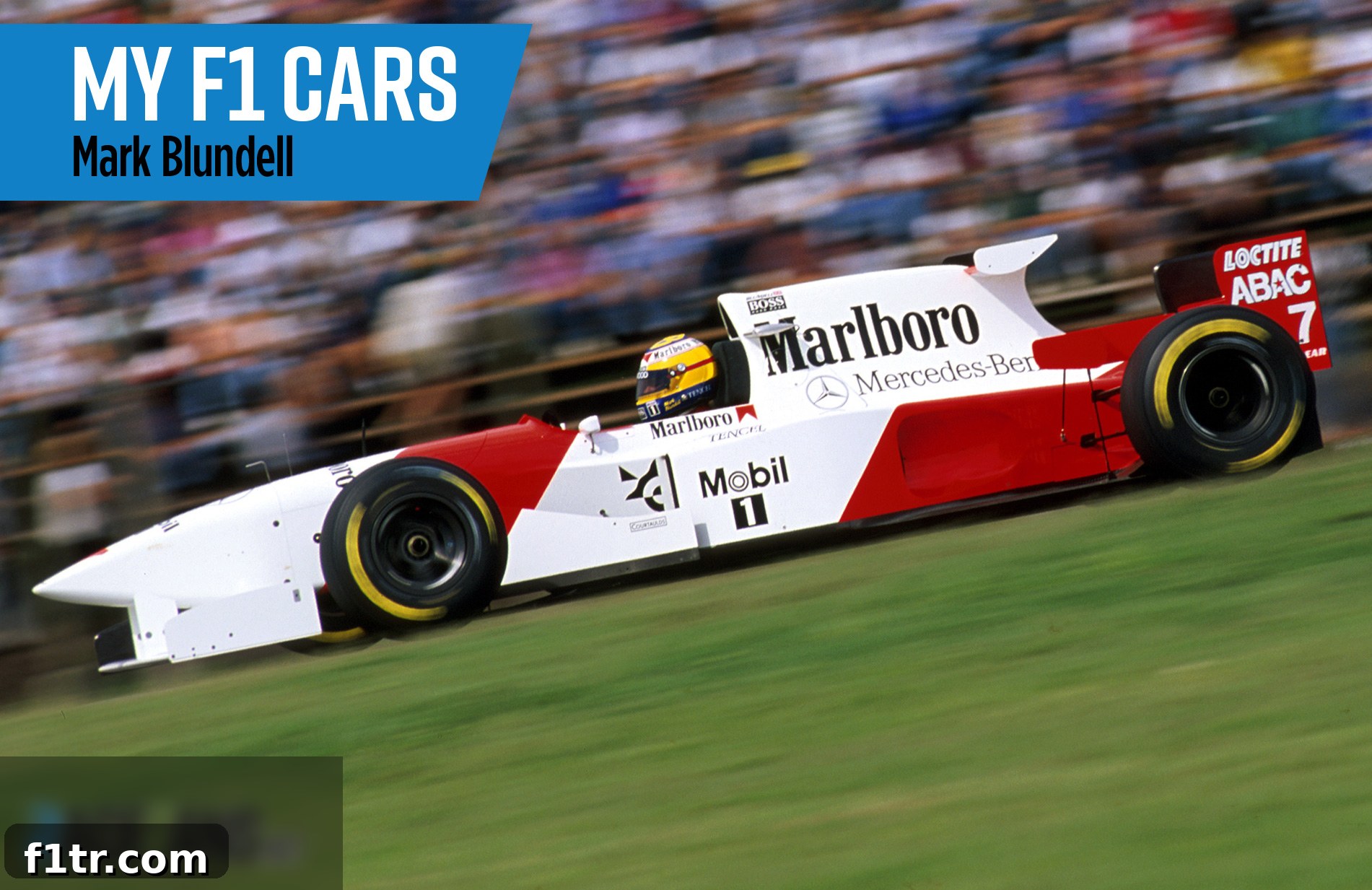
1995 McLaren-Mercedes MP4-10: A Bittersweet Return
For the 1995 season, McLaren announced an intriguing driver lineup featuring Mika Hakkinen and the returning British legend Nigel Mansell. However, team principal Ron Dennis, recognizing Blundell’s technical prowess and reliable nature from his previous testing stint, had successfully lured him back to McLaren in a test and reserve driver capacity. This decision proved prescient when Mansell encountered significant difficulties fitting into the new MP4/10 chassis, a circumstance that unexpectedly opened the door for Blundell to seize his chance for a race seat.
“Ron had said to me look, you’re wasting your time where you are, come back and join us. And I did in a test and reserve role again, not knowing at that stage that I was going to be a grand prix driver for McLaren,” Blundell recounted, highlighting the serendipitous turn of events. He suspected that the McLaren management, including Ron Dennis and Martin Whitmarsh, had underlying concerns regarding Mansell’s commitment or ability to adapt to a car that was proving to be both physically uncomfortable and inherently uncompetitive. “I think Ron probably had an understanding, and Martin Whitmarsh, that there was already some trouble in the camp there and they needed to put somebody in to fill the gap.”
Blundell’s previous experience and his easygoing nature made him the ideal candidate. “And having known me from the ’92 season, they needed capabilities near where I was at. I was a good fit and with no dramas and no politics and no baggage,” he elaborated, emphasizing his professional and straightforward approach that suited the team’s urgent needs.
Mansell ultimately ruled himself out of the season’s start, allowing Blundell to step in. He immediately made an impact, scoring a valuable point in the season-opener at Interlagos. Mansell then returned for two subsequent races, after which he abruptly bid farewell to Formula 1. This opened the door for Blundell once more, who, despite the “snug cockpit,” returned at Monaco, where he impressively claimed fifth place.
Reflecting on the Mansell situation, Blundell stated, “Nigel, for whatever reasons – I don’t know the full reasons behind all of that and do not wish to, to be honest – but there was discussions over him not fitting in the cockpit.” He drew a direct comparison: “All I do know is that me and Nigel are pretty thick-set, wide-shouldered guys and maybe we’ve got a differential in our hip size, but I got myself in it.” His determination was clear: “But put it this way, I was at a different stage of my career to Nigel and I could have been six foot eight and I’ve have made sure I fit inside that cockpit of a grand prix car. So it was going to be fitting me whatever, I didn’t really care whether I was uncomfortable or not.” This anecdote perfectly captures Blundell’s unyielding resolve to seize his opportunity.
Blundell had finally secured his longed-for chance in a top-tier team, but unfortunately, McLaren had not delivered a top-tier car. “I think, by their own admission, it was probably the worst car they’ve ever made,” he candidly stated. The MP4/10 represented a significant misstep for the Woking-based outfit, especially being the inaugural year of their partnership with Mercedes-Benz. “I honestly felt that they got it wrong in several areas there which was a crying shame because it was the first year of Mercedes-Benz back in the F1 paddock, a great relationship that generated some huge success for them later on.”
Blundell articulated a common sentiment among experienced drivers: “When you drive a grand prix car for the first time, you pretty much know within 10 laps if it’s was a good one or a bad one. And unfortunately, if it’s a bad one, there’s not a great deal that you can do to kind of improve it as much as you keep coming out with changes.” Despite the car’s inherent flaws, Blundell acquitted himself exceptionally well, scoring 13 points to teammate Hakkinen’s 17, with both drivers missing two races over the course of the year. This performance highlighted his adaptability and ability to extract the maximum from challenging machinery.
The low point for the team was particularly painful at their engine supplier’s home race. “[For] myself and Hakkinen I think the killer for us was the German Grand Prix where we got lapped in front of a Mercedes-Benz, a terrible situation,” Blundell recalled. He understood the profound impact on a team with McLaren’s heritage: “And for McLaren, you know, having been there in ’92 and been part of the success with Berger and Senna, the DNA of that company is just all about winning and they took that year incredibly hard.”
Despite his commendable efforts in a difficult car, Blundell couldn’t persuade Ron Dennis to commit to him for the full following season. By the end of the year, David Coulthard was signed to take his place for 1996. “I knew quite early on that there wasn’t going to be a seat available there for the year after because there was already a deal done with DC,” said Blundell. His F1 racing career ultimately concluded on a bittersweet note. “So, yes, it was tough in many ways. But I’m also grateful in many ways that I got to at least race for somebody like McLaren, who are still a top organisation.” Mark Blundell’s journey through Formula 1 is a compelling narrative of a skilled and technically astute driver who navigated the complexities, innovations, and harsh realities of the sport, leaving an indelible mark on its history.
My F1 Cars
- Hill on Williams’ dominant cars, Brabham’s last gasp and the “worst decision” F1 ever made
- Herbert on his painful debut, Schumacher’s title-winning Benettons and more
- ‘Aston Martin still use my steering wheel design’ – Liuzzi on his F1 career in cars
- Villeneuve on Williams’ last title-winner, BMW grief and Alonso’s ‘un-driveable’ Renault
- Coulthard on the CVT Williams, McLaren’s little-known tricks and Newey’s first Red Bulls
Browse all My F1 Cars articles