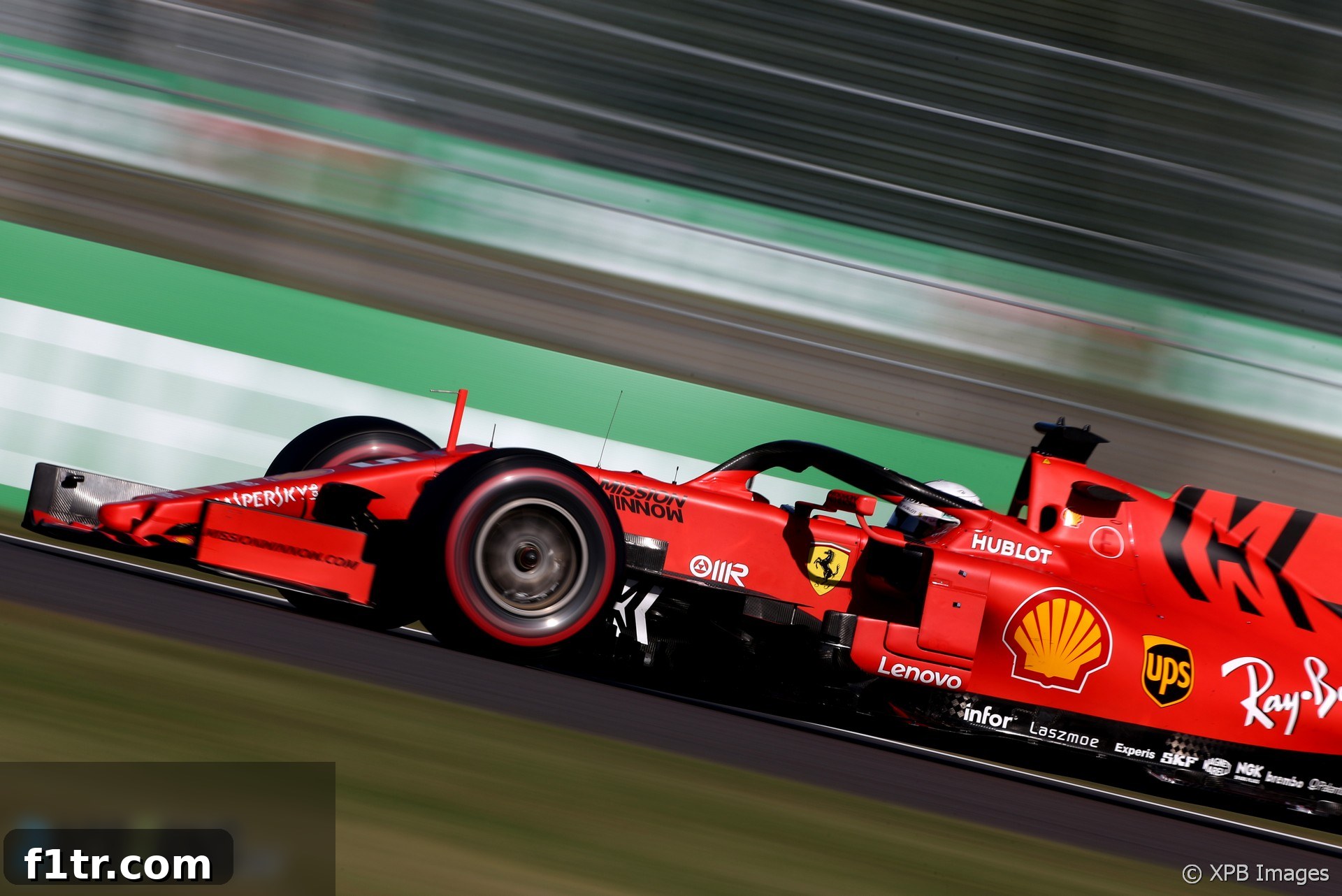
Sebastian Vettel’s Resurgence: Unpacking the Impact of Ferrari’s Singapore Upgrade at Suzuka
In the high-stakes world of Formula 1, every incremental improvement can shift the balance of power, and for Sebastian Vettel and Ferrari, a seemingly subtle upgrade introduced at the Singapore Grand Prix proved to be a pivotal moment. The four-time world champion recently broke a challenging nine-race streak of being out-qualified by his dynamic teammate, Charles Leclerc, securing a vital pole position at the Japanese Grand Prix. This breakthrough wasn’t just a testament to Vettel’s enduring skill, but, as he revealed, a direct consequence of the continuous development on their SF90 car, specifically crediting enhancements first rolled out in Singapore. His performance at the iconic Suzuka circuit reignited hopes for Vettel and provided a much-needed boost to Ferrari’s season narrative.
The 2019 Formula 1 season had presented Sebastian Vettel with a series of formidable challenges. Having previously dominated the sport with four consecutive championships, the German driver found himself in an unfamiliar position, often overshadowed by the meteoric rise of his younger teammate, Charles Leclerc. Leclerc’s exceptional qualifying pace, which saw him snatch six pole positions prior to Suzuka, placed considerable pressure on Vettel. Critics and fans alike questioned whether Vettel was losing his edge, or if the SF90’s characteristics simply didn’t align with his precise driving style. The car, while undeniably fast, particularly in a straight line, often struggled with consistency in corners and tire management, areas where a driver’s confidence in the front end is paramount. This put Vettel in a difficult psychological battle, constantly pushing to extract more from a car that, at times, seemed reluctant to cooperate fully with his inputs.
The Pivotal Singapore Grand Prix Upgrade
Formula 1 is a relentless development race, with teams constantly bringing updated components to each Grand Prix. The upgrade package introduced by Ferrari at the Singapore Grand Prix was initially designed to address specific aerodynamic inefficiencies and improve the car’s overall balance, particularly in slower corners and through complex chicanes. While the full technical details remain proprietary, such upgrades typically involve revisions to the front wing, floor, bargeboards, and diffuser – all critical areas that influence how air flows over and under the car, generating crucial downforce. Singapore, with its demanding street circuit layout, offered a crucial testing ground for these new parts, and while the immediate impact might not have been fully realized or consistently demonstrated in race trim, its foundational benefits were clearly being understood and optimized by the team.
Sebastian Vettel’s comments underscore the targeted nature of this development. He openly stated, “Obviously we’ve been improving the car, especially since Singapore. I think the update helped us, probably help me in areas where maybe I struggled a little bit before.” This insight is crucial. It suggests that the modifications weren’t just about raw speed, but about making the SF90 more predictable and responsive in specific handling characteristics. For a driver of Vettel’s caliber, confidence in the car’s front end, its braking stability, and its ability to carry speed through corners without unexpected snap oversteer or understeer, is paramount. If the Singapore upgrade provided better front-end bite or a more stable rear under braking, it would allow Vettel to attack corners with greater conviction, push the limits more effectively, and ultimately extract that precious extra tenth of a second in qualifying. It allowed him to truly “get more out of the SF90,” as he eloquently put it, transforming his relationship with the car.
Mastering Suzuka: A “Clean Session” Secures Pole
The Suzuka International Racing Course in Japan is revered by drivers and fans alike as one of the most challenging and rewarding circuits on the Formula 1 calendar. Its flowing, high-speed corners, particularly the iconic Esses, demand absolute precision, courage, and a perfectly balanced car. To extract pole position on such a track speaks volumes about both the driver and the machine. Vettel’s pole at Suzuka was not just a statistical anomaly; it was a masterful display of controlled aggression and seamless execution. His qualifying performance was described by him as “just a clean session,” a phrase that, while modest, highlights the immense pressure and intricate process of an F1 qualifying lap. A “clean session” means everything went perfectly: tire preparation was optimal, no errors were made on his fast laps, and the car performed exactly as expected, lap after lap. It was a demonstration of harmony between man and machine, a stark contrast to some of his earlier, more troubled qualifying outings.
Despite securing his first pole position since the Canadian Grand Prix much earlier in the season, Vettel downplayed notions of a sudden, dramatic “breakthrough” at Suzuka itself. He clarified, “Nothing has changed, we didn’t change the car for here so nothing that would explain the step in performance.” This reinforces his earlier point about the Singapore upgrade’s lasting effect. It wasn’t a last-minute tweak at Suzuka that delivered the pole, but rather the cumulative benefit of consistent development and a growing understanding of how to maximize the SF90 with its latest iterations. The Japanese Grand Prix simply provided the perfect stage for these improvements to manifest fully, allowing Vettel to string together two impeccably clean and fast laps that left his rivals trailing. His satisfaction was evident: “Both laps were clean, no issues on preparing the lap and so on. So I was happy with that.”
Navigating the Intra-Team Dynamics with Charles Leclerc
The internal rivalry at Ferrari between Sebastian Vettel and Charles Leclerc had become one of the most compelling storylines of the 2019 season. Leclerc, in his maiden year with the Scuderia, had quickly established himself as a potent force, not only securing six pole positions – more than any other driver that year at the time – but also consistently out-qualifying his four-time world champion teammate. The statistic of Leclerc out-qualifying Vettel nine times to six with just four races remaining underscored the shifting dynamics within the team and the sport. This internal competition, while pushing both drivers, also added an layer of complexity and pressure for Vettel. Breaking Leclerc’s dominant qualifying streak at Suzuka was therefore more than just a single pole position; it was a significant psychological victory for Vettel.
For Vettel, reclaiming the qualifying edge, even for a single race, was vital for his confidence and his standing within Ferrari. It demonstrated that he still possessed the raw speed and precision required to compete at the very top, and that with a car that better suited his style, he could challenge anyone. For Leclerc, while a momentary setback, it served as a reminder of the immense talent he was up against and the relentless nature of Formula 1 where even the smallest advantage can make a difference. The healthy competition between the two drivers, fuelled by continuous car development, was undoubtedly a driving force for Ferrari, pushing the team to explore every avenue for performance improvement.
Understanding the SF90’s Evolution and Driver Synergy
The SF90, Ferrari’s challenger for the 2019 season, was characterized by its incredible straight-line speed but also its nuanced handling characteristics. Early in the season, it was often described as a ‘nervous’ car, particularly in transient phases of cornering, which can make it challenging for drivers to find the absolute limit consistently. This is where upgrades and driver feedback become critical. A successful F1 team doesn’t just bolt on new parts; it analyzes driver telemetry, listens to their feedback, and refines the car’s setup to maximize the potential of those new components. The Singapore upgrade likely provided a fundamental shift in the SF90’s aerodynamic balance, offering a more stable and predictable platform. This, in turn, allowed Sebastian Vettel, with his detailed feedback and precise driving, to better exploit the car’s inherent pace.
The synergy between driver and machine is paramount in Formula 1. When a car ‘clicks’ with a driver, it allows them to push harder, brake later, and carry more speed through corners, unlocking performance that might have been previously unattainable. Vettel’s comments about the upgrade helping him in areas he “struggled a little bit before” vividly illustrate this point. It suggests that the team’s engineers successfully translated his feedback into tangible aerodynamic and mechanical changes, creating a car that felt more intuitive and responsive to his particular demands. This evolution of the SF90, coupled with Vettel’s refined approach and confidence, showcased how continuous development, even late in the season, can yield significant dividends.
Looking Ahead: Implications for Ferrari’s Season and Beyond
Sebastian Vettel’s pole position at Suzuka, driven by the effectiveness of Ferrari’s Singapore upgrade, sent a clear message to the paddock: Ferrari was still a potent force, and Vettel was far from being counted out. While the championship title was largely out of reach by this point in the season, such performances are crucial for team morale, driver confidence, and the momentum heading into the winter break. It demonstrated Ferrari’s commitment to development and its ability to respond to challenges, even against formidable competitors. For the remaining races of the 2019 season, this newfound harmony between Vettel and the SF90 promised more competitive outings and an even more exciting intra-team battle. Beyond 2019, it provided valuable data and insights for the development of future Ferrari challengers, reinforcing the importance of addressing driver-specific feedback in the pursuit of ultimate performance. The journey from Singapore to Suzuka was a testament to perseverance, technical ingenuity, and the enduring competitive spirit that defines Formula 1.
Don’t miss anything new from RaceFans
Follow RaceFans on social media:
- Join RaceFans on Facebook
- Follow RaceFans on Twitter
- Get daily email updates from RaceFans
Advert | Become a RaceFans supporter andgo ad-free
2019 F1 season
- Crying in the Melbourne car park at 2019 grand prix was my career low – Ocon
- McLaren Racing reports reduced £71 million loss in 2019
- Kvyat: Hockenheim podium last year was “my biggest achievement” so far
- How the FIA’s new encrypted fuel flow meter targets Ferrari’s suspected ‘aliasing’ trick
- “He smashed my office door”: 23 must-see moments from ‘Drive to Survive’ season two
Browse all 2019 F1 season articles