In the high-octane world of Formula 1, progress is measured in milliseconds and engineering ingenuity. The 2019 F1 season presented Red Bull Racing with early challenges, but the team showcased a significant leap forward with its RB15 chassis at the Chinese Grand Prix. This pivotal improvement, following a rigorous post-race test in Bahrain, marked a turning point, restoring confidence and hinting at Red Bull’s potential to challenge the front-running Mercedes and Ferrari teams.
Unlocking the RB15’s Potential: The Bahrain Breakthrough
The initial races of the 2019 season had left Red Bull Racing grappling with an underlying performance deficit. While the Honda power unit showed promise, the chassis itself wasn’t delivering the expected performance, leaving drivers Max Verstappen and Pierre Gasly struggling to extract its full potential. The team’s diligent analysis, however, pinpointed a fundamental set-up error following the Bahrain Grand Prix. This crucial issue was believed to stem from an incorrectly installed sensor, leading to a critical misinterpretation of the car’s real-time configuration. Essentially, the team was operating under the assumption that the RB15 was running one setup, when in reality, the sensor anomaly meant it was performing quite differently.
The importance of accurate sensor data in modern Formula 1 cannot be overstated. Teams rely on a vast array of sensors to monitor every aspect of the car’s performance – from suspension loads and tire temperatures to aerodynamic pressures and engine parameters. A faulty sensor, particularly one related to chassis dynamics or aerodynamic balance, can send misleading information to the engineers, causing them to make incorrect adjustments or misinterpret driver feedback. In Red Bull’s case, this error was likely preventing the team from achieving optimal chassis balance and aerodynamic efficiency, hindering both outright pace and driver confidence.
The post-race test in Bahrain proved to be invaluable for Red Bull. These test sessions are critical opportunities for teams to conduct in-depth analysis away from the pressure of a race weekend, allowing for systematic fault-finding and validation of solutions. It was during this test that Red Bull engineers were able to diagnose and rectify the sensor problem, effectively “unlocking” the RB15’s true potential. Team Principal Christian Horner articulated the positive shift, telling media after the Chinese Grand Prix, “The chassis’s getting into a much happier place now. It’s been a positive weekend. We had a very good test after Bahrain where we understood some of our issues and we’ve gone some way to addressing them. There’s still some progress to be made but we’re on the right path.”
This newfound understanding translated directly into improved on-track performance in China. Horner further elaborated on the competitive gains: “We were definitely more competitive this weekend. You look on the overlays, particularly sector one, sector two we were in good shape. Sector three we’ve got some work to do but I think we’ve got some upgrades and so on coming soon that will help with that.” The significant improvement was evident in qualifying, where Max Verstappen was just over half a second slower than the quickest car, a substantial reduction from the gap observed in the first two races. While the team acknowledged the need for further refinement, particularly in the demanding final sector of the Shanghai International Circuit, which features a 1.4-kilometer straight towards Turn 14, the overall sentiment was one of renewed optimism.
Aerodynamic Refinements: The Front Wing Endplate Evolution
Beyond the critical sensor fix, Red Bull Racing also implemented significant aerodynamic changes, particularly to the front wing, driven by both performance optimization and regulatory compliance. The intricate design of the front wing is paramount in Formula 1, as it is the first component to interact with the undisturbed airflow, shaping the air that flows over, under, and around the rest of the car. Its primary function is to generate downforce, pressing the front tires into the track for grip, but it also critically manages the “outwash” effect – directing turbulent air away from the car’s sidepods and floor to improve overall aerodynamic efficiency. The delicate balance of these functions is what makes front wing development a constant battleground of innovation and legality.
For the Chinese Grand Prix, Red Bull had to make a crucial tweak to their front wing for legality reasons, mirroring similar adjustments made by Mercedes. The strict technical regulations governing front wing designs mean that teams are constantly pushing the boundaries of what is permissible. Red Bull, demonstrating their efficiency, managed to implement this necessary modification before arriving at the track, avoiding any potential disruptions during the race weekend.
The team opted to revert to a pre-season design for its front wing endplate, a component that plays a vital role in controlling the airflow at the extremities of the wing. In Melbourne, Red Bull had introduced a revised endplate featuring a distinctive cut-out in the top rear corner. This design, similar to approaches seen elsewhere on the grid, intentionally exposed the wing tip. The purpose of this exposure was to maximize the “outwash” effect, which helps to push turbulent air generated by the front wheels away from the sensitive aerodynamic surfaces further back on the car, thereby reducing drag and improving overall downforce generation.
However, for the China race, the design evolved. The endplate was closed, and the wing tip seamlessly joined the top edge of the endplate. This seemingly minor alteration has significant aerodynamic implications. By enclosing the wing tip, the pressure building up on the wing is retained more effectively. This creates a stronger tip vortex – a swirling column of air that forms at the end of a wing due to the pressure differential between its upper and lower surfaces. While still contributing to an outwash effect as the tip vortex spills over the endplate, the enclosed design ensures that the path of this vortex is altered, passing higher and closer around the front tyre. This precise manipulation of airflow can have a profound impact on how the air interacts with the entire car, particularly the bargeboards and floor, ultimately enhancing downforce and stability through corners.
Rear Wing Optimization: Balancing Downforce and Drag
Just as critical as the front wing in shaping the RB15’s performance profile is the rear wing, which generates crucial downforce to stabilize the car at high speeds and through corners, albeit at the cost of drag. For the Shanghai circuit, Red Bull had two distinct rear wing specifications available, each tailored for different aerodynamic objectives: one offering higher downforce for increased grip, and another designed for lower drag, favoring straight-line speed. The choice between these configurations is a strategic decision, influenced by the track layout, weather conditions, and the team’s overall race strategy. The difference in the lift-to-drag ratio was primarily achieved by altering the angle of attack through deeper or shallower wing profiles.
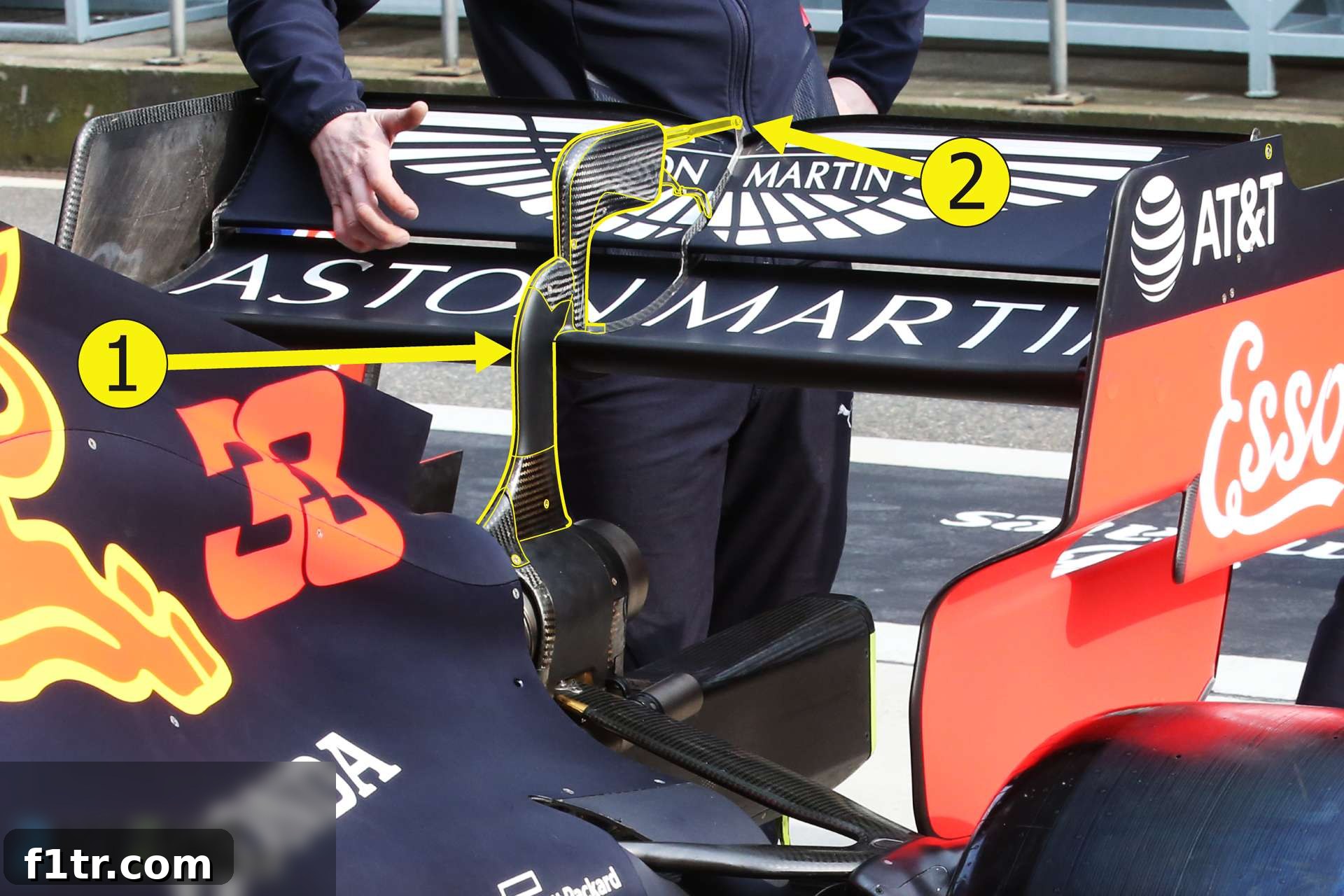
These differing wing profiles necessitated different mounting pylons, highlighting the intricate engineering required to adapt aerodynamic components. The deeper, higher downforce and higher drag wing featured a new DRS (Drag Reduction System) pod, a component that had been thoroughly tested during pre-season. Red Bull Racing has consistently employed a single pylon design to support the rear wing, positioning it centrally over the exhaust and connecting it to the middle of the main wing plane. This contrasts with many other teams on the grid that often adopt a double pylon arrangement.
Both single and double pylon designs present unique advantages and disadvantages. Red Bull’s single pylon approach is inherently lighter and offers less obstruction to the critical airflow around the rear of the car, which can be beneficial for maximizing aerodynamic efficiency. However, a potential drawback is the greater negative effect where the pylon joins the rear wing, as this connection point can potentially disrupt the smooth airflow underneath the wing, impacting its downforce generation.
An particularly innovative aspect of Red Bull’s rear wing support pylon is the DRS mechanism. It incorporates an extension, a clever design element reportedly inspired by their sister team, Scuderia Toro Rosso. This extension provides additional support and a pivot point for the movable rear wing flap when the DRS is activated. With the 2019 regulations allowing for larger and more powerful wings, and consequently a greater DRS opening, the air pressure exerted on the flap has significantly increased. By providing support and pivoting in three places instead of the traditional two, this design substantially reduces the structural load on the wing. This not only makes the flap less likely to bend or bind on its pivots when the DRS opens, but it also allows the flap itself to be constructed from lighter materials, as it needs to be less inherently stiff to withstand the aerodynamic forces. The result is a more robust, efficient, and lighter DRS system, which translates to a performance advantage.
Looking Ahead: Confidence for the Season
The remarkable progress demonstrated in China injected a much-needed boost of confidence into Red Bull Racing. While the upcoming Azerbaijani Grand Prix in Baku, with its exceptionally long straights, might not inherently flatter the high-downforce characteristics of the RB15, the team now possesses a clearer understanding of their car’s capabilities and how to extract its performance. The China performance provided crucial validation that the Red Bull RB15, paired with the Honda power unit, can indeed compete with the likes of Mercedes and Ferrari on more typical, aerodynamically demanding tracks.
The combined effect of resolving the fundamental set-up error and implementing intelligent aerodynamic refinements was immediately palpable. Drivers felt more comfortable and confident, and the technical data confirmed the gains. This momentum is vital for Red Bull as they embark on the rest of the 2019 season. With further upgrades anticipated and a deeper understanding of their package, Red Bull Racing aimed to solidify its position as a consistent podium contender, ready to capitalize on any opportunity to challenge for race victories.
Quotes: Dieter Rencken
F1 Technology & Innovation
- McLaren, Red Bull and Ferrari bring rear corner updates to Imola
- Ferrari, McLaren and Red Bull bring upgrades again for Saudi Arabian Grand Prix
- McLaren introduce major floor upgrade for Norris’ car at Mexican Grand Prix
- McLaren, Mercedes and Red Bull detail upgrade packages for United States GP
- Red Bull remove engine cover ‘cannons’ in major RB20 update – but they may return
Browse all F1 technology articles