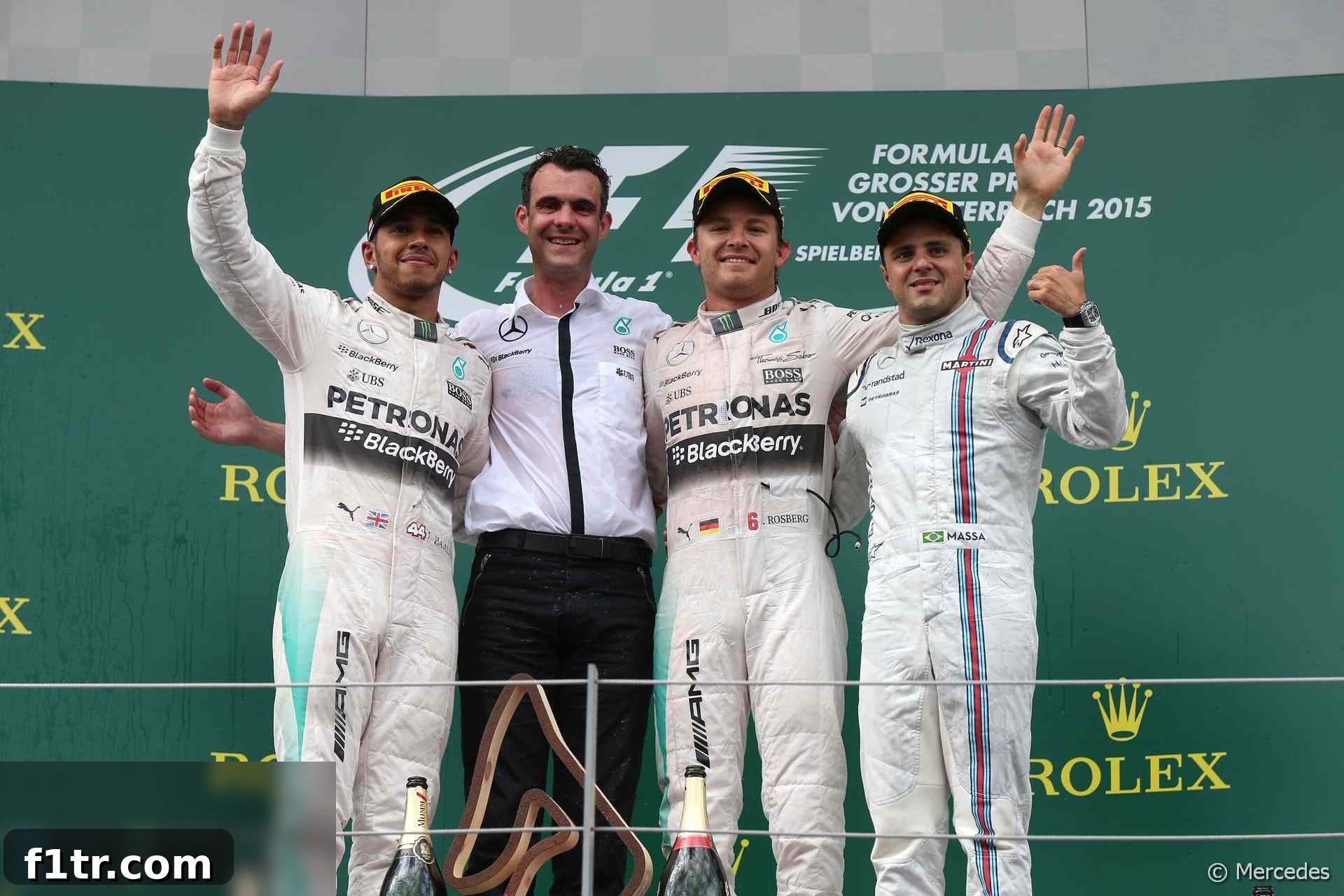
Rosberg Dominates Austrian Grand Prix to Reignite Championship Battle
The 2015 Formula 1 season witnessed an intense rivalry between Mercedes teammates Nico Rosberg and Lewis Hamilton. While Hamilton often held the upper hand, the Austrian Grand Prix marked a pivotal moment where Rosberg delivered a commanding performance, securing a victory that had been brewing since the season began. This wasn’t a win gifted by strategy or pole position; this was a decisive triumph, earned through sheer driving prowess and strategic execution, proving Rosberg’s capability to challenge Hamilton head-on.
Unlike his victory in Monaco, which benefited from a late-race strategic blunder, or his pole-led win in Spain, Austria was a true display of Rosberg seizing the initiative. This result held immense significance for the championship narrative. For much of 2014 and the early part of 2015, Hamilton had shown a knack for snatching victories from behind, often overcoming his teammate. Rosberg’s ability to turn the tables, to take a win where Hamilton started ahead, injected a potent dose of competitiveness into what was already a finely poised championship battle. It signaled that the psychological advantage might not be a permanent fixture in Hamilton’s camp.
Rosberg’s Decisive Victory: Shifting the Momentum
Lewis Hamilton arrived at the Red Bull Ring having secured six pole positions in the previous seven races, a testament to his qualifying brilliance. However, the Austrian weekend presented a different challenge. Hamilton appeared somewhat unsettled during practice sessions, failing to top either Q1 or Q2. His final lap in Q3 ended with a spin, an unusual error for the reigning champion. Fortuitously for Hamilton, his teammate Nico Rosberg then replicated the mistake, albeit at a different point, allowing Hamilton to retain pole despite his own misstep. This set the stage for a tense opening to the race.
Twelve months prior, at the same circuit, Rosberg had made a brilliant start but couldn’t maintain the lead he gained on the long run up the hill. This time, he was not to be denied. As the lights went out, Rosberg launched his Mercedes impeccably, drawing alongside Hamilton almost immediately. He decisively beat Hamilton to the apex of Turn One, claiming the coveted lead. From there, Rosberg expertly guarded his advantage. As they approached the tight right-hander of Turn Two, he meticulously picked his line to impede Hamilton’s acceleration out of the corner, denying any immediate counter-attack. Again, Hamilton attempted to draw alongside at Turn Three, but Rosberg, with equal precision and determination, positioned his car to thwart his teammate’s every move. This assertive, intelligent driving prevented Hamilton from ever truly challenging for the lead in the opening phase. It was a masterclass in defensive driving and racecraft, forcing Hamilton to concede the position and tuck in behind. Just as the intense duel seemed to settle, the Safety Car lights began to flash, signaling a significant incident behind them.
A Controversial Collision: Raikkonen and Alonso’s Early Exit
The safety car was deployed following a dramatic and somewhat baffling collision on the straight leading away from Turn Two. Fernando Alonso’s McLaren ended up perched precariously on top of Kimi Raikkonen’s Ferrari. Miraculously, both drivers emerged from their wrecked cars unharmed, a testament to the safety advancements in Formula 1. However, the sight of a front-running Ferrari entangled with a slower McLaren, especially one that had started five places further back, raised eyebrows and prompted immediate questions about the sequence of events.
Further investigation revealed a chain reaction of unfortunate circumstances. Raikkonen had experienced a delayed start from the grid, partly due to Marcus Ericsson’s slow getaway after the Sauber driver stalled his car following an initial jump start. Pastor Maldonado also reacted sluggishly. As Raikkonen attempted to navigate around these slower-moving cars, Alonso, seizing the opportunity, was making up ground rapidly on the outside. Then, at the exit of Turn Two, Raikkonen, running on the harder soft compound tires, visibly lost control of his Ferrari. The car snapped violently to the left, collecting Alonso’s McLaren in a spectacular incident that sent both cars into the barriers. The stewards subsequently investigated the crash but, to the surprise of many, decided to issue no sanction for Raikkonen. This decision was particularly notable given Alonso had been penalized in Monaco for a similar first-lap error, leaving some to ponder the consistency of stewarding decisions.
For McLaren, this early elimination was a bitter blow. The team was already enduring a torrid season, struggling for reliability and performance. Losing one car so early in such fashion was not what they needed. Their woes were compounded shortly after the race resumed when Jenson Button’s car developed a fault. “Nothing was broken on my car,” Button explained, “but something was wrong – and the switch-changes didn’t make any difference. So the team took the decision to retire the car – we’d fitted a brand new engine this weekend, and we didn’t want to unnecessarily damage it, so we decided to stop.” Button’s precautionary retirement made him the race’s fourth casualty. Will Stevens’ Manor car had earlier ingested debris, which damaged its radiator and caused an oil leak, forcing him to immediately pull over and stop, adding to the list of early retirements.
Midfield Mayhem and Ferrari’s Struggle
Once the Safety Car peeled into the pits on lap six, the race quickly settled into what appeared to be a two-horse battle at the front. Ferrari, which had shown promising pace with Raikkonen on Saturday, found itself struggling to match the Mercedes’ rhythm. Their pre-race preparation had been hampered; Raikkonen had flat-spotted a set of super-soft tires in qualifying, and gearbox trouble had disrupted Sebastian Vettel’s running. Consequently, much of their valuable practice time was spent on the soft tire compound. Running on the super-softs at the start of the race, Vettel initially lost up to seven-tenths of a second per lap compared to the front-runners, highlighting a clear performance deficit.
Further down the grid, the Toro Rosso drivers, Max Verstappen and Carlos Sainz Jnr, had made strong starts. Verstappen impressively demoted Valtteri Bottas, while Sainz gained three places, showcasing the aggressive nature of the young drivers. Romain Grosjean, in his Lotus, attempted to reclaim a position from Sainz but was robustly rebuffed on the outside of Turn Three. Sergio Perez, capitalising on the unfolding drama, seized the opportunity to gain a place himself. Perez, notably the highest-running driver on the harder soft compound tires at this stage, was conceding approximately a second per lap compared to those on the faster super-soft rubber, a strategic choice that would play out later.
Anxious to regain his lost position, Grosjean pushed hard, running wide in the final two corners of the lap. He was caught out by a new strip of artificial grass laid specifically for this weekend’s race, an unexpected challenge for many drivers. Shortly afterwards, his race engineer offered the rather unhelpful suggestion that he overtake the Force India ahead, a comment that underscored the mounting frustration in the Lotus garage. Grosjean’s challenging race ultimately ended prematurely with a gearbox failure, adding to the list of retirements and summing up a difficult weekend for the Frenchman.
Meanwhile, the battle between Bottas and Verstappen continued to rage. Bottas soon made a serious attempt to re-pass Verstappen. He skillfully moved down the inside at Turn Two, but the young Toro Rosso driver cannily lined him up to get a run on the exit of the corner. However, Bottas had already activated his Drag Reduction System (DRS), giving him the decisive speed advantage that effectively ended the squabble for the time being, cementing his position ahead of Verstappen.
The High Stakes of the Pit Lane: Hamilton’s Gamble and Vettel’s Misfortune
As the first stint progressed, Nico Rosberg meticulously built his lead over Lewis Hamilton. It peaked at a comfortable 4.29 seconds on lap 25. However, Hamilton, ever the competitor, then began a concerted effort to chip away at that gap, consistently reducing the deficit with a series of quick laps. The early Safety Car period had effectively turned the race into a clear-cut one-stopper, making the timing of the pit stops absolutely crucial.
By lap 32, the gap had narrowed to a mere 2.2 seconds. There were tell-tale signs that Rosberg was pushing his ageing super-soft tires beyond their optimal performance. He ran notably wide at Turn Two, locking his inside front-right tire, a clear indication of tires nearing their limit. He smoked his tires once again as he braked desperately late for the pit lane speed limit line, another visible sign of the pressure he was under and the wear on his rubber.
Rosberg executed a clean pit stop, rejoining the track just as Felipe Massa, in his Williams, was passing by. Hamilton’s engineers, ever alert to strategic opportunities, hoped that Massa might momentarily hold up Rosberg, even if only for a fraction of a second. This “reasonable gamble” led them to keep Hamilton out for an additional lap. Massa, not under immediate pressure from behind, could have theoretically stayed out longer. However, he chose to come in on the very next lap, effectively dissolving Hamilton’s slim chance of gaining an advantage through this pit stop strategy. As Hamilton headed for the pit lane exit, Rosberg had already flashed past, his position secure.
Any remote chance Hamilton had of emerging ahead was definitively extinguished when he strayed across the pit lane exit line. In previous seasons, this infringement would have resulted in a severe drive-through penalty, costing him approximately 20 seconds. However, the stewards, under new regulations introduced the previous year, opted for the more lenient five-second time penalty. While less punitive, it still solidified Rosberg’s lead and highlighted the fine margins in top-tier motorsport.
In other races, Sebastian Vettel might have been close enough to capitalize on such a penalty, but not in Austria. For the second consecutive race, Vettel was hampered by a slow Ferrari pit stop. This time, the delay cost him well over ten seconds and, crucially, handed his provisional third place directly to Felipe Massa. Despite Vettel’s determined efforts to close on the Williams in the closing stages of the race, his charge wasn’t quick enough to prevent Massa from securing his first podium finish of the season, a well-deserved result for the veteran driver.
Battles Beyond the Podium: Hard Fought Points
Behind the podium finishers, Valtteri Bottas found himself in a tenacious battle for fifth place. He had to pass Nico Hulkenberg not once, but twice, to cement his position. His first successful maneuver was a tidy move around the outside at Turn Three, showcasing his precise driving. However, Hulkenberg, fresh off his Le Mans 24 Hours victory, immediately headed for the pits. His Force India crew delivered the fastest pit stop of the entire race, allowing him to rejoin the track crucially just ahead of Daniel Ricciardo’s Red Bull. When Williams then took too long with Bottas’s pit stop, Hulkenberg capitalised, reclaiming his lost position.
It wasn’t until Lap 35 that Bottas finally managed to regain his fifth place, demonstrating his persistence. By then, however, any lingering hopes he might have harbored of finishing higher were all but extinguished. Max Verstappen’s impressive hold on seventh place began to slip with just two laps remaining as his tires faded significantly. He was under relentless pressure from Pastor Maldonado, who, in characteristic fashion, nearly lost his Lotus at Turn One at one point, and then executed an even more lurid skid as he finally dodged past the Toro Rosso with his DRS open, securing seventh.
A litany of misfortunes, however, wrecked the race of the other Toro Rosso driver, Carlos Sainz. Initially, Sainz hesitated when called into the pits, finding himself stuck behind Felipe Nasr, who was also making his way towards the pit entrance. When Sainz eventually did come in, his stop was agonizingly slow. Adding insult to injury, he then broke the pit lane speed limit, earning himself a penalty. All these woes became entirely moot when his car finally lost power, forcing his retirement. He had been running ahead of Sergio Perez, who ultimately finished ninth ahead of Daniel Ricciardo – both drivers, like Maldonado, had strategically saved their super-soft stint until the very end of the race, allowing for a late charge through the field.
The misfortunes extended to other parts of the grid. Brake trouble hobbled Felipe Nasr for the second race in a row, significantly impacting his performance. His Sauber teammate, Marcus Ericsson, endured a torrid race as his car cut out twice, and he also had to serve a drive-through penalty for his jump start earlier in the race. Daniil Kvyat damaged his front wing on the first lap, necessitating an early pit stop for repairs. Despite the fix, he was still carrying some residual damage throughout the race, eventually taking the checkered flag in 12th place. “It was like hell,” he reported over the radio, succinctly summarizing his arduous experience. Behind Ericsson, Roberto Merhi brought his Manor home in 14th, ensuring both Manor cars finished, a small victory for the struggling team.
Rosberg’s Mastery Confirmed: A New Chapter in the Rivalry
In the tense final laps of the 2015 Austrian Grand Prix, anxious exchanges filled Nico Rosberg’s radio as he reported a vibration on his front right wheel that was “getting stronger.” “All eyes on that,” he urged his team, the concern palpable in his voice. The issue, later attributed to tire graining, thankfully began to subside, allowing a cautious Rosberg to ease off by a couple of seconds on his penultimate lap without jeopardizing his lead. “It sort-of stabilized so it was not a problem,” he explained later. “It just came from the tire wear and just feels a bit uncomfortable when that happens.” His calm management of the situation underscored his growing maturity as a race driver.
While the second Formula 1 race at the revamped Red Bull Ring since its return to the calendar might not have been the most memorable spectacle in terms of overall drama, Rosberg’s personal track record at the circuit gave him little cause for complaint. His back-to-back victories here solidified his claim as a master of the Austrian circuit. At this identical stage in the previous year’s championship, Rosberg had held a commanding 29-point lead over Hamilton. Following this crucial victory, he now found himself just ten points behind his teammate. More importantly than the points, the strength of this performance instilled in him the undeniable belief that he could take points off Hamilton even when not starting from pole position. This was a critical psychological shift, as he had too often failed to convert such opportunities in 2014. This decisive win in Austria signaled a potential new, intriguing, and fiercely competitive phase in the championship contest, promising more direct and thrilling battles between the two Mercedes titans as the season progressed.
Related Content and Further Reading
2015 Austrian Grand Prix
- Strong run wins Hulkenberg Driver of the Weekend
- F1 continues to underwhelm in 2015
- 2015 Austrian Grand Prix team radio transcript
- Top ten pictures from the 2015 Austrian Grand Prix
- 2015 Austrian GP Predictions Championship results
Browse all 2015 Austrian Grand Prix articles
F1 race reviews
- Antonelli lucks in for second win and becomes youngest F1 championship leader
- Emotional Antonelli grabs first Formula 1 victory in Chinese Grand Prix
- Russell sees off Ferrari threat to lead Mercedes one-two in Melbourne
- Norris clinches F1 title by two points as Verstappen wins finale at Yas Marina
- McLaren strategy blunder in Losail hands Verstappen crucial win and shot at title
Read all F1 race reviews