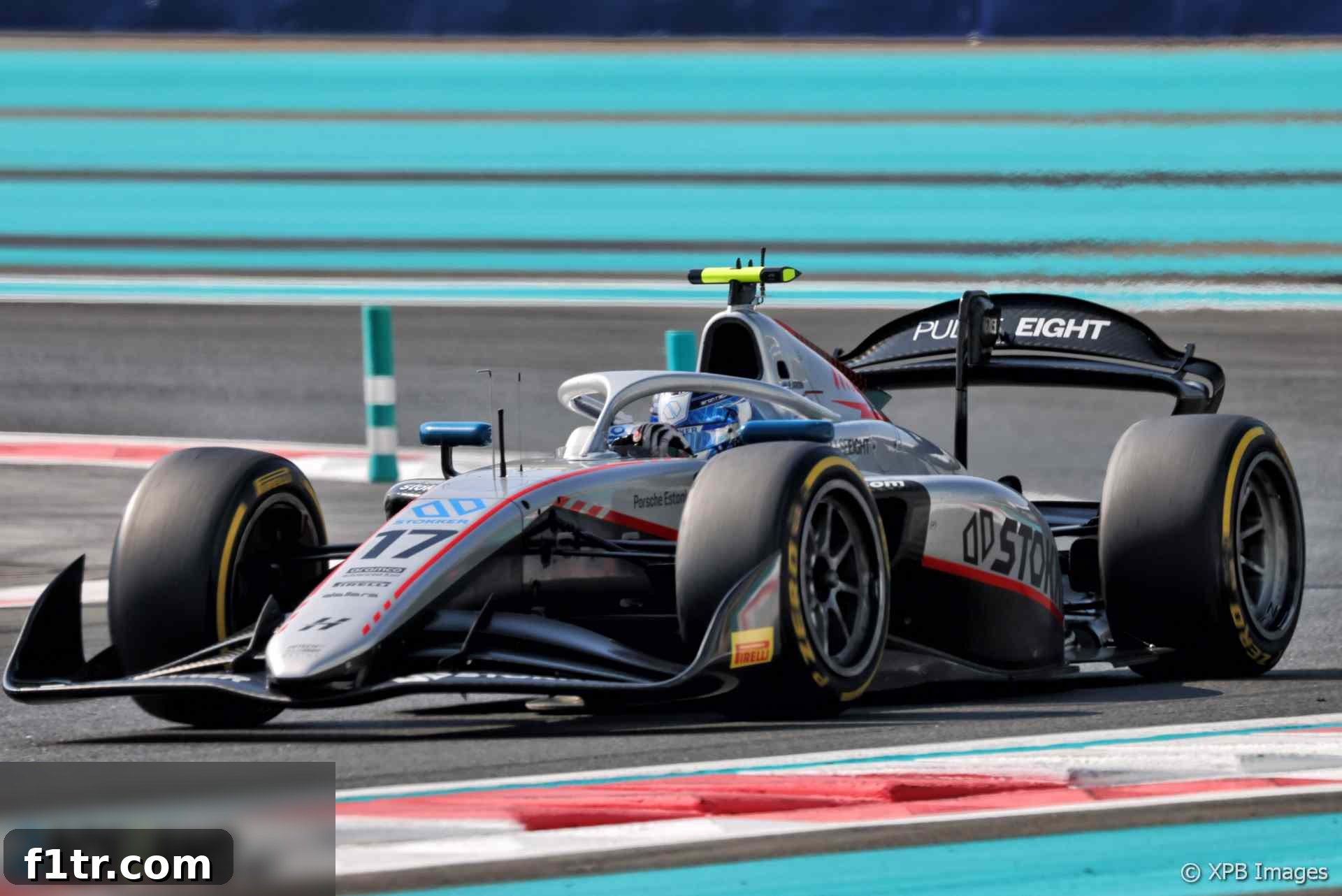
A significant controversy has rocked the Formula 2 championship as former title contender Paul Aron faced a severe double penalty following a technical infringement discovered on his Hitech Grand Prix car. The stewards at the Yas Marina circuit ruled that a “deliberate” modification had been made to the car’s Drag Reduction System (DRS), leading to his disqualification from the sprint race and a grid penalty for the subsequent feature race. This incident not only extinguished Aron’s championship aspirations but also sent a strong message about the unyielding commitment of the FIA to upholding the integrity of technical regulations in motorsport.
The dramatic turn of events unfolded after Aron finished a commendable third in the sprint race at Yas Marina, a result that, for a fleeting moment, kept his title hopes alive. However, post-race scrutiny quickly revealed an irregularity that would ultimately invalidate his performance and trigger a series of penalties. The technical inspection of his car, specifically the DRS mechanism, uncovered a modification that directly contravened the stringent technical regulations governing the FIA Formula 2 Championship. This finding immediately cast a shadow over his achievement and set in motion a process that would lead to one of the most talked-about decisions of the season.
At the heart of the controversy was the Drag Reduction System (DRS), a crucial aerodynamic aid designed to promote overtaking by temporarily reducing drag on the rear wing. For a specified period on designated straight sections of the track, drivers are permitted to open a flap on their rear wing, allowing for higher top speeds. Strict regulations govern the maximum permissible opening of this flap to ensure fair play and prevent any undue performance advantage. The stewards’ investigation into car number 17, driven by Paul Aron, revealed that the DRS actuator had been modified. Specifically, it was found that the piston of the actuator had been extended by precisely one millimetre. This seemingly minor alteration had a profound effect: it allowed the DRS wing to open wider than the regulations permit, thereby generating less drag and potentially granting Aron a significant, illicit speed advantage on the straights.
The FIA Formula 2 Championship Technical Regulations are explicit on the modification of parts. Article 1.5.2 clearly states: “no parts may be modified in any way whatsoever once supplied to the competitor, except where specifically permitted.” This regulation underscores the principle of maintaining a level playing field and ensuring that all competitors adhere to the exact specifications of the components provided. Any deviation, unless explicitly sanctioned, constitutes a breach of sporting fairness. The stewards concluded that the modification to Aron’s DRS actuator could not have been accidental; its precise nature strongly indicated a deliberate act intended to gain an unfair competitive edge. Such an act undermines the very essence of sporting competition and challenges the foundational principles of motorsport.
During the subsequent hearing, the Hitech team representative did not dispute that Aron’s car was non-compliant. Their defence centred on an alleged issue with the DRS actuator during qualifying, necessitating its replacement with a different unit from their spare parts inventory. The representative claimed ignorance regarding why this particular spare actuator had been modified. However, the technical delegate present at the hearing pointed out a standard operating procedure within motorsport teams: whenever a performance-critical part is changed, it is customary and expected practice to meticulously check that the replacement part conforms precisely to the technical specifications. The team representative, however, admitted that this crucial check was not performed in this instance, and could not provide a satisfactory explanation for this oversight. The stewards viewed this lapse in due diligence with extreme seriousness, noting a “strong presumption that the team was aware of the non-conformity of the part (or at least should have been, if they had exercised due diligence).” This finding indicated that even if the modification wasn’t actively orchestrated by the team in that moment, their failure to inspect the replacement part adequately made them complicit in the technical infringement.
The standard penalty for a technical infringement of this nature is disqualification from the race in question. Consequently, Paul Aron was stripped of his third-place finish in the sprint race, and all points associated with that performance were nullified. However, the stewards deemed the nature and seriousness of this particular offence warranted a further, more punitive sanction. Citing Article 12.4.6 of the FIA International Sporting Code, which empowers stewards to impose additional penalties, they ruled that Aron would also be ordered to start the upcoming feature race from the back of the grid. This additional penalty was explicitly imposed “in view of the seriousness and nature of the offence,” highlighting the FIA’s zero-tolerance policy for actions perceived as deliberate attempts to circumvent the regulations. The decision to penalize him beyond simple disqualification sent a clear and unequivocal message across the paddock: deliberate technical infringements carry severe consequences that can extend beyond immediate race results.
The repercussions of Aron’s penalty rippled through the Formula 2 championship standings, particularly impacting his rivals. Isack Hadjar, who initially finished behind Aron, was elevated one position to fifth place, earning him an additional championship point. This gain was crucial as it further reduced his deficit to championship leader Gabriel Bortoleto, intensifying the battle for the title heading into the final stages. The penalty also had a significant positive impact on Ferrari junior driver Dino Beganovic, who was promoted to third place, securing a podium finish in only his third Formula 2 start – an unexpected bonus and a testament to the unforeseen consequences of such technical breaches. Furthermore, the back-of-grid penalty for Aron in the feature race directly benefited Hadjar again, as it moved him up another place on the grid, placing him in an even stronger position directly behind Bortoleto, thereby amplifying the drama and stakes of the championship decider.
This incident transcends a simple technical glitch; it highlights the critical importance of integrity in professional motorsport. Technical regulations are the bedrock of fair competition, ensuring that success is earned through driver skill, team strategy, and engineering prowess within defined parameters, not through illicit modifications. The FIA and its stewards bear the immense responsibility of safeguarding this integrity. Their robust response to Aron’s DRS infringement underscores their commitment to maintaining a level playing field and protecting the sporting essence of the championship. Such penalties serve not only as a deterrent for potential future infractions but also reinforce confidence among competitors and fans that the rules are applied consistently and justly, irrespective of a driver’s championship standing or team’s stature. The message is clear: deliberate attempts to bend or break the rules will be met with severe and unambiguous consequences.
For Paul Aron, this incident marks a significant setback in what had been a promising season. Beyond the immediate loss of points and grid position, the shadow of a “deliberate” technical infringement can have longer-term implications for a driver’s reputation and career trajectory, especially in the highly competitive feeder series like Formula 2, where aspiring talents aim for Formula 1. For Hitech Grand Prix, the ruling necessitates a thorough internal review of their procedures for part inspection and team communication to prevent any recurrence of such a serious breach of regulations. The challenge for Aron will be to recover from this professional blow, demonstrate resilience, and re-establish himself as a credible and fair competitor on track. Ultimately, the Yas Marina DRS saga serves as a potent reminder that in the high-stakes world of motorsport, adherence to the rulebook is as crucial as speed and skill.