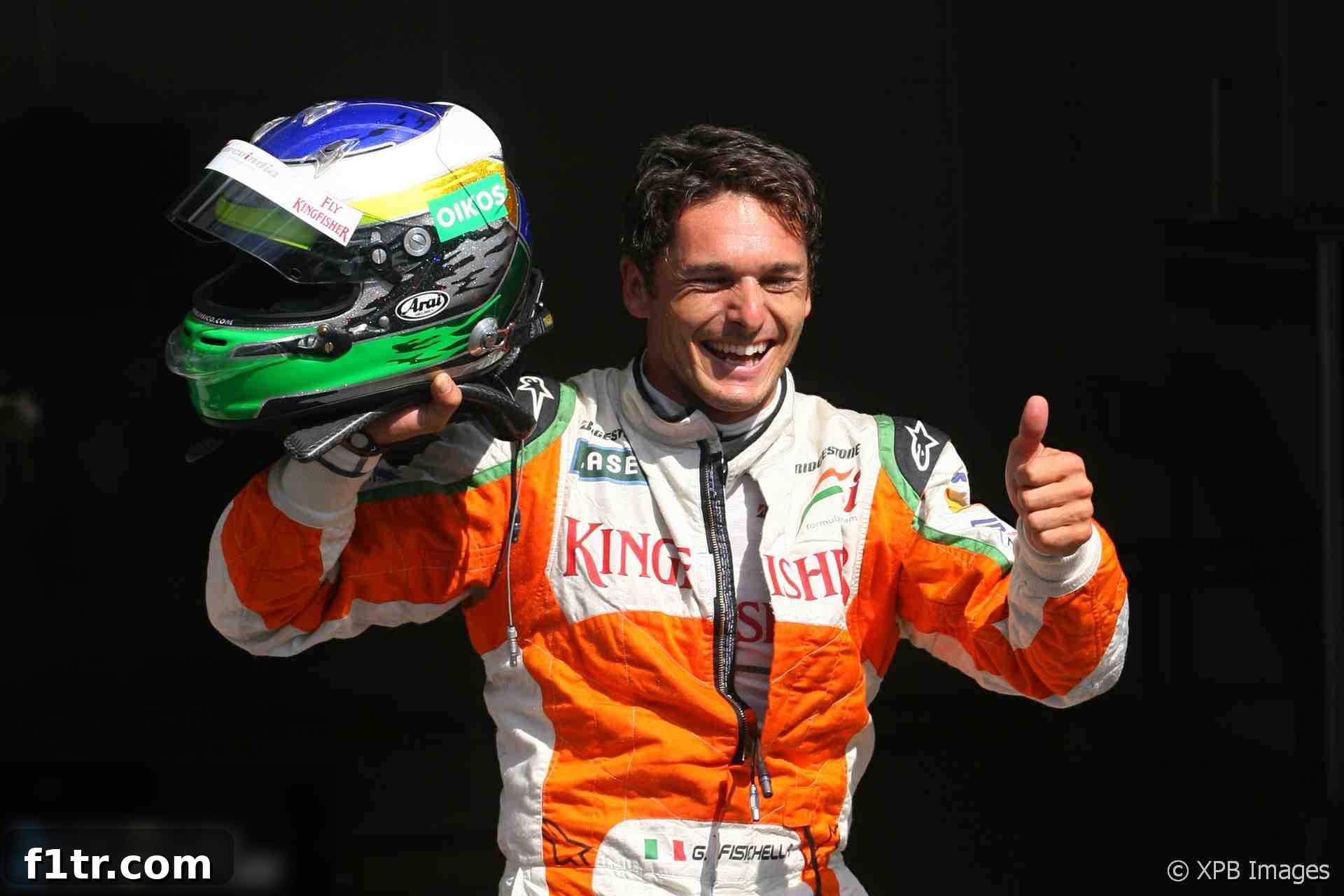
The legendary Spa-Francorchamps circuit, nestled amidst the Ardennes forest, set the stage for a truly unforgettable qualifying session at the Belgian Grand Prix. While the morning began with an unusual incident for Giancarlo Fisichella, who unfortunately collided with a rabbit during practice, forcing a front wing replacement, the Italian driver was about to turn his fortunes around in spectacular fashion. What unfolded on Saturday afternoon was a masterclass in adapting to tricky conditions, culminating in Fisichella snatching his first pole position in three years – and, more remarkably, securing the first-ever pole for the fledgling Force India team. This unprecedented achievement sent shockwaves through the paddock and promised an exhilarating race day on one of Formula 1’s most revered tracks.
Advert | Become a Supporter & go ad-free
The capricious weather often plays a pivotal role at Spa, and this qualifying session was no exception. Teams faced a perplexing challenge right from the outset, struggling to ascertain the optimal tyre compound for the cool, damp-feeling track. The mercury hovered around a modest 25 degrees Celsius, creating a scenario where the softer compound, typically the go-to for outright pace, often proved counter-intuitive, leading to grip issues and slower lap times. This strategic quandary would define the entire session, catching out even the most experienced teams and drivers.
Q1: Navigating the Treacherous Conditions
As the first segment of qualifying commenced, the cool track conditions immediately presented a unique set of challenges. Teams grappled with finding the grip required, and the tyre choice became a critical gamble. Early on, the Toyota team appeared to be mastering the enigmatic track and its cool ambient temperatures. Both Jarno Trulli and Timo Glock showcased impressive pace, swiftly ascending to the top of the time sheets, signalling a strong start for the Japanese manufacturer.
Initially, championship leaders Brawn GP found themselves playing catch-up, positioning themselves just behind the Toyotas. However, their performance in these lower temperatures showed a marked improvement from previous weekends, hinting at potential adjustments to their car’s setup. Soon after, Nick Heidfeld of BMW Sauber demonstrated his prowess, taking over the fastest lap, confirming the strong form he had displayed throughout the earlier practice sessions. His ability to extract speed from his car in these demanding conditions highlighted the fine margins at play.
As the final runs of Q1 began, the tension escalated palpably, with a cluster of drivers fighting desperately to escape the elimination zone. The bottom five spots were occupied by Romain Grosjean, Nico Rosberg, Kazuki Nakajima, Jaime Alguersuari, and Luca Badoer. Each driver pushed to the limit, knowing that a single mistake or a fraction of a second could end their qualifying dreams prematurely.
The closing moments of Q1 delivered a dramatic sequence of events, particularly for the three Italian drivers on track. Jarno Trulli, who had been consistently fast, momentarily reclaimed the top spot. However, his lead was swiftly eclipsed by a truly sensational performance from Giancarlo Fisichella. The Force India driver, opting for three rapid laps on the medium tyre, stunned everyone by setting an unassailable time, securing first place at the end of Q1. This wasn’t merely a flash in the pan; it was an early indication of the extraordinary pace he and his Force India VJM02 possessed on this particular day.
Tragedy struck for Luca Badoer, Ferrari’s stand-in driver, who, on his desperate final attempt, cut the infamous Les Combes chicane too aggressively. Losing control, he crashed into the barriers, narrowly missing Sebastian Vettel in the process. This unfortunate incident capped off a difficult weekend for Badoer, further fueling paddock whispers that Fisichella might be a strong contender for his Ferrari seat at the upcoming Italian Grand Prix. Meanwhile, reigning world champion Lewis Hamilton endured a frustrating Q1. A poor final lap left him dangerously close to the drop zone, eventually placing 15th, a mere two-tenths of a second from elimination, showcasing just how competitive and unpredictable the session truly was.
Advert | Become a RaceFans supporter andgo ad-free
Drivers Eliminated in Q1:
16. Sebastien Buemi, Toro Rosso-Ferrari – 1’45.951
17. Jaime Alguersuari, Toro Rosso-Ferrari – 1’46.032
18. Kazuki Nakajima, Williams-Toyota – 1’46.307
19. Romain Grosjean, Renault – 1’46.359
20. Luca Badoer, Ferrari – 1’46.957
Q2: High Stakes and Shocking Exits
The second qualifying segment kicked off with the same intense competition, as drivers pushed harder to secure a spot in the coveted top ten. Jarno Trulli once again demonstrated his exceptional command of the Spa circuit, setting the pace early on and reaffirming Toyota’s strong weekend form. Hot on his heels, the Red Bull duo began to truly unleash the potential of their cars, their lap times rapidly improving as they found their rhythm. The Brawns also upped their game, showing consistent performance in the tricky conditions, a testament to their championship-leading machinery.
However, the real story of Q2 was the incredibly tight margins between the contenders. With just six minutes remaining on the clock, the gaps were minuscule. For instance, Adrian Sutil in eleventh, highlighting the fierce competition and the razor-thin difference between advancing and being eliminated. Every tenth, every hundredth of a second, became critical as the clock wound down.
As the final flying laps commenced, a host of prominent names found themselves precariously close to the elimination line. Fernando Alonso, Adrian Sutil, Nick Heidfeld, Heikki Kovalainen, and Nico Rosberg occupied the bottom five spots, each driver facing immense pressure. Rosberg, in a tactical gamble, only emerged from the pits once, undertaking a series of continuous laps in a bid to build momentum and achieve a sufficiently fast time, a strategy that often pays off at tracks like Spa.
In a repeat of Q1, Fisichella once more defied expectations, setting the fastest time of the session. His Force India car seemed perfectly dialled into the circuit, a stark contrast to the struggles faced by others. While Fisichella soared, Lewis Hamilton battled hard, managing to scrape into the tenth-fastest spot, a mere 0.014 seconds quicker than Fernando Alonso. However, as Heidfeld and Rosberg found crucial improvements in their final attempts, both Hamilton and Alonso were tragically nudged out of the top ten, ending their qualifying hopes.
But the biggest, most astonishing shock of Q2 was arguably the elimination of championship leader Jenson Button. The Brawn GP driver struggled significantly to extract performance from the softer tyres, a compound that had plagued him at various points throughout the season. Despite his team mate Rubens Barrichello comfortably securing sixth place, Button could only manage 14th, finding himself eliminated from qualifying. He was a full 0.4 seconds slower than Barrichello, a critical deficit that highlighted his difficulties and sent ripples of surprise across the F1 paddock.
Q2 concluded with Fisichella triumphantly topping the timesheets, ahead of the impressive Robert Kubica and Sebastian Vettel. The session had claimed several high-profile casualties, promising an even more electrifying final segment.
Advert | Become a RaceFans supporter andgo ad-free
Drivers Eliminated in Q2:
11. Adrian Sutil, Force India-Mercedes – 1’45.119
12. Lewis Hamilton, McLaren-Mercedes – 1’45.122
13. Fernando Alonso, Renault – 1’45.136
14. Jenson Button, Brawn-Mercedes – 1’45.251
15. Heikki Kovalainen, McLaren-Mercedes – 1’45.259
Q3: Fisichella’s Unstoppable Rise to Pole
The final and most crucial part of qualifying, Q3, featured an intriguing and somewhat unexpected lineup of contenders vying for pole position. The grid included both BMW Sauber cars, both Toyotas, and both Red Bulls, alongside the remarkable Giancarlo Fisichella, Ferrari’s Kimi Räikkönen, Rubens Barrichello of Brawn GP, and Nico Rosberg from Williams. This diverse mix underscored the unpredictable nature of the conditions and the competitiveness across the field.
Initially, most of the cars ventured out onto the track equipped with the soft compound tyres, hoping to extract maximum performance. However, as Jenson Button had discovered to his detriment in Q2, these tyres proved not to be the ideal choice for the prevailing cool track temperatures. Recognizing this critical strategic misstep, all drivers, with the notable exception of Kimi Räikkönen, swiftly pitted and switched back to the medium compound tyres. This rapid adjustment highlighted the dynamic and often frustrating tyre lottery that had become a hallmark of the 2009 season.
As the drivers adapted their strategies, Nick Heidfeld, on his second lap with the harder tyres, managed to eclipse Räikkönen’s earlier benchmark. But the session still had its ultimate surprise in store. It was Giancarlo Fisichella’s penultimate run that truly sealed his fate. He unleashed a blistering lap, a 1’46.308, which proved to be unassailable by any of his rivals. Jarno Trulli came closest with a commendable 1’46.395 on his final effort, but even his strong performance was not enough to dislodge the determined Italian. Trulli had to settle for a brilliant second place, securing an all-Italian front row.
The final grid formation further underscored the unexpected turn of events. Nick Heidfeld and Robert Kubica secured impressive third and fifth positions for BMW Sauber, sandwiching Rubens Barrichello’s Brawn GP in fourth. This strong showing for BMW Sauber, a team often battling in the midfield, was a welcome sight and a testament to their engineers’ efforts. Kimi Räikkönen, Ferrari’s only representative in Q3, secured sixth, while the Toyotas of Timo Glock and Trulli demonstrated their consistent speed throughout the weekend.
While the full fuel weights, which would undoubtedly provide crucial insights into each team’s race strategy, were yet to be published, the immediate focus was firmly on Fisichella and Force India. This historic pole position was a monumental achievement for a team that had previously struggled at the back of the grid. It marked not just a personal triumph for Fisichella, but a landmark moment for the entire Force India outfit, one to be savoured and celebrated as they prepared for Sunday’s grand prix.
Update: Fuel weights have since been announced, providing deeper insight into the strategic landscape for the race. These details suggested that Trulli, with a potentially lighter fuel load, might be in a strong position to challenge Fisichella in the race. Further analysis on the Belgian Grand Prix fuel and strategy can be found here.
Read more: Belgian Grand Prix grid
Top Ten Drivers in Q3:
1. Giancarlo Fisichella, Force India-Mercedes – 1’46.308
2. Jarno Trulli, Toyota – 1’46.395
3. Nick Heidfeld, BMW – 1’46.500
4. Rubens Barrichello, Brawn-Mercedes – 1’46.513
5. Robert Kubica, BMW – 1’46.586
6. Kimi Raikkonen, Ferrari – 1’46.633
7. Timo Glock, Toyota – 1’46.677
8. Sebastian Vettel, Red Bull-Renault – 1’46.761<
9. Mark Webber, Red Bull-Renault – 1’46.788
10. Nico Rosberg, Williams-Toyota – 1’47.362
Advert | Become a RaceFans supporter andgo ad-free