Formula 1’s current era is proving to be a golden age for breakthrough victories, with the 2024 season already witnessing two new winners: Lando Norris and Oscar Piastri. Their recent triumphs have ignited fresh excitement and underscored the incredible depth of talent within the sport. This surge in maiden victories follows a remarkable trend, making the previous year an anomaly rather than a new norm in a sequence of seasons where several drivers have celebrated their first Grand Prix wins.
Advert | Become a Supporter & go ad-free
The competitive landscape of Formula 1 has seen a significant shift, culminating in a grid now brimming with proven race winners. Piastri’s memorable victory at the Hungarian Grand Prix, a testament to his burgeoning talent and McLaren’s resurgence, means that an impressive 13 of the 20 drivers currently competing in F1 have at least one win to their names. This figure not only surpasses the high of 12 race winners observed at the close of the 2022 season but also highlights a remarkable period of competitive balance and individual achievement.
The journey to this current density of winners began several years ago. In 2022, Carlos Sainz Jnr and George Russell broke their duck, securing their inaugural victories with Ferrari and Mercedes, respectively. The year prior, Esteban Ocon celebrated his first win for Alpine, marking a significant milestone in his career. The 2020 season saw Sergio Perez and Pierre Gasly clinch their maiden wins, both providing thrilling narratives of perseverance and opportunistic brilliance. Before them, Charles Leclerc broke through in 2019, signalling his arrival as a future championship contender. These drivers joined an already illustrious roster of established winners, including multiple world champions Lewis Hamilton, Fernando Alonso, and Max Verstappen, alongside Grand Prix victors Daniel Ricciardo and Valtteri Bottas, contributing to one of the most decorated grids in modern Formula 1 history.
This rich concentration of winners on a relatively compact 20-car grid is a strong indicator of the current health and competitive intensity of Formula 1. Each race weekend presents a genuine opportunity for a diverse set of drivers to vie for victory, thrilling fans and keeping the championship battle engaging. The recent successes of Norris and Piastri are particularly noteworthy, not only for their individual achievements but also for elevating McLaren’s status back to the top echelons of the sport. Norris’s long-awaited first win was a moment of pure elation, widely celebrated across the F1 community, while Piastri’s rapid ascent to Grand Prix winner status underscores the exceptional talent emerging from the junior categories.
While the current F1 grid boasts an impressive number of winners, the sport has witnessed similarly strong fields in the past, often with larger grid sizes. The highly praised 2012 season finale at Interlagos, for instance, featured 11 drivers who had previously won races, although this was within a field of 24 cars. That season is often remembered for its dramatic title decider, but the depth of talent on display, with almost half the grid consisting of race winners, was equally remarkable. Drivers like Sebastian Vettel, Fernando Alonso, Lewis Hamilton, Kimi Raikkonen, Jenson Button, Mark Webber, and Felipe Massa ensured that every race was fiercely contested.
Delving further back into the annals of F1 history, a handful of grids featured even more than the current 13 winners. This number was last reached at the penultimate race of the 1980 season in Montreal, a testament to the competitive nature of that era. Just two rounds earlier, at Zandvoort, the Dutch Grand Prix grid included a staggering 14 previous winners within its 24-car field. The early 1980s were a period of rapid technological advancement and intense rivalries, attracting and retaining a high calibre of driving talent that ensured grids were consistently packed with champions and race winners alike.
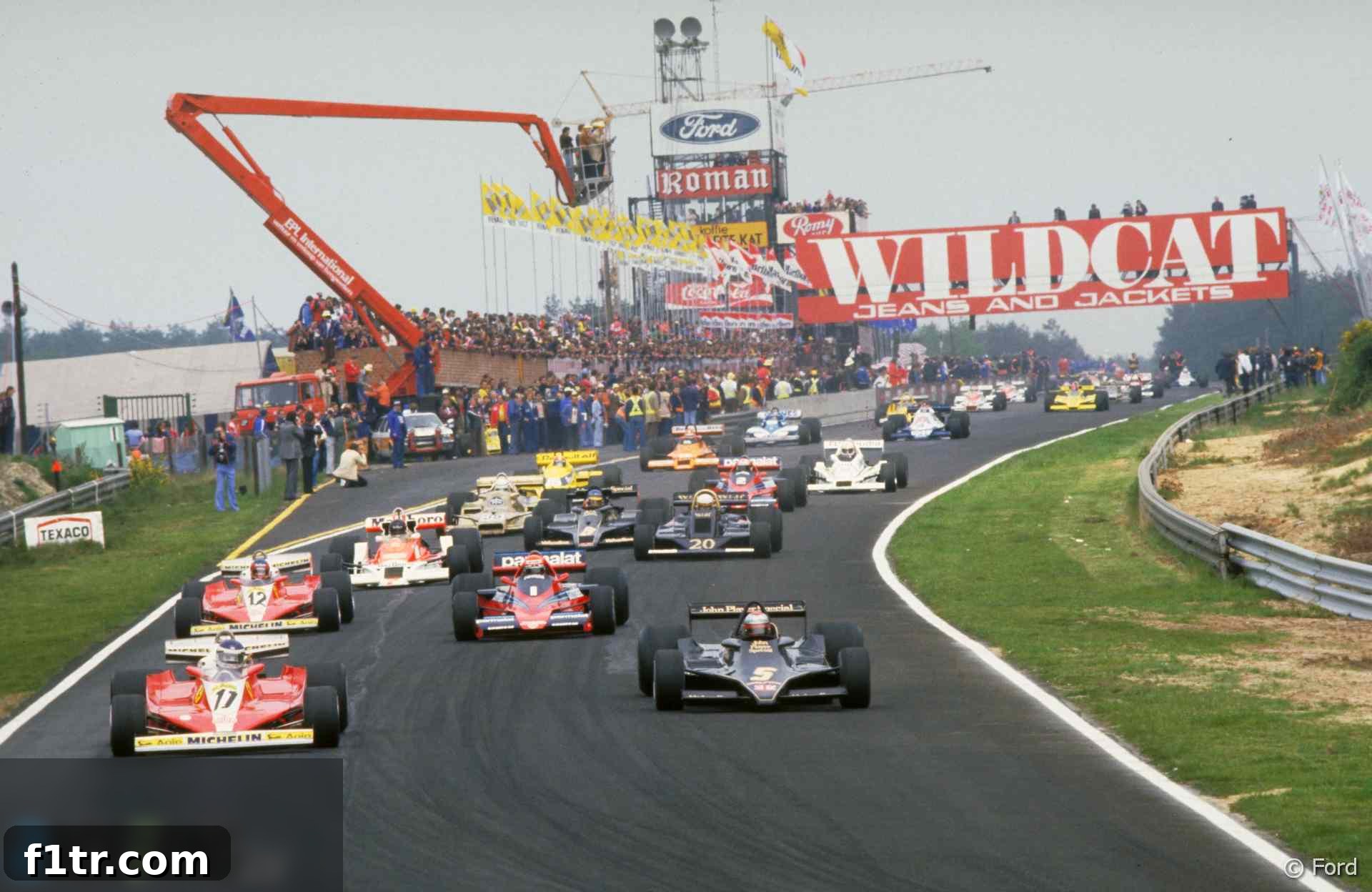
However, the absolute peak for the number of previous winners on a Formula 1 grid occurred two years prior, in the glorious 1978 season. This remarkable feat was first achieved at the Belgian Grand Prix at Zolder, which was the sixth round of a captivating championship. This particular season started with an already impressive contingent of race winners, setting the stage for an unprecedented display of talent and experience.
Advert | Become a RaceFans supporter andgo ad-free
When the 1978 season kicked off at Argentina’s Buenos Aires circuit in mid-January, a remarkable 13 of the 24-strong entry were prior winners. This group included reigning world champion Niki Lauda, who was then driving for Brabham, alongside fellow title winners James Hunt with McLaren and Emerson Fittipaldi, who was competing with his family’s Fittipaldi Automotive team. The presence of such iconic figures alone spoke volumes about the quality of the field, but they were by no means the only stars.
Among the other race winners who lined up for the start of the 1978 season were the formidable Lotus team mates Mario Andretti and Ronnie Peterson. This duo would go on to dominate that season, with Andretti eventually clinching the world championship, a testament to their individual skill and the revolutionary Lotus 79. Ferrari’s Carlos Reutemann, a highly respected and consistent performer, already had five Grand Prix wins to his name. Ex-Ferrari driver Clay Regazzoni, then with Shadow, boasted four victories, adding to the wealth of experience on the grid. Jody Scheckter, driving for Walter Wolf Racing, was another seasoned winner, having secured seven victories by that point in his career.
Beyond these multi-race winners, several other drivers had picked up singular, but significant, victories with an array of different teams, further enriching the grid’s pedigree. Lauda’s Brabham team mate John Watson had delivered Penske their only Formula 1 victory in 1976. ATS driver Jochen Mass had scored the sole win of his career for McLaren in the grim circumstances of the 1975 Spanish Grand Prix at Montjuich Park, a race tragically cut short when a car was launched into the crowd, resulting in four fatalities. Vittorio Brambilla took his only win that same year at the Österreichring, driving for March. Two years later, in 1977, it had been Alan Jones’s turn to claim a maiden victory, also for Shadow, and in that very same season, Jacques Laffite gave Ligier their historic first triumph, a momentous occasion for the French team.
To this already impressive roster of 13 Grand Prix winners, a 14th was added at the Monaco Grand Prix. Eight-time Grand Prix winner and two-time championship runner-up Jacky Ickx, a legendary figure in motorsport, made a return to the championship with the Ensign team. His presence further elevated the calibre of the grid, bringing with him decades of top-tier racing experience and a reputation as a master of wet weather conditions.
The record wasn’t complete yet. For the very next round of the championship, the Belgian Grand Prix at Zolder, an astonishing 15th race winner joined the fray – though he had been part of the season’s entry since the start. Patrick Depailler, driving for Tyrrell, triumphed dramatically in Monaco, becoming Formula 1’s latest race winner. This victory not only marked a career highlight for Depailler and Tyrrell but also boosted the contingent of proven winners on the grid to an unprecedented 15. The 1978 Belgian Grand Prix thus saw a grid where a remarkable 15 out of 24 starters had tasted Grand Prix victory, a truly extraordinary statistic that speaks volumes about the talent pool of that era.
Advert | Become a RaceFans supporter andgo ad-free
The competition to simply make the race was intense. With only 24 places on the grid and 32 drivers vying for them, it was a testament to their skill and the quality of their machinery that all 15 past victors managed to qualify for the Belgian Grand Prix. They repeated this impressive feat a second time for the Spanish Grand Prix at Jarama just two weeks later, demonstrating consistency and competitive edge. However, this peak was fleeting.
For the subsequent Swedish Grand Prix at Anderstorp, despite a slightly reduced field of 27 cars looking to make the race, Jacky Ickx failed to qualify. Unhappy with the uncompetitive Ensign, Ickx did not return for the remainder of the season, and with his departure, the count of active race winners on the grid dropped slightly from its historic high. F1 has never since seen as many race-winning drivers on a single grid as it did during that two-race spell in the middle of 1978. With the smaller grid sizes of today, typically 20 cars, achieving that height again would require three-quarters of the entire field to be race winners, a challenging prospect given the intense competition and the cyclical nature of team dominance. While the current 13 winners on a 20-car grid is a fantastic achievement, reaching 15 would mean only five drivers on the entire grid had not yet won a race, a truly daunting and perhaps unattainable benchmark in modern F1.
The 1978 season stands as a remarkable benchmark, a golden era when the sheer concentration of proven winners on the grid was unparalleled. It highlights a different dynamic in F1, where more teams and diverse opportunities allowed a greater number of drivers to secure victories. While the modern era, with its smaller grids and often more dominant teams, presents different challenges, the current resurgence in new winners and the presence of 13 Grand Prix victors is a compelling testament to the enduring talent and excitement that Formula 1 continues to deliver. Will we ever witness such a saturated field of champions again? Only time will tell, but the ongoing battles for supremacy ensure F1 remains as captivating as ever.
Race winners at the 1978 and 2024 Belgian grands prix
| 1978 Belgian Grand Prix | 2024 Belgian Grand Prix |
|---|---|
| Niki Lauda | Charles Leclerc |
| James Hunt | Sergio Perez |
| Emerson Fittipaldi | Lewis Hamilton |
| John Watson | Lando Norris |
| Patrick Depailler | Oscar Piastri |
| Mario Andretti | George Russell |
| Ronnie Peterson | Carlos Sainz Jnr |
| Jochen Mass | Fernando Alonso |
| Clay Regazzoni | Esteban Ocon |
| Vittorio Brambilla | Max Verstappen |
| Jody Scheckter | Pierre Gasly |
| Jacky Ickx | Daniel Ricciardo |
| Jacques Laffite | Valtteri Bottas |
| Alan Jones | |
| Carlos Reutemann |
Advert | Become a RaceFans supporter andgo ad-free
Formula 1
- Controversies, Norris, Newey and more: Five new motorsport books reviewed
- One of F1’s greatest races happened 15 years ago today. Or did it?
- “Overtaking is overtaking”: Domenicali denies F1’s yo-yo racing is “artificial”
- The crashes F1 is trying to prevent may be rare – but the danger is obvious
- F1 returning to India soon after 2027 sounds like wishful thinking
Browse all Formula 1 articles