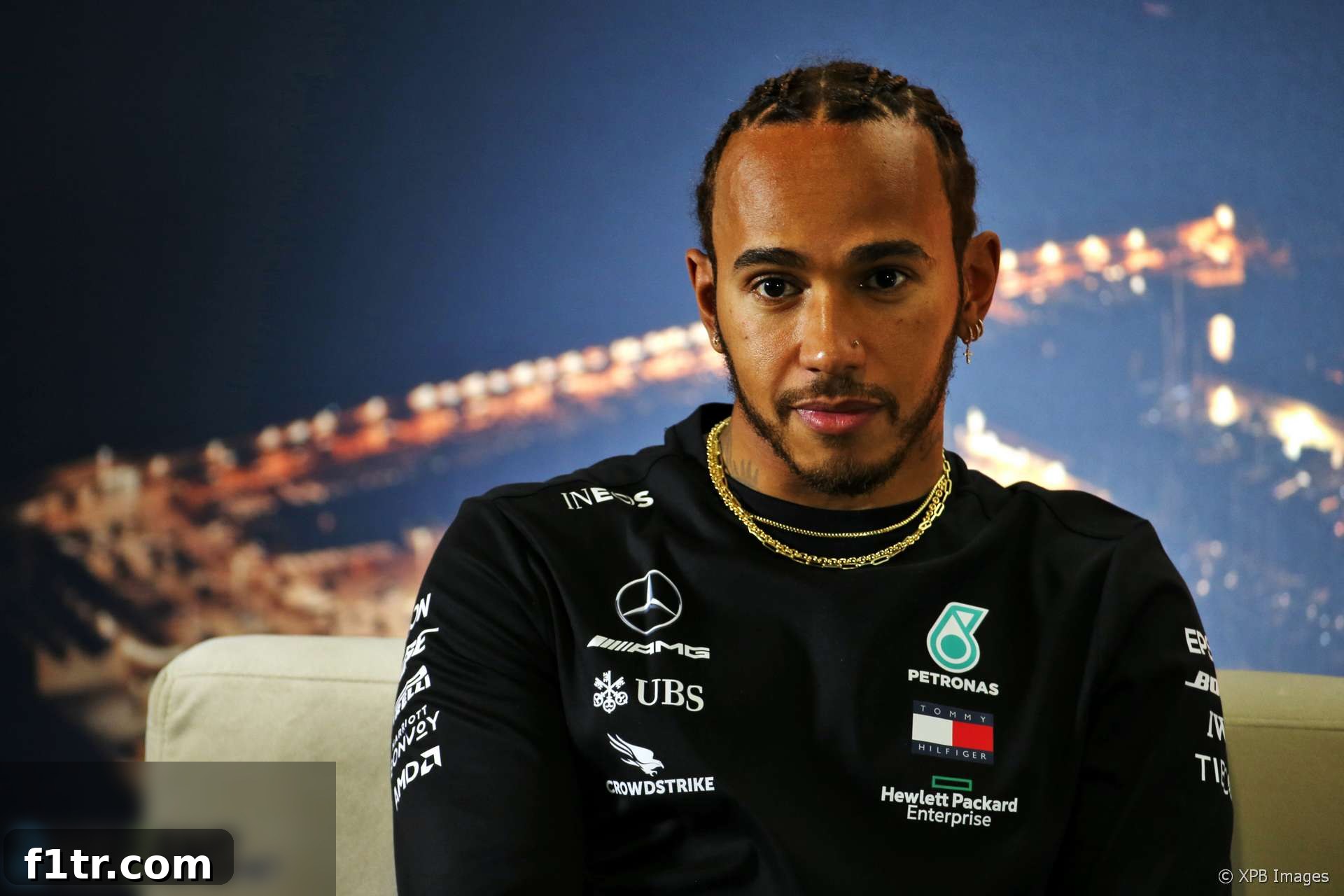
Lewis Hamilton: The Unblemished Record of a Formula 1 Legend
In the high-octane world of Formula 1, where the pursuit of victory often pushes the boundaries of sportsmanship, one name consistently emerges with a distinct reputation for integrity: Lewis Hamilton. This claim isn’t merely anecdotal; it’s a professional assessment from within his own team. James Allison, the technical director at Mercedes, emphatically declared Hamilton’s driving record “utterly unblemished,” describing it as a feat “unprecedented” among multiple world champions. This statement challenges common perceptions of F1’s most successful figures and prompts a deeper examination into what constitutes a truly clean career at the pinnacle of motorsport.
The Purity of a Champion: Lewis Hamilton’s Unprecedented Legacy
Hamilton is one of just sixteen drivers in the sport’s illustrious history to have claimed more than a single world title. Yet, according to Allison, he stands alone among this elite group for the remarkable absence of controversial incidents that decided championships. What does it truly mean to have an “unblemished record” in a sport where competitive fire often ignites contentious moments? It suggests a career devoid of deliberate collisions, questionable blocking maneuvers, or any unsporting conduct that directly impacted the outcome of a title fight. Such a record is indeed a rare gem, especially when viewed through the lens of F1’s turbulent past.
This claim immediately brings to mind the contentious history of Formula 1, where some of the sport’s greatest heroes have also been involved in its most infamous clashes. Hamilton’s generation of fans grew up watching legendary drivers whose championship narratives were often intertwined with moments of profound controversy, forever shaping their legacies. This contrast is what makes Allison’s praise for Hamilton so potent and provocative, inviting us to delve into F1’s past to understand the true weight of his words.
A History of High-Stakes Collisions: When Championships Hung in the Balance
The history of Formula 1 is replete with instances where the battle for the world championship spilled beyond fair racing, culminating in collisions that decided titles. From 1989 to 1997, a nine-year period saw four world championships controversially determined by direct contact between title rivals. These moments are etched into the sport’s folklore, igniting endless debates and casting long shadows over the careers of some of its most revered figures. Understanding these historical flashpoints is crucial to appreciating the uniqueness of Hamilton’s clean sheet.
The Senna-Prost Rivalry: A Defining Era of Conflict
Perhaps the most iconic and emotionally charged rivalry in F1 history, that between Alain Prost and Ayrton Senna, brought the issue of aggressive driving to the forefront. In the 1989 Japanese Grand Prix, the penultimate race of the season, Prost and Senna, both McLaren teammates and fierce title rivals, collided at the Suzuka chicane. Prost, leading the championship, closed the door on Senna, who attempted an ambitious overtake. The resulting contact took both cars off the track. While Prost retired, Senna rejoined, won the race, but was later controversially disqualified for cutting the chicane. This handed Prost the title and sparked a furious debate about the fairness of Prost’s defensive move and the legitimacy of Senna’s disqualification. The incident deeply divided fans and commentators, highlighting the fine line between aggressive racing and unsporting conduct.
Twelve months later, in 1990, the Japanese Grand Prix witnessed a dramatic role reversal. Senna, now needing to win the race to secure his second world championship, was on pole position, but Prost, his new Ferrari rival, started alongside him on the cleaner side of the track. After a poor start, Senna was famously blocked by Prost into the first corner, a move which the Brazilian driver had felt was deliberately unfair following the previous year’s events. Just seconds into the race, Senna, refusing to yield, dramatically drove into Prost’s car at extremely high speed into turn one. Both cars were out, and Senna was crowned world champion. This act of retaliation, openly admitted by Senna years later, remains one of the most brazen and debated championship-deciding incidents, cementing a legacy of ‘win at all costs’ for the legendary Brazilian.
Michael Schumacher’s Contentious Title Triumphs
Michael Schumacher, widely considered one of the greatest drivers of all time, also has two controversial championship deciders etched into his record. In the final race of the 1994 season, the Australian Grand Prix, Schumacher arrived with a one-point lead over Damon Hill. On lap 36, Schumacher clipped a wall, damaging his Benetton. As Hill attempted to pass him for the lead, Schumacher abruptly turned into Hill’s Williams. The collision forced both drivers out of the race, controversially handing Schumacher his first world championship. The incident was met with widespread condemnation, with many believing Schumacher intentionally caused the collision to secure the title, an accusation he always denied.
Three years later, in 1997, Schumacher attempted a similar tactic against Jacques Villeneuve at the European Grand Prix in Jerez, with the championship once again on the line. Leading the race, Schumacher turned into Villeneuve’s Williams as the Canadian tried to overtake. This time, however, the maneuver backfired spectaculously. Villeneuve’s car survived, while Schumacher’s Ferrari was stranded in the gravel trap. Villeneuve went on to finish third and win the championship, while Schumacher was later disqualified from the entire 1997 season by the FIA for unsporting conduct. These incidents highlight a competitive ferocity that, while admirable in its pursuit of victory, crossed ethical lines, demonstrating how difficult it has been for multiple champions to maintain an entirely “unblemished” record.
Hamilton’s Philosophy: Winning “The Right Way”
Given this contentious history, the question naturally arises: Does Lewis Hamilton view himself as distinctly different from these legends? At the United States Grand Prix where he secured his sixth world championship, Hamilton was directly asked if he considered himself a “cleaner” driver than Schumacher or Senna. His response, carefully chosen and reflective, offered insight into his philosophy. Hamilton emphasized the profound importance of winning “the right way” to him.
He articulated a commitment to achieving success through “sheer hard work and through ability,” rather than through dubious tactics. “I just always wanted to do it the right way, win it in the right way,” he stated, highlighting a deeply ingrained principle he has strived to uphold throughout his career. This consistent adherence to a particular ethical framework, even in the most intense championship battles, underpins Allison’s claim of an “unblemished” record. While he modestly admitted, “It doesn’t mean I’m perfect in any way, shape or form,” Hamilton expressed pride in his tally of victories and, crucially, “the respectful manner that I have” in approaching racing.
Intriguingly, Hamilton hinted at his awareness of controversial incidents not only from the eras he grew up watching but also “in my time seeing certain things happen with other drivers.” This suggests a conscious decision to steer clear of such tactics, learning from both historical examples and contemporary rivalries. The foundation of this philosophy, he revealed, traces back to his upbringing: “Ultimately, it’s for you guys to reflect on how good that is. But that’s not going to change. That’s how my dad raised me to race.” This personal testimony underscores the deep roots of his ethical approach, showcasing a commitment to sportsmanship instilled from a young age.
A Record Judged by Others: Public Perception and Legacy
While Hamilton acknowledges that ultimate judgment rests with others, his consistent performance and avoidance of major controversy speak volumes. The F1 paddock and the wider fan base often debate what constitutes fair play. For a driver to achieve such unparalleled success – numerous race wins, pole positions, and world championships – without resorting to the kind of aggressive, borderline (or outright illegal) tactics seen from some of his predecessors, is genuinely remarkable. He has engaged in intense wheel-to-wheel battles, some resulting in contact, but none have been characterized by the deliberate, championship-deciding maneuvers that define the controversial moments of Prost, Senna, and Schumacher.
The rarity of Hamilton’s clean record sets a new benchmark for what is achievable in Formula 1. It demonstrates that it is possible to dominate the sport for an extended period, to push the limits of performance and competition, without compromising ethical standards at crucial junctures. This aspect of his career not only enhances his personal legacy but also offers a different narrative for future generations of drivers, proving that victory can indeed be attained “the right way,” as his father taught him. This legacy of integrity, combined with his sheer talent, positions Hamilton not just as a statistical giant, but as a paragon of sportsmanship in a sport often fraught with moral ambiguities.
Beyond the Track: Hamilton’s Broader Impact
Hamilton’s commitment to winning the right way extends beyond his on-track actions. In recent years, he has become a vocal advocate for diversity, inclusion, and environmental sustainability, using his platform to champion causes far removed from the racetrack. This broader engagement with social issues, marked by sincerity and conviction, further reinforces his image as a sportsman of high integrity. It suggests that the ethical framework he applies to his driving is part of a larger, consistent character that values fairness, respect, and positive impact, further solidifying the perception of an “unblemished” career not just in racing, but in his public persona.
Conclusion: A New Benchmark for Formula 1 Champions
Lewis Hamilton’s remarkable journey through Formula 1, crowned by multiple world championships, is distinguished not only by its statistical dominance but also by its ethical purity. James Allison’s assertion of an “utterly unblemished record” is a powerful testament to a driver who has consistently demonstrated exceptional skill, relentless hard work, and an unwavering commitment to integrity. In a sport where the line between aggressive racing and unsporting conduct has historically blurred, Hamilton stands as a unique figure. He has proven that ultimate success can be achieved while upholding the highest standards of sportsmanship, setting a new, unprecedented benchmark for future champions and cementing his legacy as one of Formula 1’s most revered and honourable legends.
Controversial Title Deciders in F1 History
For those interested in revisiting some of the most debated championship-deciding moments, here are four significant examples where collisions played a pivotal role:
- 1989 Japanese Grand Prix: Prost’s Suzuka Chicanery Denies Senna the Title
- 1990 Japanese Grand Prix: Senna Clinches Second World Championship by Taking Prost Out
- 1994 Australian Grand Prix: Schumacher’s First Title Tainted by Clash with Hill
- 1997 European Grand Prix: Villeneuve Takes Title as Schumacher’s Attack Gets Him Thrown Out
Related 2020 F1 Season Articles
Explore more content from the 2020 F1 season and beyond:
- Grosjean to make F1 test return tomorrow for first time since Bahrain horror crash
- Pictures: Wrecked chassis from Grosjean’s Bahrain fireball crash to go on display
- Bottas vs Rosberg: Hamilton’s Mercedes team mates compared after 78 races each
- F1 revenues fell by $877 million in Covid-struck 2020 season
- Hamilton and Mercedes finally announce new deal for 2021 season
Browse all 2020 F1 season articles