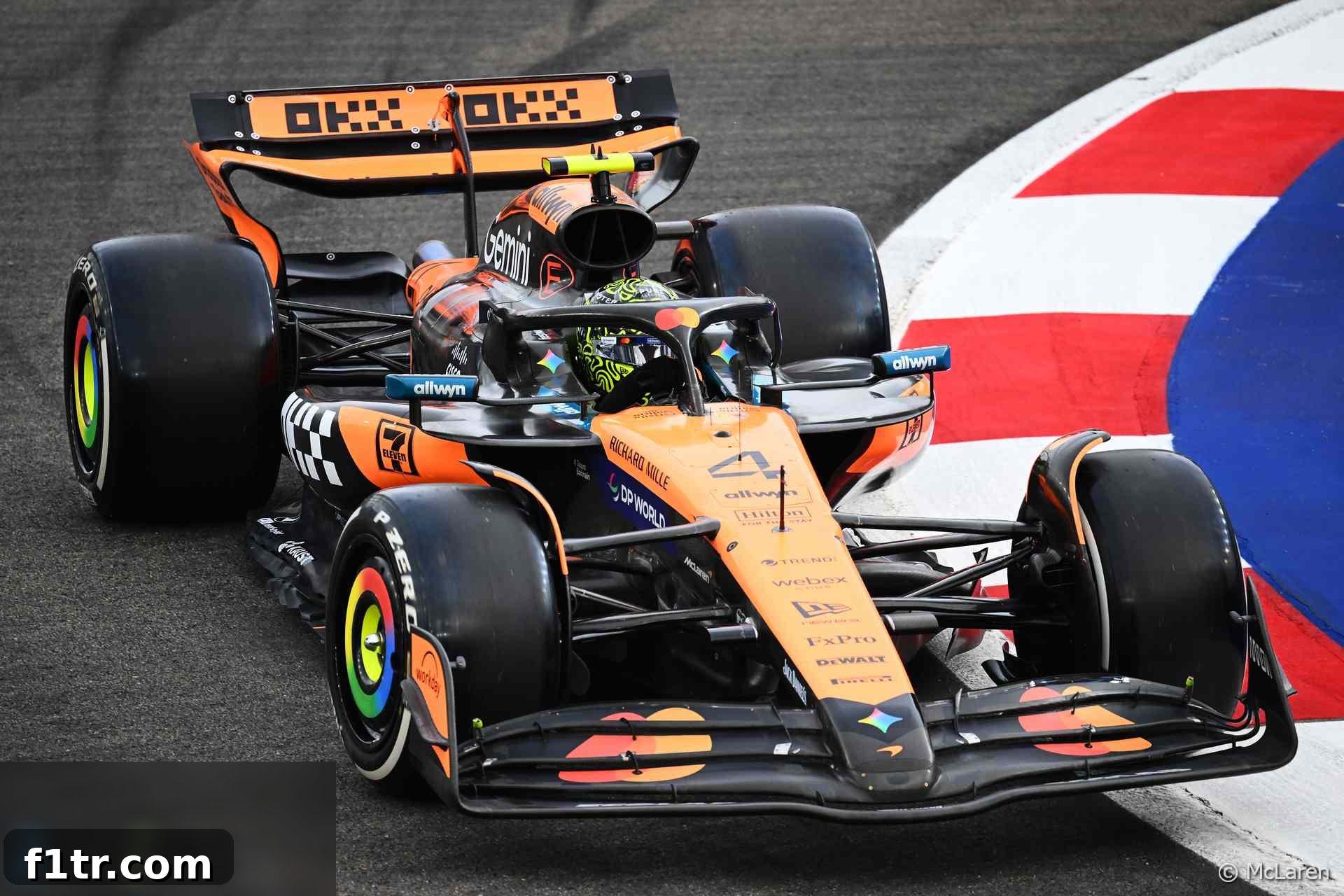
McLaren’s Mixed Fortunes in Singapore Practice: Norris Struggles, Piastri Shines
The highly anticipated Singapore Grand Prix weekend kicked off with a compelling, albeit contrasting, narrative for the McLaren F1 Team. While Oscar Piastri showcased formidable pace by topping the Friday practice sessions, his teammate Lando Norris openly admitted to significant discomfort and a struggle to find rhythm with his MCL38. The challenging Marina Bay Street Circuit, renowned for its demanding nature under the intense floodlights, once again proved to be a formidable test for drivers and their machinery, setting the stage for a dramatic qualifying session and race.
Norris, who famously delivered a stellar performance including a podium finish at this very circuit last year, expressed palpable frustration following what he described as a difficult day. “It was a difficult day for me,” Norris confided to the official Formula 1 channel after practice. “I’m not feeling too great with the car. I’m missing all of the feelings that I had here last year, so there’s plenty of things to work on. It was just a bad day.” This candid assessment highlights the intricate and often delicate relationship between a driver and their car, especially on a street circuit where confidence, precise feedback, and absolute trust in the vehicle’s capabilities are paramount. The narrow, unforgiving layout of Marina Bay leaves no room for error, and any perceived lack of comfort or predictability can translate into significant lap time deficits and a compromised performance.
Norris Grapples with Car Balance and Pit Lane Incident Adds to Woes
The young British driver found himself almost half a second adrift of his pace-setting teammate Oscar Piastri, a gap that is uncharacteristic for the usually closely matched duo. Norris’s self-critical reflection underlined his ambition and high standards for performance: “Oscar’s quick, so I’ve got nothing to complain about. I’m just not doing a very good job.” This frank admission underscores the immense internal pressure drivers face, constantly striving for perfection in a sport where milliseconds can define success or failure, and where comparison to a teammate is an ever-present benchmark.
Adding to Norris’s challenging Friday was an unfortunate incident in the pit lane during the crucial second practice session. His critical qualifying simulation run was severely compromised after a collision with Charles Leclerc of Ferrari. The stewards swiftly summoned both Norris and Leclerc to investigate the circumstances surrounding the incident, particularly focusing on whether an “unsafe release” by Ferrari was the root cause. Such occurrences, while seemingly minor in isolation, can have significant repercussions, including potential grid penalties that could severely hinder a driver’s weekend prospects, especially on a track where track position is often considered more valuable than raw pace.
The Repercussions of an Unsafe Release Investigation
An “unsafe release” is a serious infraction in Formula 1 regulations, occurring when a car is released from its pit box directly into the path of another car, creating a potential safety hazard or impeding another competitor. Race stewards take these incidents very seriously, often imposing penalties that can range from financial fines for the team to, more critically for the driver, grid penalties for the upcoming race. For Norris, already struggling to find his footing with the car and chasing crucial lap time, a grid penalty would compound his challenges, making the prospect of fighting for a strong points finish considerably more difficult in Singapore’s notoriously tight confines. Such a penalty would force a more aggressive strategy or reliance on external factors like safety cars, adding further layers of unpredictability to his race.
Piastri’s Dominant Start and the Red Flag Dilemma
In stark contrast to Norris’s struggles, championship leader Oscar Piastri enjoyed a much more auspicious start to his Singapore Grand Prix weekend. The Australian driver impressively topped the timesheets on Friday, demonstrating immediate confidence and strong pace with his McLaren MCL38. His ability to quickly adapt to the demanding street circuit and consistently extract performance from his machinery signals a strong contender for pole position and a potential race victory. This rapid adaptation is a testament to Piastri’s growing maturity and skill in Formula 1.
Piastri’s feedback on the tyre compounds reflected his positive experience: “I found my feet on the medium [tyre] at the end there and then the soft felt good,” he commented. “Obviously, I’ve not had much representative race running but the car’s been in a good place.” This sentiment, however, highlights a critical challenge faced by all teams during Friday practice: balancing qualifying preparation with gathering crucial data for race simulation. The limited running due to two red flags caused by separate crashes in the second practice session severely reduced the amount of time available for teams to collect long-run data essential for understanding tyre degradation, fuel consumption, and overall race pace. This shortage of data could introduce an element of uncertainty into Sunday’s race, potentially opening up strategic variations and unexpected outcomes.
Red Flags: A Hindrance to Crucial Race Preparation
Red flags are an unfortunate but necessary part of Formula 1, deployed to neutralize the track for safety reasons after an incident or debris. While vital for driver safety and track clearance, they come at the significant cost of valuable track time for teams. In Singapore, where understanding tyre degradation over a full stint, managing fuel effectively, and knowing how the car behaves with a heavy fuel load are paramount, losing significant portions of practice to red flags can be particularly disruptive. Teams must then rely more heavily on simulations, pre-race analysis, and historical data, making their setups and race strategies more of an educated guess than a finely tuned plan. This unpredictability could potentially benefit teams that find a sweet spot early, or conversely, penalize those still chasing an optimal balance, adding another layer of strategic complexity to the race weekend.
Qualifying: The Ultimate Decider in Singapore’s Street Fight
Piastri underscored a universally acknowledged truth about the Singapore Grand Prix: the colossal importance of qualifying. “Here qualifying is a massive part of the weekend – it’s a massive part everywhere, but I think especially here, it’s one of the most important – so you’d rather qualify further up and deal with the unknown for the race than qualify further back but know exactly what’s gonna happen in the race because it’s not really going to help you.” This statement perfectly encapsulates the strategic mindset required for success at Marina Bay, where track position often dictates the final outcome.
The circuit’s tight, twisty nature, coupled with its unforgiving concrete barriers, makes overtaking incredibly difficult. Historically, the vast majority of Singapore Grand Prix winners have started from the front row, emphasizing the premium placed on grid position. A strong qualifying performance not only grants a clear track ahead and significantly reduces the risk of entanglement in first-lap incidents but also provides crucial strategic flexibility for tyre management and pit stop windows. Starting further back often forces drivers into aggressive, often sub-optimal strategies in a desperate attempt to gain positions, frequently leading to frustration, compromised race results, and a reliance on safety cars or fortunate circumstances.
The Pressure Cooker Environment of Singapore Qualifying
Qualifying in Singapore is frequently cited by drivers as one of the most intense and demanding sessions of the season. The precision required to thread a Formula 1 car through the narrow confines of the street circuit at maximum speed, often grazing barrier walls, demands absolute concentration, immense courage, and pinpoint accuracy. The slightest error can result in a significant crash, a damaged car, or a lost lap time that can be impossible to recover. This immense pressure adds another layer to the weekend’s drama, transforming Saturday afternoon into a crucial battle for supremacy, where mental fortitude and unflappable composure are as important as raw speed and car performance.
McLaren’s Weekend Outlook: A Critical Juncture
For McLaren, the contrasting fortunes of their two talented drivers present a fascinating and complex challenge. On one hand, Piastri’s commanding performance offers a strong ray of hope, suggesting that the MCL38 possesses the inherent pace and balance to compete at the sharp end of the grid. His immediate comfort with the car and consistent lap times are undeniably positive indicators. On the other hand, Norris’s struggles highlight specific areas where the team needs to work intensively overnight. Finding the optimal setup that allows Norris to regain his confidence and extract maximum performance from his car will be paramount for Saturday’s critical qualifying session. The engineers face the intricate task of balancing both drivers’ unique feedback and preferences.
The team’s engineers will be working tirelessly through the night, meticulously analyzing data, making precise adjustments to suspension, aerodynamics, and power unit settings to ensure both cars are perfectly dialed in for the intensity of qualifying. Given the track’s nature, a well-balanced car that inspires driver confidence and provides consistent grip through the numerous corners is far more valuable than raw horsepower alone. McLaren’s ability to maximize both drivers’ potential will be crucial in their quest to consolidate their position among the front-running teams and challenge for coveted podium finishes. The limited long-run data from practice means that race strategy might need to be more reactive and adaptable on Sunday, emphasizing the need for robust contingency plans and quick thinking from the pit wall in a race notoriously prone to safety car interventions.
The Road Ahead: From Practice Pains to Podium Ambitions
As the Singapore Grand Prix weekend progresses towards its climax, all eyes will be intently focused on McLaren to see if they can reconcile the divergent performances of their two star drivers. Can Lando Norris rediscover the “feelings” that made him so competitive here last year and unlock the true potential of his MCL38? Can Oscar Piastri convert his exceptional practice pace into a dominant qualifying performance and ultimately a strong race finish? The answers will unfold under the bright, iconic lights of Marina Bay, where every session, every lap, and every strategic decision holds immense weight. The inherent unpredictability caused by limited race simulation data, combined with the formidable and unique challenges of the street circuit, promises an enthralling spectacle for Formula 1 fans globally. McLaren’s ability to navigate these complexities and optimize their package will ultimately define their success in this pivotal and demanding race of the season.
Related 2025 Singapore Grand Prix Articles
- What are McLaren’s “repercussions” for Norris and why did they wait to apply them?
- Hamilton “had no choice” about cutting corners when brakes failed in Singapore
- Norris reveals he faces ‘repercussions to the end of the season’ over Piastri clash
- Russell denies Verstappen a ‘full set’ of wins, Hamilton breaks Schumacher record
- ‘Good shout on staying out’: Did Verstappen consider a second pit stop in Singapore?
Browse all 2025 Singapore Grand Prix articles