In the vibrant glow of a Jeddah evening, following a relentless Wednesday filled with intricate briefings and a barrage of media inquiries concerning his team, his father, and his highly anticipated future with Red Bull, Max Verstappen sought refuge in his hotel. As the clock ticked past 10 PM, the reigning Formula 1 world champion opted for a familiar pre-race ritual to unwind: settling into his hotel room desk, gripping his controller, and joining his Team Redline teammates for an evening of competitive online racing, meticulously testing iRacing’s newly implemented rain feature.
Streaming live on Twitch, as he frequently does, Verstappen was undeniably in his element. He expertly wrestled a virtual Porsche GT3 around a wet and challenging Algarve circuit, demonstrating the same precision and relentless pursuit of perfection that defines his real-world performances. While it might have been well past his usual pre-race bedtime, it was difficult to fault the Red Bull driver; this digital battle was, quite possibly, the closest and most enthralling racing he would experience all week. The virtual world offered a stark contrast to the anticipated procession in the Saudi Arabian Grand Prix, where his dominance often left competitors trailing in his wake.
Red Bull’s Unyielding Dominance: Setting the Pace in Jeddah
Following a season-opening display of unparalleled might in Bahrain, where Max Verstappen and his Red Bull teammate Sergio Perez left no doubt that no rival had managed to bridge the performance gap over the winter, the racing world turned its attention to the Jeddah Corniche Circuit. Teams like Ferrari, Mercedes, McLaren, and Aston Martin harbored a glimmer of hope that the unique characteristics of Jeddah – its incredibly fast, flowing corners and demanding high-speed sections – might present a more level playing field, potentially allowing them to keep pace with the formidable RB20.
Their hopes, however, were quickly dashed. The Saudi Arabian Grand Prix would prove to be another emphatic statement of Red Bull’s superiority. Verstappen’s pole position margin in Saudi Arabia was not just impressive; it was even larger than his commanding lead in Bahrain, stretching to a decisive three-tenths of a second over his nearest competitor. This substantial gap underscored the inherent advantage of the RB20, a machine that seemed perfectly attuned to the high-speed demands of the Jeddah circuit. Although the car alongside him on the front row was not the second Red Bull, but rather the Ferrari of Charles Leclerc – who had masterfully edged out Perez with a sensational final qualifying effort – the message was clear: Red Bull remained the team to beat.
On the grid, Leclerc found himself in a challenging position, sandwiched between the two dominant RB20s with no teammate support. His usual partner, Carlos Sainz Jnr, was absent, recovering from emergency appendix surgery just a day prior. This unexpected turn of events paved the way for a remarkable debut.
Oliver Bearman’s Extraordinary Debut Under Pressure
Stepping into Sainz’s SF-24 was 18-year-old Ferrari junior Oliver Bearman. With wide eyes and a heart pounding with a mix of nerves and exhilaration, Bearman faced the daunting prospect of his very first Grand Prix start. His preparation was minimal, thrust into the spotlight on one of the championship’s most technically demanding and unforgiving circuits, starting from a respectable 11th position. The pressure on the young Briton was immense, not only to perform but to avoid mistakes on a track known for its high-speed hazards.
To bolster Bearman’s confidence and provide a strategic advantage for his crucial opening stint, Ferrari made a bold call: they gifted their youngest-ever F1 driver a brand new set of soft tyres. This decision contrasted sharply with most of the field, who opted for the more durable medium compound. Only Valtteri Bottas joined Bearman in eschewing mediums for the more fragile, but initially faster, compound. This choice highlighted Ferrari’s belief in their prodigy, while also presenting a tactical gamble that could pay dividends if managed correctly, or expose him to early degradation.
The Race Begins: Turn One Drama and Early Overtakes
As the five red lights extinguished, signaling the start of the 2024 Saudi Arabian Grand Prix, Charles Leclerc, starting second, was eager to capitalize on his front-row grid slot. Jeddah has a history of drivers making successful lunges from second to lead into Turn 1, and Leclerc aimed to be the latest. However, Max Verstappen, anticipating the move, executed a flawless defense, decisively covering off the inside line into the tight first corner. This shrewd positioning allowed Sergio Perez to sweep around the outside, claiming the apex of Turn 2 in a decisive maneuver. Despite momentarily being ahead, Perez was out-muscled by Leclerc on the run to Turn 4, ensuring the Ferrari driver regained second place. “I was like, ‘oh, I hope Checo will leave the space’,” Leclerc recalled, “And he did,” acknowledging the fair but firm racing from his rival.
The opening lap saw minimal changes among the top ten starters, indicating a largely clean getaway. Only Lance Stroll, dropping to ninth, and Yuki Tsunoda, gaining a position to tenth, exchanged places. The first casualty of the race was Pierre Gasly, whose early stoppage due to a gearbox fault, preventing him from shifting higher than fifth gear, meant that this would not be the third consecutive race in which every car was classified. The premature retirement served as a stark reminder of the mechanical fragility inherent in Formula 1.
As the race moved into its second lap, with F1 now permitting drivers to activate DRS from Lap 2, Max Verstappen wasted no time in asserting his lead. He quickly opened a gap beyond the one-second DRS activation window, leaving Charles Leclerc to focus intently on his mirrors, as the second Red Bull of Sergio Perez was comfortably within striking distance. Perez tucked into the Ferrari’s slipstream along the pit straight at the end of the third lap. Displaying a blend of aggression and caution, Perez backed off early approaching Turn 1 to avoid any risky contact. Leclerc, seemingly willing to cede the position to avoid a potential battle that could compromise his race, allowed Perez to move up to second, establishing the expected Red Bull one-two.
Safety Car Drama and Strategic Gambles
The Jeddah Corniche Circuit is often considered one of the simpler circuits for race strategy due to its low tyre wear rate. However, the ever-present, high-speed walls and the inherent risk of an unexpected Safety Car deployment mean that simplicity can quickly turn into complex strategic gambles. For the second successive season in Saudi Arabia, Lance Stroll inadvertently triggered a Safety Car intervention. This year, however, he couldn’t lay the blame on his Aston Martin car. Stroll misjudged his entry to the notoriously fast left-hander of Turn 22, a corner that has claimed many before him. He clipped the barrier at the apex, sending him skidding into the reinforced TecPro lining the outside of the run-off area. Although Stroll emerged unharmed from the incident, the barrier was not so lucky, necessitating the deployment of the Safety Car.
With 44 laps still remaining in the race, the Safety Car presented a critical strategic juncture. While asking the hard tyres to last for the remaining 265 kilometers was not ideal, it was entirely possible. Red Bull and Ferrari, eager to minimize variables and avoid being caught out, both opted for a straightforward strategy, immediately calling in both their drivers to pit for hard tyres. McLaren followed suit with Oscar Piastri, as did Aston Martin with Fernando Alonso, solidifying a collective decision among many front-runners. However, a brave few saw an opportunity. Lando Norris, Lewis Hamilton, Nico Hulkenberg, and Zhou Guanyu decided to take a different path, gambling on staying out on their medium tyres, hoping for either another Safety Car or a dramatic tyre advantage later in the race.
By the time the field reformed behind Aston Martin’s sleek new Safety Car, the race order had been dramatically reshuffled. Lando Norris found himself leading the pack on the medium tyres he had started on, ahead of Max Verstappen, Lewis Hamilton, Sergio Perez, and Charles Leclerc. For Norris’s bold strategy to succeed, he knew he would have to sprint as hard and for as long as possible. His mission began with the restart at the start of Lap 10, where he successfully maintained his lead, fending off Verstappen’s initial pursuit down the pit straight.
Verstappen’s Unchallenged Ascent and Perez’s Penalty Management
Despite the temporary advantage of softer tyres and a brief lead, Lando Norris could sense the inevitable. He radioed his team, warning them that Max Verstappen would soon reclaim his rightful position at the front. True to form, Verstappen’s pass to reclaim the lead into Turn 1 at the start of Lap 13 appeared almost effortless, as if he were merely toying with the competition. Once back in front, he would remain unchallenged for the remaining 38 laps, his Red Bull RB20 an indomitable force.
In the same swift motion that his teammate regained the lead, Sergio Perez swiftly moved past Lewis Hamilton, securing third place. However, a five-second time penalty loomed over Perez’s performance, incurred for an unsafe pit release during the Safety Car period – he had exited his pit box while Red Bull’s traffic light was still red. This penalty meant Perez had to push relentlessly, nursing his hard tyres to build a sufficient gap to mitigate the time deduction. Meanwhile, Max Verstappen’s consistently setting new fastest laps of the race indicated a driver in absolute control, feeling no immediate need to manage his tyres.
Charles Leclerc soon followed suit, also dispatching Lewis Hamilton. Now, only Lando Norris remained ahead of the Red Bull-Ferrari duo. Perez executed a clean overtake on Norris at Turn 2 at the start of Lap 18. It took Charles Leclerc a little longer, but he eventually passed the McLaren with the aid of DRS on Lap 27. By the halfway point of the race, Max Verstappen’s lead had swelled to just over seven seconds ahead of his teammate. Crucially, Perez held a comfortable eight-second advantage over the pursuing Ferrari, more than enough to safeguard his second-place finish even with the five-second penalty applied, showcasing Red Bull’s strategic brilliance.
Norris and Hamilton’s Tyre Gamble and Bearman’s Heroics
The longed-for second Safety Car, which would have significantly benefited the strategies of Lando Norris and Lewis Hamilton, never materialized. Resigned to their fate, the pair eventually had to make their obligatory pit stops, waiting for the optimal moment to swap their medium tyres for fresh softs and push hard through the final stint. For Mercedes, that moment arrived with 14 laps remaining, at the end of Lap 36. Norris, anticipating an undercut from Hamilton, called for his McLaren team to cover him on the very next lap. They responded swiftly, but a critical four seconds lost during a slow right-rear tyre change allowed Hamilton to close within a second of the McLaren, reigniting their battle.
Hamilton immediately tried to pressure Norris along the pit straight on the subsequent lap. Norris, in a defensive masterclass, weaved laterally across the track, attempting to break the Mercedes’ slipstream and deny Hamilton the tow. While he successfully kept Hamilton at bay, his defensive tactics earned him a black-and-white flag from race control, a warning for weaving. This incident, however, mattered little in the long run. Hamilton’s Mercedes proved notably weaker through the high-speed corners, unable to maintain pace with the McLaren through the first sector, and eventually fell out of DRS range.
With Norris and Hamilton finally having made their pit stops, Oliver Bearman, the rookie sensation, found himself in a genuine seventh place. Remarkably, he was matching the pace of Charles Leclerc, some 20 seconds ahead of him. However, with Norris and Hamilton now behind him on fresh, faster soft tyres, Bearman faced intense pressure for the final 11 laps, needing to maintain his composure and pace to stay out of their reach. “You’re doing a mega job out there,” his race engineer Ricardo Adami encouraged the young driver, his words echoing the sentiment across the paddock for the incredible performance being delivered. McLaren had initially given Norris the ambitious target of catching Fernando Alonso in fifth, but it soon became clear that this was not viable. Even the extra grip from the soft tyres wasn’t enough for Norris to get within two seconds of Bearman, let alone within DRS range. “We might have a chance to stay ahead of both of them,” Adami further encouraged the rookie. “Just focus on your fastest race until the end.”
Verstappen’s Milestone Victory and Haas Controversy
As the race entered its concluding stages, the leaders’ tyres were all approaching 40 laps old. Max Verstappen, despite maintaining a comfortable lead, began to report his tyres losing temperature as he continued to operate well within his maximum pace. This was compounded when he had to skillfully navigate around a gaggle of backmarkers, specifically those stuck behind Kevin Magnussen, momentarily costing him precious speed. However, with a commanding seven-second lead over Sergio Perez, coupled with the knowledge that Perez would incur an additional five-second penalty, there was no tangible pressure applied to the Dutchman.
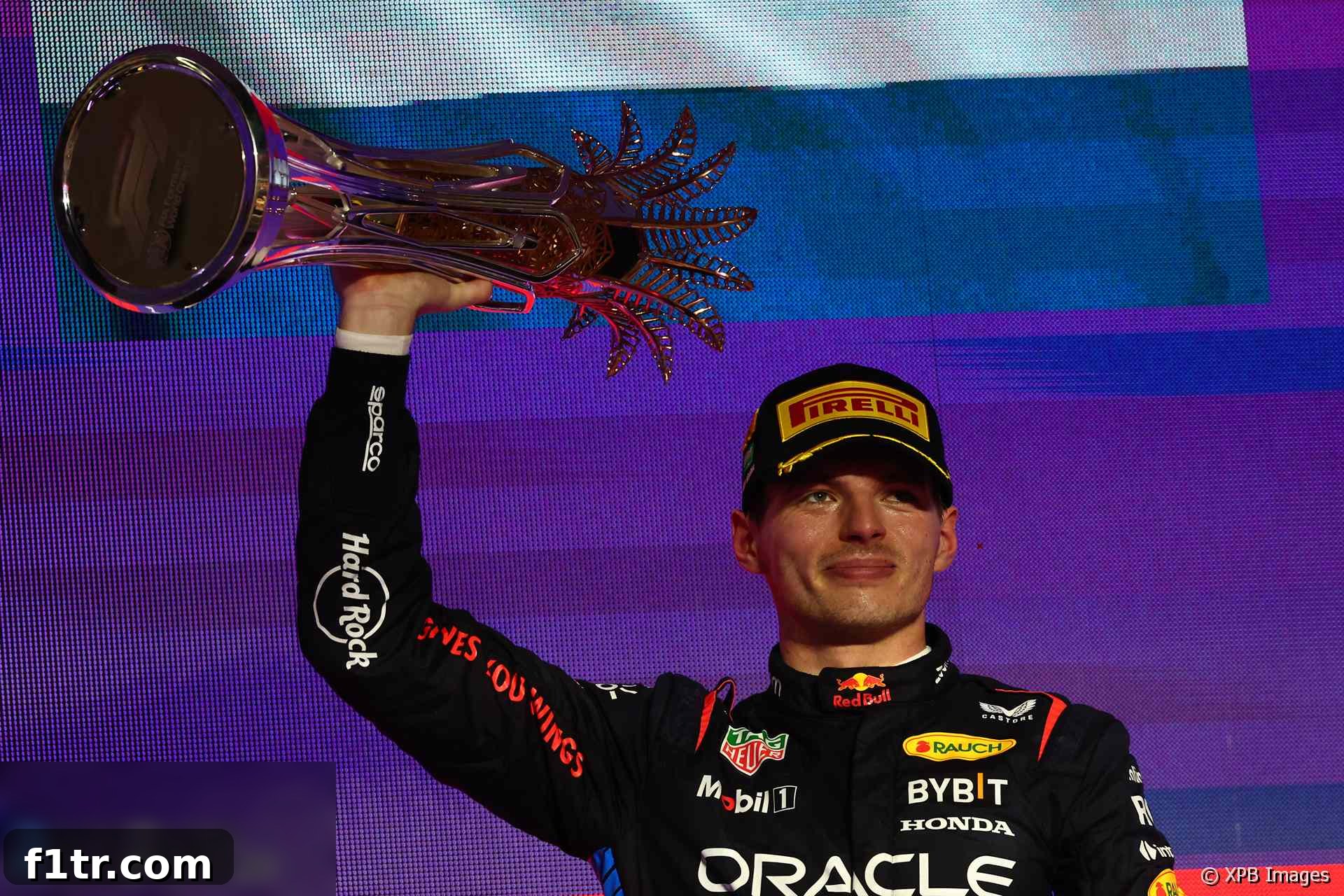
Max Verstappen flawlessly hit all his marks for the remainder of the race, eventually crossing the finish line to secure his 100th career podium finish, his ninth consecutive Grand Prix victory, and an astonishing 19th win from his last 20 starts. While this victory might not have been as utterly straightforward as his dominant performance in Bahrain, its demanding nature, with the early Safety Car and the strategic reshuffles, arguably made it all the stronger. The only minor blemish on a near-perfect weekend for Verstappen was Charles Leclerc’s last-lap effort, which denied the champion a maximum points haul of pole, fastest lap, and the race win. Verstappen’s race engineer, Gianpiero Lambiase, softly delivered that piece of news to his driver after the checkered flag.
Post-race, Max Verstappen expressed his satisfaction: “I think the whole weekend, the car has been performing really well, probably a little bit better than expected even. Overall, of course, very pleased to win here.” Sergio Perez was notably closer to his teammate this time, finishing under nine seconds adrift before his unsafe release penalty dropped him to 13 seconds back. Charles Leclerc secured his first podium of the season, a further five seconds behind Perez.
“We maximised everything today,” said a positive Leclerc. “I look back the last six, seven months, we are the team that have improved the most and we are slowly closing the gap. The gap is still quite big, but if we keep working like that, I’m sure it’s a matter of time before we put the Red Bull under a bit more pressure.”
After enduring countless laps stuck behind Lewis Hamilton before finally being released to showcase his pace, Oscar Piastri ultimately secured a strong fourth place. Fernando Alonso, ever the veteran, exceeded both his own and his Aston Martin team’s expectations with a commendable top-five finish, demonstrating his enduring skill. George Russell led a quartet of British drivers home, finishing less than three seconds ahead of the newest, and arguably most impressive, addition to the grid: Oliver Bearman, who completed a memorable and deeply impressive debut in seventh, having masterfully held off both Lando Norris and Lewis Hamilton in the closing stages.
Nico Hulkenberg skillfully claimed the final point in tenth position, a result that was significantly aided by a controversial team strategy. Haas deployed Kevin Magnussen to deliberately hold up the chasing pack for over 12 seconds, creating a crucial gap for Hulkenberg to pit and retain his position. This audacious tactic infuriated RB, who accused Magnussen of “unsportsmanlike” conduct and vowed to raise the matter with the FIA, highlighting the intense competitive spirit and the fine line between strategic brilliance and unfair play in Formula 1.
Max Verstappen’s second win from two starts to his championship defense left little room for doubt about Red Bull’s commanding position. A palpable sense of resignation could be detected in the paddock after the race, as the sheer pace of the Red Bull cars proved even stronger than many had anticipated. Despite the considerable off-track turmoil surrounding Red Bull Racing’s leadership in recent weeks, which Christian Horner insists has not impacted the team’s unity, their second one-two finish in just eight days unequivocally underlined the fact that these controversies had no discernible effect on their on-track performance. Professional, precise, and poised, Red Bull continues to look unstoppable on the track, though serious questions regarding their internal affairs continue to linger off-track.
For Max Verstappen and the rest of the Formula 1 field, a two-week reprieve awaits before the third round of the season in Melbourne. Perhaps the individual most content with this brief pause will be Verstappen himself. For now, he has more time to delve back into the virtual world of iRacing, honing his craft and enjoying the pure thrill of racing, whether simulated or real.
2024 Saudi Arabian Grand Prix Analysis
- Bearman’s 2024 Jeddah debut performance makes him ‘feel like an absolute idiot’
- Vowles being patient with Sargeant but expects to see “progress”
- “So I’ve got nothing to worry about?” – The best unheard team radio from Jeddah
- “Shock” of poor start to season showed need for change at Alpine – Famin
- “My tyres are dying”: Stroll’s short-lived struggle until he hit the wall
Browse all 2024 Saudi Arabian Grand Prix articles
Formula 1 Race Reviews
- Antonelli lucks in for second win and becomes youngest F1 championship leader
- Emotional Antonelli grabs first Formula 1 victory in Chinese Grand Prix
- Russell sees off Ferrari threat to lead Mercedes one-two in Melbourne
- Norris clinches F1 title by two points as Verstappen wins finale at Yas Marina
- McLaren strategy blunder in Losail hands Verstappen crucial win and shot at title
Read all F1 race reviews