Mercedes-AMG Petronas Formula 1 team principal Toto Wolff has made a stark and sobering admission, conceding that the eight-time reigning constructors’ champions can no longer realistically consider themselves among the title contenders for the 2022 season. This candid statement comes amidst a challenging start to the year for the Silver Arrows, marked by unexpected performance issues and a noticeable drop in competitiveness.
Advert | Become a Supporter & go ad-free
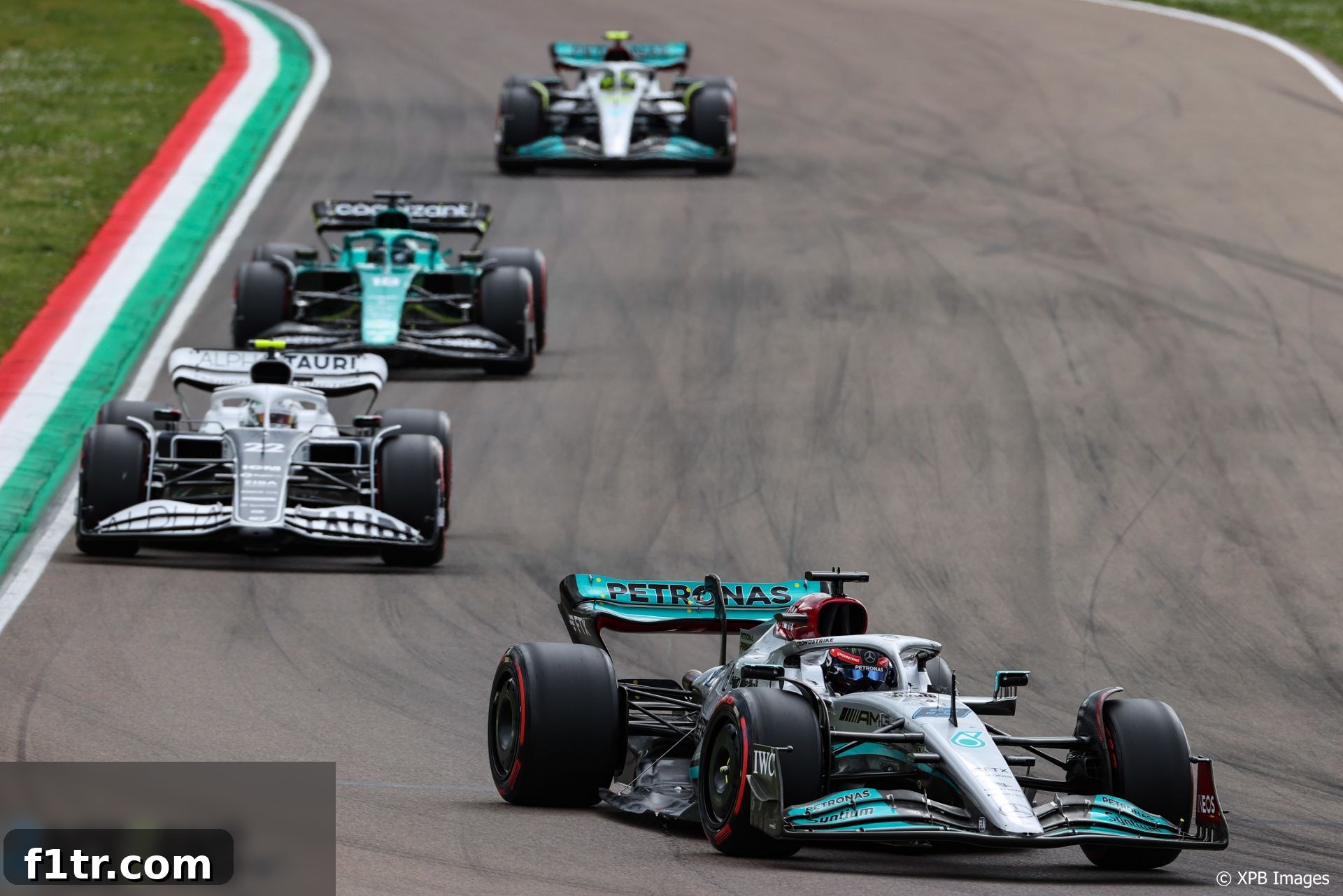
The severity of Mercedes’ predicament was vividly illustrated during the sprint race at the Emilia-Romagna Grand Prix in Imola. Drivers George Russell and Lewis Hamilton finished 11th and 14th respectively, a far cry from the front-running positions Mercedes has historically occupied. Both drivers failed to improve upon their starting grid positions, with seven-time world champion Hamilton even losing one place during the condensed Saturday race. This performance left the team facing the grim prospect of struggling to even score points in the main Grand Prix, a situation almost unthinkable for a squad that has dominated Formula 1 for the better part of a decade.
Wolff did not mince words when discussing the team’s current standing. “We are four races in and probably today marks the low of these first four races,” he stated, reflecting on the challenging weekend. His assessment underscores the deep frustration pervading the team. “It’s obvious that we are not anywhere near the fight at the front. It would be pretty unrealistic to claim to have a slot amongst the front runners for fighting for the championship.” This declaration signals a significant shift in ambition for the constructor, moving from championship aspirations to a focus on fundamental performance recovery.
When pressed by RaceFans about the likelihood of securing points in the upcoming Sunday race, Wolff conveyed his profound disappointment at such a modest target. “I think point scoring needs to be the minimum, but this is not where we set our expectations and therefore this weekend is a complete write-off,” he remarked. His words highlight the inherent pride and relentless pursuit of excellence that defines Mercedes. To be relegated to merely aiming for a top-10 finish is a stark reminder of how far they have fallen from their customary position at the pinnacle of the sport.
The Mercedes team principal elaborated on the challenges faced, particularly concerning their car, the W13. “You can say, well, we’re trying to learn. But we weren’t great with tyre warm-up – that’s why there’s no miracles that you can expect but the race start because overtaking is so difficult. We can make up positions, we’ve shown it today, but not quickly enough. And, therefore, beyond the fact that we are learning, it’s another humbling experience.” The issue of tyre warm-up has plagued Mercedes throughout the early 2022 season, significantly impacting their ability to extract performance, especially during qualifying and at the start of races. This technical hurdle, combined with the inherent difficulty of overtaking at circuits like Imola, compounds their struggles and leaves them vulnerable in the competitive midfield.
The 2022 regulations, which introduced ground effect aerodynamics, have proven particularly challenging for Mercedes. Their W13 chassis has famously suffered from “porpoising,” a phenomenon where the car bounces violently at high speeds, compromising both performance and driver comfort. While not explicitly mentioned by Wolff in this specific quote, the underlying technical issues, including the struggle with the car’s setup window and aerodynamic characteristics, are directly linked to these new regulations. The team is caught in a difficult cycle: modifying the car to alleviate porpoising often means sacrificing downforce, further impacting lap times. This technical labyrinth is what the team is relentlessly trying to unravel.
Wolff also took the opportunity to clarify a televised exchange between himself and Lewis Hamilton following yesterday’s qualifying session, which some observers had interpreted as a sign of discord or an argument. He explained that the interaction was nothing more than a shared expression of frustration at both cars being eliminated in Q2. “It’s quite funny how it’s being interpreted,” Wolff noted. “Lewis and I shared frustration about that we weren’t really able to extract lap one performance and how annoying it was. But it was the same point of view and just sheer anger. There is no division, there’s no blaming or anything of that.” This reassurance underscores the strong bond and mutual respect within the team, even when under immense pressure. It highlights that the frustration is directed at the car’s performance, not at each other, a crucial element for maintaining team cohesion in adverse times.
Despite the current difficulties, Wolff affirmed the internal resolve. “There’s pressure in the system but I would say the necessary pressure to get things right. Nobody in the team is anywhere near enjoying the ride at the moment and this team, we’ve done it in the past, and we just need to dig ourselves out of that hole.” This statement reflects the competitive spirit ingrained within Mercedes. The pressure, though intense, is viewed as a catalyst for improvement rather than a source of collapse. The team’s history is rich with examples of overcoming adversity, and this collective memory serves as a powerful motivator. From their initial return to Formula 1 as a works team to their era of unprecedented dominance, Mercedes has repeatedly demonstrated its capacity for resilience and innovation.
The performance of both drivers, George Russell and Lewis Hamilton, also paints a complex picture. Russell, the younger of the two, has consistently shown remarkable adaptability, often extracting the maximum from the challenging W13 and frequently outperforming his more experienced teammate in the early stages of the season. His ability to finish consistently in the points, even with a difficult car, has been a silver lining for Mercedes. For Hamilton, however, racing in the midfield is an unfamiliar and undoubtedly frustrating experience. A driver accustomed to fighting for victories and championships, finding himself battling for minor points is a test of character and resolve. His public statements and body language have at times reflected the immense struggle, but his commitment to the team’s recovery remains unwavering.
Looking ahead, Mercedes’ immediate priority is a thorough understanding of their W13 package. This involves extensive data analysis, simulator work, and potentially significant aerodynamic and mechanical upgrades. The team’s factory in Brackley and Brixworth will be working tirelessly to diagnose the root causes of their performance deficit, whether it be related to the porpoising, tyre management, or overall aerodynamic efficiency. The development race in Formula 1 is relentless, and while the gap to front-runners like Ferrari and Red Bull currently appears substantial, Mercedes possesses the resources, talent, and engineering prowess to mount a formidable comeback. However, Wolff’s frank admission suggests that this will be a long and arduous journey, focusing more on rebuilding for future seasons rather than immediate championship glory in 2022.
Advert | Become a RaceFans supporter andgo ad-free
2022 Emilia-Romagna Grand Prix
- Aston Martin’s first points reward “immense” effort by factory after Melbourne crashes
- Verstappen becomes 14th driver in F1 history to score more than one ‘grand slam’
- Transcript: “I need more power” – Hamilton and Russell’s contrasting fortunes at Imola
- Ferrari backs increase to six sprint races as F1 Commission meets in London
- Ocon blames pit equipment after penalty for near-miss with Hamilton in pits
Browse all 2022 Emilia-Romagna Grand Prix articles