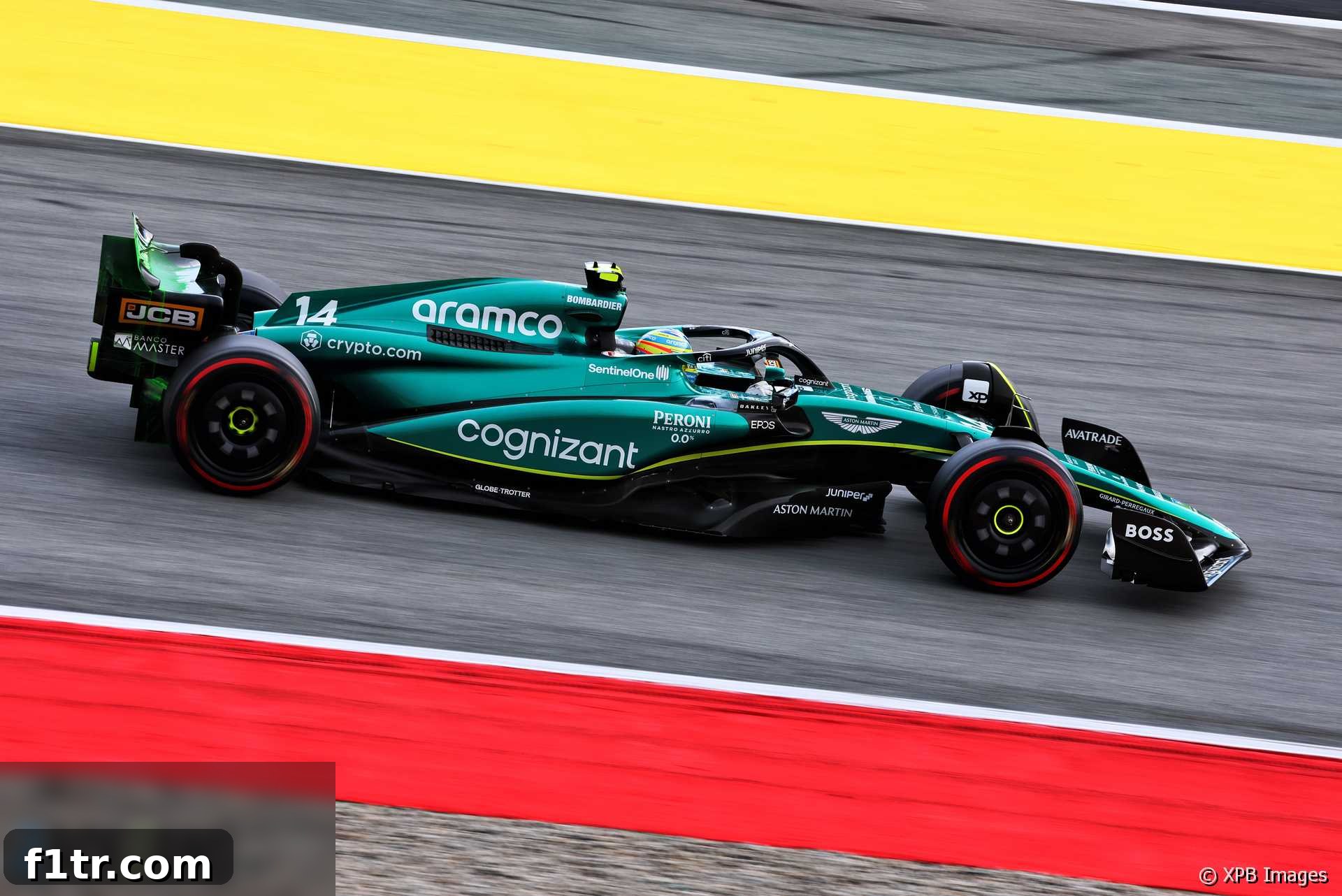
Alonso’s Spanish GP Qualifying: From Front Row Ambition to P9 After Costly Errors
Advert | Become a Supporter & go ad-free
Fernando Alonso, the Aston Martin veteran, found himself grappling with a mixture of frustration and optimism after a dramatic qualifying session for his home race, the Spanish Grand Prix. The two-time world champion openly admitted that a pair of errors on the iconic Circuit de Barcelona-Catalunya track likely cost him a coveted front-row starting position, a stark contrast to his eventual ninth-place grid slot – his lowest qualifying performance of the current Formula 1 season.
Despite the setback, Alonso’s innate competitiveness shone through as he analyzed his performance. He firmly believes that without these critical mistakes, particularly one that inflicted significant damage to his car’s floor, he possessed the raw pace to challenge for P2 alongside Max Verstappen. This conviction is fueled by the impressive underlying speed he felt from his Aston Martin AMR23, even in its compromised state.
A Double Dose of Regret: Alonso’s Qualifying Missteps
The qualifying session for the Spanish Grand Prix unfolded as a narrative of missed opportunities for Fernando Alonso. The chain of events that culminated in his P9 start began early, during the crucial first segment of qualifying (Q1). It was here that a seemingly innocuous moment on an out-lap set the tone for the remainder of his Saturday.
Q1 Error: The Out-Lap That Cost So Much
Alonso recounted the initial mistake that sent ripples through his qualifying efforts. “Q1 probably did compromise everything today,” he stated, reflecting on the profound impact of a seemingly minor incident. The Aston Martin driver explained how he ran slightly wide at the final corner during an out-lap, encountering a damp patch on the circuit. This momentary lapse in concentration, not even on a hot lap, proved incredibly costly. As the car briefly ventured off the racing line, it picked up gravel, which, unbeknownst to him initially, inflicted critical damage to the delicate aerodynamic floor of his AMR23.
The frustration was palpable. “I went from the damp part of the circuit, I guess, at the last corner, because I lost the car. And then it was very costly because that gravel completely destroys the floor.” This wasn’t just a cosmetic scratch; in modern Formula 1, the floor of the car is arguably the single most vital aerodynamic component, responsible for generating a substantial portion of the overall downforce. Damage to this area can dramatically alter the car’s handling, balance, and outright speed, forcing a driver to contend with a sub-optimal package for the rest of the session.
The irony of the situation – suffering such significant damage on an out-lap when not even pushing for a lap time – only amplified Alonso’s disappointment. “It hurts even more because it was the out-lap, I was not even pushing, it was not the push lap it was the out-lap. So I’m disappointed with my performance today. Hopefully I can do a better Sunday.” This detail underscores the fine margins in F1 and how a single, seemingly minor misjudgment can have cascading and severe consequences.
Q3 Missed Opportunity: The Front Row That Almost Was
Despite the compromised floor, Alonso courageously pushed his Aston Martin into Q3, demonstrating both his skill and the underlying pace of the AMR23. However, the shadow of his earlier error lingered. In the decisive Q3 run, he found himself once again making a critical mistake that prevented him from realizing his true potential.
“Probably even with the floor as it was, because in the Q3 lap I was coming for a 12.7 until turn 10. But again I ran wide into the damp part in turn 10 on the outside.” His words painted a clear picture of the near miss. He was on pace to match the 1’12.7 lap times set by Carlos Sainz Jnr and Lando Norris, who secured second and third positions on the grid respectively. To be on such a competitive pace with a damaged car speaks volumes about his driving and the car’s capability.
The realization of what he had squandered hit hard. “So when I saw now that a 12.7 is P2 and P3, I was surprised. That’s why I’m optimistic for tomorrow because the car seems to have a lot of pace.” This moment of introspection perfectly encapsulated his mixed emotions: frustration over the errors, but also renewed confidence in the car’s potential for Sunday’s race. The difference between starting P2/P3 and P9 is colossal in Formula 1, significantly impacting strategy and the likelihood of challenging for a podium.
The Crucial Role of F1 Floors: Why Damage Matters So Much
In the highly competitive world of Formula 1, every component of the car is engineered for peak performance, and the underbody, particularly the floor, is an aerodynamic marvel. Damage to this area, as experienced by Alonso, is not just a minor inconvenience; it can be devastating to a car’s performance.
The floor of an F1 car is meticulously designed to create a “ground effect,” essentially sucking the car to the track surface. This generates immense downforce, allowing cars to take corners at incredible speeds. Even minor scuffs or holes can disrupt the airflow beneath the car, leading to a significant loss of downforce, increased drag, and an unstable aerodynamic platform.
Alonso’s observation that the AMR23 was “moving weirdly in a few corners” directly correlates with the effects of floor damage. Such instability compromises driver confidence, especially in high-speed sections, making it harder to extract the car’s maximum potential. Engineers spend countless hours refining these intricate designs, understanding that even the smallest imperfection can have a measurable impact on lap times. The challenge for Alonso was not only to drive a compromised car but also to recalibrate his driving style and expectations on the fly, a testament to his adaptability.
Advert | Become a RaceFans supporter andgo ad-free
Alonso’s Race Day Optimism Despite the Setback
Despite the disappointment of a P9 start, Fernando Alonso’s outlook for Sunday’s Spanish Grand Prix remains remarkably positive. His confidence stems from an unwavering belief in the raw pace of his Aston Martin AMR23, even after sustaining floor damage in Q1.
“The car still feels competitive even with some damage on the floor,” he affirmed, highlighting the underlying strength of the Aston Martin package. This resilience, coupled with Alonso’s legendary race craft and strategic acumen, gives him a strong foundation for a recovery drive. Starting from ninth on the grid on a circuit like Barcelona, which is notoriously difficult for overtaking, presents a significant challenge. However, Alonso has repeatedly demonstrated his ability to extract maximum performance and exploit any opportunities that arise during a race.
His optimism isn’t merely hopeful thinking; it’s rooted in the data and feeling from the car. The strong sector times he was achieving in Q3 before his second error suggested a podium-contending pace was well within reach. This inherent speed will be crucial on Sunday, allowing him to push hard, manage his tires effectively, and potentially climb through the field. For a driver of Alonso’s caliber, a P9 start often translates into a fascinating strategic battle and a determined pursuit of championship points.
An Unpredictable Qualifying Session for Many
The 2023 Spanish Grand Prix qualifying was marked by an unusual level of unpredictability, with several top drivers failing to progress as expected. This provided a broader context to Alonso’s struggles, suggesting that the circuit conditions or car setup challenges were widespread.
“It was a strange qualifying to see Leclerc out of Q1 and Perez, Russell out of Q2. We were struggling as well. So it was tricky for everyone. In my case it was just my mistake in the out lap of Q1, so that compromises everything.” Alonso pointed out the surprising exits of Charles Leclerc in Q1, and Sergio Perez and George Russell in Q2. These were significant upsets, as all three drivers are typically front-runners for top teams.
Such unexpected results often indicate that track conditions were particularly challenging, perhaps due to varying grip levels, wind gusts, or slight damp patches that caught drivers out. The pressure of a home Grand Prix, combined with the nuances of a highly technical circuit like Barcelona, can amplify any small error. While Alonso directly attributed his woes to his own mistakes, the fact that other strong contenders faced similar difficulties underscores the overall complexity and demanding nature of the session for the entire grid.
Looking Ahead: The Spanish Grand Prix Race
With qualifying behind him, Fernando Alonso’s focus now squarely shifts to the main event: Sunday’s Spanish Grand Prix. Starting from ninth offers a challenging but not insurmountable path to significant points. The Barcelona circuit, while familiar to all drivers, demands precision, strategic thinking, and strong race pace.
Alonso’s reputation for relentless race day performances precedes him. He excels at tire management, navigating traffic, and making shrewd strategic decisions. His Aston Martin AMR23 has consistently shown strong race pace throughout the season, often performing even better on Sundays than it does in qualifying. This bodes well for his chances of advancing through the field and battling for a strong points finish, potentially even a podium, should circumstances align.
The objective for Sunday is clear: to maximize points for Aston Martin and continue their impressive championship campaign. “But the race is tomorrow. The car still feels competitive even with some damage on the floor. So if we put everything together for tomorrow, I’m still optimistic that we can score many points.” This resolute statement encapsulates the fighting spirit that defines Fernando Alonso. The Spanish Grand Prix promises to be an exciting spectacle, with Alonso determined to turn his qualifying disappointment into a triumphant home race performance.
Bringing the F1 news from the source
RaceFans strives to bring its readers news directly from the key players in Formula 1. We are able to do this thanks in part to the generous backing of our RaceFans Supporters.
By contributing £1 per month or £12 per year (or the equivalent in other currencies) you can help cover the costs involved in producing original journalism: Travelling, writing, creating, hosting, contacting and developing.
We have been proudly supported by our readers for over 10 years. If you enjoy our independent coverage, please consider becoming a RaceFans Supporter today. As a bonus, all our Supporters can also browse the site ad-free. Sign up or find out more via the links below:
- Become a RaceFans Supporter
- RaceFans Supporter FAQ
Advert | Become a RaceFans supporter andgo ad-free
2023 Spanish Grand Prix
- Ben Sulayem raises safety concerns over “too many people on the grid” at races
- Why Ferrari say their change in design is the result of “discipline”, not “copying”
- Hamilton and Russell were seeking tow from Sainz when they collided – Mercedes
- Red Bull’s Spanish GP diffuser update was ‘inspired by rivals’ including Williams
- Why McLaren always doubted second-row start in Spain would lead to points finish
Browse all 2023 Spanish Grand Prix articles