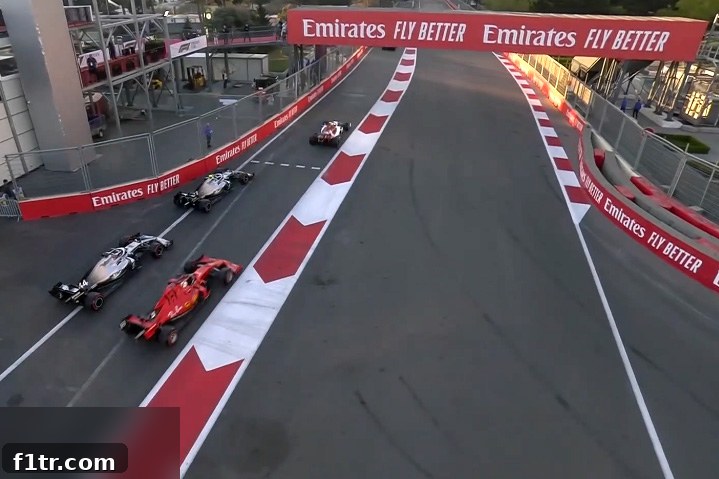
In the high-stakes arena of Formula 1 qualifying, where mere milliseconds can dictate grid positions and championship trajectories, teams often push the boundaries of strategy. The 2019 Azerbaijan Grand Prix qualifying session saw Mercedes-AMG Petronas Motorsport execute a daring and unconventional maneuver – a series of ‘dummy starts’ performed by their star drivers, Lewis Hamilton and Valtteri Bottas. This audacious tactic, orchestrated to gain a crucial aerodynamic advantage, was later described by Mercedes motorsport strategy director James Vowles as “an enormous risk” that left the team cutting it exceptionally fine to commence their final flying laps.
Advert | Become a Supporter & go ad-free
As the climax of Q3 approached, both Hamilton and Bottas pulled over at the pit lane exit, briefly stopping before rejoining the track. Initially, the drivers were guarded about the true nature of their actions, ambiguously terming it a “clutch calibration.” However, the veil of secrecy was soon lifted by team principal Toto Wolff, who candidly revealed the strategic brilliance behind the maneuver. The team’s objective was to position their cars perfectly to benefit from the slipstream, or ‘tow,’ of competitors, an advantage estimated to be worth a significant four-tenths of a second on Baku’s high-speed straights. This seemingly minor fraction of a second can be the definitive factor between pole position and a challenging starting spot, highlighting the immense pressure under which such decisions are made.
The High Stakes of F1 Qualifying Strategy
Formula 1 qualifying is not merely about raw pace; it’s a intricate ballet of timing, tire management, and strategic positioning. The final segment of qualifying, Q3, is particularly intense, with teams vying for the optimal track position to maximize their performance. Drivers often look for a ‘tow’ from a car ahead, which reduces aerodynamic drag and allows for higher top speeds. This pursuit of the perfect tow frequently leads to what Vowles aptly termed a “Mexican stand-off” in the pit lane. Teams are reluctant to be the first car out, knowing they would sacrifice their own tow advantage for the benefit of those behind them. This strategic deadlock creates a tense waiting game, with engines fired up and everyone watching each other, hoping to be the beneficiary rather than the provider of the slipstream.
The Allure of the Slipstream in Baku
The Baku City Circuit, with its exceptionally long main straight and other fast sections, amplifies the effect of slipstreaming more than most tracks on the F1 calendar. The aerodynamic benefits gained from following another car closely can translate into significant lap time improvements, making the tow an invaluable asset during qualifying. A gain of four-tenths of a second, as identified by Mercedes, is a colossal margin in Formula 1, potentially the difference between starting on the front row or further down the grid. Understanding this critical advantage, Mercedes knew that leveraging the slipstream could be the deciding factor in securing pole position for the 2019 Azerbaijan Grand Prix.
Mercedes’ Daring “Dummy Start” Unveiled
The decision to employ the “dummy start” tactic was born out of Mercedes’ deep understanding of both the Baku circuit’s characteristics and the prevailing qualifying dynamics. Recognising the widespread desire for a tow, and the consequent reluctance of teams to lead the pack out of the pits, Mercedes formulated a plan that was both ingenious and audacious. Rather than falling into the ‘Mexican stand-off,’ they decided to take proactive control of the situation.
The strategy involved sending Hamilton and Bottas out of the pit lane slightly earlier than their rivals. This initial move was calculated to ‘pull’ the entire train of cars behind them, setting the stage for the next phase of the plan. Once on the track, instead of continuing their out-lap, both drivers executed a controlled “practice start” – effectively pulling over to the left-hand side of the track, allowing the following cars to overtake. This momentary pause served to reposition the Mercedes cars further back in the queue, enabling them to then benefit from the slipstream of those who had just passed them. It was a perfectly choreographed dance, designed to outmaneuver their rivals in the complex strategic chess game of Q3.
Learning from Shanghai: A Cautionary Tale
The memory of the 2019 Chinese Grand Prix qualifying served as a stark reminder of the risks associated with such strategic maneuvering. In Shanghai, several drivers, in their eagerness to secure a tow, waited too long in the pit lane, resulting in them failing to cross the start/finish line before the chequered flag fell, and thus missing their opportunity to set a final lap time. This incident underscored the delicate balance between seeking an advantage and risking the entire Q3 session. Vowles specifically cited this event, stating that in Baku, Mercedes was “very conscious that this effect could well dictate whether we were on pole or not.” The possibility of missing their final flying lap was a tangible and immense risk that Mercedes willingly accepted, betting on their precision and coordination to navigate the narrow window of opportunity.
The Execution: A Precision Maneuver under Pressure
Executing the “dummy start” was a testament to the team’s meticulous planning and the drivers’ unwavering trust. As Vowles explained, the plan was to send the cars out early to draw out the competition, then perform the practice start to drop back. “We only crossed the line several seconds before the flag as a result of this,” Vowles revealed, highlighting just how fine the margins were. The timing had to be absolutely impeccable. Had they miscalculated, even by a fraction, Hamilton and Bottas could have found themselves in the same predicament as the unfortunate drivers in China, without a registered lap time.
However, the execution was flawless. The Mercedes cars pulled over, competitors swept past, and crucially, Sebastian Vettel, who ended up leading the pack, did not have the benefit of a tow on his own flying lap. This perfectly orchestrated sequence allowed Hamilton and Bottas to slot into ideal positions behind their rivals, reaping the dual benefits of a strong slipstream and advantageous track positioning for their crucial final laps. The success of the strategy was palpable, providing a clear illustration of how high-level strategic thinking can directly translate into on-track performance.
Balancing Risk and Reward
The inherent risk of the dummy start strategy cannot be overstated. By intentionally stopping and rejoining, Mercedes gambled with the most precious commodity in Q3: time. The few seconds lost by pausing at the pit lane exit, combined with the need to create a gap and then build speed again, meant that Hamilton and Bottas had barely any time to spare. This tight window underscored the confidence Mercedes had in its calculations, its drivers, and its communication. The reward, however, was substantial: a potential four-tenths advantage, which, in a sport defined by fractional differences, was well worth the calculated gamble. This strategy exemplified Mercedes’ philosophy of relentlessly seeking competitive edges, even if it meant venturing into unconventional and high-risk territory.
The Human Element: Briefing the Champions
Such an unusual and high-pressure tactic required extensive preparation and buy-in from the drivers. “This sort of plan doesn’t go without quite a bit of discussion beforehand, especially with the drivers,” Vowles emphasised. For Lewis Hamilton and Valtteri Bottas, Q3 is a routine of intense focus, precision, and peak performance. Deviating from this established routine, particularly by performing an unexpected stop-start maneuver, demands not just skill but also absolute trust in the team’s judgment.
Vowles detailed the meticulous briefing process: “We discussed it with the drivers in the morning, made sure that they completely understood what we may and may not do during qualifying, and again before they went out we briefed them so that they understood exactly what was required of them.” This level of detailed communication ensured that both drivers were not only aware of the plan but also fully understood its rationale, risks, and their precise roles. Their ability to execute such a complex and counter-intuitive instruction under the immense pressure of Q3 speaks volumes about their professionalism, discipline, and the profound trust they place in their strategists. “And they did a fantastic job,” Vowles concluded, acknowledging the drivers’ crucial role in the successful execution of this audacious plan.
Inside the Cockpit: Radio Communications During Q3
The tension and precision of the dummy start tactic are further illuminated by the revealing team radio messages exchanged during the critical moments of Q3. These snippets of communication offer a rare glimpse into the real-time coordination between the pit wall and the drivers, showcasing the concise instructions, confirmations, and reminders necessary to execute such a complex strategy flawlessly. The language is direct, leaving no room for ambiguity, as the team guided Bottas and Hamilton through the unusual sequence of events.
For Bottas, the instructions were clear: “throw the dummy,” “go for the dummy at the start,” and “do not hold for long. As far left as possible.” The urgency and specificity of the messages reflect the tight timeframe and the critical need for precise positioning. Hamilton, too, received detailed guidance: “Follow Valtteri out and be prepared to stop. Normal starting position, normal pull-away,” followed by specific instructions on where to stop: “So far left as possible, before the dotted line.” These messages highlight the minute details that had to be communicated and understood perfectly by both drivers to ensure the strategy unfolded as planned.
Radio Transcripts from the Start of Q3
| To Bottas: | And Valtteri we’ll throw the dummy, so… |
| To Bottas: | We’re going for the dummy at the start if I call it down the pit lane. |
| To Bottas: | And remember it’s going to be just a pull-away. |
| To Bottas: | Ah, sorry, I’m not going to tell you on the radio. |
| Bottas: | Copy. |
| To Bottas: | Ah we’re going for that plan. |
| To Bottas: | We’ll go for the start. |
| To Bottas: | Do not hold for long. As far left as possible. |
| To Bottas: | OK let’s go. |
| To Bottas: | Watch traffic exit. |
| To Bottas: | Raikkonen the car ahead. |
| To Hamilton: | Follow Valtteri out and be prepared to stop. Normal starting position, normal pull-away. |
| Hamilton: | Marcus, EB2? |
| To Hamilton: | Affirm. |
| Hamilton: | Up to turn four? |
| To Hamilton: | So just follow Valtteri out, and we’ll pull over for a start. |
| To Hamilton: | So far left as possible, before the dotted line. |
| To Hamilton: | And we can go again. Just normal pull-away. |
| To Hamilton: | You’ve got traffic, all clear, go, go. |
| Hamilton: | There’s a lot of cars ahead. |
| To Hamilton: | Yeah no problem Lewis just focus on that gap ahead. |
A Masterclass in Strategic Edge
The Mercedes “dummy start” in the 2019 Azerbaijan Grand Prix qualifying stands as a compelling example of strategic innovation and execution under immense pressure. It showcased the team’s willingness to embrace risk, their analytical prowess in identifying a crucial performance advantage, and the seamless coordination between strategists and drivers. While the tactic itself was simple in concept, its perfect execution in the heat of Q3, against the backdrop of an unforgiving circuit and a cautionary tale from previous races, transformed it into a masterclass in gaining a competitive edge. It underscored that in Formula 1, success is not solely about having the fastest car or the most talented drivers, but also about the relentless pursuit of every possible strategic advantage, no matter how unconventional or risky it may seem. This memorable moment continues to be a benchmark for clever, calculated strategy in the exhilarating world of Grand Prix racing.
Advert | Become a RaceFans supporter andgo ad-free
2019 F1 season
- Crying in the Melbourne car park at 2019 grand prix was my career low – Ocon
- McLaren Racing reports reduced £71 million loss in 2019
- Kvyat: Hockenheim podium last year was “my biggest achievement” so far
- How the FIA’s new encrypted fuel flow meter targets Ferrari’s suspected ‘aliasing’ trick
- “He smashed my office door”: 23 must-see moments from ‘Drive to Survive’ season two
Browse all 2019 F1 season articles