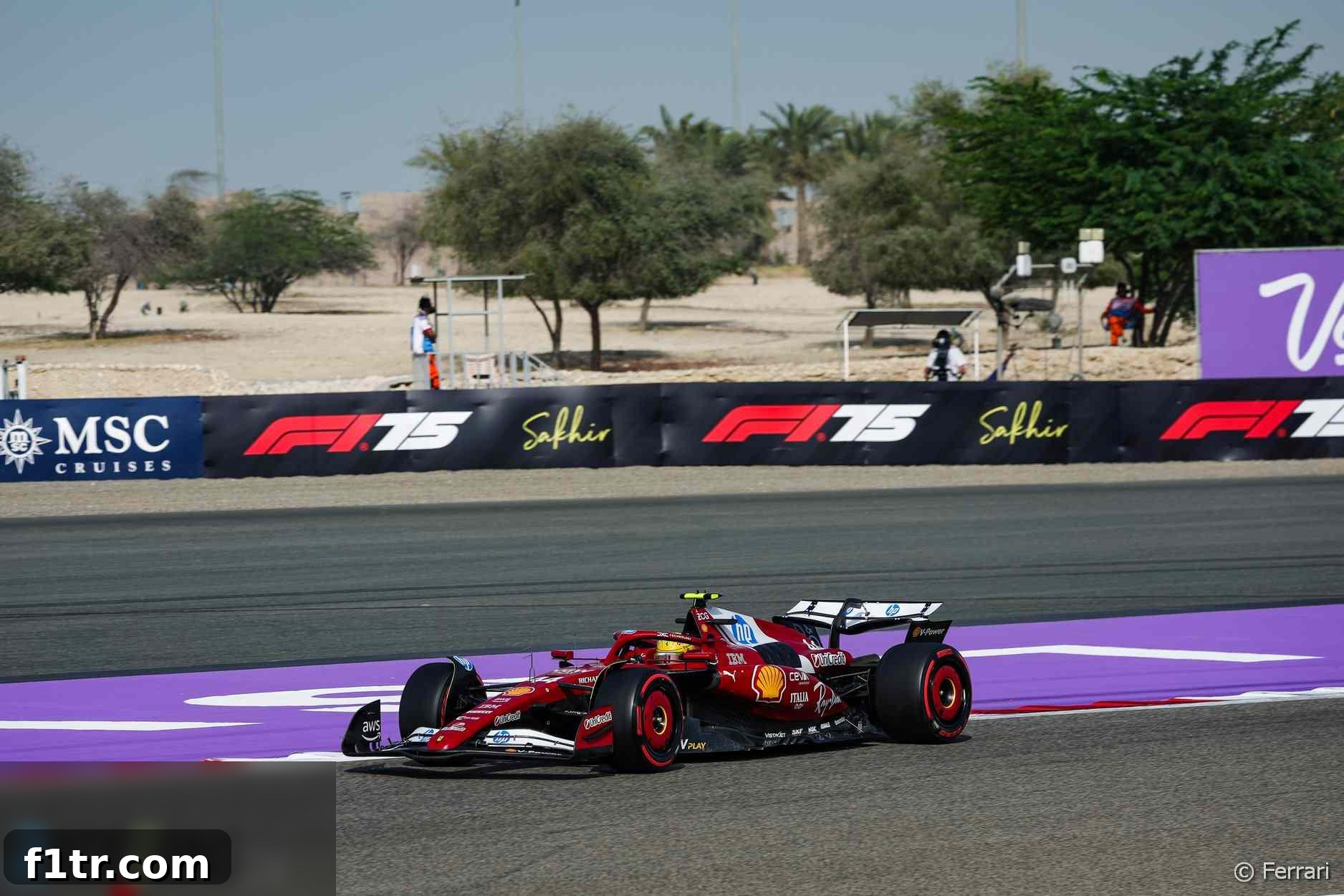
In the high-stakes world of Formula 1, every upgrade and every practice session offers a glimpse into a team’s potential and its ongoing development journey. Following the initial practice sessions, Lewis Hamilton, the acclaimed Mercedes driver, expressed measured optimism regarding the performance of Ferrari’s newly introduced upgraded floor. His comments offered a crucial insight into the team’s progress, even as his teammate, Charles Leclerc, provided a more grounded assessment of their competitive standing against a formidable rival like McLaren.
Hamilton’s Initial Impressions: Encouragement from Ferrari’s New Aero Package
Emerging from the garage after putting the revised machinery through its paces, Hamilton conveyed a sense of encouragement. “The upgrade’s definitely working,” he stated, a note of gratitude evident in his voice as he addressed the official F1 channel. His words were not just a simple observation; they were a profound acknowledgment of the tireless efforts expended by the team back at the factory. Developing and implementing such crucial aerodynamic components is an arduous process, demanding meticulous design work in wind tunnels, advanced computational fluid dynamics (CFD) simulations, and precision engineering for fabrication.
The floor of a modern Formula 1 car is arguably its most critical aerodynamic element, responsible for generating a significant portion of its downforce. Its design directly influences how the car interacts with the airflow, dictating grip levels, stability, and overall cornering speed. Therefore, any upgrade in this area holds immense potential for performance gains. Hamilton’s positive feedback underscored the initial success of Ferrari’s latest iteration, a testament to the dedication of hundreds of engineers and designers who pour countless hours into finding those elusive tenths of a second.
“So a big, big thank you to everyone back home for working so hard on bringing the upgrades because it’s never an easy thing,” Hamilton reiterated, emphasizing the complexity involved. “It’s a lot of work that goes on in the wind tunnel and a lot work that goes into fabricating and putting together these floors.” This gratitude highlights the symbiotic relationship between a driver and their team, where performance on track is a direct reflection of innovation off it.
Despite the positive initial signs, the journey to fully unlock the potential of new components is often fraught with challenges. Hamilton articulated this reality, noting, “It’s just good to see that we’re taking steps forward. We’re trying to now extract more from it, I hope that we can make the right steps overnight to tomorrow.” This sentiment perfectly encapsulates the ongoing development race in F1, where incremental improvements are key, and continuous refinement through data analysis and setup adjustments is paramount.
Navigating the Setup Challenges: Seeking Unwavering Consistency
The transition from a new component working in isolation to integrating it seamlessly into a competitive package requires exhaustive setup work. Hamilton reflected on the nuanced process, reporting that his car “felt pretty decent” after a series of adjustments were made for the second practice session. However, the pursuit of perfection is relentless, and he acknowledged the ongoing challenge of achieving consistent performance across an entire lap, particularly through varying corner types.
“I’m just trying to pull the laps together, having a car that’s easy to drive and that’s consistent through the lap at the moment,” he explained. The modern F1 car is a marvel of engineering, but its complexity means that optimizing it for different corner speeds—low, medium, and high—is a delicate balancing act. A setup that excels in slow corners might compromise performance in fast sweeps, and vice-versa. Finding that sweet spot, that perfect equilibrium, is what separates a good car from a truly great one.
Hamilton continued, “It’s a bit different between low, medium and high [speed corners] as you often have so we’re just trying to finesse it, trying to tweak it and then make sure that we have good long-run pace because that’s where you need to be strong here, particularly.” The emphasis on “long-run pace” is critical. While qualifying performance determines grid position, race day success hinges on a car’s ability to maintain speed and manage tire degradation over extended stints. This focus reveals Ferrari’s strategic thinking, aiming for a robust race package rather than a one-lap wonder.
At the close of the second practice session, Hamilton found himself eighth on the timesheets, a full second adrift of Oscar Piastri’s McLaren. This gap, while significant, did not entirely overshadow the underlying optimism about the floor upgrade, but it did underscore the formidable challenge posed by their rivals. The data collected from these sessions would be meticulously scrutinized by engineers, feeding into crucial decisions about setup changes for qualifying and the race.
Leclerc’s Candid Assessment: The McLaren Benchmark
While Hamilton focused on the positive steps taken by Ferrari, his teammate, Charles Leclerc, offered a more sobering perspective, particularly concerning their competitive position relative to McLaren. Leclerc, who finished fourth in the second practice session, half a second off Piastri’s pace, voiced doubts about Ferrari’s ability to significantly close the gap to the Woking-based outfit in the immediate future.
“I’m trying to push into a direction that allows me to extract a bit more out of the car, but to be honest, the potential of the car remains the same and we’re just not fast enough,” Leclerc admitted candidly. His assessment highlights a fundamental issue: while upgrades can improve the car, the inherent performance ceiling might still be lower than that of their closest competitors. This honest appraisal is characteristic of Leclerc, known for his straightforward analysis of Ferrari’s performance.
Leclerc’s most striking comment painted a vivid picture of McLaren’s current dominance: “When we look at the McLaren, they are just on another planet for now. It’s annoying, but it’s the way it is, and it actually motivates me to try and close that gap as soon as possible. But they are incredibly fast.” This frank admission underscores the formidable challenge McLaren presents. Their resurgence in recent seasons, particularly with consistent upgrades, has transformed them into a genuine front-running team, capable of challenging for podiums and even victories.
The frustration in Leclerc’s voice was palpable, but so too was his determination. Such a significant performance gap, especially in practice, can be disheartening, yet it also fuels the competitive fire within a driver. His desire to “close that gap as soon as possible” reflects the relentless pursuit of excellence that defines Formula 1 drivers.
The Impact of Track Conditions and Future Work
Beyond the technical merits of the upgrade and the inherent pace of rival teams, track conditions played a significant role in the practice sessions. Leclerc specifically noted the tricky nature of the sessions, attributing it to the substantial temperature differences compared to previous testing periods. “It’s been a tricky session because it’s so much warmer than the test and obviously you go into a session expecting the grip that you had at the test and it’s completely different.”
Warmer track temperatures typically lead to reduced grip, as the tires behave differently, and the aerodynamic efficiency can also be affected. Drivers rely heavily on their understanding of tire performance and grip levels, and a sudden shift in conditions requires rapid adaptation and significant setup changes. This adds another layer of complexity to an already challenging weekend. “So we’ve got to readjust the car and there will be a lot of work during the night to try and turn the situation around more,” Leclerc confirmed, pointing to the intense workload facing the engineers and mechanics overnight.
This “overnight work” is a crucial aspect of every Grand Prix weekend. Teams meticulously analyze vast amounts of data—telemetry, tire temperatures, driver feedback, and aerodynamic data—to fine-tune the car’s setup. The goal is to optimize the vehicle for qualifying pace and, more importantly, for sustained performance during the race, taking into account predicted weather and track evolution. Success often hinges on who makes the most effective adjustments between Friday practice and Saturday’s critical sessions.
Ferrari’s Path Forward: Balancing Optimism with Reality
In summary, both Ferrari drivers agreed on one crucial point: the upgraded floor is indeed working. “Leclerc confirmed Ferrari’s floor changes worked, ‘so that’s positive, but unfortunately the gap to McLaren is still too big.'” This consensus provides a foundation for optimism within the team, validating the hard work put into development. However, Leclerc’s pragmatic view offers a necessary dose of reality, highlighting the substantial performance deficit they still face against key competitors like McLaren.
Ferrari’s journey in the current Formula 1 season is a testament to the perpetual cycle of development and adaptation. While the floor upgrade represents a positive step, the real challenge lies in unlocking its full potential and integrating it into a car that can consistently challenge at the very front. The contrasting perspectives of Hamilton and Leclerc perfectly encapsulate this dynamic: the encouragement derived from tangible progress versus the stark reality of the competitive landscape.
The team will now enter a critical phase of data analysis and setup refinement. The aim will be to minimize the gap to McLaren and other front-runners, not just in outright pace but also in long-run consistency. The upcoming qualifying session will be a true test of their overnight efforts, determining whether they can translate their developmental strides into strong grid positions. For Ferrari, the pursuit of championship glory is an intricate dance between aggressive innovation and meticulous optimization.
The Broader F1 Landscape: A Season of Relentless Development
Ferrari’s situation mirrors the broader narrative of the current Formula 1 season: a relentless development race where teams constantly strive for marginal gains. Every Grand Prix weekend is not just a competition of drivers but also a battle of engineering prowess and strategic acumen. The evolution of car performance throughout a season can be dramatic, with teams bringing upgrade packages almost continually. Ferrari’s upgraded floor is just one piece of this complex puzzle, and its effectiveness will be measured not only by initial feelings but by tangible results on track.
The challenge from McLaren, as articulated by Leclerc, also highlights the intensely competitive nature of the sport. No team can afford to stand still; stagnation means falling behind. For Ferrari, a team with a storied history and immense pressure to succeed, these upgrades are vital for maintaining their championship aspirations and delivering on the high expectations of their passionate global fanbase. The season is long, and while McLaren might appear “on another planet” for now, the continuous pursuit of performance ensures that the competitive landscape is ever-shifting.
2025 Bahrain Grand Prix
- Hamilton making “drastic shift” in driving style to master Ferrari’s car
- Leclerc revealed Ferrari strategy details to Gasly before Bahrain Grand Prix
- Lawson made “very significant step forward” in Bahrain – Mekies
- Russell’s transponder was ‘frazzled and charred’ after Bahrain Grand Prix DRS drama
- “Don’t give me too much now”: Hamilton’s search for speed at Ferrari continues
Browse all 2025 Bahrain Grand Prix articles