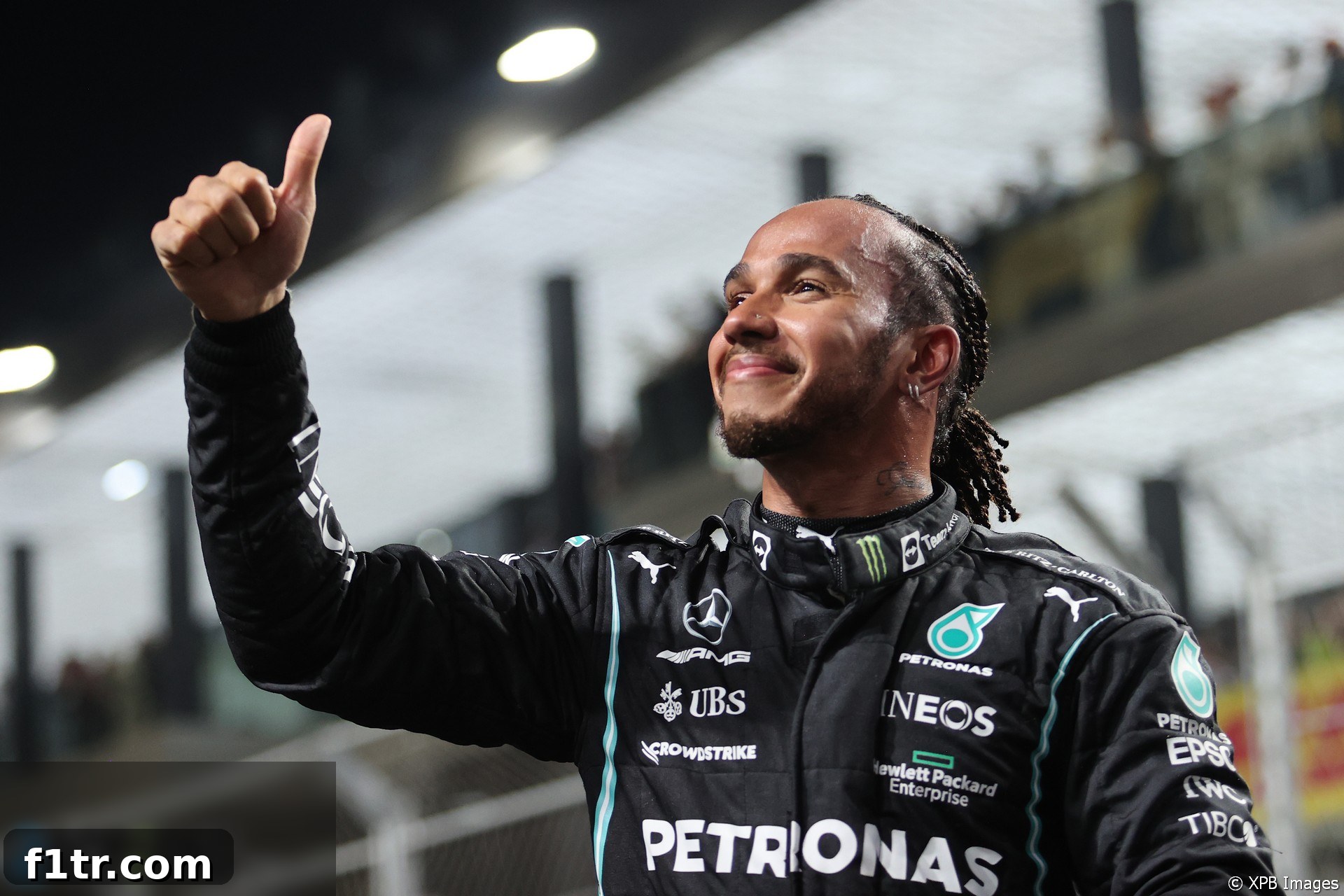
In the high-stakes environment of Formula 1, where championship dreams can be made or broken in an instant, every decision from the stewards carries immense weight. Minutes before the crucial qualifying session for the inaugural Saudi Arabian Grand Prix, a cloud of uncertainty hung over the Mercedes garage. Reigning world champion Lewis Hamilton found himself under investigation for two distinct incidents that occurred during the final free practice session. The allegations were serious: firstly, for reportedly failing to respect double waved yellow flags; and secondly, for allegedly impeding Haas driver Nikita Mazepin. These investigations cast a long shadow over his immediate future, threatening to derail his bid for a record-breaking eighth world title in a season already defined by an intense rivalry with Max Verstappen.
Advert | Become a Supporter & go ad-free
The gravity of the situation was undeniable. Hamilton, not for the first time in the intensely competitive 2021 season, faced the very real prospect of penalties – potentially two – that could have delivered a devastating blow to his world championship aspirations. Each grid position, each point, was magnified in significance as the season reached its climactic stages. However, as the dust settled and qualifying concluded, the tension within the Mercedes camp gave way to a palpable sigh of relief. Hamilton was ultimately cleared of one infringement and received a comparatively minor sanction for the other. This allowed him to maintain his pole position, a critical advantage for the demanding race ahead on the Jeddah Corniche Circuit.
The outcome sparked considerable discussion, especially given recent precedents. Just two weeks prior, Hamilton’s primary championship rival, Max Verstappen, had incurred a five-place grid penalty for a similar offense of ignoring double waved yellows during qualifying in Qatar. The stark contrast begged a crucial question: how did Lewis Hamilton manage to avoid a potentially race-losing penalty, not once, but twice, under circumstances that initially appeared precarious?
The Double Waved Yellow Flag Incident: A False Alarm
The first of the two incidents concerned the alleged failure to respect double waved yellow flags. This particular case, while initially alarming, turned out to be a relatively straightforward decision for the FIA stewards, albeit an unusual one in its specifics. During final practice, approximately 20 minutes into the session, as Hamilton embarked on a flying lap, a warning signal was momentarily triggered directly ahead of him. The official decision published by the stewards shed light on the anomaly: “The double yellow flag warning on the FIA Marshalling System was activated at light panel number six accidentally, for less than one second.” This fleeting signal was displayed on the outside of Turn 8, a critical corner on the high-speed Jeddah circuit.
Crucially, the stewards meticulously reviewed the available evidence, including telemetry and onboard footage from Hamilton’s car. Their findings were decisive: “As the on-board video of car 44 [Hamilton] clearly shows, there was no yellow flag displayed, no yellow lights were displayed to that driver and the yellow warning light was not visible on the driver’s steering wheel.” This pivotal detail completely differentiated Hamilton’s situation from Verstappen’s incident in Qatar. In that instance, a marshal was visibly waving yellow flags as the Red Bull driver passed, and Pierre Gasly’s car was indeed stranded off the racing line. Verstappen, along with Valtteri Bottas, was rightly penalised for failing to sufficiently reduce speed under those clear warning conditions.
The stewards’ conclusion regarding Hamilton’s case underscored this distinction: “Unlike other incidents this year, there was no yellow flag or yellow light displayed to the driver (the driver already being well into the marshalling sector when the system was briefly activated) hence no breach of the regulations has occurred.” Essentially, the system experienced a technical glitch, a “false alarm” that was both accidental and extremely brief. Furthermore, no actual vehicles were stranded on track in the sector when Hamilton was negotiating that portion of the circuit, removing any real danger that the warning would have been intended to mitigate. Hamilton himself corroborated this, explaining, “With the yellow flags, there was a white panel going through Turn 9, but there was no yellows. There wasn’t a car stopped anywhere.” His onboard camera in fact showed a white flag, indicating the presence of the slower car of Yuki Tsunoda ahead, rather than a yellow flag signifying danger. Hamilton subsequently passed Verstappen on approach to Turn 13, the lightly-banked hairpin at the far end of the circuit, without incident related to the false yellow flag. This thorough analysis led to Hamilton being entirely cleared, an outcome that brought immense relief to the championship contender.
Advert | Become a RaceFans supporter andgo ad-free
The Impeding Incident: A Reprimand and a Team Fine
While the yellow flag issue was quickly resolved in Hamilton’s favor, the second incident involving Nikita Mazepin presented a much more tangible breach of regulations, bringing Hamilton considerably closer to a grid penalty. The incident saw Mazepin forced to take drastic evasive action, venturing into the run-off area at Turn 8, as he approached Hamilton’s slow-moving Mercedes at full speed. Hamilton was on a cool-down lap, a critical phase where drivers typically manage tire and brake temperatures, often weaving slowly on the racing line, which can be particularly perilous on a circuit like Jeddah.
For this impeding infraction, the penalties were swift and clear: Mercedes-AMG Petronas F1 Team was fined a substantial €25,000, and Lewis Hamilton received his second reprimand of the season. The significance of this reprimand cannot be overstated: accumulating three reprimands in a season automatically triggers a 10-place grid penalty, meaning Hamilton was now just one away from facing a significant setback in the title fight. The exchange between Hamilton and his race engineer, Peter Bonnington (Bono), broadcast on the world feed, highlighted the communication breakdown. Bonnington was informing Hamilton that both Mazepin and his Haas teammate Mick Schumacher were rapidly approaching, but the warning came too late. A visibly startled Hamilton exclaimed, “Fuck, Bono, you didn’t tell me, man – I had no idea [Mazepin] was coming.”
Hamilton elaborated on the lapse: “With Nikita, I was told that he is 10 seconds behind starting a lap.” However, as the stewards’ assessment noted, that initial warning was the last he received until Mazepin was virtually alongside him, leaving a critical gap in communication. Hamilton emphasized the unique challenges of the Jeddah Corniche Circuit, stating, “It’s such a difficult track. You have to get the feedback all the way down to when they’re four seconds behind or something like that, three seconds, so you know when to get out of the way. And there was radio silence, so I had no idea where he was. Next thing I know he’s right behind me.” This incident echoed a concern Hamilton had raised during the preceding driver’s briefing: “Yesterday in the driver’s briefing, I did say that there was a potential for this. So we should probably keep a minimum speed everywhere. Like they did for [turns] 22 [through] 27.” Race director Michael Masi, in a subsequent radio conversation, confirmed that “there was no flags of any form shown through that sector for Nikita or Lewis,” further underscoring the reliance on team radio.
Stewards’ Sympathy and Jeddah’s Unique Challenges
Remarkably, the stewards viewed Hamilton’s situation with a degree of sympathy. Their official verdict noted: “Due to a failure in communication by the team he was not given another warning until car nine [Mazepin] was alongside him.” This specific phrasing placed significant responsibility on the Mercedes team rather than solely on the driver. What truly made this ruling stand out was the stewards’ acknowledgment of the unusually fast and winding confines of the Jeddah Corniche Circuit as a mitigating factor. The circuit, dubbed the “fastest street circuit” in Formula 1, is characterized by its high-speed sections, narrow width, and numerous blind corners, making it incredibly challenging for drivers to monitor their mirrors effectively.
The stewards’ ruling explicitly stated: “The stewards accept that this circuit presents challenges for drivers in relation to using their mirrors as the method of determining the approach of overtaking cars.” They further clarified their stance: “Although it is the driver’s ultimate responsibility to avoid impeding, for this circuit the driver must depend upon the team to communicate efficiently. This did not happen in this case and accordingly the penalty for the competitor is imposed.” This ruling was pivotal, effectively assigning a larger share of blame to the team for the communication breakdown, which led to the substantial fine for Mercedes and a less severe reprimand for Hamilton himself. The stewards took this opportunity to emphasize a critical point: “The stewards take this opportunity to emphasise that due to the nature of this circuit it is essential that teams communicate effectively and proactively with their drivers. This is not to be taken as a precedent for other circuits.” This caveat highlighted Jeddah’s unique design, suggesting that similar leniency regarding driver responsibility might not apply at more conventional tracks.
Considering the circumstances – running slowly on the racing line and forcing a competitor to take evasive action on an ultra-high-speed circuit riddled with blind corners – some observers might argue that Hamilton was indeed fortunate to receive only a reprimand. The potential for a far more serious incident was clear, yet the stewards recognized the extraordinary difficulties presented by the Jeddah layout. The decision on the incident between Hamilton and Mazepin was issued after qualifying had commenced, and new video evidence was released concurrently. To ensure fairness, the FIA granted any teams considering an appeal an additional 30 minutes to do so. However, Mercedes’ fiercest title rivals, Red Bull Racing, ultimately chose not to take advantage of this opportunity, suggesting they were, in the end, satisfied with the stewards’ decision and explanation.
Further reinforcing the notion of leniency tailored to the specific conditions of Jeddah, a similar incident occurred during qualifying where Pierre Gasly received only a warning for impeding Carlos Sainz Jnr. In that case, the speeds involved were lower, and neither driver was on a fast lap, making it a less severe infraction. These decisions collectively painted a picture of officials acutely aware of the circuit’s challenges and adjusting their approach accordingly. However, the stewards were also keen to lay down a clear marker for the upcoming Grand Prix race itself. In their verdict, they stressed: “The stewards take this opportunity to stress to ALL TEAMS that due to the nature of this circuit, it is essential that efficient and timely radio communications be made to their drivers about cars that may be overtaking during the race (in the case of lapped cars).” This served as a firm reminder that while practice sessions might allow for some mitigation, race conditions demand impeccable communication to ensure safety and fair play.
In conclusion, Lewis Hamilton’s near-miss with significant penalties at the Saudi Arabian Grand Prix qualifying underscored the delicate balance between driver responsibility, team communication, and the unique characteristics of modern F1 circuits. While one incident was quickly dismissed as a technical anomaly, the other highlighted the critical importance of accurate and timely radio messages, especially on a demanding track like Jeddah. The stewards’ nuanced approach, acknowledging the specific difficulties of the circuit, allowed Hamilton to retain his pole position, setting the stage for a thrilling and fiercely contested race in the ongoing battle for the Formula 1 World Championship.
Advert | Become a RaceFans supporter andgo ad-free
2021 Saudi Arabian Grand Prix
- Mercedes seal record eighth consecutive constructors title as Hamilton misses driver’s crown
- Analysis: Is Jeddah circuit’s layout fit for F1 or a “recipe for disaster”?
- Hamilton closes on another Schumacher record with first ‘hat-trick’ of 2021
- How Hamilton and Verstappen’s roughest scrap yet played out on the radio
- Brawn defends Masi following criticism of Saudi Arabian GP decisions
Browse all 2021 Saudi Arabian Grand Prix articles