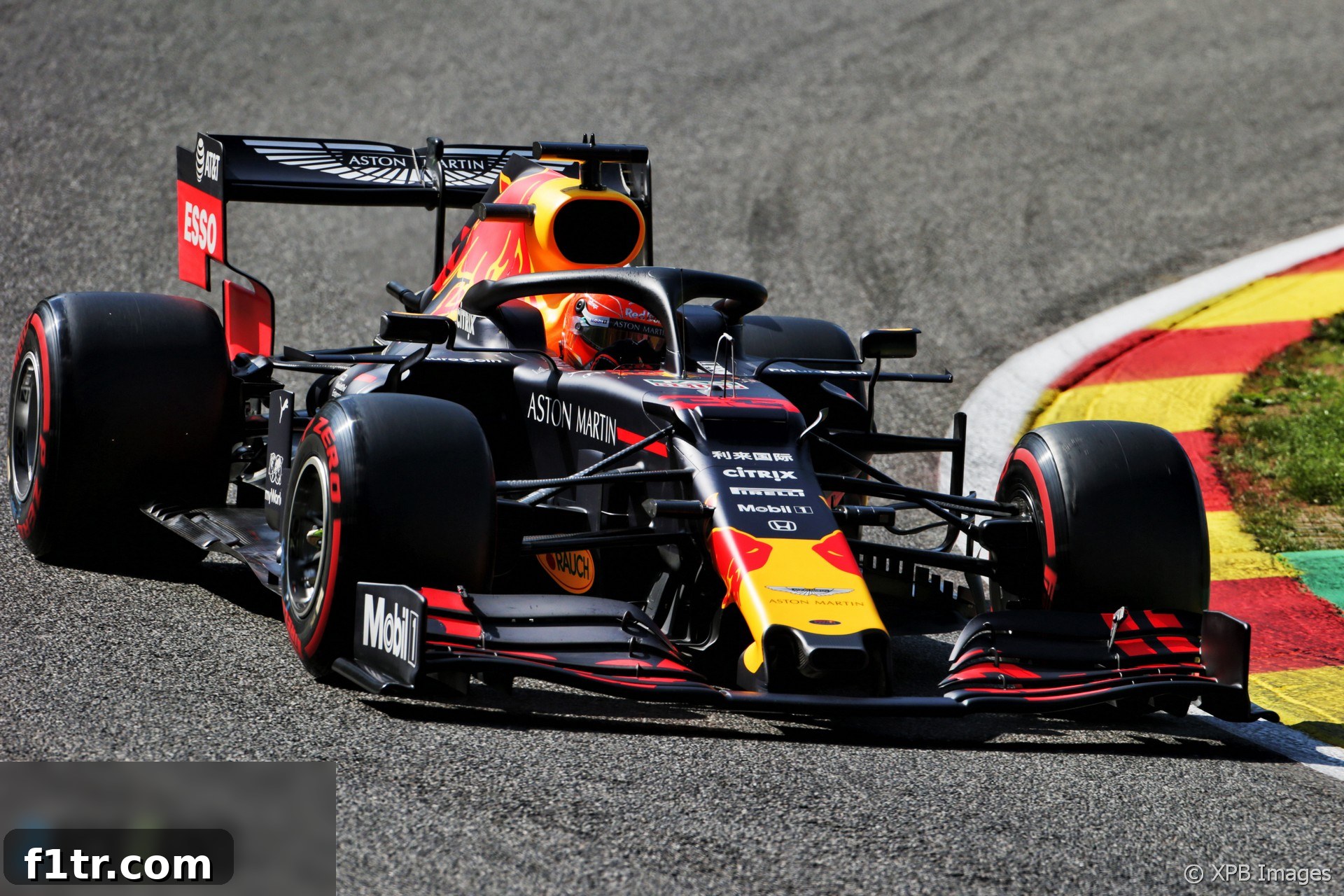
Max Verstappen faced a significant uphill battle at the Belgian Grand Prix weekend, entering the fiercely competitive event with a clear disadvantage. The Red Bull Racing driver was compelled to use the same power unit that had been pushed to its absolute limits just weeks prior at the Hungaroring, a decision that would inevitably impact his performance on the legendary Spa-Francorchamps circuit.
Verstappen’s Power Unit Woes: A Consequence of Aggressive Hungarian GP Strategy
Advert | Become a Supporter & go ad-free
Christian Horner, Red Bull’s astute team principal, shed light on the strategic conundrum. He revealed that Verstappen’s Honda power unit had been run “very aggressively” during the Hungarian Grand Prix. This high-risk, high-reward approach was a calculated gamble to protect Verstappen’s lead against the relentless pursuit of Mercedes’ Lewis Hamilton. While it helped secure a strong result in Hungary, it left the engine with significant mileage and reduced performance potential for Spa.
“Because we ran this engine very aggressively at previous races, one being Budapest trying to get the race win, we couldn’t run the engine quite as aggressively in performance modes as previously,” Horner explained. The consequence of this intense previous outing became evident during qualifying at Spa, where Verstappen notably complained about subpar power delivery from his engine. This directly affected his ability to extract maximum speed, especially through the long straights and uphill sections of the iconic Belgian track.
Horner further elaborated on the situation, stating, “That’s just due to the amount of mileage [in] the engine and how hard it’s been run.” He assured that despite the aggressive usage, the engine remained within its operational parameters, implying no immediate risk of failure. However, the delicate balance between outright performance and engine longevity is a constant challenge for Formula 1 teams, particularly as the season progresses and power unit allocations dwindle. Each engine component has a finite lifespan, and pushing them beyond their intended operational envelope, even briefly, can accelerate wear and necessitate a more conservative approach in subsequent races.
Navigating Engine Specs: Albon’s Penalty and Honda’s Development Path
The intricate dance of power unit management continued for Red Bull at Spa. Despite Alexander Albon incurring a grid penalty for introducing new engine components, both Red Bull drivers ultimately raced with the ‘spec two’ Honda power unit. This decision highlights the strategic complexities involved, where teams often introduce new specifications during practice sessions to gather data, even if it means taking a penalty, before deciding on the race-day configuration.
Horner confirmed the setup for the race: “Neither driver raced the spec four engine this weekend. We obviously took a penalty with Albon on Friday. Both drivers ended up racing the spec two engine and unfortunately Max’s race didn’t get further than the first corner.” While Verstappen’s race was cut short by a first-lap incident, the team’s engine strategy was under scrutiny. The decision to revert both cars to the older ‘spec two’ unit for the race, despite Albon taking a penalty for new components, could have been a tactical move to ensure reliability or perhaps due to unforeseen issues with the newer specification.
Crucially, the weekend was not without its developmental benefits. Horner expressed optimism based on the data collected: “But I think it’s encouraging from what we saw on Friday with performance data that we no doubt got from [Daniil] Kvyat running the new engine that I think progress is definitely being made and delivering what was expected.” This indicates that while Red Bull itself might not have raced the very latest ‘spec four’ unit, the sister team Toro Rosso (for whom Kvyat drove) was instrumental in evaluating its performance. This collaborative approach between Honda’s teams allows for accelerated development and testing of new components, providing invaluable feedback for future upgrades and ensuring the power unit’s competitiveness against rival manufacturers.
The continuous development of the Honda power unit throughout the season was a critical factor in Red Bull’s aspirations. Each new specification represents advancements in areas such as combustion efficiency, energy recovery systems, and overall power output. The data gathered from extensive testing, even if it leads to grid penalties for specific components, is vital for fine-tuning these complex machines and extracting every last horsepower. The encouraging feedback from Kvyat’s running suggested that Honda was indeed on track with its development roadmap, a positive sign for Red Bull’s ambitions in the latter half of the season.
Monza’s Power Challenge: Ferrari’s Dominance and the Convergence of Rivals
Advert | Become a RaceFans supporter andgo ad-free
With the Belgian Grand Prix concluded, Formula 1 quickly turned its attention to the Italian Grand Prix at Monza, a circuit renowned as the “Temple of Speed.” Monza presents a unique challenge, being arguably the most power-sensitive circuit on the calendar. Its long straights, punctuated by high-speed chicanes, demand maximum engine performance and exceptional straight-line speed. This makes the power unit a decisive factor in a car’s overall competitiveness.
Christian Horner did not shy away from acknowledging the current pecking order in the power unit department. He openly declared home favorites Ferrari as “the benchmark in the power unit department at the moment.” This statement underscored the perceived dominance of the Scuderia’s engine, especially noticeable in qualifying sessions where they consistently demonstrated blistering straight-line speed. “They’re doing an incredible job,” Horner commended, observing that “Their straight-line speed looks hugely impressive. Particularly on Saturdays.”
Ferrari’s ability to unlock such raw power was a significant advantage at high-speed tracks like Spa and Monza. Their engine philosophy seemed geared towards maximizing outright power, allowing them to pull away from competitors on the straights, often making up for any deficits in cornering performance. This clear advantage put pressure on rival engine manufacturers – Honda, Mercedes, and Renault – to close the gap.
However, Horner also noted a promising trend: “So they’re the benchmark we all have to drive for. But it seems to be certainly the group behind is converging between Mercedes, Honda and Renault. It definitely looks like finally we have some convergence.” This observation of convergence suggested that while Ferrari might hold a slight edge, the performance gap between the leading engine suppliers was shrinking. Such a tightening of the field bodes well for the sport, promising closer racing and more unpredictable outcomes. It implies that the intensive development efforts by Honda, coupled with Mercedes’ consistent performance and Renault’s ongoing improvements, were starting to yield results, creating a more level playing field behind Ferrari.
The fight for power unit supremacy is a relentless technological arms race in Formula 1. Each manufacturer pours vast resources into research and development, seeking marginal gains that can translate into significant lap time advantages. The “convergence” that Horner highlighted suggests that these efforts were bearing fruit, setting the stage for an even more thrilling conclusion to the season as teams continued to push the boundaries of engine performance and reliability.
2019 F1 Season Insights
- Crying in the Melbourne car park at 2019 grand prix was my career low – Ocon
- McLaren Racing reports reduced £71 million loss in 2019
- Kvyat: Hockenheim podium last year was “my biggest achievement” so far
- How the FIA’s new encrypted fuel flow meter targets Ferrari’s suspected ‘aliasing’ trick
- “He smashed my office door”: 23 must-see moments from ‘Drive to Survive’ season two
Browse all 2019 F1 season articles