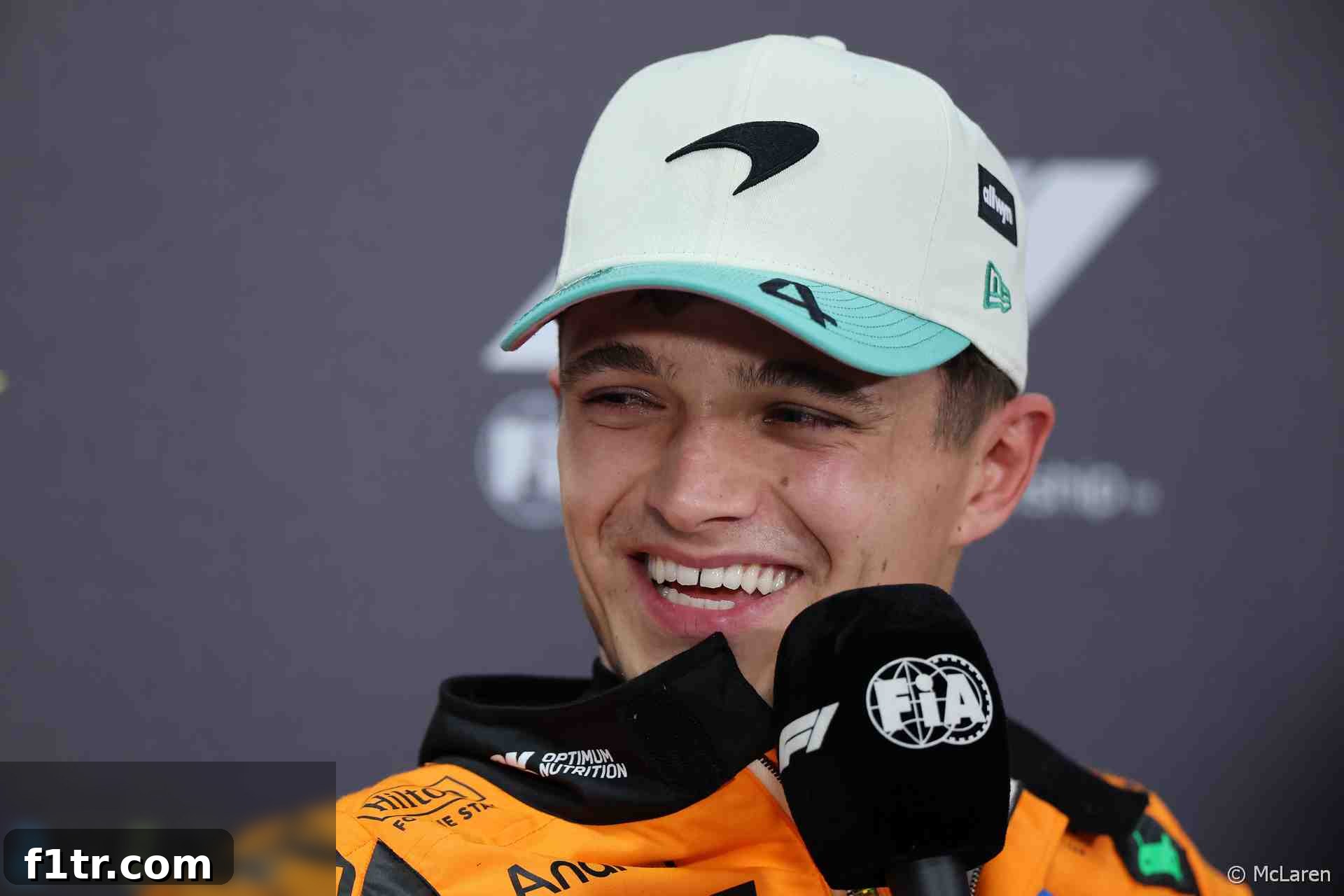
Lando Norris Secures Thrilling Brazilian Grand Prix Pole Position
In a display of sheer determination and evolving skill, Lando Norris dramatically clinched pole position for the Brazilian Grand Prix. Starting his decisive final qualifying run from a provisional tenth place, the McLaren driver unleashed a sensational lap that rocketed him to the top of the leaderboard, surprising many, including himself. This remarkable performance wasn’t merely a stroke of luck; it underscored a significant progression in Norris’s driving and mental fortitude throughout the season.
Norris Credits Enhanced Consistency and Reduced Weaknesses
Following Saturday’s qualifying session, where he secured his third consecutive pole position (including sprint races), Norris reflected on his improved form. “I feel like I’m doing a good job,” he stated, a clear sense of satisfaction in his voice. “I’m driving well.” He candidly admitted to previous inconsistencies that had hindered his qualifying efforts earlier in the season, costing him valuable grid positions. “Before, earlier in the season, I would just have weaknesses, and I feel like I’ve maybe still got some here and there, but I’ve lessened them.”
This self-assessment highlights a critical shift in his approach. What were once significant lapses, potentially costing tenths of a second, have now been whittled down to mere hundredths. “They’re not like one tenth [of a second] now, it’s two hundredths. So when I can put together the good parts and have those not-so-bad parts, things go very well.” This meticulous attention to detail and ability to minimize errors has been a cornerstone of his recent success, allowing him to string together highly competitive laps when it truly matters.
Battling the Unpredictable Elements at Interlagos
The Autódromo José Carlos Pace, affectionately known as Interlagos, is renowned for its challenging layout and often unpredictable weather conditions. Norris’s pole lap was made even more impressive by the variable wind conditions that plagued qualifying. On his initial attempt, he lost crucial time after running wide into the iconic Senna ‘S’ corner, a mistake he attributes directly to these shifting atmospheric pressures. “I looked at the data quickly between the two runs and [it showed] I braked earlier with less pressure and still somehow locked up,” he explained. “So it was a bit weird. Maybe a bit of wind or something. But that certainly put a little bit more pressure on my final lap.”
The Senna ‘S’ is a high-speed, downhill left-right chicane that demands absolute precision and commitment. Drivers arrive at this section carrying immense speed, braking heavily while simultaneously turning in. Any subtle change in wind direction, especially a tailwind, can significantly reduce downforce and make the car unstable under braking, leading to lock-ups or missed apexes. Norris’s ability to recalibrate and deliver under such conditions speaks volumes about his adaptability and mental resilience.
Driving Blind: The Absence of Delta Time Guidance
Adding another layer of challenge and intrigue to his pole-winning lap was Norris’s conscious decision earlier in the season to stop using the delta time indication on his steering wheel. This crucial piece of information typically informs drivers whether they are faster or slower than their previous best lap or the current pole time. Without this real-time feedback, Norris was essentially driving blind, relying solely on his feel for the car and the track. “I saw the others improving, but not a lot. It was just difficult again, just with the track conditions, the wind, everything — hard to get a nice feeling out there.”
The psychological impact of this decision cannot be underestimated. While it removes the temptation to push too hard or become demoralized by a negative delta, it also means a driver must trust their instincts completely. “Again, I didn’t know if I was up or down on my delta, so I was a bit stressed,” he admitted. The relief and joy were palpable when he crossed the finish line. “But when I went over the line and saw the lap, I was pretty happy. And when I saw no one running quicker, even happier.” This ‘blind’ approach forces a driver to focus purely on the execution of each corner, a testament to Norris’s growing maturity and confidence behind the wheel.
An “Imperfect” Pole Lap Amidst Fierce Competition
Despite securing pole position, Norris was quick to acknowledge that his lap was “definitely not a perfect lap.” This level of self-critique is common among elite Formula 1 drivers, who are always striving for the absolute maximum, even when they achieve the best result. He cited specific areas where improvements could have been made. “My turn one wasn’t amazing,” he noted. “I think Kimi [Andrea Kimi Antonelli] was purple in sector one by a thousandth, so maybe a thousandth more there. There were little bits.”
The razor-thin margins in Formula 1 mean that even fractions of a second can separate triumph from disappointment. Norris elaborated on the profound impact of the wind, often an unseen adversary. “But it’s so difficult with the wind. Every lap it changes — three kilometres per hour, four kilometres per hour, you don’t really notice it, probably, when you’re standing there, but it can easily make you go a tenth quicker in a corner or half a tenth here and there, and that can be a lot at the end of the day. That can be positions, it can be pole and not pole, those kinds of things.”
This statement perfectly encapsulates the subtle yet significant challenges faced by F1 drivers. What appears to be a minor environmental factor can drastically alter a car’s aerodynamic balance, grip levels, and ultimately, lap time. Drivers often describe doing “the same thing” lap after lap, only to find vastly different outcomes due to these unseen variables. “So it’s difficult. And sometimes you do the same thing — you repeat, like my turn one — but you just make a mistake for no apparent reason, no obvious reason why, in the car.” This candid reflection underscores the immense difficulty of extracting peak performance consistently in the high-stakes world of Formula 1 qualifying.
Significance for McLaren and Norris’s Career Trajectory
This pole position at the Brazilian Grand Prix is more than just a personal triumph for Lando Norris; it represents a significant milestone for McLaren. The team has shown remarkable progress throughout the season, transforming from a midfield contender to a consistent front-runner. Norris’s ability to extract maximum performance from the car in challenging conditions reinforces McLaren’s engineering prowess and strategic direction.
For Norris, securing pole at a historic venue like Interlagos further solidifies his reputation as one of F1’s brightest talents. It demonstrates a maturation in his racecraft and an enhanced ability to deliver under immense pressure. While the coveted first Grand Prix win still eludes him, performances like this consistently place him in prime positions to challenge for victory. Each pole position adds to his growing confidence and experience, inching him closer to that ultimate goal.
Looking Ahead: The Brazilian Grand Prix Race
Starting from pole position at Interlagos offers a considerable advantage, particularly on a circuit known for its overtakes but also its narrow and challenging sections. The run down to Turn 1, the Senna ‘S’, is a critical moment in any Brazilian Grand Prix, and Norris will be acutely aware of the need for a strong start to convert his pole into a leading position. With fierce competition from rivals like Andrea Kimi Antonelli and other top teams, the race promises to be an enthralling spectacle. Norris’s recent run of consistent form and his ability to manage pressure will be key factors in his pursuit of victory on Sunday.
His impressive qualifying lap, born out of improved consistency, raw talent, and a courageous approach to driving without a delta, will undoubtedly serve as a powerful foundation for the race ahead. The Brazilian Grand Prix often delivers drama, and with Lando Norris leading the charge from the front, fans can anticipate another thrilling chapter in the 2025 Formula 1 season.
Miss nothing from RaceFans
Get a daily email with all our latest stories – and nothing else. No marketing, no ads. Sign up here:
2025 Brazilian Grand Prix
- 2026 rules will stop F1 teams making “strategic” engine changes for performance
- Tsunoda admits he could have “easily” scored points in Brazil
- Top 10: Most controversial penalty calls during a Formula 1 title fight
- Verstappen is eighth F1 driver to race from pits to podium: Brazilian GP stats
- Verstappen’s latest setback makes this season look even more like a 2007 repeat
Browse all 2025 Brazilian Grand Prix articles