As the curtains rose on the highly anticipated 2022 Formula 1 season, fans worldwide, including our dedicated RaceFans readers, eagerly cast their votes, predicting which driver would emerge victorious in the intra-team battles across all ten teams. The season, marked by significant regulation changes and a fresh technical landscape, promised unpredictability, and it certainly delivered. Now, with the final checkered flag waved and the points tallied, a fascinating picture emerges, revealing just how accurate, or surprisingly off, those pre-season forecasts proved to be. While our readers correctly anticipated the outcome in seven of the ten team duels, three battles in the top half of the field offered compelling plot twists that defied popular opinion.
This comprehensive review delves into each team’s internal contest, dissecting the predictions against the actual results, highlighting the drivers who not only met expectations but also those who astonishingly outperformed their highly-regarded teammates, sending ripples of surprise through the F1 community.
Red Bull Racing: Verstappen’s Unstoppable Dominance
At the outset of the 2022 season, an overwhelming 96% of RaceFans readers confidently predicted that Max Verstappen would finish ahead of his Red Bull teammate, Sergio Perez. The final standings solidified this belief, with Verstappen accumulating a staggering 454 points compared to Perez’s 305.
However, the initial phase of the season presented a more nuanced narrative. Uncharacteristically, Verstappen grappled with Red Bull’s revolutionary new car, the RB18, finding it challenging to extract its maximum potential in the early races. It was Sergio Perez who initially shone, demonstrating remarkable adaptability and claiming his first career pole position in Saudi Arabia – a significant milestone for the Mexican driver. His early season form, including a memorable victory in Monaco, hinted at a formidable challenge to Verstappen’s supremacy.
Yet, as the season progressed, the familiar pattern of Verstappen’s dominance swiftly re-established itself. The Dutch reigning champion found his rhythm, unleashing the full potential of the RB18. His performance escalated to unprecedented levels, culminating in a record-breaking 15 Grand Prix victories, an astounding feat that underscored his unmatched talent and the team’s engineering prowess. Team principal Christian Horner lauded both drivers for achieving their best-ever seasons, but the sheer statistical advantage and consistent performance of Verstappen left no doubt about who held the upper hand. While Perez contributed significantly to Red Bull’s Constructors’ Championship, securing two victories, Verstappen’s season was a masterclass in relentless pursuit of perfection, cementing his status as a true legend of the sport.
Ferrari: Leclerc Edges Out Sainz in a Season of Mixed Fortunes
Before the 2022 campaign began, a slight majority of RaceFans readers, 54% to be precise, believed that Carlos Sainz Jnr would outscore Charles Leclerc. This prediction was a stark contrast to their first season together in 2021, where Sainz narrowly edged Leclerc in the points standings, much to the surprise of many. However, the 2022 season saw a reversal of fortunes, with Leclerc finishing ahead on 308 points, compared to Sainz’s 246.
The Ferrari F1-75 was a revelation in the early races, demonstrating impressive pace and initially putting Leclerc at the helm of the championship fight. Leclerc capitalized on this, delivering several stunning performances and establishing an early lead. In contrast, Sainz initially struggled to adapt to the new car, particularly with its front-end characteristics, often finding himself a step behind his teammate in qualifying and race pace. This period of adaptation allowed Leclerc to build a significant points advantage.
However, Ferrari’s promising start was soon overshadowed by a combination of strategic missteps, reliability issues, and driver errors that plagued both men throughout the season. Despite these challenges, Leclerc consistently maintained a slight edge in raw pace and qualifying performance. While Sainz found his stride in the mid-season, even securing his maiden F1 victory at Silverstone, he couldn’t consistently match Leclerc’s peak performances. The cumulative effect of Ferrari’s operational struggles, coupled with Leclerc’s intrinsic speed and stronger start, ultimately ensured he came out on top, demonstrating his status as the Scuderia’s leading driver despite the team’s frustrating title challenge.
Mercedes-AMG Petronas F1 Team: Russell’s Ascendance Over Hamilton
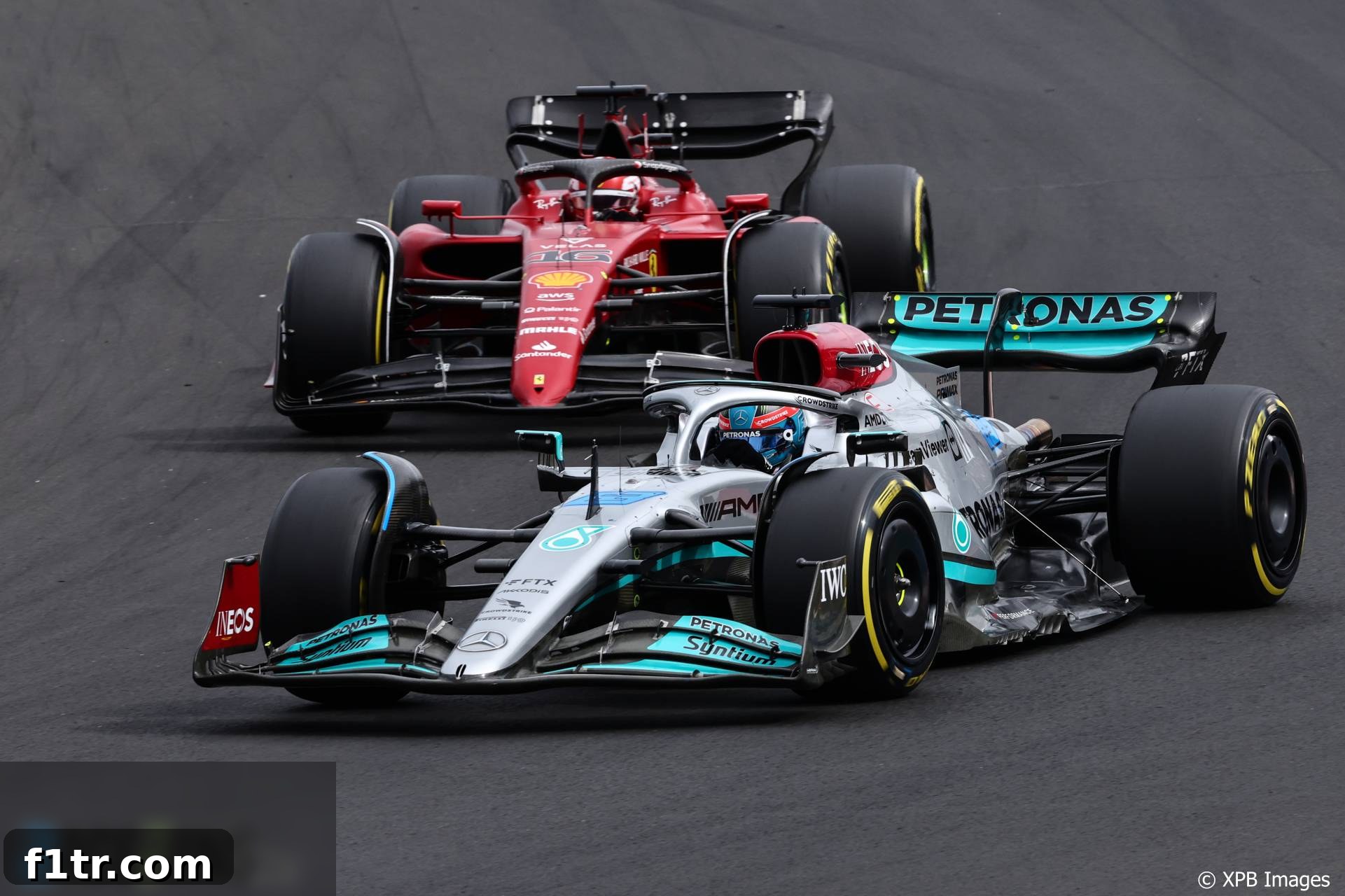
Perhaps one of the most astonishing outcomes of the 2022 season was George Russell outscoring his legendary seven-time world champion teammate, Lewis Hamilton. Despite 69% of readers expecting Hamilton to finish ahead, Russell defied these odds, ending the season with 275 points against Hamilton’s 240. This result was not entirely unforeseen by a discerning minority of fans, who sensed that the young Briton would provide a stern challenge.
The 2022 season was a challenging one for Mercedes, as their W13 chassis struggled with severe “porpoising” and a lack of competitive pace, particularly in the early races. This presented a unique test for both drivers. Russell, in his debut season with the factory Mercedes team, adapted remarkably well to the difficult car. He showcased incredible consistency, consistently finishing in the points and notably outscoring Hamilton over a critical six-race stretch early in the year. His ability to extract performance from an uncooperative car, combined with his clean driving and strategic intelligence, was a testament to his burgeoning talent.
Hamilton, despite his vast experience, found the W13’s unpredictable nature more challenging to tame. While he gradually adapted and showed flashes of his unparalleled brilliance in the latter half of the season, securing more podiums than Russell, the early deficit proved insurmountable. Crucially, Russell was the only Mercedes driver to achieve both a pole position (in Hungary) and a race victory (in Brazil), underscoring his pivotal role in what was a difficult year for the Silver Arrows. His maiden F1 win was a significant milestone, solidifying his position as a future star and a formidable opponent for any teammate.
Alpine F1 Team: Ocon’s Persistence Over Alonso Amidst Reliability Woes
A significant 80% of readers anticipated that Fernando Alonso, a two-time world champion renowned for his enduring skill, would finish ahead of Esteban Ocon. However, the 2022 season painted a different picture, with Ocon narrowly outscoring Alonso, 92 points to 81. This outcome speaks volumes about Ocon’s tenacity and development, especially considering Alonso’s formidable reputation for rarely being outscored by a teammate.
The Alpine A522 proved to be a reasonably competitive midfield car, but its Achilles’ heel was its reliability. Alonso, in particular, suffered a disproportionate number of technical failures and misfortunes, often occurring at crucial moments during races or qualifying sessions. These issues, which the Spaniard was quick to highlight, undeniably cost him a considerable number of points and masked his true performance potential. Alonso often displayed flashes of his vintage brilliance, extracting incredible pace and executing daring overtakes, but these efforts were frequently undermined by mechanical gremlins.
While Ocon also experienced some reliability setbacks with his A522, they were less frequent and often less impactful than those endured by Alonso. This allowed Ocon to accumulate points more consistently throughout the season. His steady performances, combined with Alonso’s unfortunate string of DNFs and grid penalties, enabled the Frenchman to secure a career-best points total and edge out his illustrious teammate. This result, while partly influenced by external factors, still stands as a testament to Ocon’s consistent driving and ability to maximize opportunities, reinforcing his credentials within the sport.
McLaren F1 Team: Norris’s Emphatic Victory Over Ricciardo
The 2022 season saw a dramatic and largely anticipated outcome at McLaren. An overwhelming 84% of RaceFans readers correctly predicted that Lando Norris would finish ahead of Daniel Ricciardo. The actual result was a stark reflection of this, with Norris amassing 122 points compared to Ricciardo’s mere 37.
This pre-season consensus marked a significant shift in perception from 2021, where Ricciardo, as a new McLaren driver, was initially favored by many over his younger teammate. However, Norris emphatically asserted his dominance in their first season together, a trend that continued and intensified in 2022. The MCL36, while not a front-running car, proved to be one that Norris could consistently extract significant performance from. He frequently outperformed the car’s capabilities, delivering stellar qualifying laps and securing crucial points finishes, including McLaren’s only podium of the season at Imola.
Conversely, Ricciardo’s struggles with the McLaren car, particularly its braking characteristics and sensitivity, continued unabated. Despite his best efforts and extensive work with the engineering team, the experienced Australian driver simply could not adapt his driving style to consistently match Norris’s pace. The growing performance disparity became a significant concern for the team. The monumental points difference underscored the severity of Ricciardo’s challenges and ultimately led to McLaren making the difficult decision to terminate his contract a year early, a move that few could have confidently predicted just nine months prior, despite the looming signs. Norris’s performance truly solidified his position as McLaren’s undisputed leader and a rising star in F1.
Alfa Romeo F1 Team ORLEN: Bottas’s Leadership Guides a Promising Rookie
With an entirely new driver lineup at Alfa Romeo for 2022, expectations were clear. A commanding 93% of readers foresaw Valtteri Bottas, a seasoned race winner, easily outscoring rookie Zhou Guanyu. The season unfolded exactly as predicted, with Bottas tallying 49 points against Zhou’s 6.
Bottas, arriving from Mercedes, embraced his new role as the team’s experienced leader and primary points scorer. He quickly adapted to the C42, which, especially in the early part of the season, proved to be a surprisingly competitive midfield contender. Bottas consistently delivered strong qualifying performances and converted them into valuable points, often single-handedly carrying the team’s hopes. His experience and composure were instrumental in Alfa Romeo’s best start to a season in years.
Zhou Guanyu, as the sport’s first Chinese F1 driver, faced the immense challenge of his rookie year. While the points gap to Bottas was substantial, Zhou’s performances were nonetheless creditable and showed significant progression. He demonstrated resilience, clean racing, and a strong learning curve, improving steadily as the season wore on. He often matched Bottas’s pace in practice and showed flashes of brilliance, securing his maiden F1 point in his debut race in Bahrain and later adding more. Though Bottas’s experience and consistent top-10 finishes ensured his dominance in 2022, Zhou’s development suggests that the intra-team battle could become much closer and more exciting in future seasons.
Aston Martin Aramco Cognizant F1 Team: Vettel’s Swan Song Superiority
For Sebastian Vettel’s final season in Formula 1, 89% of RaceFans readers expected him to outperform Lance Stroll at Aston Martin. This prediction held true, with Vettel scoring 37 points against Stroll’s 18, even though the four-time world champion missed the first two races of the season due to COVID-19.
Vettel, despite a challenging start to his year and the general underperformance of the AMR22 car, consistently showcased his class and determination. He demonstrated an uncanny ability to maximize opportunities, often securing points finishes in a car that frequently struggled for pace. His strategic insights, vast experience, and relentless pursuit of perfection were evident in his qualifying efforts and race craft, allowing him to extract more from the Aston Martin package than his teammate.
Lance Stroll, while a competent driver, found himself once again playing second fiddle to his illustrious teammate. Despite a full season of racing and the benefit of a clean bill of health from the start, he couldn’t consistently match Vettel’s pace or points-scoring ability. The points gap, even with Vettel’s absence from two races, clearly demonstrated the German’s superior performance. As Stroll prepares to welcome another world champion, Fernando Alonso, to the team in 2023, he faces the daunting task of raising his game considerably to challenge such a high-caliber teammate.
Haas F1 Team: Magnussen’s Immediate Impact Outshines Schumacher
The 2022 season marked a significant improvement for Haas, as their VF-22 car was finally competitive enough to score points consistently. With the unexpected return of Kevin Magnussen to replace Nikita Mazepin just before the season began, 67% of readers predicted he would finish ahead of Mick Schumacher. This proved to be an accurate assessment, with Magnussen scoring 25 points against Schumacher’s 12.
Magnussen’s comeback was nothing short of sensational. He immediately found pace with the VF-22, securing a remarkable fifth-place finish in the season opener in Bahrain and consistently challenging for points in the early races. His raw speed, aggressive driving style, and extensive experience instantly elevated Haas’s performance and morale. He became the team’s primary points scorer and a reliable benchmark.
Mick Schumacher, in his second F1 season, faced immense pressure to perform. While he did show flashes of improvement and secured his first-ever F1 points, his season was marred by a few high-profile crashes and a struggle for consistency. He often found himself trailing Magnussen in both qualifying and race pace, unable to match the Dane’s immediate impact. The clear performance gap ultimately contributed to Haas’s decision not to renew Schumacher’s contract for 2023, confirming the pre-season judgment that Magnussen would lead the charge for the American team.
Scuderia AlphaTauri: Gasly Maintains His Edge Over an Improving Tsunoda
Heading into the 2022 season, a dominant 95% of RaceFans readers confidently predicted that Pierre Gasly would finish ahead of Yuki Tsunoda at AlphaTauri. This prediction never truly looked in jeopardy, with Gasly accumulating 23 points against Tsunoda’s 12.
The AlphaTauri AT03 proved to be a more challenging and inconsistent car than its predecessor, making points-scoring a more difficult task for both drivers. However, Gasly, as the established team leader, continued to demonstrate his proven ability to extract maximum performance from the package. He consistently delivered strong qualifying results and fought hard for points, often punching above the car’s weight, particularly in the early stages of the season when the car was at its most competitive. His experience, feedback, and mature approach were vital for the team.
Yuki Tsunoda’s second season in Formula 1 showed clear signs of improvement over his rookie year. He exhibited greater consistency, reduced the number of errors, and often ran closer to Gasly’s pace than in 2021. He demonstrated moments of genuine speed and aggression, particularly in races. However, he still struggled to consistently convert strong performances into significant points hauls, and the overall reliability and performance of the AT03 didn’t always play into his hands. While Tsunoda certainly kept Gasly “honest” and demonstrated progress, the Frenchman’s established prowess and greater consistency ultimately ensured he maintained a clear advantage in the points standings, confirming the pre-season expectations.
Williams Racing: Albon’s Leadership and Latifi’s Farewell Struggles
For the Williams team, 89% of readers predicted that Alexander Albon would finish ahead of Nicholas Latifi. This prediction was confirmed by the end of the season, with Albon scoring 4 points to Latifi’s 2.
Alexander Albon, returning to a full-time F1 seat after a year out, quickly established himself as the team’s leader. Despite the FW44 being one of the slowest cars on the grid, Albon consistently impressed with his ability to fight for positions and extract every ounce of performance. He delivered several remarkable drives, notably securing points in Australia and Belgium, which were invaluable for Williams. His technical feedback and calm demeanor were also highly praised by the team, proving his worth beyond just raw pace.
Nicholas Latifi, in what would be his final season in Formula 1, endured a challenging year marked by a lack of pace and consistency. For much of the season, it appeared he might finish as the only full-time driver without a point. However, a bold early tire change strategy in the wet Japanese Grand Prix netted him a ninth-place finish, sparing him that ignominy. This relief was compounded by the fact that not only had Albon already scored points, but even his stand-in for one race, Nyck de Vries, managed to score points on his debut. By the time Latifi scored in Japan, Williams had already confirmed that he would not be part of their plans for 2023, underscoring the performance deficit he faced throughout the season.
Conclusion: A Season of Surprises and Confirmed Dominance
The 2022 Formula 1 season, with its radical new regulations, delivered a compelling blend of expected outcomes and thrilling surprises in the battle between teammates. While the sheer dominance of drivers like Max Verstappen and Lando Norris was largely foreseen and emphatically delivered, the ascendance of George Russell over Lewis Hamilton and Esteban Ocon’s subtle triumph over Fernando Alonso were significant plot twists that captivated fans. These intra-team dynamics are often the true litmus test of a driver’s ability, revealing resilience, adaptability, and raw talent.
Such battles are rarely straightforward, often influenced by the intricate interplay of car performance, strategic decisions, and the cruel hand of reliability. The varying fortunes of Ferrari’s strategy and Alpine’s mechanical woes undeniably played a role in shaping some of these outcomes, adding layers of complexity to the raw points totals. As the dust settles on another exhilarating season, these head-to-head comparisons offer invaluable insights into the ever-evolving landscape of Formula 1, reminding us that in this sport, the unexpected is often just around the corner.
2022 F1 Season – Further Reading
- Mercedes told me “you’re wrong” about 2022 car’s problems – Hamilton
- FIA confirms all 10 F1 teams complied with 2022 cost cap
- Steiner “not ashamed” of panning “slow” Schumacher in Drive to Survive
- Albon believes year out of F1 improved him as a driver
- Hamilton sees diversity gains in F1 years on from his ‘traumatising’ experience of racism
Browse all 2022 F1 season articles