The 2021 Formula 1 Qatar Grand Prix at the Losail International Circuit promised an exhilarating contest, particularly from the second row of the grid. Pierre Gasly, Fernando Alonso, and Lando Norris, all starting consecutively from second to fourth respectively, were poised for a memorable afternoon. However, as the checkered flag waved, their stories unfolded in starkly contrasting fashion, encapsulating the unpredictable drama that is quintessential to Formula 1 racing.
Advert | Become a Supporter & go ad-free
While two-time world champion Fernando Alonso brilliantly secured his first podium finish of the year, marking a significant milestone in his return to the sport, Pierre Gasly endured a disappointing outing, failing to convert his front-row start into points. Lando Norris, initially a strong contender, had his race hopes dashed by a late-race puncture, a recurring theme that plagued several drivers throughout the demanding Qatar Grand Prix.
A Race of Contrasts: Alonso’s Masterclass vs. Gasly’s Struggles
The early moments of the race set the tone for the varied fortunes of these three drivers. Speculation suggested that Gasly and Norris might have been disadvantaged by starting on the “dirty” side of the grid, a common challenge on circuits where the racing line sweeps away debris. However, this initial disadvantage wasn’t the primary factor in their lost time. Instead, the race saw an immediate shift in momentum as Fernando Alonso, demonstrating his unparalleled racecraft and experience, surged ahead of the Alpine of Esteban Ocon and then swiftly moved past Gasly’s AlphaTauri with a magnificent pass for second place on the outside of Turn 2. This audacious move at the very start showcased Alonso’s intent and proved to be a pivotal moment in his charge towards the podium, laying the groundwork for his historic return to the top three.
As the first stint progressed, it became strikingly evident that Pierre Gasly was struggling significantly with the pace of his AlphaTauri. Analysis of lap times clearly showed him falling behind both the McLaren of Norris and, more notably, the Alpine of Alonso. Alonso, in particular, managed to establish a considerable advantage over Norris as well, indicating strong car performance and masterful tyre management. Gasly later conceded that even on fresh tyres, he found it impossible to match the consistent pace of the Alpine, which seemed to effortlessly out-pace him even on older rubber. This marked a stark contrast to his impressive qualifying performance, where he had secured a sensational second place, and highlighted the unexpected challenges he faced in race trim at the demanding Losail circuit, battling tyre degradation and a lack of outright race pace.
Norris’s Unlucky Break and Alonso’s Calculated Drive
Heading into the second stint, Lando Norris began to close the gap on Fernando Alonso, signaling a potential battle for the podium positions. The McLaren driver showcased strong pace and strategic driving, steadily reducing the deficit. However, as Norris himself later admitted, challenging the experienced Alonso would have been an incredibly difficult task under normal circumstances. The veteran Spaniard consistently delivered remarkably consistent lap times, maintaining a relentless rhythm that was hard to break, showcasing his enduring talent and the Alpine’s race-day strength. Alonso’s exceptional tyre management was a masterclass in itself; he drove with particular care to avoid the aggressive kerbs, a strategy that proved prescient and ultimately crucial. This cautious approach was especially vital after Valtteri Bottas’s lap 33 tyre failure put every team and driver on high alert regarding the extreme demands placed on the Pirelli tires at Losail. Indeed, Norris’s pursuit of Alonso stalled a few laps before his own unfortunate puncture and subsequent pit stop on lap 49, effectively ending his podium aspirations and highlighting the circuit’s brutal impact on tyre integrity.
The tyre issues continued to mount across the field, ultimately triggering a Virtual Safety Car (VSC) period as other drivers also encountered problems, necessitating careful recovery of damaged cars and debris. Until this critical juncture, Sergio Perez, starting from P11, had been relentlessly catching Alonso at an alarming rate, at times shaving off up to two seconds per lap with blistering pace on fresh tyres. Had it not been for the timely deployment of the VSC, which neutralized the gaps and slowed the field, it is highly probable that Perez would have been directly on Alonso’s tail in the final couple of laps, setting the stage for a dramatic, wheel-to-wheel fight for the coveted final podium spot. The VSC, therefore, played a critical role in preserving Alonso’s hard-earned third position, underscoring the unpredictable and often luck-dependent nature of motorsport, where split-second decisions and external factors can dramatically alter the outcome.
Strategic Decisions and Record-Breaking Paces
Following the VSC, championship leader Max Verstappen seized an opportune moment to pit for a fresh set of C3 soft tyres. This audacious strategic move, executed in the closing stages of the race, allowed him to further lower the fastest lap time, a record he already held, securing a crucial bonus point in his intensely fought championship battle against Lewis Hamilton. This third stop made Verstappen the only driver to employ a three-stop strategy throughout the entire Grand Prix, a daring but ultimately rewarding decision that showcased Red Bull’s aggressive approach to maximizing every available point. Most teams initially targeted conventional single-stop strategies, hoping to minimize time lost in the pit lane. However, the intensity of the title fight and the growing concerns over tyre integrity prompted both title contenders, Verstappen and Hamilton, to opt for two stops each, prioritizing tyre longevity and sustained performance over track position, knowing they had the raw pace and luxury of time over their midfield rivals.
Ferrari also demonstrated shrewd strategic thinking in a highly competitive midfield. Charles Leclerc and Carlos Sainz Jnr ran impressively long opening stints on their C2 medium tyres, pushing their rubber to the limit with careful management. The team then executed a well-timed double-stack in the pits after 27 laps, bringing both cars in one after the other in a display of seamless teamwork. This efficient maneuver paid off handsomely, allowing both Ferraris to remain firmly within the points-paying positions and, significantly, stay ahead of Daniel Ricciardo’s McLaren. Furthermore, they ultimately finished ahead of both McLarens, largely benefiting from Norris’s unfortunate puncture later in the race, underscoring how a combination of strong strategy and unforeseen incidents can drastically alter the competitive landscape.
Pit Stop Drama and Precision
The Qatar Grand Prix pit stops presented a mixed bag of fortunes and performances, reflecting the high stakes and inherent risks of racing at this level. Unsurprisingly, the longest pit stops of the race were recorded by those drivers who had suffered punctures or encountered significant car damage. Valtteri Bottas, for instance, not only required a full tyre change after his lap 33 puncture but also needed a new front wing on his Mercedes, drastically increasing his pit stop duration to over 36 seconds. Lando Norris, coincidentally sporting car number four, experienced a peculiar duality, recording both one of the quickest (25.319s) and one of the longest (26.552s, post-puncture) pit stops of the event, reflecting the chaotic and unpredictable nature of his race.
In stark contrast, the title contenders once again showcased their relentless pursuit of every conceivable advantage, demonstrating extraordinary efficiency. The three quickest pit stops of the entire race were all performed on the cars of Max Verstappen and Lewis Hamilton, highlighting the exceptional precision, speed, and pressure execution of their respective pit crews. This unwavering precision under immense pressure underscores the razor-thin margins in the championship battle, where even milliseconds gained or lost in the pit lane can have significant implications for track position and overall race outcome. It’s a testament to the dedication and flawless coordination between drivers and their teams, where every element must perform at its absolute peak.
Advert | Become a RaceFans supporter andgo ad-free
2021 Qatar Grand Prix Lap Chart Analysis
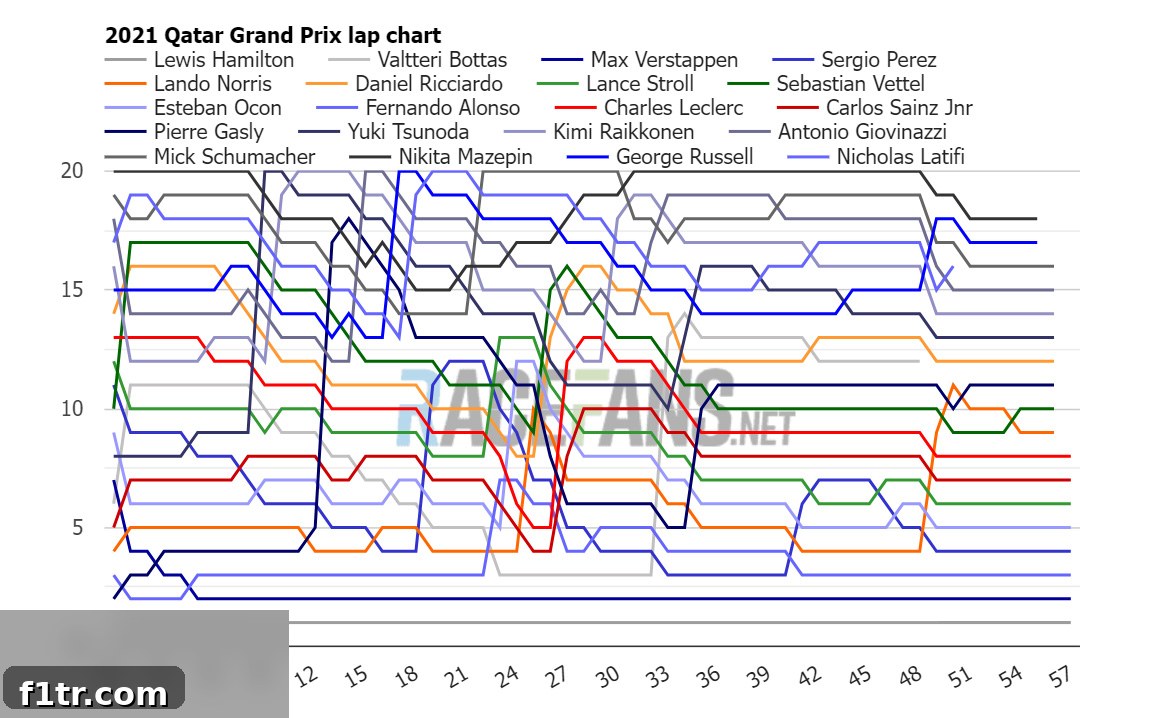
The intricate ballet of position changes throughout the 2021 Qatar Grand Prix is vividly illustrated by the lap chart. Observing the ebb and flow of each driver’s standing lap-by-lap provides critical insight into their race strategies, underlying pace, and challenges encountered. While the full interactive chart captures the real-time dynamics, a review of key movements reveals fascinating narratives. Drivers like Max Verstappen and Sergio Perez demonstrated remarkable progression from their challenging starting positions, steadily climbing through the field with superior car pace, aggressive overtakes, and clever strategy execution. Conversely, those who suffered setbacks, such as Pierre Gasly, saw their initial promising positions erode due to various factors, from car performance limitations in race trim to tyre degradation issues. Lando Norris’s sudden drop in position after his puncture would also be starkly visible. The lap chart serves as a compelling visual testament to the ever-evolving nature of a Grand Prix, where every single lap can rewrite a driver’s fate and reshape the competitive order.
Go ad-free for just £1 per month>> Find out more and sign up
2021 Qatar Grand Prix Race Chart: Gaps and Performance
Delving deeper into driver performance, the race chart offers a fascinating perspective on the gaps between each driver relative to the leader’s average lap time. This visualization is crucial for understanding who was gaining time, who was losing ground, and the overall rhythm of the race for each competitor. Very large gaps, often indicative of significant incidents, extended pit stops, or stark differences in car performance and tyre management, are typically omitted for clarity, focusing on the competitive clusters. For instance, the dramatic closing rate of Sergio Perez on Fernando Alonso before the Virtual Safety Car would be clearly depicted here, illustrating how rapidly the gap was diminishing and the threat to Alonso’s podium. Similarly, drivers struggling with severe tyre degradation would see their relative gap to the leader widen steadily, signaling their struggles. This chart provides a granular, lap-by-lap view of performance trends, essential for comprehensive race analysis and understanding the strategic implications of each driver’s pace throughout the Qatar Grand Prix.
Position Changes: Who Gained and Who Lost in Qatar
The final standings often mask the incredible battles and strategic maneuvers that unfold throughout a Grand Prix, making a detailed look at position changes essential for true understanding. A closer examination of the position changes from the grid to the checkered flag reveals the true movers and shakers of the 2021 Qatar Grand Prix. Lewis Hamilton maintained his pole position, orchestrating a flawless race from start to finish, ultimately losing no positions. However, behind him, a flurry of action saw significant gains and losses. Max Verstappen, starting seventh after a grid penalty, executed a masterful drive to finish second, gaining five crucial positions. Sergio Perez, starting even further back in eleventh, made an impressive charge, gaining seven spots to secure fourth place, showcasing the formidable raw pace of his Red Bull and his ability to navigate the midfield.
On the other side of the spectrum, Pierre Gasly experienced a steep decline, dropping nine positions from his second-place start to finish eleventh. This highlighted the stark difference between his single-lap qualifying prowess and race-day performance, likely due to tyre wear and car balance issues. Lando Norris, despite his strong start, ultimately lost five positions due to his late puncture, a cruel twist of fate. Carlos Sainz Jnr also dropped two places. The data reveals that drivers like Lance Stroll and Charles Leclerc made notable progress, gaining six and five positions respectively, underlining their effective strategies and consistent pace throughout the race. The position change table offers a raw summary of the race’s dynamic narrative, extending beyond just the top three finishers and illustrating the individual triumphs and challenges of each competitor.
| Driver | Start position | Lap one position change | Race position change |
|---|---|---|---|
| Lewis Hamilton | 1 | 0 | 0 |
| Valtteri Bottas | 6 | -5 | |
| Max Verstappen | 7 | 3 | 5 |
| Sergio Perez | 11 | 2 | 7 |
| Lando Norris | 4 | -1 | -5 |
| Daniel Ricciardo | 14 | -2 | 2 |
| Lance Stroll | 12 | 2 | 6 |
| Sebastian Vettel | 10 | -7 | 0 |
| Esteban Ocon | 9 | 3 | 4 |
| Fernando Alonso | 3 | 1 | 0 |
| Charles Leclerc | 13 | 0 | 5 |
| Carlos Sainz Jnr | 5 | -2 | -2 |
| Pierre Gasly | 2 | -1 | -9 |
| Yuki Tsunoda | 8 | 0 | -5 |
| Kimi Raikkonen | 16 | 4 | 2 |
| Antonio Giovinazzi | 18 | 4 | 3 |
| Mick Schumacher | 19 | 1 | 3 |
| Nikita Mazepin | 20 | 0 | 2 |
| George Russell | 15 | 0 | -2 |
| Nicholas Latifi | 17 | -2 |
2021 Qatar Grand Prix Lap Times Overview
Every single lap time clocked by the drivers in the 2021 Qatar Grand Prix paints a detailed picture of performance, consistency, and moments of struggle. Excluding exceptionally slow laps (which are often indicative of pit stops or major incidents, and would skew performance analysis), these times allow for an in-depth analysis of driver skill and car capabilities. The data reveals who was able to maintain blistering pace consistently throughout their stints, who managed their tyres effectively to post strong times deep into their runs, and where specific cars might have struggled with degradation or balance as the race unfolded. A visual representation, which the interactive chart below allows, would further highlight performance trends, showing how some drivers gradually sped up as their fuel load decreased, while others saw their lap times degrade significantly as their tyres wore out under the punishing conditions. This granular data is invaluable for engineers and strategists alike, offering key insights into race execution and car setup effectiveness at Losail.
Go ad-free for just £1 per month>> Find out more and sign up
Fastest Laps: Verstappen’s Dominance and the Pursuit of Bonus Points
The pursuit of the fastest lap, and the crucial bonus point it carries, adds an extra layer of excitement and strategic complexity to Formula 1 races, especially in tightly contested championships. In the 2021 Qatar Grand Prix, Max Verstappen utterly dominated this category, setting an astonishing fastest lap of 1’23.196 on lap 57. This remarkable feat was achieved after a calculated late pit stop for fresh C3 soft tyres, showcasing both his Red Bull car’s raw pace and his unyielding determination to snatch every possible point in his championship battle. His nearest competitor, Lewis Hamilton, was nearly two seconds slower on his fastest lap, underscoring the formidable performance delivered by Verstappen on his final, high-stakes push.
Sergio Perez and Lando Norris also registered impressive fastest laps, further down the order, reflecting their strong individual pace at certain points in the race. The significant gaps in fastest lap times across the field highlight the varied performance envelopes of the different cars and the diverse strategies employed by the teams. While the top teams, particularly in a championship fight, could afford a late push for this bonus point, midfield teams often had to balance preserving tyres for position with chasing a rapid lap, a compromise clearly visible in the data. George Russell’s fifth fastest lap, driving for Williams, was particularly commendable, demonstrating his exceptional talent even in less competitive machinery. This table serves as a definitive snapshot of the ultimate single-lap pace achieved by each driver under race conditions, a key metric for evaluating pure performance.
| Rank | Driver | Car | Fastest lap | Gap | On lap |
|---|---|---|---|---|---|
| 1 | Max Verstappen | Red Bull-Honda | 1’23.196 | 57 | |
| 2 | Lewis Hamilton | Mercedes | 1’25.084 | 1.888 | 50 |
| 3 | Sergio Perez | Red Bull-Honda | 1’25.613 | 2.417 | 49 |
| 4 | Lando Norris | McLaren-Mercedes | 1’25.746 | 2.550 | 51 |
| 5 | George Russell | Williams-Mercedes | 1’25.768 | 2.572 | 55 |
| 6 | Kimi Raikkonen | Alfa Romeo-Ferrari | 1’26.358 | 3.162 | 53 |
| 7 | Sebastian Vettel | Aston Martin-Mercedes | 1’26.434 | 3.238 | 53 |
| 8 | Charles Leclerc | Ferrari | 1’26.555 | 3.359 | 46 |
| 9 | Carlos Sainz Jnr | Ferrari | 1’26.570 | 3.374 | 46 |
| 10 | Fernando Alonso | Alpine-Renault | 1’26.682 | 3.486 | 48 |
| 11 | Pierre Gasly | AlphaTauri-Honda | 1’27.019 | 3.823 | 46 |
| 12 | Yuki Tsunoda | AlphaTauri-Honda | 1’27.043 | 3.847 | 50 |
| 13 | Esteban Ocon | Alpine-Renault | 1’27.061 | 3.865 | 46 |
| 14 | Daniel Ricciardo | McLaren-Mercedes | 1’27.198 | 4.002 | 50 |
| 15 | Valtteri Bottas | Mercedes | 1’27.246 | 4.050 | 39 |
| 16 | Nikita Mazepin | Haas-Ferrari | 1’27.340 | 4.144 | 55 |
| 17 | Lance Stroll | Aston Martin-Mercedes | 1’27.356 | 4.160 | 44 |
| 18 | Antonio Giovinazzi | Alfa Romeo-Ferrari | 1’27.823 | 4.627 | 40 |
| 19 | Mick Schumacher | Haas-Ferrari | 1’28.412 | 5.216 | 46 |
| 20 | Nicholas Latifi | Williams-Mercedes | 1’28.732 | 5.536 | 44 |
Advert | Become a RaceFans supporter andgo ad-free
2021 Qatar Grand Prix Tyre Strategies: A Deep Dive into Pit Lane Decisions
Tyre strategy is often the lynchpin of success in Formula 1, and the 2021 Qatar Grand Prix proved to be a prime example of its critical importance, especially given the unexpected tyre degradation and multiple punctures that occurred throughout the event. Pirelli supplied the C1 (Hard), C2 (Medium), and C3 (Soft) compounds for this race, with the aggressive kerbs and high-speed, sweeping nature of the Losail circuit putting immense and unforeseen stress on the rubber. While many teams initially aimed for a conventional one-stop strategy to minimize time lost in the pit lane, the unfolding events, particularly the series of tyre failures experienced by several drivers, forced a comprehensive rethink across the paddock.
Most front-runners like Lewis Hamilton ultimately opted for a more conservative yet effective two-stop strategy, typically starting on the C2 Medium compound, transitioning to the durable C1 Hard, and then back to the C2 Medium for the final stint. This provided a crucial balance of speed, durability, and a safety margin against potential tyre issues. Max Verstappen, uniquely, deployed an aggressive three-stop strategy, using an extra set of C3 Softs at the very end to secure the fastest lap point, a bold move that perfectly encapsulated his team’s relentless and aggressive championship pursuit. Drivers like Fernando Alonso and Esteban Ocon successfully executed two-stop races using a C3 Soft start followed by a long, well-managed C1 Hard stint, highlighting the Alpine’s strong tyre management characteristics and Alonso’s experienced touch.
The longer first stints from Ferrari drivers Charles Leclerc and Carlos Sainz Jnr on C2 Mediums before switching to C1 Hards showcased their ability to preserve tyres effectively, allowing them to benefit strategically in the midfield battle. Conversely, drivers like Pierre Gasly and Yuki Tsunoda, starting on the faster C3 Softs, had to pit much earlier due to higher degradation, indicating either a different car setup or inherent difficulties with tyre longevity. The wide array of strategies, from aggressive three-stops to cautious two-stops, vividly demonstrated how teams adapted to the challenging and often treacherous conditions, as well as the unforeseen tyre failures that became a defining and decisive characteristic of the inaugural Qatar Grand Prix, ultimately shaping its outcome.
| Stint 1 | Stint 2 | Stint 3 | Stint 4 | |
|---|---|---|---|---|
| Lewis Hamilton | C2 (18) | C1 (24) | C2 (15) | |
| Max Verstappen | C2 (17) | C1 (24) | C2 (14) | C3 (2) |
| Fernando Alonso | C3 (23) | C1 (34) | ||
| Sergio Perez | C2 (19) | C1 (22) | C2 (16) | |
| Esteban Ocon | C3 (24) | C1 (33) | ||
| Lance Stroll | C2 (23) | C1 (34) | ||
| Carlos Sainz Jnr | C2 (27) | C1 (30) | ||
| Charles Leclerc | C2 (27) | C1 (30) | ||
| Lando Norris | C3 (25) | C1 (24) | C2 (7) | |
| Sebastian Vettel | C3 (26) | C2 (30) | ||
| Pierre Gasly | C3 (13) | C2 (22) | C2 (21) | |
| Daniel Ricciardo | C2 (26) | C1 (30) | ||
| Yuki Tsunoda | C3 (9) | C2 (25) | C1 (22) | |
| Kimi Raikkonen | C3 (10) | C2 (20) | C1 (26) | |
| Antonio Giovinazzi | C3 (15) | C2 (17) | C2 (24) | |
| Mick Schumacher | C3 (22) | C2 (34) | ||
| George Russell | C3 (17) | C1 (32) | C3 (6) | |
| Nikita Mazepin | C2 (31) | C3 (24) | ||
| Nicholas Latifi | C3 (18) | C1 (32) | ||
| Valtteri Bottas | C2 (33) | C1 (15) |
Go ad-free for just £1 per month>> Find out more and sign up
2021 Qatar Grand Prix Pit Stop Times: The Battle of the Box
In the high-pressure, blink-and-you-miss-it environment of Formula 1, every millisecond counts, especially during a pit stop. The 2021 Qatar Grand Prix’s detailed pit stop times highlight the incredible efficiency of the top teams and the unfortunate, costly delays faced by others. The battle for the fastest pit stop often runs parallel to the race for victory itself, with pit crew performance being a crucial differentiator that can make or break a driver’s race. In Qatar, the consistent, world-class execution of Red Bull and Mercedes pit crews was once again on full display.
Max Verstappen and Lewis Hamilton’s teams consistently delivered some of the quickest stops of the race, with Verstappen clocking the fastest overall time at an astonishing 25.175 seconds. These rapid turnarounds demonstrate the finely tuned choreography, precision training, and immense pressure handling capabilities of their pit crews. Such efficiency is invaluable in regaining track position, defending against an undercut from a rival, or simply minimizing time lost during a routine tyre change. Conversely, some pit stops were significantly longer, often due to unforeseen circumstances or necessary repairs. Valtteri Bottas’s lengthy 36.341-second stop after his puncture, which crucially included a full front wing change, perfectly illustrates how quickly fortunes can change in the pit lane due to damage. George Russell and Lando Norris also experienced longer-than-average stops due to their respective tyre issues, further impacting their race outcomes.
This detailed breakdown of pit stop durations provides crucial insight into not only overall team performance but also the specific challenges drivers and crews faced under race conditions. From routine tyre changes executed with lightning speed to emergency repairs carried out under immense pressure, the pit lane is a crucible of speed and composure, and the Qatar Grand Prix offered plenty of examples of both triumphs and tribulations in the box, playing a pivotal role in the final results.
| Driver | Team | Pit stop time | Gap | On lap | |
| 1 | Max Verstappen | Red Bull | 25.175 | 41 | |
| 2 | Lewis Hamilton | Mercedes | 25.235 | 0.060 | 18 |
| 3 | Max Verstappen | Red Bull | 25.300 | 0.125 | 17 |
| 4 | Lando Norris | McLaren | 25.319 | 0.144 | 25 |
| 5 | Antonio Giovinazzi | Alfa Romeo | 25.347 | 0.172 | 32 |
| 6 | Lewis Hamilton | Mercedes | 25.381 | 0.206 | 42 |
| 7 | Sergio Perez | Red Bull | 25.419 | 0.244 | 19 |
| 8 | Sergio Perez | Red Bull | 25.420 | 0.245 | 41 |
| 9 | Max Verstappen | Red Bull | 25.465 | 0.290 | 55 |
| 10 | Esteban Ocon | Alpine | 25.517 | 0.342 | 24 |
| 11 | Daniel Ricciardo | McLaren | 25.562 | 0.387 | 26 |
| 12 | Pierre Gasly | AlphaTauri | 25.630 | 0.455 | 13 |
| 13 | Kimi Raikkonen | Alfa Romeo | 25.633 | 0.458 | 30 |
| 14 | Carlos Sainz Jnr | Ferrari | 25.639 | 0.464 | 27 |
| 15 | Yuki Tsunoda | AlphaTauri | 25.659 | 0.484 | 9 |
| 16 | Sebastian Vettel | Aston Martin | 25.726 | 0.551 | 26 |
| 17 | Charles Leclerc | Ferrari | 25.799 | 0.624 | 27 |
| 18 | Nicholas Latifi | Williams | 25.811 | 0.636 | 18 |
| 19 | Mick Schumacher | Haas | 25.881 | 0.706 | 22 |
| 20 | Antonio Giovinazzi | Alfa Romeo | 25.987 | 0.812 | 15 |
| 21 | Fernando Alonso | Alpine | 25.991 | 0.816 | 23 |
| 22 | Pierre Gasly | AlphaTauri | 26.109 | 0.934 | 35 |
| 23 | George Russell | Williams | 26.121 | 0.946 | 17 |
| 24 | Lance Stroll | Aston Martin | 26.157 | 0.982 | 23 |
| 25 | Kimi Raikkonen | Alfa Romeo | 26.174 | 0.999 | 10 |
| 26 | Nikita Mazepin | Haas | 26.515 | 1.340 | 31 |
| 27 | Lando Norris | McLaren | 26.552 | 1.377 | 49 |
| 28 | Yuki Tsunoda | AlphaTauri | 26.674 | 1.499 | 34 |
| 29 | George Russell | Williams | 35.006 | 9.831 | 49 |
| 30 | Valtteri Bottas | Mercedes | 36.341 | 11.166 | 33 |
2021 Qatar Grand Prix Further Reading
- Pirelli’s investigation into Qatar tyre failures indicates kerbs caused punctures
- Horner rejects talk of title fight pressure after criticism over marshal comment
- “I don’t know how much slower I can go”: Inside Ricciardo’s unnecessary economy run
- ‘No regulator in the world will be popular’ with a title fight this intense – Masi
- Why drivers backed Hamilton’s call for clarity after meeting over Verstappen incident
Browse all 2021 Qatar Grand Prix articles