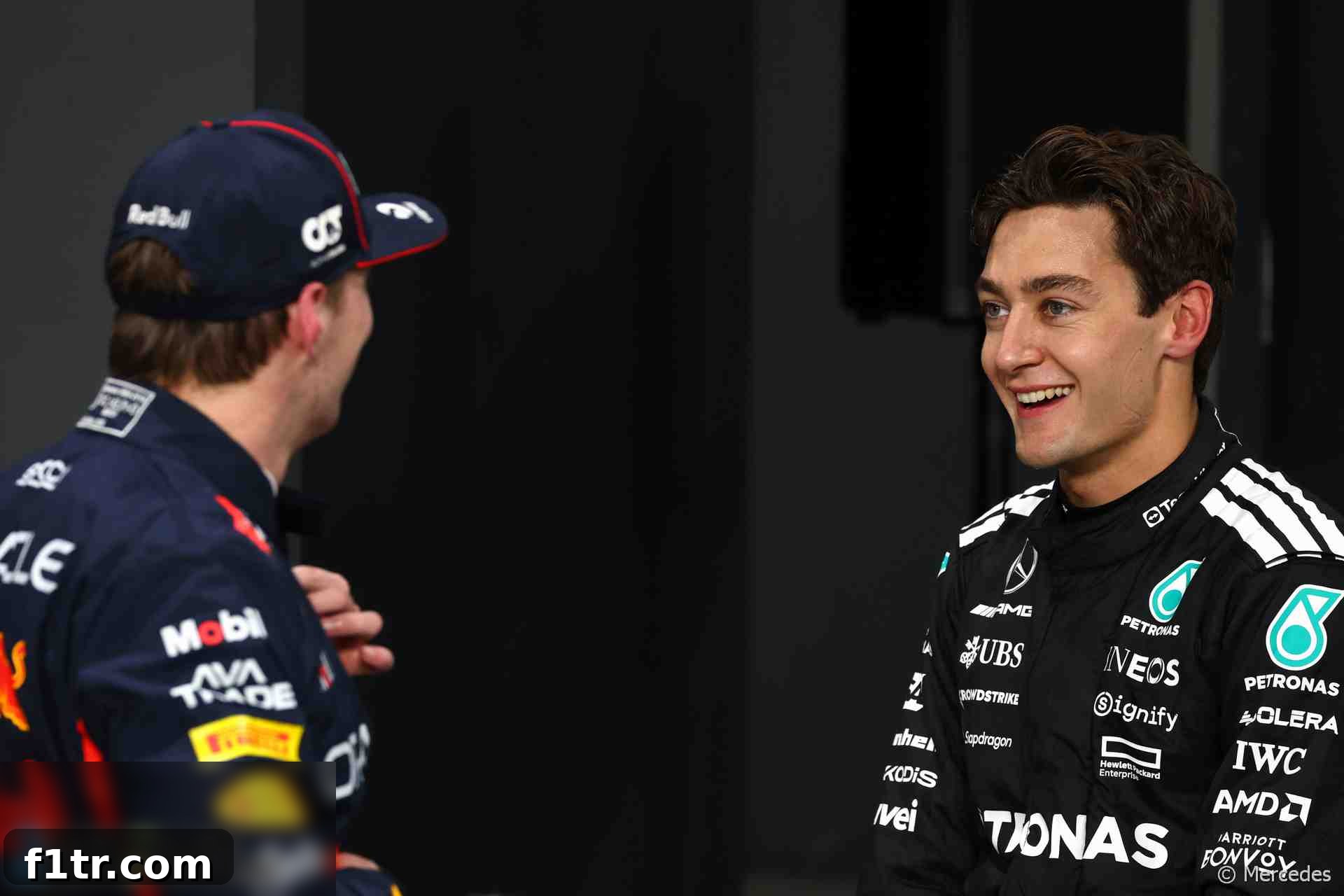
The high-stakes world of Formula 1 is perpetually abuzz with speculation, but few narratives capture the imagination quite like the prospect of a championship-winning driver switching allegiances. At the heart of the latest swirling rumors is Mercedes-AMG Petronas F1 Team Principal, Toto Wolff, who has unequivocally stated that the idea of pairing the formidable talents of George Russell and Max Verstappen within his team would be a challenge he’s prepared to embrace, rather than one that would “faze” him.
This bold declaration comes amidst intensifying discussions regarding the future of the driver market, particularly concerning the reigning world champion, Max Verstappen. Despite being under contract with Red Bull Racing until a distant 2028, whispers of a potential departure have gained traction, fueled by perceived internal instability at Red Bull and the allure of a new challenge for Verstappen. Wolff has openly hinted at considering a bid to lure the Dutch superstar to Mercedes for the upcoming seasons, a move that would undoubtedly send shockwaves through the sport and reshape the competitive landscape.
The implications of such a monumental transfer are far-reaching, especially for Mercedes’ current lineup. George Russell, whose contract is set to expire at the end of the current year, finds himself at the center of this contractual maelstrom. The very notion of Verstappen joining Mercedes has inevitably led to speculation that Russell might lose his coveted seat. However, Wolff’s comments suggest a different vision – one where two of F1’s brightest stars could potentially join forces.
The rivalry between Russell and Verstappen has been simmering, occasionally boiling over, since the close of last season. Their competitive encounters on track have highlighted both drivers’ uncompromising determination. Verstappen, for instance, was reportedly incensed by Russell’s perceived role in his penalty during the dramatic Qatar Grand Prix. Later, a notable collision at the Spanish Grand Prix further underlined the intensity between them. Red Bull Racing has also lodged three unsuccessful protests against the Mercedes driver in a short two-month span, showcasing the fierce competition and the tactical battles that extend beyond the track.
Despite this history of on-track skirmishes and team-level disagreements, Wolff remains unfazed by the potential for internal friction. Speaking at Friday’s FIA press conference, he underscored his readiness for any driver combination. “I can imagine every line-up,” Wolff stated confidently. “I had Rosberg and Hamilton fighting for a world championship, so everything else afterwards is easy.” This reference to the incandescent rivalry between Lewis Hamilton and Nico Rosberg from 2014 to 2016 serves as a powerful testament to Wolff’s experience in managing intensely competitive, championship-caliber teammates.
Advert | Become a Supporter & go ad-free
The Hamilton-Rosberg era at Mercedes was a period of unprecedented dominance for the team, yielding multiple constructors’ and drivers’ championships. Yet, it was also marked by a fierce, often fractious, personal rivalry that tested the limits of team management. Lewis Hamilton secured two world championships in 2014 and 2015 while alongside Rosberg. However, the German driver famously turned the tables in 2016, clinching the title himself before making the shocking decision to retire from Formula 1 just days later, despite having recently signed a two-year contract extension with Mercedes. This unique chapter in F1 history provides Wolff with invaluable insights into the complexities of managing two drivers at the absolute peak of their powers, vying for the ultimate prize.
“There’s pros and cons of having two drivers fighting each other hard,” Wolff reflected, acknowledging the dual nature of such high-octane partnerships. “We’ve seen examples where that functioned and other examples where it didn’t.” The “pros” are clear: an unparalleled level of internal competition that pushes the team’s technical development and extracts every ounce of performance from the car. The “cons” can include internal political battles, potential on-track incidents, and the risk of destabilizing team harmony, all of which Mercedes navigated during the Hamilton-Rosberg years. Wolff’s willingness to entertain a Russell-Verstappen pairing suggests he believes the benefits could outweigh the risks, or that he has developed strategies to mitigate the downsides.
Adding another layer to this intricate driver market puzzle, Russell himself indicated on Thursday that ongoing discussions to extend his Mercedes contract have been somewhat delayed by Wolff’s open pursuit of Verstappen. This candid admission highlights the real-world impact of such high-profile rumors on drivers’ immediate futures. Despite this, Wolff maintains a confident stance regarding his current driver pool. While he is actively “considering his options” for the future, he reiterated his unwavering confidence in the capabilities of his current lineup: George Russell and promising rookie Andrea Kimi Antonelli.
“I think we are very transparent in the team for what we do, what we plan, and we’ve been like that since I was put in charge,” Wolff asserted, addressing any concerns about internal communication or uncertainty. “So that’s not the issue. At the moment, clearly, you need to explore what’s happening in the future, but it doesn’t change anything of what I said before about George or about Kimi, about the line-up that I’m extremely happy to have.” This statement seeks to reassure both drivers of their standing within the team, emphasizing that strategic exploration of the driver market is a normal part of F1 team management, rather than a sign of dissatisfaction with current personnel.
Advert | Become a RaceFans supporter andgo ad-free
Wolff reserved particular praise for George Russell, underscoring the young Briton’s consistent performance. Russell has “always performed to the expectations that we have set, and he’s continuing to do so,” Wolff declared. This endorsement is crucial, especially when Russell is facing intense scrutiny. Wolff also took responsibility for the team’s recent struggles, emphasizing that the car, not the driver, has been the limiting factor. “We haven’t given him a car to win a world championship in the last three years, so that’s completely on us. And the times the car has been good, he has been winning races […], he’s always there. You know that when he’s getting in the car, he’s going to extract what is in the car.” This robust defense highlights Russell’s talent and his ability to maximize the car’s potential, even when it’s not a race-winning machine. Russell’s victory at the 2022 Brazilian Grand Prix, his maiden F1 win, stands as a testament to this capability, achieved during a period when Mercedes was not consistently challenging for victories.
The discussion around driver contracts and potential moves is often amplified by media speculation, creating an atmosphere of heightened anticipation and uncertainty. Wolff touched upon this aspect, explaining that contract discussions, in his view, are typically private and methodical. “Having said that, for whatever reason, in early summer, those kinds of contract discussions start to end up being accelerated in the media or accelerated because of a lack of information. What I have been doing the last 30 years in a normal business, contract discussions are not being held as town halls. So, everything is normal, everything goes to plan.” This perspective grounds the frenzied F1 driver market within the realities of corporate negotiations, suggesting that while public interest is high, the underlying processes are often more calculated and less dramatic than portrayed.
The potential acquisition of Max Verstappen, even amidst his long-term contract at Red Bull, is a strategic play by Mercedes that reflects their unwavering ambition to return to the pinnacle of Formula 1. Verstappen’s perceived discontent at Red Bull, coupled with Mercedes’ relentless pursuit of engineering excellence, could create a compelling narrative for the Dutchman to consider a future in silver. Such a move would not only inject new dynamism into the Mercedes team but also significantly impact the wider F1 driver market for the 2025 and 2026 seasons, potentially triggering a cascade of movements across the grid.
Simultaneously, Mercedes’ investment in Andrea Kimi Antonelli represents a commitment to their long-term future and driver development pipeline. Antonelli is widely regarded as one of the most promising talents to emerge from the junior categories in recent years. His integration into the Mercedes F1 project, potentially as a teammate to either Russell or Verstappen, signifies the team’s multi-pronged approach: securing immediate championship-contending talent while also nurturing the stars of tomorrow. This balance between experienced, proven winners and raw, exciting youth is a strategic cornerstone for any top-tier F1 team.
Advert | Become a RaceFans supporter andgo ad-free
Ultimately, Toto Wolff’s willingness to consider a Russell-Verstappen pairing, despite the obvious challenges and historical precedents, underscores a fundamental truth about top-tier Formula 1: success often requires bold decisions and a readiness to manage intense rivalries. The prospect of two of the sport’s most skilled and ambitious drivers competing under the same roof at Mercedes is a tantalizing thought for fans and a testament to the team’s relentless pursuit of victory. As the driver market continues to evolve, all eyes will remain on Mercedes, waiting to see which direction their strategic decisions will take, and how these choices will shape the future of Formula 1.
Formula 1
- Controversies, Norris, Newey and more: Five new motorsport books reviewed
- One of F1’s greatest races happened 15 years ago today. Or did it?
- “Overtaking is overtaking”: Domenicali denies F1’s yo-yo racing is “artificial”
- The crashes F1 is trying to prevent may be rare – but the danger is obvious
- F1 returning to India soon after 2027 sounds like wishful thinking
Browse all Formula 1 articles