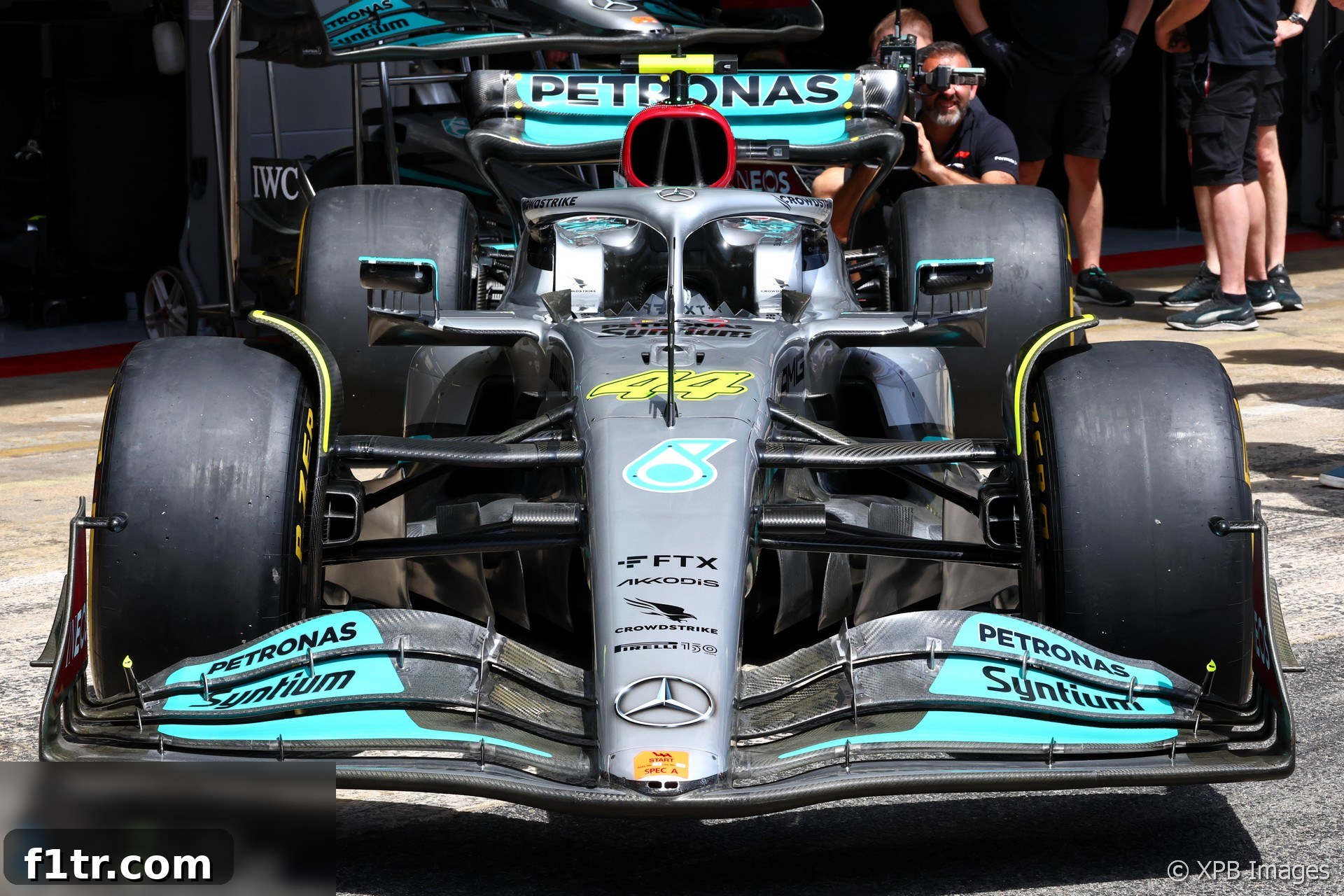
The Spanish Grand Prix has been highlighted as a pivotal moment for Mercedes-AMG Petronas Formula One Team, serving as a crucial testbed for the future development trajectory of their W13 challenger. George Russell, one of Mercedes’ star drivers, underscored the immense significance of this race weekend in Barcelona, suggesting that the team’s performance here could dictate their entire developmental path for the remainder of the 2022 Formula 1 season.
Mercedes has faced an unexpectedly challenging start to the 2022 campaign. After years of unparalleled dominance, the team finds itself in an unfamiliar third position in the constructors’ championship, significantly trailing behind the formidable pace of both Red Bull Racing and Scuderia Ferrari. A primary culprit for their struggles has been the severe ‘porpoising’ phenomenon – an aerodynamic oscillation that causes the car to bounce violently at high speeds. This issue has not only compromised the W13’s performance but has also made driving incredibly uncomfortable for both Russell and his seven-time world champion teammate, Lewis Hamilton.
As the Formula 1 circus arrived at the Circuit de Catalunya, a track renowned for its demanding layout and as a traditional testing ground, Mercedes, alongside many other teams, introduced a comprehensive suite of upgrades to their car. These upgrades were meticulously designed to address the W13’s inherent issues, particularly the persistent porpoising that has plagued their performance since pre-season testing. Russell articulated the complexity of the situation, stating, “I think this weekend is for sure going to be important, as most weekends are. But I think Rome wasn’t built in a day, and it is taking time to first recognise what the problems are, develop things back at the factory to try and resolve these problems, and then try to implement them.” This analogy perfectly encapsulates the methodical and often lengthy process of F1 car development, where identifying an issue is merely the first step in a much longer journey towards a solution.
The Circuit de Catalunya holds a unique place in Mercedes’ recent history, as it was here, three months prior during the first pre-season test, that the team unveiled its radical ‘sidepodless’ design. This innovative, almost minimalist approach to the sidepod area of the car immediately drew attention and speculation across the paddock. While initially hoped to be a revolutionary concept that would unlock significant performance gains, its effectiveness has been overshadowed by the W13’s handling characteristics and the relentless porpoising.
Russell further elaborated on the iterative nature of F1 development, referencing the previous Miami Grand Prix as an initial indicator. “Obviously, we don’t get much track time, and Miami was a first taste of the direction we need to take,” he explained. “I think this weekend will be the second taste, and I think we will have a good conclusion after this weekend if we can continue down the path that we’ve chosen or we need to go down a different path. So that’s exciting.” The Spanish Grand Prix, therefore, served as a critical follow-up, a second data point that would either validate or invalidate the engineering philosophy underpinning their current development trajectory. The data gathered from Barcelona would provide the engineering team with concrete evidence to decide whether to double down on their current concept or embark on a significant strategic shift.
Despite the high stakes, Russell maintained a realistic outlook on the immediate outcomes. He cautioned against expecting a sudden leap to the front of the grid, stating, “I think if this is the path, we’re not going to suddenly see us on the top step of the podium. But either way, we will have a positive outcome from this weekend.” This perspective highlights the long-term nature of F1 development and the understanding that even positive steps are often incremental rather than revolutionary, especially in a championship as tightly contested as Formula 1. The “positive outcome” could simply mean a clearer understanding of the car, which is invaluable for future progress, regardless of the immediate race result.
Adding his seasoned perspective, Lewis Hamilton offered reassurance that even if Mercedes were to deviate from their distinctive ‘sidepodless’ design, it would not necessitate a complete overhaul or a return to square one. Hamilton, who has been instrumental in Mercedes’ previous championship successes, emphasized the team’s capacity for innovation and adaptation. “I’m not a designer, so I don’t want to say that I have an opinion on whether design is right or wrong,” Hamilton humbly stated, acknowledging the highly specialized role of the design team. He continued, “It looks a little bit different to some others, but I think it looks unique, and that’s what we stand for as a team. Just always innovating and coming up with interesting concepts.”
Hamilton’s comments underscored Mercedes’ philosophy of pushing boundaries and exploring novel aerodynamic solutions. The unique sidepod design, while challenging, is a testament to their engineering audacity. His pragmatic view on potential changes was equally insightful: “But I think we will understand from this weekend whether where we are is the right direction or, if not, we’ll burn it up and we’ll move in another direction. But it won’t mean that we have to start from scratch. I don’t think, it would just probably be a side step in either direction.” This implies that while significant adjustments might be required, the fundamental architectural elements and underlying principles of the W13 could still be retained. A “side step” suggests a modification or evolution of existing components rather than a complete redesign, saving valuable development time and resources under the stringent budget cap regulations.
The Spanish Grand Prix, therefore, was not just another race on the calendar for Mercedes; it was a pivotal moment of introspection and strategic recalibration. The outcome of this weekend, particularly in understanding how the car responded to the upgrades and how much the porpoising could be mitigated, promised to be instrumental in shaping Mercedes’ 2022 season. Whether they continue to refine their current innovative concept or opt for a different aerodynamic philosophy, the decisions made following Barcelona were set to have profound implications for their championship aspirations and their pursuit of challenging Red Bull and Ferrari for supremacy.
The challenges faced by Mercedes in 2022, particularly the porpoising issue, have been widely discussed within the F1 community. This aerodynamic phenomenon, largely unforeseen to this extent with the new ground-effect regulations, has forced teams to rapidly understand and counteract its effects. For Mercedes, a team accustomed to being at the forefront of technical innovation, overcoming this hurdle is not just about performance, but also about reaffirming their engineering prowess. The W13, despite its early struggles, remains a marvel of engineering, and the quest to unlock its full potential is a testament to the relentless pursuit of perfection inherent in Formula 1.
In conclusion, the Spanish Grand Prix acted as a critical diagnostic session for Mercedes, providing vital data to guide their future development efforts. The insights gained, combined with the feedback from both George Russell and Lewis Hamilton, were crucial in plotting the course for the W13’s evolution. The team’s decision, whether to persist with their unique design philosophy or to pivot, carries significant weight for their ambition to return to the top step of the podium and reclaim their dominant position in Formula 1. The journey from Barcelona promises to be a fascinating chapter in Mercedes’ quest for recovery.
2022 Spanish Grand Prix Related Articles
- Q&A: Kubica ‘shocked’ by ‘completely different’ Alfa Romeo in Spain
- How heat and traffic trouble left F1 fans fuming after the Spanish Grand Prix
- Mercedes not yet certain their porpoising problem has “disappeared”
- Sticking to budget cap “pretty much impossible” due to rising costs – McLaren
- Ricciardo hoping to find an explanation for Spanish GP pace deficit to Norris
Browse all 2022 Spanish Grand Prix articles