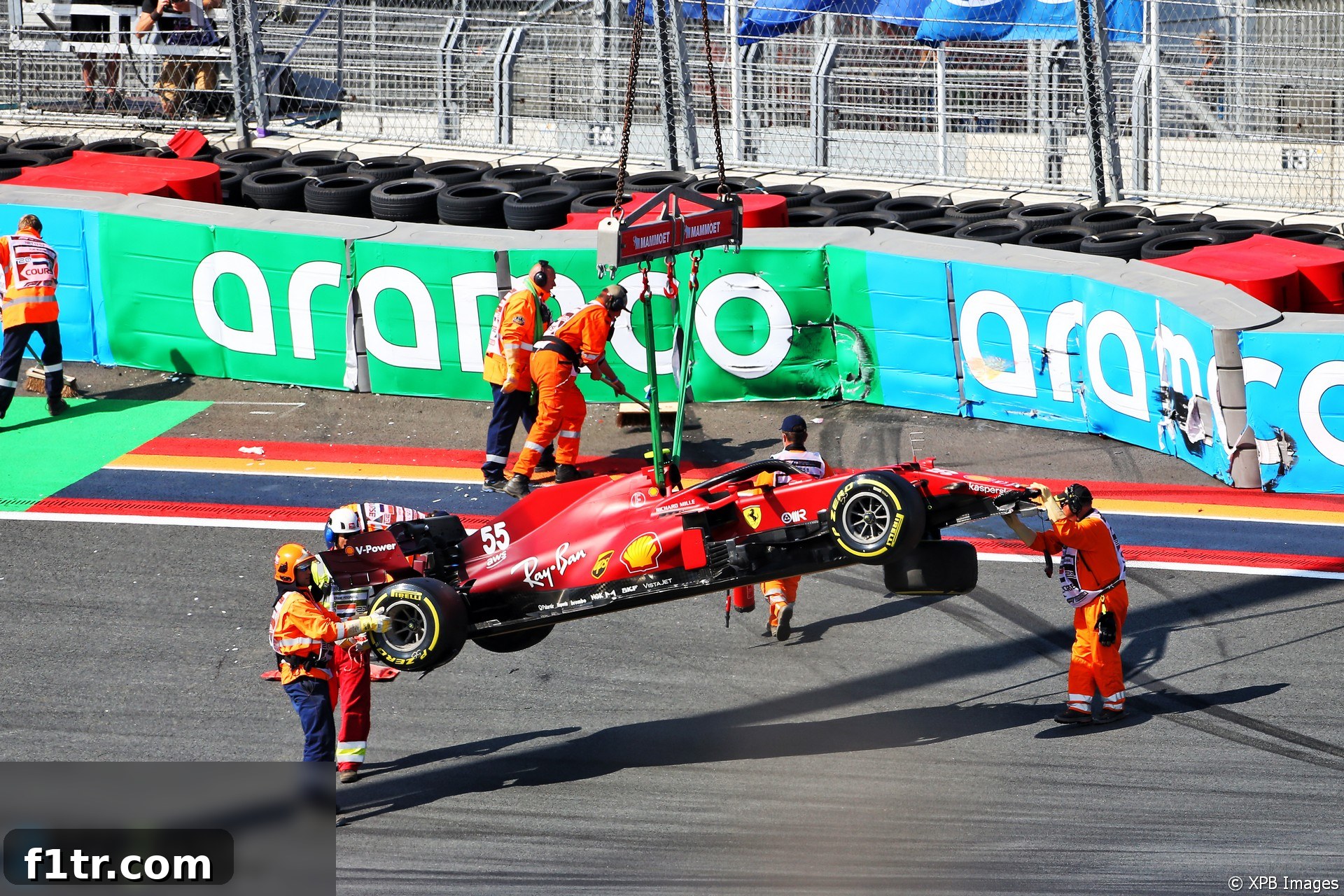
Carlos Sainz’s Zandvoort Crash: A 20cm Misjudgment and Ferrari’s Heroic Recovery
In the high-stakes world of Formula 1, the difference between triumph and disaster can often be measured in mere centimeters. This harsh reality was dramatically underscored at the 2021 Dutch Grand Prix when Carlos Sainz Jnr, the talented Ferrari driver, experienced a heavy crash during the final practice session (FP3). The incident, which saw his car violently impact the barriers, could have easily derailed his entire weekend. However, Sainz’s candid explanation after the fact highlighted an almost imperceptible error, revealing that his car strayed just 20 centimeters from the optimal racing line – a tiny margin with monumental consequences on the unforgiving Zandvoort circuit.
The crash occurred in Turn 2, a deceptively fast section of the track, before Sainz lost control and hit the wall hard at the subsequent corner. Reflecting on the harrowing moment, Sainz described the rapid sequence of events: “It happened very quickly. At the beginning, I didn’t know what had happened.” It wasn’t until a period of analysis and a mental ‘cool down’ that the true cause became clear. He observed the qualifying sessions and realized the extreme sensitivity of the track surface: “Centimetres off-line there’s clearly less grip than on-line, there’s a bit of sand. I missed the apex by maybe 20 centimetres in that lap and I caught up and you can see maybe that I pulled up a bit of dust, and I think that is enough to create an accident at this circuit.” This insight provides a crucial glimpse into the razor-edge precision demanded from Formula 1 drivers, especially on a track like Zandvoort where the slightest deviation can lead to catastrophic results.
The Fine Margins: Understanding Sainz’s 20-Centimeter Error at Zandvoort
A 20-centimeter error might sound insignificant in everyday driving, but in Formula 1, it represents a chasm. At speeds exceeding 200 km/h, a deviation of less than a foot can completely alter the aerodynamic balance and grip profile of a highly tuned racing machine. The unique characteristics of Zandvoort, with its old-school layout and limited run-off areas, amplify these sensitivities. The circuit’s surface, particularly when fresh tarmac meets older sections or where sand from the nearby dunes drifts onto the track, creates varying levels of grip. Even a microscopic layer of dust or sand can drastically reduce the tire’s ability to maintain traction, especially when a car is subjected to immense G-forces through a corner. Sainz’s assessment that “there’s clearly less grip than on-line” underscores the perilous nature of straying even slightly from the perfectly rubbered-in racing groove. This particular incident serves as a stark reminder of the delicate balance between pushing the limits and overstepping them, a constant tightrope walk for every F1 driver. It highlights not just the driver’s skill, but also their profound understanding of the car’s dynamic behavior under extreme conditions and the nuances of the track surface itself.
Zandvoort: A Track That Punishes Imperfection and Rewards Bravery
Despite the severity of his impact, Sainz expressed a genuine appreciation for the challenge posed by Zandvoort. The circuit’s narrow confines and notoriously limited run-off areas are features that many modern F1 tracks have abandoned in favor of wider, safer asphalt zones. Yet, Zandvoort’s design ethos, reminiscent of motorsport’s golden era, forces drivers to confront the consequences of their mistakes directly. “It’s what makes it so challenging and what it makes it so incredible as a driver, so [enjoyable], because you know that you cannot put a foot wrong,” Sainz explained. This sentiment resonates with many F1 purists and drivers alike, who argue that such circuits truly test a driver’s mettle, rewarding pinpoint accuracy and punishing even the slightest lapse in concentration. The track’s iconic banked corners, like the famously exhilarating Tarzanbocht and the Arie Luyendyk Bocht, demand unwavering commitment and courage, adding another layer of complexity. The palpable risk associated with Zandvoort not only elevates the spectacle for fans but also sharpens the focus and determination of the drivers, pushing them to the absolute limits of their abilities. It’s a circuit that doesn’t forgive, making every successful lap a testament to exceptional skill and bravery.
The Unsung Heroes: Ferrari Mechanics’ Race Against Time
While Carlos Sainz’s recovery in qualifying was a testament to his own resilience, he was quick to credit the indispensable team behind him. “The recovery is purely thanks to the mechanics,” he stated emphatically. The car was not returned to the garage until 20 minutes after the practice session concluded, placing immense pressure on the Ferrari crew. Despite the incredibly tight timeframe, they performed an astounding feat of engineering and teamwork. Rebuilding a Formula 1 car after a heavy shunt is a monumental task, involving the meticulous replacement of damaged components, often including complex aerodynamic parts, suspension elements, and sometimes even structural chassis repairs, all while adhering to stringent safety protocols. The precision, speed, and coordinated effort required for such a repair under intense time pressure are nothing short of extraordinary. “They did an incredible job to put everything together and to allow me to go out,” Sainz praised, highlighting that while drivers often receive the spotlight, the dedication and skill of the mechanics are equally crucial to success. “We sometimes talk a lot about Formula 1 drivers being very special, but Formula 1 mechanics are incredible and especially the guys today did amazing.” This powerful acknowledgement underscores the collective nature of Formula 1, where every member of the team plays a vital role in ensuring the car is not just operational, but competitive.
Battling Back: Sainz’s Mental Fortitude in Qualifying
The physical damage to the car was repaired, but the psychological impact of a high-speed crash can linger, testing a driver’s mental fortitude to its very core. Sainz openly admitted to lacking confidence during qualifying, describing it as a “high-pressure moment, high-tension moment in Q1 with the red flags, with a lack of confidence in myself, in the car.” Recovering that essential belief, especially when the memory of a recent heavy impact is fresh, requires immense mental strength. Drivers must quickly recalibrate their internal risk assessment, trusting both their own judgment and the integrity of the newly repaired machine. The added pressure of red flags interrupting sessions can further disrupt rhythm and concentration. Sainz described his process as “building it up little by little,” a gradual re-engagement with the limits of the car and the track. He likened his situation to “always one or two sets of tyres behind, like trying to play catch-up,” indicating the uphill battle he faced to get up to speed. However, his determination paid off: “But in Q3, I went for it and it paid off,” resulting in a “very strong lap” that nearly placed him in the top five. This journey from trepidation to aggressive confidence is a powerful testament to the psychological resilience that defines elite Formula 1 drivers, demonstrating their ability to overcome adversity and perform under unimaginable pressure.
The Broader Impact: A Defining Moment in the 2021 Dutch Grand Prix Narrative
Carlos Sainz’s FP3 crash and subsequent recovery served as a pivotal subplot during the 2021 Dutch Grand Prix weekend. In a sport where grid position at circuits like Zandvoort often dictates race outcome due to limited overtaking opportunities, a strong qualifying performance was paramount for Ferrari. Sainz’s ability to not only get back out for qualifying but to also deliver a competitive lap in Q3, battling for a top-five spot, was crucial for the Scuderia’s strategic options for the race. This incident not only highlighted Sainz’s personal character – his candidness, resilience, and appreciation for his team – but also showcased the extraordinary collective effort that underpins every Formula 1 operation. It underscored the demanding nature of the sport, where technical prowess, human skill, and mental strength converge to produce results. The narrative of Sainz’s crash and comeback added an extra layer of drama to a weekend already buzzing with excitement, especially with the return of Formula 1 to Zandvoort after decades. It reminded fans that beyond the glitz and glamour, F1 is a relentless test of man and machine, where the slimmest margins can lead to the most profound stories of triumph and adversity.
In conclusion, Carlos Sainz’s experience at the 2021 Dutch Grand Prix served as a microcosm of Formula 1 itself: a sport defined by incredible speed, razor-edge precision, and relentless pressure. His 20-centimeter misjudgment underscored the unforgiving nature of circuits like Zandvoort, while the heroic efforts of his Ferrari mechanics showcased the vital, often unseen, teamwork that powers every race weekend. Most importantly, Sainz’s mental fortitude to overcome a significant setback and deliver a strong qualifying performance demonstrated the profound psychological strength required at the pinnacle of motorsport. It was a weekend that proved success in Formula 1 is not just about individual brilliance, but the synergy of an entire team pushing the boundaries of what’s possible.
More from the 2021 Dutch Grand Prix
- “So many people love him”: Raikkonen’s rivals pay tribute to retiring champion
- Alonso studied junior series, not IndyCar, for Zandvoort banking clues
- 2021 Dutch Grand Prix Star Performers
- Paddock Diary: Dutch Grand Prix part two
- Verstappen makes the Netherlands 12th country to produce a home F1 winner
Browse all articles from the 2021 Dutch Grand Prix