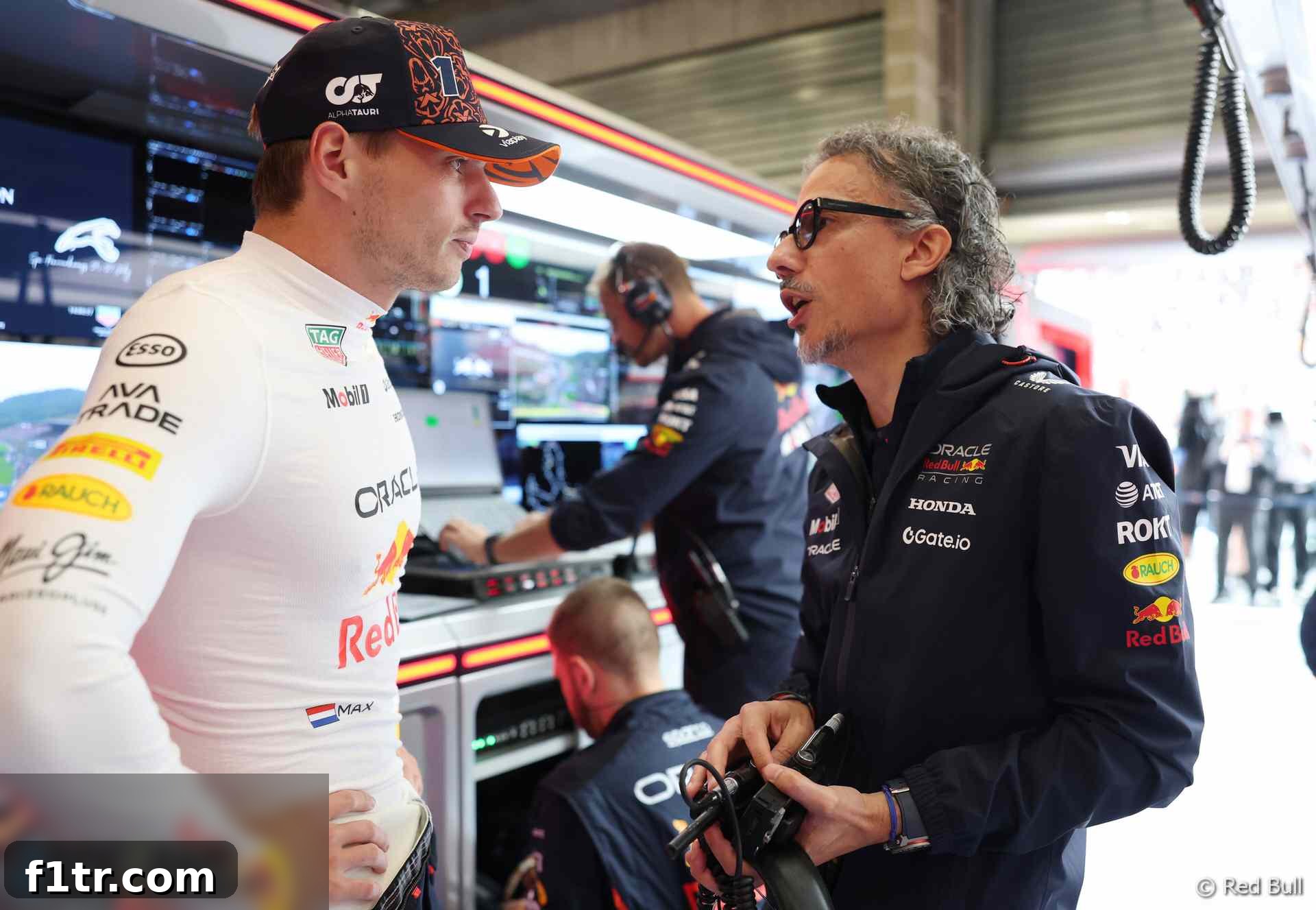
Dominance Reaffirmed: Max Verstappen’s Monza Masterclass and the Mekies Effect
In a breathtaking display of talent and strategic brilliance, Max Verstappen clinched a resounding victory at the illustrious Monza Grand Prix. Crossing the finish line a phenomenal 19 seconds ahead of Lando Norris, this dominant performance marked Verstappen’s third win of the season and signaled a powerful resurgence for Red Bull Racing. According to the Dutch ace, this crucial turnaround, leading to his emphatic triumph, owes significant credit to the transformative influence of the team’s new principal, Laurent Mekies. The renewed sense of control and unwavering confidence Verstappen exhibited throughout the race hints at a pivotal shift for the reigning champions, following a period of challenging performance in the mid-season.
The Monza Triumph: A Return to Form
Verstappen’s commanding display at Monza was more than just another victory; it was a potent declaration of Red Bull’s renewed prowess. The sheer margin of his win over a fiercely competitive field, including a robust challenge from McLaren, vividly underscores the substantial enhancements made to the Red Bull challenger. For a team accustomed to dominating the early phases of Formula 1’s current technical regulations, the performance slump experienced in the middle of the previous year had raised pertinent questions about their trajectory. This recent triumph, however, served as an unequivocal answer, firmly repositioning Red Bull Racing as a formidable force at the apex of motorsport.
The journey back to this level of peak performance has been characterized by meticulous effort and relentless innovation. Red Bull, a team synonymous with engineering excellence, faced the complex task of fully unlocking the potential of their RB21 car. This period of intense self-assessment and targeted development, though undoubtedly challenging at times, has evidently yielded significant rewards. The Monza circuit, celebrated for its unique demands for minimal downforce and exceptional high-speed stability, frequently acts as an accurate gauge of a car’s aerodynamic efficiency and raw engine power. Verstappen’s flawlessly executed race in these specific conditions strongly suggests that the team has achieved considerable progress in optimizing the RB21 to perform across a broader spectrum of track characteristics, silencing skeptics and reinforcing their championship credentials.
Laurent Mekies: The Architect of Red Bull’s Revival
The strategic appointment of Laurent Mekies as Red Bull Racing’s new team principal marks a transformative era for the Milton Keynes outfit. Verstappen’s explicit commendation of Mekies underscores the profound impact a visionary leader can have on a high-stakes, performance-driven environment. Mekies’ extensive engineering background has proven to be an invaluable asset, enabling him to dissect and address the intricate technical challenges of the RB21 at a fundamental level. As articulated by Verstappen, Mekies has instilled a much-needed sense of order, analytical rigor, and logical inquiry into the team’s approach to fine-tuning the car’s complex setup.
Verstappen’s candid reflections provide crucial insight into the team’s prior difficulties with car configuration. He revealed, “Up until now we’ve had a lot of races where we were just shooting left and right a little bit with the set-up of the car. Quite extreme changes, which shows that we were not in control. We were not fully understanding what to do.” This honest admission highlights the depth of the struggles encountered, where the team grappled with an unpredictable and often uncooperative machine. Mekies’ systematic methodology, characterized by “asking the right questions to the engineers – common-sense questions,” has evidently streamlined their development process. This structured approach has empowered the team to methodically analyze their experimental data, extract valuable lessons from their various setups, and ultimately converge on a clear, definitive direction for the RB21’s evolution. It vividly illustrates the critical role of a sharp, analytical mind at the helm, particularly when navigating the myriad intricate variables inherent in contemporary Formula 1 machinery.
The positive repercussions of Mekies’ leadership were not confined to theoretical discussions; they translated directly into tangible improvements on the track. Verstappen observed that these enhancements became discernible as early as Mekies’ third race in charge, during the Dutch Grand Prix. “I definitely felt that in Zandvoort already we took a step that seemed to work quite well, and then here another step which felt again a little bit better.” This clear, progressive enhancement from one Grand Prix to the next stands as a compelling testament to the effectiveness of Mekies’ strategic oversight and the team’s remarkable capability to implement significant changes with speed and precision. The synergistic collaboration between Mekies’ guiding vision and the engineers’ diligent execution has indisputably revitalized Red Bull’s development trajectory, transforming previous uncertainty into a newfound clarity and confidence.
Unlocking the RB21: Verstappen’s Enhanced Control
For an elite driver like Max Verstappen, the sensation of having absolute command over his racing machine is paramount to extracting its maximum performance. His recent commentaries paint a vivid and compelling picture of the profound transformation in the RB21’s handling characteristics. “Before, it felt like you were a passenger in the car,” he candidly admitted, recalling earlier races where the car’s erratic and unpredictable behavior presented a formidable challenge, severely impacting his ability to drive consistently at the limit. This recurring lack of balance was a persistent issue, often leading to inconsistent tire performance and a less than optimal, or even frustrating, driving experience.
However, the narrative has demonstrably shifted. “Now, finally, there was more balance in the car and then the tyres also behaved a little bit more normally,” Verstappen affirmed. This critical improvement in balance is a cornerstone of success in Formula 1, enabling a driver to push the limits with significantly greater confidence, to meticulously extract every ounce of performance from the Pirelli tires, and to maintain a precise and consistent pace throughout extended race stints. The newfound ability to proactively dictate the car’s behavior, rather than merely reacting to its unpredictable movements, unlocks an entirely different stratum of performance. This enhanced responsiveness facilitates more precise braking points, sharper and more confident turn-in into corners, and a more controlled application of power, all of which synergistically contribute to the commanding advantage Verstappen so clearly demonstrated at Monza.
The restored synergy between driver and machine is now unmistakably a fundamental pillar of Red Bull’s re-emergent dominance. The sophisticated technical adjustments and strategic refinements championed by Laurent Mekies have evidently harmonized with Verstappen’s aggressive yet meticulously precise driving style, forging a formidable combination that few rivals can currently emulate. This newfound harmony is not solely about raw, blistering speed; it encompasses the crucial ability to manage an entire race from start to finish, to adeptly adapt to dynamically changing track conditions, and to flawlessly execute complex race strategies. Verstappen’s palpable feeling of enhanced control serves as perhaps the most conclusive indicator of Red Bull’s successful efforts in meticulously troubleshooting and optimally calibrating the RB21, setting a new benchmark for their performance.
Race Day Reflections: Pace, Strategy, and Adaptation
Beyond the fundamental and profound improvements in car balance, Max Verstappen’s execution on race day at Monza was a masterclass in meticulous pace management and astute strategic awareness. Despite a brief period where Lando Norris managed to significantly reduce his lead towards the conclusion of Verstappen’s initial stint, the Red Bull driver confidently assessed his overall race pace as “probably a bit better than expected.” This measured and insightful confidence speaks volumes about his profound understanding of the car’s capabilities and the dynamic ebb and flow of the race itself, allowing him to react and adapt effectively.
Verstappen provided further clarity on the intricate nuances of his performance, stating: “Once I got back in the lead I just tried to focus on my own pace and it kept on going well. I would say only the last maybe six to eight laps of that stint I started to struggle a little bit on the medium [tyre].” This candid insight reveals a driver who is acutely attuned to the subtle, yet critical, shifts in tire performance – an indispensable skill in the highly competitive realm of modern Formula 1. His remarkable ability to effectively manage this late-stint degradation, all while maintaining a fiercely competitive pace, stands as a testament to his vast experience and the RB21’s significantly improved characteristics. “Up until that point, it was nice for once. The car was doing a little bit more what I liked.” This concise yet powerful statement perfectly encapsulates the profound satisfaction a driver experiences when finally piloting a machine that responds intuitively and precisely to their inputs, enabling them to extract every conceivable ounce of performance. The Monza weekend, therefore, transcended a mere victory; it served as a monumental validation of the entire team’s exhaustive efforts, solidifying the conviction that “this weekend has been another step forward with the behaviour of the car and that also then shows in the race. So that was a big positive for us.”
The Road Ahead: Track Dependency and Future Prospects
Despite the elation emanating from a dominant victory at Monza, Max Verstappen maintains a carefully measured optimism regarding Red Bull’s capacity to sustain this elevated level of performance throughout the remainder of the season. His pragmatic assessment keenly highlights the inherent and often unpredictable challenges within Formula 1, where the distinct characteristics of each track can profoundly influence a car’s overall performance envelope. “I think it’s still a bit track dependent,” Verstappen thoughtfully commented. “Here you drive with low downforce. It always seems like our car is a little bit more competitive when it’s low-to-medium downforce.” This acute observation is absolutely critical, as it strongly suggests that while substantial progress has undeniably been made, the RB21 might still possess certain intrinsic characteristics that naturally favor specific circuit layouts, rather than being universally dominant.
This nuanced perspective acts as an important counterweight to any potential overconfidence, underscoring that the team has not necessarily returned to a state of absolute, unassailable dominance on every single race weekend. “So it’s not like suddenly now we are back. It’s not like we can fight, I think, every single weekend.” However, the overwhelming positive to emerge from this period of intense development is the significantly improved understanding of the car itself. “But the positive is that we seem to understand a little bit more what we need to do with the car to be more competitive.” This deeper, more comprehensive comprehension of the RB21’s intricate operational envelope is arguably far more valuable than a singular dominant performance. It strategically empowers the team’s engineers and strategists to make increasingly informed decisions regarding car setup, the deployment of crucial upgrades, and meticulous race planning, even on tracks that might not inherently play to the car’s current strengths. This strategic insight is a powerful asset in a championship battle.
The prevailing hope now is that this enhanced understanding will seamlessly translate into a consistent series of competitive showings in the forthcoming rounds. Verstappen’s concluding thought, “So I hope that that carries on into the coming rounds as well, and some tracks will be a bit better than others,” perfectly encapsulates the team’s determined yet realistic outlook for the future. Red Bull’s adaptability and their proven ability to continually optimize the RB21 for a diverse array of circuit challenges will serve as the ultimate litmus test of Laurent Mekies’ profound influence and the team’s reinvigorated engineering prowess. The championship battle, consequently, remains captivatingly intense, with Red Bull unequivocally demonstrating clear signs that they are poised to contend fiercely at the sharp end, now armed with a far better-understood car and a strategically revitalized approach to every Grand Prix.
Conclusion: A Glimmer of Consistent Excellence
Max Verstappen’s commanding victory at Monza, profoundly amplified by the astute tactical and technical guidance of new team principal Laurent Mekies, undeniably signifies a crucial resurgence for Red Bull Racing. The remarkable transformation from what was once described as a challenging and unpredictable car to a meticulously tuned, responsive, and intuitive machine speaks volumes about the collective effort and strategic reorientation that has taken place within the team. While acknowledging the inherent track-specific nature of certain performance gains, the significantly clearer understanding of the RB21 and the enhanced control now felt by Verstappen offer a compelling and optimistic vision of sustained competitiveness. Red Bull is not merely achieving victories; it is actively engaged in a continuous process of learning, adapting, and evolving, thereby setting a formidable stage for what promises to be an intensely engaging and decisive remainder of the Formula 1 season.
Further Reading: Insights from the World of F1
- The Evolution of F1 Aerodynamics: A Deep Dive into Car Design Principles
- The Impact of a Team Principal: Shaping F1 Championship Contenders
- Mastering Strategy: F1 Tire Choices and Pit Stop Precision Explained
- Max Verstappen’s Journey: From Prodigy to F1 World Champion
- Red Bull Racing’s Engineering Philosophy: The Path to Dominance
Browse all Formula 1 articles