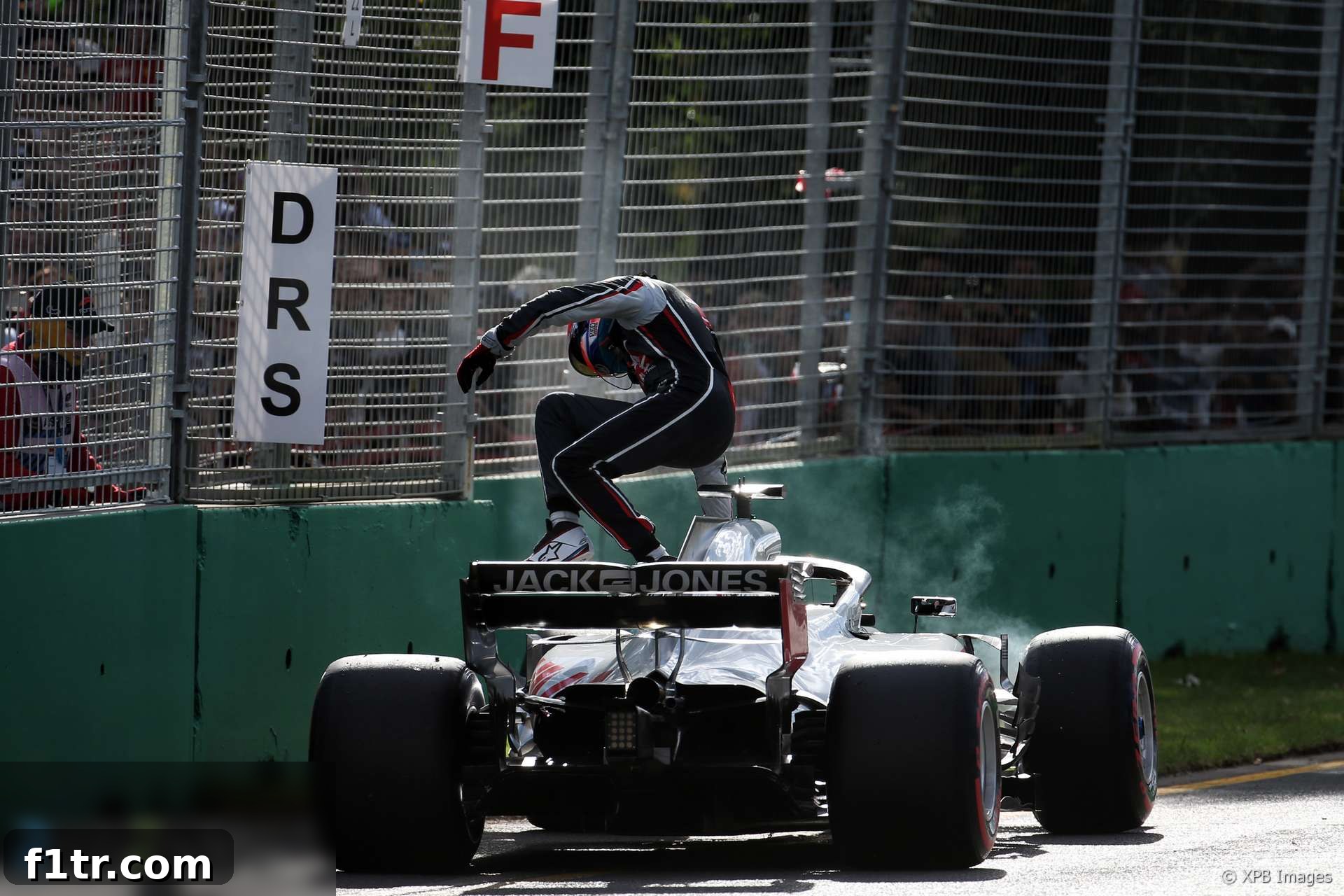
The exhilarating start to the 2018 Formula 1 season at the Australian Grand Prix quickly turned into a devastating disappointment for the Haas F1 Team, as both Kevin Magnussen and Romain Grosjean were forced to retire from the race due to a highly unusual and unfortunate pit stop error. This incident, described by team principal Guenther Steiner as a “freak” occurrence, involved improperly tightened wheel nuts on both cars, leading to a double DNF that cost the team a significant haul of championship points.
The weekend had begun with immense promise for the American outfit. Throughout practice and qualifying, the Haas VF-18 had demonstrated impressive pace, firmly positioning itself as a strong midfield contender, potentially even challenging the established front-runners. Kevin Magnussen and Romain Grosjean capitalized on this performance, starting the race from impressive positions and swiftly moving up the order. At one crucial stage, the pair were running as high as fourth and fifth, a position that would have marked Haas’s best-ever finishing result in Formula 1 history. The potential for a monumental points haul, one that could have significantly shaped their season, hung tantalizingly close.
The unfolding of events, however, took a cruel turn during their respective pit stops. Magnussen was the first to enter the pit lane for his tire change. While the stop initially appeared routine, the car was released with its front-left wheel not securely fastened. Moments later, as he accelerated out of the pit box, the issue became alarmingly apparent, forcing him to pull over and retire. The mood in the Haas garage, which had been brimming with optimism, turned to palpable concern.
Tragically, just laps later, history repeated itself with Romain Grosjean. Following his pit stop, Grosjean experienced a similar sensation with his front-left wheel, signaling a repeat of the precise mechanical failure. He too was forced to halt his car, bringing an end to what had promised to be a truly memorable race for the team. The double retirement, stemming from what appeared to be identical wheel nut problems, left the entire paddock stunned and the Haas team utterly dejected. The elation of running in points-scoring positions was brutally replaced by the sting of a double DNF, a devastating blow not just to their championship aspirations but also to team morale.
Immediately after the race, Team Principal Guenther Steiner addressed the media, expressing his profound disappointment while emphasizing the unprecedented nature of the incident. “It was just a bad pit stop,” Steiner admitted, his frustration evident but his resolve clear. “The wheel nut got on wrong and it was cross-threaded. We couldn’t catch it early enough, and that’s what happened. You work in a two-and-a-half-second window to do this, and we were unlucky.” This frank admission highlighted the extreme precision and speed required during a modern Formula 1 pit stop, where fractions of a second can dictate success or failure, and even the smallest imperfection can lead to catastrophic consequences.
The concept of a wheel nut being “cross-threaded” is a critical detail in understanding the failure. In simple terms, it means the threads of the nut did not align correctly with the threads on the wheel hub when the pit crew member attempted to fasten it. Instead of smoothly engaging and tightening, the threads jammed or stripped, preventing the nut from achieving a secure fit. In the frenetic environment of an F1 pit stop, with the pit gun operating at immense torque and speed, detecting such a subtle malfunction within the blink of an eye is incredibly challenging, especially when the overall operation needs to be completed in under three seconds.
Steiner further emphasized the extraordinary nature of the double failure, clarifying that the pit crew responsible for the stops had remained unchanged from the previous season. “It’s one of these things, it’s unbelievable,” he stated, conveying the shock within the team. “If you try to explain it, people would say it’s not possible. But it seems they are possible, so we just have to deal with it and get it better for Bahrain.” This statement underscored that the issue was not a lack of experience or a wholesale change in personnel, but rather an inexplicable and synchronous failure in a highly refined and practiced operation. The consistency of the crew suggested that the problem lay elsewhere, perhaps in a procedural anomaly, equipment malfunction, or an incredibly rare combination of human factors under extreme pressure.
The F1 pit stop is a meticulously choreographed dance involving up to 20 individuals, each with a specific role, executed under immense pressure. Wheel gun operators are trained to perfection, and their equipment is designed for maximum efficiency. For two separate instances of cross-threading to occur on the same day, on different cars, is almost unheard of. This is precisely why Steiner categorized it as a “freak incident,” defying statistical probability and conventional explanations. The team’s immediate focus shifted to an intensive internal investigation, aiming to uncover the precise root cause and implement preventative measures before the next race in Bahrain, just two weeks away.
“It’s high risk this,” Steiner acknowledged, referring to the inherent dangers and complexities of Formula 1 pit stops. “If it goes wrong, normally it doesn’t go wrong in one race when you are in this position, twice.” This comment highlighted the uniqueness of the situation. While pit stop errors are not entirely unprecedented in F1, a double retirement from strong points-scoring positions due to identical, consecutive mechanical failures during pit stops is extremely rare and profoundly damaging. The lost points, estimated to be between 18 and 22 based on their running positions, represented a significant setback for a team like Haas, which operates on a smaller budget compared to the sport’s giants and relies heavily on every championship point.
Beyond the immediate financial and championship implications, there was also a profound psychological toll on the team. The euphoria of a strong qualifying and race start quickly evaporated, replaced by frustration and the need for immediate problem-solving. However, Steiner maintained a pragmatic and forward-looking perspective. “This is a freak incident. We need to keep our heads up. We know we have a good year in front of us. We need to just analyse what actually happened and how can we make it that it doesn’t happen again.” His leadership aimed to prevent demoralization, redirecting the team’s energy towards analysis, learning, and improvement.
The Australian Grand Prix incident served as a stark reminder of the razor-thin margins in Formula 1, where even a momentary lapse or an unforeseeable mechanical quirk can derail an entire race weekend. For Haas, the primary objective post-Melbourne was to conduct a thorough and unbiased root cause analysis, meticulously examining every detail of the pit stop procedure, the equipment used, and the human element. This would involve reviewing telemetry data, onboard camera footage, and interviewing every member of the pit crew to understand the sequence of events leading to the failures. The ultimate goal was to implement robust safeguards, whether through procedural adjustments, equipment modifications, enhanced training protocols, or a combination thereof, to ensure such an incident would never be repeated. The resilience and technical acumen of the Haas F1 Team would be tested in the wake of this disheartening start, as they prepared to demonstrate their capability to learn from adversity and bounce back stronger in the subsequent races of the 2018 season.
Go ad-free for just £1 per month>> Find out more and sign up
2018 F1 season
- F1 feared “death knell” for Drive to Survive after Ferrari and Mercedes snub
- McLaren staff told us we were “totally crazy” to take Honda engines in 2018 – Tost
- ‘It doesn’t matter if we start last’: How Red Bull’s junior team aided Honda’s leap forward
- Honda’s jet division helped F1 engineers solve power unit problem
- McLaren Racing losses rise after Honda split
Browse all 2018 F1 season articles