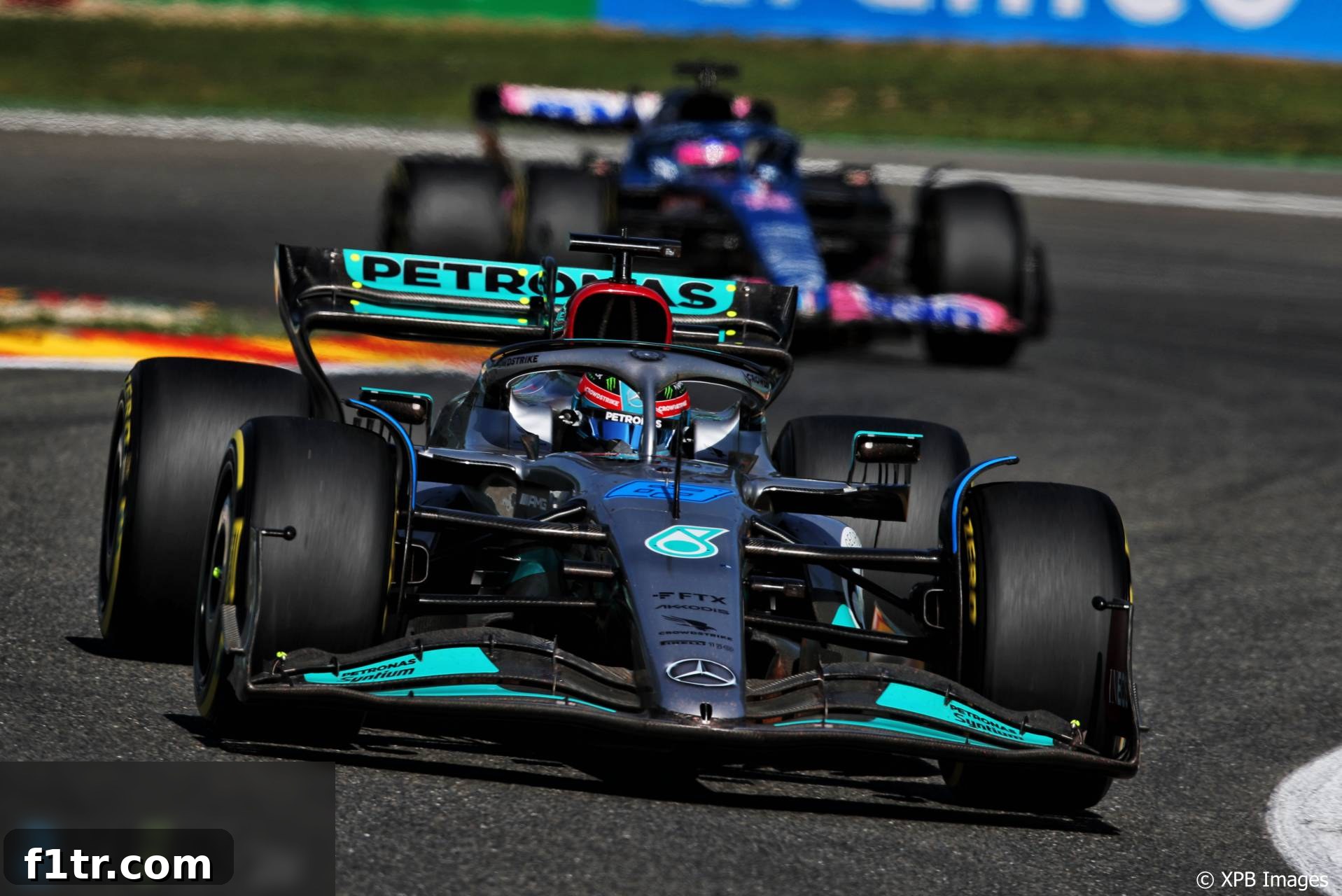
Mercedes has unequivocally stated that significantly reducing its straight-line speed deficit to Red Bull Racing is a core objective for the design of its 2023 Formula 1 car. However, until this crucial engineering challenge is overcome, the team anticipates that its current vehicle will continue to face compromises in performance, particularly on circuits where top-end speed is a decisive factor.
Advert | Become a Supporter & go ad-free
Following the Dutch Grand Prix, a race where Mercedes drivers George Russell secured an impressive second place and Lewis Hamilton finished fourth, Team Principal Toto Wolff openly acknowledged the team’s straight-line performance as a significant handicap. This admission came even after a strong showing on a track like Zandvoort, which is not typically renowned for its high-speed characteristics. Wolff’s comments underscore a deeper, more pervasive issue that has impacted Mercedes throughout the season.
“I don’t think that, on a par with the same tyre, we could have overtaken the Red Bull with the straight-line speed,” Wolff explained, reflecting on the race. He specifically highlighted an instance where Hamilton found himself stuck behind Carlos Sainz’s Ferrari during the initial laps, unable to convert what appeared to be superior cornering pace into a definitive overtake. “You’ve seen that with Carlos Sainz. We had less pace, we weren’t really able to pass him at the beginning.” This scenario vividly illustrates how a deficit in straight-line performance can severely restrict a team’s strategic options and hamper its ability to capitalize on track position or tire advantages during a race.
The Quest for Speed: Mercedes Prioritizes 2023 Aerodynamics
The urgency to match Red Bull’s straight-line speed is not merely a wish but a “definite” priority for Mercedes’ 2023 car design, as affirmed by Wolff. His humorous remark about “removing the rear wing overall to be less vulnerable on the straight” subtly hints at the extent of the challenge and the team’s determination to explore fundamental changes rather than superficial adjustments. This signals a potential paradigm shift in their aerodynamic philosophy for the upcoming season, aiming to reclaim their competitive edge at the very top of the grid.
Wolff offered a more technical insight into the problem, explaining, “We have a band or [section] of a car with too much drag, and downforce where we really don’t need it.” This statement is crucial, pointing to an inherent inefficiency in the W13’s aerodynamic design. In Formula 1, achieving the perfect balance between maximizing downforce for cornering grip and minimizing drag for straight-line acceleration is an art form. Mercedes’ current car appears to be generating downforce in areas that incur a disproportionate drag penalty, thus compromising its overall top speed and acceleration. This “hard way” of learning, as Wolff put it, suggests that the team is grappling with the complex interplay of aerodynamic elements under the new regulations, striving to understand and optimize every aspect of the car’s airflow.
The implications of this drag-induced deficit are particularly pronounced in qualifying sessions. “I believe that on some tracks, especially in qualifying, that will bite us,” Wolff predicted. While race conditions often allow for strategic nuances, tire management, and the exploitation of rivals’ weaknesses, qualifying is a pure test of a car’s raw, uncompromised pace. A significant straight-line speed disadvantage can make it exceedingly difficult to secure front-row starts, forcing drivers to contend with traffic and limiting their tactical flexibility on race day. However, Wolff also noted a slight silver lining: “The races look better, like you’ve seen also in Spa, that there wasn’t such a big differential on the straights.” This suggests that the car might be more forgiving or adaptable in longer race stints, where factors like tire degradation and fuel loads alter the performance landscape.
A Tale of Two Tracks: Spa-Francorchamps vs. Zandvoort
The contrasting performances of Mercedes at Spa-Francorchamps and Zandvoort serve as compelling case studies illustrating the impact of their straight-line speed issues and the car’s sensitivity to circuit characteristics.
Spa-Francorchamps: A Challenging Circuit for the W13
Mercedes was notably uncompetitive at Spa-Francorchamps, a historic track synonymous with long straights and high-speed sections. Trackside Engineering Director Andrew Shovlin shed light on the underlying reasons for their struggles. “In Spa we definitely struggled particularly on a single lap,” he confirmed in a team video. He explained that the team had identified specific areas in the car’s development that made it difficult to operate in its optimal condition on such high-speed, often bumpy, circuits.
The core issue at Spa revolved around ride height. “In Spa we had to lift the car a bit, we were struggling with it on some of the bumps and the net effect was that it was costing us performance,” Shovlin detailed. Raising the car’s ride height, while mitigating issues like bottoming out or porpoising, inevitably compromised the aerodynamic efficiency of the underfloor and diffuser, which are critical for generating ground effect downforce. This forced compromise led to a loss of inherent performance, particularly in terms of drag.
To counteract this loss of downforce, Mercedes was compelled to run a larger rear wing than they would have ideally preferred for Spa’s high-speed layout. This, in turn, exacerbated the straight-line speed deficit. “We then decided to run a bigger wing than we would have ideally done to try and put the downforce back on the car and the net result is that we were okay in the corners, but we were slow on the straights and that was costing us.” This perfectly encapsulates the dilemma: a forced compromise that sacrificed top speed for cornering ability on a track where both are paramount, ultimately exposing the W13’s fundamental weaknesses.
Zandvoort: A More Favorable Outcome
In stark contrast, Zandvoort offered Mercedes a much more competitive platform. This circuit, characterized by its flowing corners and shorter straights, plays more to the strengths of a high-downforce, corner-centric car. “Now, at Zandvoort the car was easier to get into the right window. It was riding well, it wasn’t bouncing over the bumps that gave the drivers confidence and they could push it,” Shovlin remarked. The nature of the track allowed the W13 to run closer to its optimal ride height and aerodynamic setup, enabling the drivers to extract maximum performance without the severe compromises seen at Spa.
The result was a highly encouraging weekend for Mercedes, with Shovlin noting it was “probably our most competitive weekend when you look at qualifying and race that we had all year.” This performance validated the team’s development efforts and demonstrated the W13’s potential when its characteristics align with the circuit demands. However, it also underscored the car’s track-specific nature and the urgent need to expand its performance window to be competitive across a broader spectrum of circuits. The hope, as Shovlin expressed, is for “more of those circuits to come,” but the long-term solution lies in fundamental design changes rather than relying on track calendars.
Looking to 2023: A New Aerodynamic Chapter for Mercedes
Advert | Become a RaceFans supporter andgo ad-free
The challenges of the 2022 season, particularly the persistent straight-line speed deficit, are serving as a powerful catalyst for Mercedes’ development strategy for 2023. The team’s commitment to tackling this issue head-on suggests a comprehensive re-evaluation of its aerodynamic philosophy and overall car concept.
Addressing “too much drag” and “downforce where we don’t need it” will entail meticulous design work. Engineers will likely focus on optimizing the car’s bodywork, floor design, and wing profiles to achieve a more efficient aerodynamic package. This means finding innovative ways to generate substantial downforce for supreme cornering performance without incurring the penalty of excessive drag on the straights. It’s a delicate balance that often involves intricate flow conditioning, reducing wake, and ensuring that every surface contributes positively to the car’s overall efficiency. Furthermore, lessons learned about managing porpoising and ride height sensitivity will be crucial. The 2023 car needs to be inherently more robust, allowing it to run at lower, more aerodynamically efficient ride heights across various track conditions without compromising driver confidence or performance due to instability.
The journey of the W13 has been one of profound learning for Mercedes. From grappling with severe porpoising early in the season to progressively unlocking performance and achieving strong results in the latter half, the team has showcased its resilience and engineering prowess. This experience, though challenging, has provided invaluable data and insights into the nuances of the new technical regulations. This deep understanding will undoubtedly inform every aspect of the 2023 car’s design, from its chassis and suspension to its intricate aerodynamic surfaces.
The pursuit of straight-line speed is more than just about outright pace; it’s about unlocking strategic flexibility, enhancing overtaking opportunities, and ultimately, empowering the drivers to compete at the very limit without fundamental car limitations holding them back. Mercedes’ unwavering focus on resolving this critical deficit signifies their ambition to return to championship contention. Fans and rivals alike will eagerly watch to see if the Silver Arrows can emerge with a revitalized package in 2023, one that can challenge for supremacy on every type of circuit.
2022 Dutch Grand Prix Related Content
- Ferrari’s season of missed chances led to “difficult” criticism for Binotto
- How many victory chances did Hamilton have in his first winless F1 season?
- Why F2’s role as F1’s sustainable fuel guinea pig ‘isn’t going to be a reliability issue’
- Straight-line speed deficit will continue to “bite” Mercedes in qualifying – Wolff
- Verstappen achieves his longest winning streak with second home victory
Browse all 2022 Dutch Grand Prix articles