Alfa Romeo Racing experienced a truly enigmatic season. The C38 chassis often struggled to consistently deliver performance across various circuits and tyre compounds, leading to a frustratingly inconsistent run of results. While many teams encountering similar foundational issues might opt to pause significant aerodynamic overhauls to fully understand and resolve the core problems, Alfa Romeo took a decidedly different approach. The team remained committed to an aggressive development trajectory, relentlessly pushing through major revisions to their C38 challenger. This ongoing commitment to innovation was evident at the British Grand Prix held at Silverstone, where a host of crucial front-end updates were introduced. Moreover, observers at the event spotted an intriguing and rather unusual cockpit modification within Antonio Giovinazzi’s car, hinting at the team’s holistic approach to extracting every ounce of performance, from aerodynamics to driver ergonomics.
Advert | Become a Supporter & go ad-free
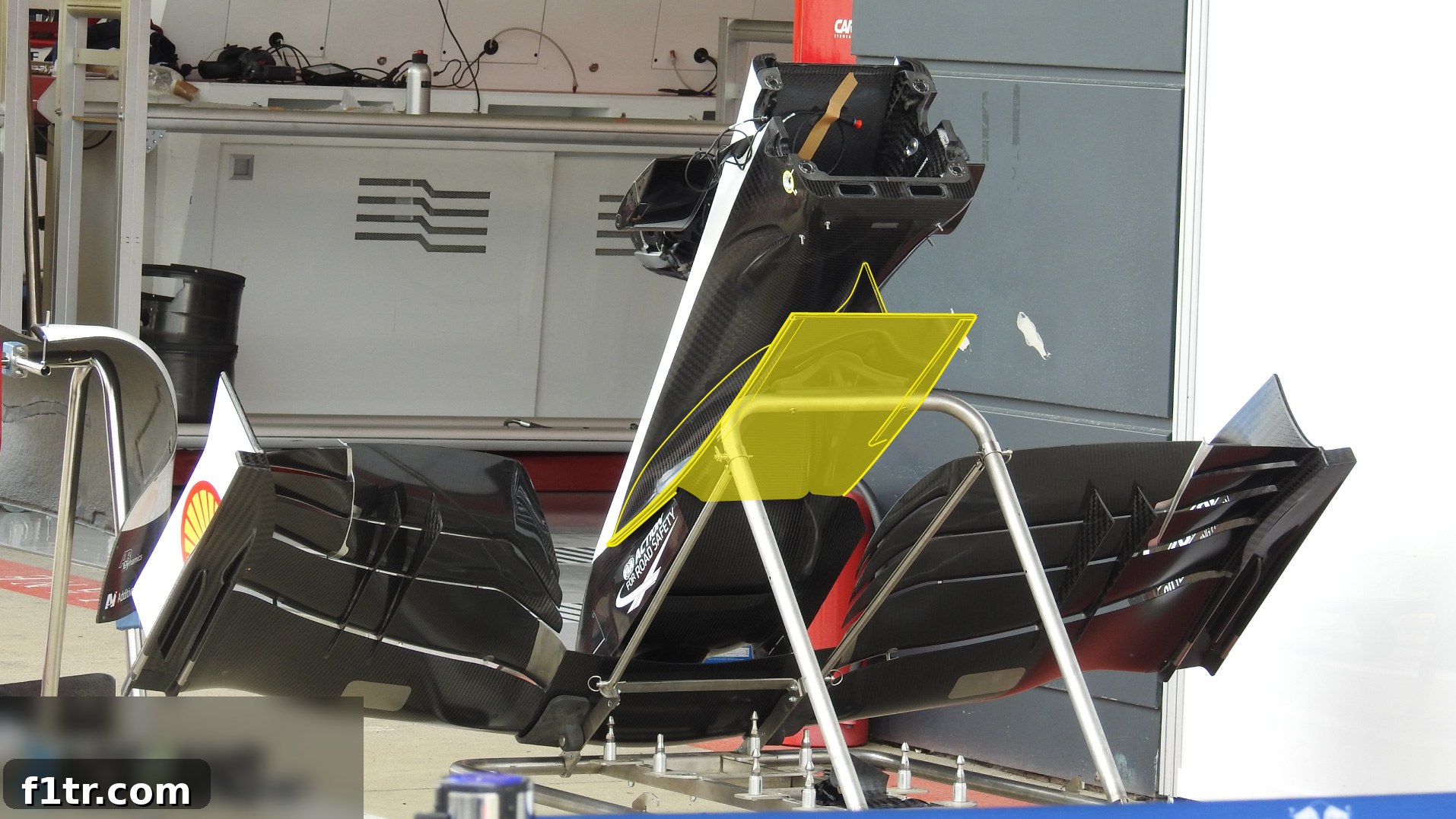
The Silverstone upgrade package for the Alfa Romeo C38 was comprehensive, focusing heavily on enhancing airflow management at the very front of the car. A key addition was the integration of a ‘cape’ element beneath the nose vane, a sophisticated aerodynamic device designed to channel airflow more efficiently. This crucial revision was accompanied by a re-sculpted nose cone and a series of adjustments to the front wing. With the introduction of this cape, Alfa Romeo became the seventh team on the Formula 1 grid to adopt this innovative solution, originally pioneered by Mercedes-AMG Petronas in their dominant 2017 season. The cape’s primary function is to create a more controlled airflow path beneath the chassis, which in turn feeds vital downstream aerodynamic components such as the bargeboards and floor.
The C38’s nose assembly was already recognised as one of the most intricately designed on the grid, featuring an advanced arrangement of internal airflow passages including holes through the nose tip and a sophisticated S-Duct system. The S-Duct itself works by drawing air from an inlet on the underside of the nose and expelling it through an outlet on the upper surface, helping to manage pressure distribution and improve aerodynamic efficiency. The addition of the new cape (which was visually highlighted in yellow during technical analyses) layered another level of complexity onto this already advanced structure. This integration was no small feat; marrying these distinct aerodynamic concepts required meticulous design and countless hours of CFD (Computational Fluid Dynamics) and wind tunnel testing to ensure harmonious interaction and optimal performance, showcasing Alfa Romeo’s dedication to pushing the boundaries of F1 aero development.
Further demonstrating the team’s relentless pursuit of aerodynamic excellence, the C38’s cape was not a simple, unadorned surface. Instead, it featured intricate, long slots strategically placed along its edges. These slots serve a critical purpose: they are engineered to generate a stronger, more energised vortex when the air interacts with the cape’s trailing edge. Such powerful vortices are highly desirable in Formula 1 aerodynamics because they act as invisible walls, helping to seal the turbulent air generated by the spinning front wheels away from the car’s underfloor. This ‘sealing’ effect is vital for maintaining a clean, high-pressure airflow to the bargeboards and ultimately the diffuser, thereby maximising downforce and stability. Complementing these changes, the shape of the front wing mounting pylons was also meticulously revised. These pylons, often overlooked, play a significant role in directing the turbulent airflow generated by the front wing into the various inlets and conditioning the air around the complex nose tip, ensuring that every millimetre of the C38’s frontal area contributes positively to its overall aerodynamic performance.
While the fundamental architecture of the front wing itself was largely retained, Alfa Romeo’s engineers focused on refining crucial details, particularly on the end plates. These components are far from passive; they are active aerodynamic surfaces that play a critical role in managing airflow around the front wheels. The footplate section of the end plate, in particular, underwent significant modification. It was reshaped into a more squared-edged profile, featuring distinctly pronounced sidewalls. This alteration is not merely cosmetic; it is designed to manipulate the airflow in a specific manner to enhance the wing’s efficiency. The redesigned footplate also incorporated a unique fin (labelled ‘1’ in technical diagrams) within the tunnel formed by its new shaping. This fin acts as a mini-vortex generator, further energising the airflow passing through this critical area. Furthermore, mirroring a trend observed across several other F1 teams, the footplate tunnel was engineered to flatten progressively towards the rear (indicated by ‘2’), a design choice that helps to condition the airflow as it exits the front wing and travels towards the bargeboards and sidepods.
These detailed modifications to the front wing are intrinsically linked to the “inboard-loaded front wing” aerodynamic philosophy. This concept prioritises generating downforce more aggressively towards the centre of the wing, rather than distributing it evenly across the entire span. By doing so, the engineers aim to create powerful outwash – a phenomenon where air is aggressively pushed outwards around the front tyres. Outwash is paramount in modern Formula 1 as it helps to minimise the detrimental impact of the turbulent wake generated by the spinning front wheels, shielding the rest of the car’s aerodynamics from chaotic airflow. The revised end plates and footplate work harder to facilitate this outwash, effectively creating a cleaner, more stable airflow for the bargeboards, which in turn are tasked with further conditioning the air before it reaches the underfloor and diffuser. This intricate dance of airflow management, starting from the very front of the car, is fundamental to improving the overall aerodynamic efficiency and downforce generation, ultimately translating into better grip and lap times for the Alfa Romeo C38.
Beyond the intricate world of aerodynamics, another intriguing detail emerged from Silverstone, highlighting the often-overlooked area of driver ergonomics and performance. Inside the cockpit of Antonio Giovinazzi’s car, an unusual piece of foam padding was observed. Current Formula 1 safety regulations already mandate the installation of an ‘M’-shaped foam pad positioned between the dashboard bulkhead and the pedals. This standard padding is a critical safety feature, designed to absorb impact energy and protect the driver’s legs in the event of a high-speed crash. The characteristic dip in the middle of this ‘M’ shape is specifically engineered to accommodate the steering column, which extends forwards from the steering wheel to the steering rack, ensuring both safety and functionality for the driver’s interface with the car.
However, on Giovinazzi’s C38, car number 99, an additional and unique piece of ‘Y’-shaped padding was discovered, located strategically below the main steering column section. When questioned, Giovinazzi himself confirmed that this bespoke addition served a very specific purpose: to provide crucial support for his legs during cornering. Formula 1 drivers experience immense G-forces in turns, requiring significant physical effort to brace themselves within the cockpit. By enabling him to brace not only against the traditional footwell walls but also against this ‘Y’ piece, Giovinazzi gained a more stable and secure anchoring point. This enhanced support helps to mitigate muscle fatigue over a race distance, allowing him to maintain greater precision in his steering and pedal inputs, ultimately translating to more consistent performance and better car control. While some drivers opt for sections of their custom-moulded seats to extend upwards and cradle their thighs in a similar fashion, Giovinazzi’s ‘Y’ piece solution appears to offer a more direct and perhaps more effective bracing point, tailored specifically to his individual needs and driving style.
This subtle yet significant modification underscores the extreme lengths to which Formula 1 teams and drivers go to maximise performance, recognising that even marginal gains in driver comfort and stability can translate into valuable tenths of a second on track. In a sport where every detail matters, optimising the interface between driver and machine is just as crucial as cutting-edge aerodynamics. Alfa Romeo’s commitment to continuous development, from the most complex aero elements to personalized cockpit solutions, showcases the relentless innovation inherent in Formula 1. While the C38’s overall performance remained challenging at times, the Silverstone updates represented a clear intent from the team to push forward, learn, and adapt in the fiercely competitive world of Grand Prix racing, striving to unlock the full potential of their package through both macro and micro engineering advancements.
Advert | Become a RaceFans supporter andgo ad-free
F1 Technology Insights
- McLaren, Red Bull and Ferrari bring rear corner updates to Imola
- Ferrari, McLaren and Red Bull bring upgrades again for Saudi Arabian Grand Prix
- McLaren introduce major floor upgrade for Norris’ car at Mexican Grand Prix
- McLaren, Mercedes and Red Bull detail upgrade packages for United States GP
- Red Bull remove engine cover ‘cannons’ in major RB20 update – but they may return
Browse all F1 technology articles